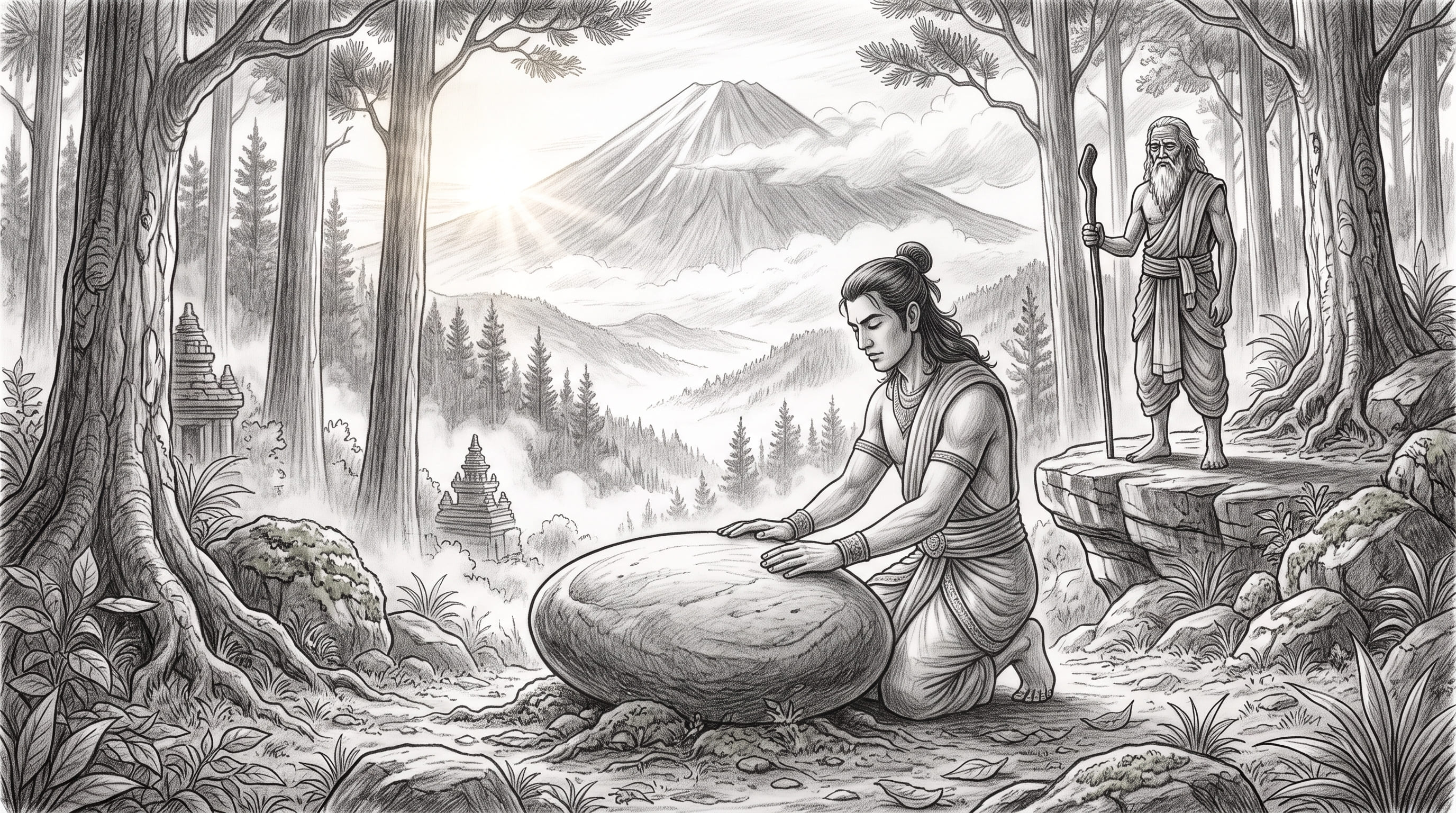
Bhre Kertabhumi
Chapter 003 — The Pulse of Semeru's Navel
The Silent Plain, Slopes of Mount Semeru, 1453 CE — The forging of the Tunggal Pancer breath and the surrender of will upon the Watu Gendheng.
PART 1 — Devotion and Meditation at the Silent Plain
Kertabhumi still stood before the oval stone, yet now he no longer merely gazed—he listened.
Since his hand had been withdrawn from the surface of the Watu Gendheng, the warmth that had crept through his palm had not faded. That warmth remained, as if it had adhered to his skin like a thin film of oil that water could not wash away. That warmth traveled slowly from his fingertips, up his wrists, flowing through the veins of his arm, and finally stopping at the center of his belly—at the point of the Tunggal Pancer where his Wiji Daya resided.
There, at the center of his belly, he felt something strange.
His Wiji Daya—that golden-red seed which since the previous night he had guarded with all his resolve—now pulsed with a rhythm that was different. Not a rhythm that was faster, not a rhythm that was stronger, but a rhythm that was deeper. A rhythm that seemed to be adjusting itself to something greater than himself—something that Kertabhumi immediately recognized as the pulse of the Watu Gendheng.
Those two pulses—the pulse of the Wiji Daya and the pulse of the stone—now lived side by side within him, like two rivers flowing together toward the same sea. They had not yet merged, yet they had already come to know one another. They had already greeted one another. And between them, a subtle bond was woven that Kertabhumi immediately understood as a bond that could not be severed by anything.
He gazed at the oval stone with eyes that were now clearer.
Under the dim light piercing through the canopy of branches, the blue-black surface of the stone seemed to gleam faintly—not a gleam born of reflection, but a gleam that came from within, like the luster of a gem sleeping in the depths of the earth. That gleam moved slowly, like gentle waves on the surface of a calm lake, like the breath of an ancient creature dreaming.
Kertabhumi watched that movement closely.
He saw how the gleam traveled from one side of the stone to the other, how it rotated slowly upon the stone's smooth surface, how it finally paused at a certain point—the point that Kertabhumi immediately recognized as the center of the stone, the point that Dewamatra called the navel of Semeru. At that point, the gleam gathered, thickened, becoming brighter, warmer, more alive—like a heart beating within the chest of an ancient creature asleep.
"You see it, do you not?" Dewamatra's voice came from beside him—a voice that was low, calm, like the flow of a small stream winding between ancient stones.
Kertabhumi nodded gently, without turning.
"I see it, Sang Resi," he whispered, his voice barely audible—barely audible even within the silence of that plain. "That gleam... it moves. It lives."
Dewamatra smiled faintly.
A smile that this time contained teaching, a smile containing patience, a smile that comes only when a teacher knows his disciple has begun to see with new eyes—eyes that no longer see with the flesh, but with the soul.
"It lives," Dewamatra said softly. "Yet not as humans live. It lives as the earth lives—living with a rhythm slower, deeper, more ancient. A rhythm that cannot be measured by the count of hours or days, but by the count of seasons and centuries."
He stepped closer, standing beside Kertabhumi, his eyes gazing at the oval stone with an expression Kertabhumi immediately recognized as reverence—reverence born not of fear, but of acknowledgment. An acknowledgment that he stood before something older than himself, something greater than himself, something that had existed before he was born and would remain after he was gone.
"This stone," Dewamatra continued, his voice now lower, more solemn, "has existed here since Semeru first rose from the belly of the earth. Since this mountain first drove its peak into the sky, since the dahana fire first churned in the depths of its belly. This stone is a witness to all that has occurred on these slopes—a witness to every rain that has fallen, every wind that has blown, every dew that has dripped, every poisonous dew that has frozen nature."
Kertabhumi listened in silence.
Every word of Dewamatra felt like a stone placed one by one upon his chest—a stone that did not press, but built. Building something he did not yet fully understand, yet that he felt to be true within his soul.
"The sages of old," Dewamatra continued, "from the era before Majapahit stood, from the Singhasari era, from the Kediri era, even from the age of the ancient Mataram kings who first set foot upon Java—they all came to this place. They came to listen to the earth's breath. They came to unite their breath with the breath of this stone. They came to learn that human breath and earth's breath originate from the same source."
He paused briefly, letting his words sink into Kertabhumi's soul.
"And now," he continued, his voice now lower, more solemn, "you come to the same place. You come to learn the same lesson. Yet know this, Kertabhumi—the path you will tread will not be easy. That path will test you not only as a prince, not only as the heir of Majapahit, but as a human learning to become a whole being."
Kertabhumi swallowed.
The bitter taste in his throat had not faded—but now, amid that bitterness, he felt something else. Something deeper, firmer, more enduring. Something that Kertabhumi immediately understood as resolve—resolve born not of anger, but of awareness. Awareness that what he faced—what awaited him before this oval stone—was something he could not change, something he could not undo, something he must face with head held high, with steady breath, with a steadfast soul.
"I am ready, Sang Resi," he whispered softly. "Teach me what I must learn."
Dewamatra gazed at him with deep eyes—eyes that seemed to see to the deepest bone, to the seed of light newly grown in his disciple's belly.
"Before you learn," he said softly, "you must first understand. You must understand what you face. You must understand why this stone is so sacred. You must understand why the sages of old came to this place with hearts full of reverence, with steps full of caution, with breath full of purity."
He stepped forward, standing directly before the Watu Gendheng, his hand raised slowly—raised with a movement slow, full of reverence, as if he were raising a hand to touch the face of someone he loved.
"This stone," he continued, his voice now lower, more solemn, "is the navel of Semeru. The point where this mountain's earth breathes. The point where the dahana fire churning in the depths of the earth finds its exit—a gentle exit, a calm exit, one that does not burn, but warms. The point where earth's breath and human breath meet, unite, becoming one."
He placed his palm upon the stone's surface—placing it carefully, with reverence, as if placing his hand upon the skin of someone he loved. And instantly the stone's surface seemed to pulse more strongly—rising and falling with a clearer rhythm, like the chest of someone awakening from a long sleep.
"Feel it," Dewamatra whispered. "Feel its pulse. Feel its warmth. Feel its breath. And understand that what you feel is not merely a physical vibration—this is a greeting from the earth itself. A greeting that can only be felt by those who have learned to hear with the soul, not with the ears."
Kertabhumi stepped forward.
He stood beside Dewamatra, his eyes gazing at the stone's surface that had been pulsing beneath the sage's palm. He raised his hand slowly—slowly like the hand of an ascetic who had long lived in the mountains, never rushing because he knew he was approaching something sacred.
And when his fingertip touched that stone's surface, a subtle vibration traveled through his entire body.
That vibration was different from the vibration he had felt before.
The previous vibration—the one he felt when he first touched the stone—was a vibration that startled, that made him hold his breath, that made him feel a warmth sweeping his entire body. But this vibration was different. This vibration was subtler, deeper, gentler—like the greeting of an old friend long unseen, like the embrace of a mother who has long awaited her child's return.
That vibration traveled from his fingertip, entering through the pores of his skin, rising through the veins of his arm, flowing to his chest, and finally stopping at the center of his belly—at the point where his Wiji Daya resided. There, the vibration met the pulse of his Wiji Daya—and for a moment, both pulsed together, like two hearts learning to unite.
Kertabhumi closed his eyes.
He let that vibration flow through his body, letting it seep into every muscle fiber, into every bone, into every strand of his breath. He let that warmth sweep his entire body, letting it dispel the remnants of night cold still trying to cling to his skin, letting it fill him with strength greater than himself.
And amid that flow of vibration and warmth, he heard something.
Not a voice.
Not words.
But a rhythm—a rhythm extremely slow, extremely deep, extremely ancient. A rhythm like the heartbeat of a giant pulsing once for every thousand seasons. A rhythm that carried faint images flashing behind his closed eyelids: he saw oceans of fire churning in earth's depths, he saw tree roots piercing soil darkness seeking water, he saw heavy rains striking mountain peaks for centuries, he saw old sages sitting cross-legged in the same place, aging and passing, while that stone remained, remained warm, remained breathing.
Tears fell from the corners of Kertabhumi's eyes.
He wept not from sadness. He wept from fullness—full of something too vast for his small body to contain, too deep for his young mind to comprehend, too ancient for the words he knew to explain.
"Enough."
Dewamatra's voice was heard, pulling Kertabhumi back from the depths of his meditation.
Kertabhumi opened his eyes slowly, withdrawing his hand from the stone's surface slowly, as if releasing the grip of an old friend's hand. His palm felt warm, and that warmth did not fade even though he no longer touched the stone.
He gazed at Dewamatra with eyes still wet with tears.
"Sang Resi..." he whispered, his voice hoarse—hoarse like the voice of one who had passed a long night without a drop of water, yet that hoarseness now contained a resolve previously absent. "What I just felt... was that..."
He did not know how to finish his sentence.
He did not know what word could describe what he had just felt—a sense of deep unity, a sense of ancient oneness, a sense of fullness surpassing all words. He only knew he had touched something he had never touched before—something that had long awaited him, something that had long called to him, something that had now accepted him as part of itself.
Dewamatra smiled faintly.
A smile that this time contained teaching, a smile containing patience, a smile that comes only when a teacher knows his disciple has begun to understand—yet who also knows that understanding is still new, still fragile, still needing to be tempered by time and by trial.
"That is the breath of the earth," he said softly. "Breath that has flowed since Semeru first rose from the belly of the earth. Breath that will continue to flow long after you are gone. Breath that knows no time, knows no space, knows no boundary between life and death."
He paused briefly, gazing at Kertabhumi with deep eyes.
"And now," he continued, "that breath has begun to know you. It has begun to greet you. It has begun to accept you as part of itself. Yet remember—that union is not yet perfect. It is still fragile. It can still be severed by fear, by doubt, by desire. Your task now is to guard it—to guard it in every circumstance, in every movement, in every storm to come."
Kertabhumi nodded gently.
He understood Dewamatra's words—understanding not just with his mind, but with his entire body, his entire soul, his entire being. He knew that what he had just experienced was not the end—but the beginning. The beginning of a longer, deeper, heavier journey. The beginning of trials to come—trials that would test not only his body, not only his mind, but his soul.
"And what is the next trial, Sang Resi?" he asked softly.
Dewamatra did not answer immediately.
He gazed far toward the pine trees surrounding the Silent Plain—gazing with eyes that seemed to see beyond the trees, beyond the valley, beyond time. He gazed in a way only possible for those who had long lived in the mountains, who had long heard the earth's breath, who had long been intermediaries between man and cosmos.
"The next trial," he said finally, his voice low yet solemn, "will come when you no longer sit before the Watu Gendheng as one who listens. The next trial will come when you must breathe like this stone—breathe from the navel, breathe from the Tunggal Pancer, breathe with the same rhythm as the earth."
He paused briefly.
His eyes gazed at Kertabhumi with a sharp look—a look that seemed to see into the future, into the destiny written for his disciple.
"The chest breath you have used all this time," he continued softly, "is limited breath. It tires quickly. It is easily disturbed. It breaks when your body is weary or your mind chaotic. And when you face Suraprabhawa—when you face the shadow seeking to drown Majapahit—your chest breath will become your weakness. It will make you panic. It will make you doubt. It will make you lose before the battle begins."
Kertabhumi listened in silence.
Every word of Dewamatra felt like a stone placed one by one upon his chest—a stone that did not press, but built. Building something he did not yet fully understand, yet that he felt to be true within his soul.
"Therefore," Dewamatra continued, "you must learn to breathe in a new way. A way that will keep you steadfast amid storms, a way that will keep you calm amid fear, a way that will keep you alive amid all trials to come."
He pointed toward the Watu Gendheng—the oval stone that had been pulsing in the center of the plain, the stone mountain sages called the navel of Semeru, the point where this mountain's earth breathed.
"This stone will be your teacher," he continued. "Its breath will be your breath. Its pulse will be your pulse. And when you succeed in uniting your breath with its breath, then you will no longer breathe alone. You breathe with Semeru. You breathe with the earth. You breathe with all life flowing on these mountain slopes."
Kertabhumi gazed at the oval stone with eyes now clearer, firmer, more ready.
He knew that what he faced was not merely breathing exercise. He knew that what awaited him was not merely a technique learnable in a few days. He knew that what he would experience was something that would change him forever—something that would separate him from ordinary youth, something that would make him one destined to challenge Suraprabhawa, something that would prepare him to sit upon the throne of Majapahit.
"I am ready, Sang Resi," he whispered softly. "Teach me how to breathe like this stone."
Dewamatra nodded gently.
But before he began to teach, he did something that made Kertabhumi hold his breath.
The great sage knelt.
Kneeling upon the golden moss covering the plain's ground, before the Watu Gendheng that had been pulsing with a slow yet regular rhythm. He folded both hands before his chest, joining palms in a gesture of devotion, then bowed his head deeply—bowing in a way Kertabhumi immediately recognized as that of an ascetic offering prayer to something greater than himself.
Kertabhumi gazed at Dewamatra with wide eyes.
He had never seen the great sage kneel. He had never seen him bow his head. He had never seen him perform a gesture of devotion—even to Hyang Widhi. And now, before him, Dewamatra—sage of sages, teacher of chief ascetics, a figure said not to dwell in one place but to move following Semeru's energy lines—was kneeling before that oval stone, offering prayer with an attitude full of reverence, with a silence louder than any shout.
"Is... is Sang Resi worshipping this stone?" Kertabhumi asked softly, his voice barely audible—barely audible even within the plain's silence.
Dewamatra did not answer immediately.
He remained kneeling, remained bowed, remained offering prayer in a silence Kertabhumi immediately understood as living silence—silence that breathed, silence possessing its own awareness. Silence that seemed to be listening, receiving, repaying the sage's prayer in a way only understandable by those who had learned to hear with the soul, not with ears.
Only after some time—some time that felt like eternity—did Dewamatra raise his head, open his folded hands, and stand slowly.
He gazed at Kertabhumi with eyes now softer, clearer, fuller of something Kertabhumi immediately recognized as peace—peace possessed only by those who have made peace with themselves, with nature, with the cosmos.
"I do not worship this stone," he said softly. "I worship something greater than this stone—something mountain sages call Sang Hyang Tunggal, the Supreme One, who resides in all things—in stone, in tree, in wind, in water, in every human born into this world."
He paused briefly, letting his words sink into Kertabhumi's soul.
"This stone," he continued, "is one manifestation of Sang Hyang Tunggal. It is the place where the Divine chooses to reveal Itself—revealing Itself not as a figure visible to eyes, but as breath felt by the soul. And when I worship this stone, I am actually worshipping the Divine residing within it—the Divine who also resides within you, within me, within all things in this nature."
Kertabhumi listened in silence.
Those words of Dewamatra opened something within his soul—something he had long felt but never fully understood. He had always felt there was something greater than himself, something moving all things in nature, something the brahmins called Hyang Widhi, the ascetics called Sang Hyang Tunggal, the mountain sages called the Divine residing in all things.
Yet he had never felt it directly—never felt it in a way so clear, so deep, so undeniable as he felt now.
"And now," Dewamatra continued, his voice now lower, more solemn, "you will learn to feel that Divine not only within this stone, but within yourself. You will learn that the breath you draw every day—breath you consider ordinary, something not needing thought—is actually the same breath exhaling from this stone. The same breath exhaling from Semeru's peak. The same breath of Sang Hyang Tunggal moving all things in nature."
He stepped closer, standing directly before Kertabhumi, his eyes gazing straight into the young prince's pupils.
"Yet to feel that," he continued, "you must change how you breathe. You must move your breath's center from chest to navel—from lungs to Tunggal Pancer. And for that, you must pass through a torment that will shatter all your body's habits, a torment that will force you to release all you have considered part of yourself."
Kertabhumi swallowed.
He knew that what awaited him was not easy. He knew the torment Dewamatra meant was not physical torment—not torment bearable by muscle strength or mental resolve alone. He knew the torment awaiting him was deeper—torment that would test his soul, that would force him to face all fears, all doubts, all weaknesses he had long hidden within his soul.
"I am ready, Sang Resi," he whispered softly, his voice hoarse yet containing a resolve previously absent. "Teach me."
Dewamatra smiled faintly.
A smile this time containing pride—pride he rarely felt, pride coming only when a teacher sees his disciple ready to step past a threshold not all disciples can cross.
"Good," he said softly. "Yet before we begin, there is one thing you must do."
He pointed toward the Watu Gendheng—the oval stone pulsing in the center of the plain.
"You must offer devotion first," he continued. "You must offer prayer to Sang Hyang Tunggal residing within this stone. You must ask permission—permission to touch, permission to listen, permission to unite your breath with its breath. For without that permission, all your efforts will be in vain. For this stone will not open itself to those who come with arrogance, to those who come with desire to conquer, to those who come without humility."
Kertabhumi nodded gently.
He understood Dewamatra's words—understanding not just with his mind, but with his entire body, his entire soul, his entire being. He knew that what he would do was not merely empty ritual—not merely movement performed without meaning. He knew that what he would do was something sacred—something that would open the path for him to enter life's most important lesson.
Slowly, he knelt.
Kneeling upon the golden moss covering the plain's ground, before the Watu Gendheng that had been pulsing with a slow yet regular rhythm. He folded both hands before his chest, joining palms in a gesture of devotion, then bowed his head deeply—bowing in a way Dewamatra immediately recognized as that of a disciple coming with a clean heart, with pure intent, with true humility.
Kertabhumi closed his eyes.
Behind his closed eyelids, he did not see darkness—he saw light. Light that was soft, warm, that he immediately recognized as the same light he saw within his soul when he first found the Wiji Daya—golden-red light pulsing with a slow yet regular rhythm.
Yet this time, that light was not only within him—the light was also outside him, before him, around him. That light traveled from the Watu Gendheng, sweeping the entire plain, enveloping his body, seeping into every pore of his skin, into every muscle fiber, into every bone.
And amid that light, he felt a presence.
A presence greater than himself.
A presence he immediately recognized as the presence of Sang Hyang Tunggal—the Divine residing in all things, moving all things, called by mountain sages the source of all breath, source of all pulse, source of all life.
Kertabhumi did not know how to offer prayer.
He had never been taught the exact words of prayer—words the brahmins considered most sacred, most powerful, most able to touch the Divine's heart. He had never been taught the exact mantra—mantra the mountain sages considered most able to open the path for man to unite with the cosmos.
Yet amid that confusion, he felt something deeper than words, deeper than mantra—something he immediately understood as feeling.
Feeling of reverence.
Feeling of gratitude.
Feeling of humility.
Feeling of readiness to receive whatever would come.
And with that feeling—with feeling that could not be spoken in words, that could not be explained by mantra—he offered his prayer.
Prayer not spoken with lips, but with soul.
Prayer not heard by ears, but by spirit.
Prayer that by Sang Hyang Tunggal—who resided within the Watu Gendheng, who resided within himself, who resided within all things in nature—was immediately accepted.
Kertabhumi did not know how long he knelt before the Watu Gendheng.
He only knew that when he opened his eyes again, the world around him seemed different—clearer, brighter, more alive. The golden moss covering the plain's ground seemed more lustrous, the ancient stones standing in a circle around the plain seemed sturdier, and the Watu Gendheng—the oval stone pulsing in the center of the plain—seemed warmer, more alive, more welcoming.
He drew a long breath.
That morning air was cool, yet no longer piercing. It carried with it the scent of damp earth, the fragrance of pine needles, the aroma of wildflowers that since the previous night had bloomed among the underbrush. Yet among those scents, he felt something new—something he immediately recognized as the aroma of the Watu Gendheng.
An aroma that Kertabhumi immediately understood as older than time itself—an aroma originating from the earth's depths, from the place where dahana fire churned, from the place where Semeru's breath first exhaled into this world.
He turned toward Dewamatra.
The great sage still stood in his place, his black casuarina staff planted in the earth, his eyes gazing at Kertabhumi with an expression Kertabhumi immediately recognized as acknowledgment—an acknowledgment that his disciple had passed through something not all disciples could pass, an acknowledgment that he had been accepted by the Watu Gendheng, an acknowledgment that he was ready to step to the next lesson.
"You have been accepted," Dewamatra said softly, his voice low yet solemn. "The Watu Gendheng has accepted your presence. It has accepted your breath. It has accepted your intent. And now, it is ready to be your teacher."
Kertabhumi nodded gently.
He rose from his kneeling position slowly—slowly like the movement of an ascetic who had long lived in the mountains, never rushing because he knew time in the mountains flowed with its own rhythm. He gazed at the Watu Gendheng with eyes now clearer, firmer, more ready.
"And now," Dewamatra continued, his voice now firmer, more serious—serious like a teacher who knows the hardest lesson has not yet begun, "you will begin the true lesson."
He stepped closer, standing directly before Kertabhumi, his eyes gazing straight into the young prince's pupils.
"Yet before we begin," he continued, "there is one thing you must understand. The lesson you will receive today is not merely a breathing lesson. It is not merely a technique you can learn in a few days, then forget. It is a lesson that will change how you live—how you breathe, how you think, how you feel, how you become."
He paused briefly, letting his words sink into Kertabhumi's soul.
"This lesson will force you to release all your body's habits—habits you have carried since you first cried in this world. It will force you to face all your fears, all your doubts, all your weaknesses. And it will force you to find something deeper than all that—something mountain sages call true breath, breath originating from your core, from the place where your soul resides, from the place where your Wiji Daya grows."
Kertabhumi listened in silence.
Every word of Dewamatra felt like a stone placed one by one upon his chest—a stone that did not press, but built. Building something he did not yet fully understand, yet that he felt to be true within his soul.
"And for that," Dewamatra continued, "you must sit before the Watu Gendheng. You must place both your palms upon its surface. You must close your eyes. And you must try to move your breath—move your breath's center from chest to navel, from lungs to Tunggal Pancer."
He pointed toward the Watu Gendheng—the oval stone pulsing in the center of the plain.
"This stone will be your teacher," he continued. "Its breath will be your breath. Its pulse will be your pulse. And when you succeed in uniting your breath with its breath, then you will have breath that never ends—breath that will support you in every trial to come."
Kertabhumi gazed at the oval stone with eyes now clearer, firmer, more ready.
He knew that what awaited him was not easy. He knew the torment Dewamatra meant was not torment bearable by muscle strength or mental resolve alone. He knew the torment awaiting him was deeper—torment that would test his soul, that would force him to face all fears, all doubts, all weaknesses he had long hidden within his soul.
Yet he also knew he was not alone.
He was not alone because the Watu Gendheng was awaiting him—awaiting him with gentle warmth, with regular pulse, with ancient breath. He was not alone because Dewamatra was with him—accompanying him with steadfast presence, with patient guidance, with sincere acknowledgment. He was not alone because his Wiji Daya was pulsing at the center of his belly—pulsing with a rhythm that was stable, strong, alive.
And he was not alone because Semeru was watching over him—watching over him with its ancient breath, with its cold wind, with its old stones, with its tall trees, with its clear rivers.
"I am ready, Sang Resi," he whispered softly, his voice hoarse yet containing a resolve previously absent. "Teach me."
Dewamatra smiled faintly.
A smile this time containing pride—pride he rarely felt, pride coming only when a teacher sees his disciple ready to step past a threshold not all disciples can cross.
"Good," he said softly. "Sit before the Watu Gendheng. Place both your palms upon its surface. And listen to its breath—before you try to unite your breath with its breath."
Kertabhumi obeyed.
He stepped forward, approaching the Watu Gendheng with steps that were slow, careful, full of reverence. Every footstep upon that golden moss he made without sound—a sound he immediately understood as something that could disrupt this place's sanctity, a sound that could disturb the slumber of something awaiting him in the center of the plain.
And when he arrived before that oval stone, he knelt slowly.
He placed both palms upon the stone's warm surface—placing them carefully, with reverence, as if placing his hands upon the skin of someone he loved. The stone pulsed beneath his fingers—pulse that was slow, deep, like the heartbeat of an ancient creature sleeping.
He closed his eyes.
And behind his closed eyelids, he began to listen.
Listening to the stone's breath.
Listening to the earth's breath.
Listening to the breath of Sang Hyang Tunggal residing in all things.
Outside the Silent Plain, Semeru's wind blew harder.
Wind that since morning had blown gently—wind carrying pine and damp earth aroma, wind sweeping fallen leaves, wind that seemed to be breathing together with that plain—now blew harder. That wind carried a different aroma—aroma sharper, colder, that seemed to originate from Semeru's peak, from the place where eternal snow resided, from the place where ancient sages came to listen to the earth's breath.
Yet within the Silent Plain, that wind did not reach.
Within that plain, the air remained calm, remained clear, remained warm—warm by the warmth traveling from the Watu Gendheng, warm by earth's breath exhaling from Semeru's depths, warm by the presence of Sang Hyang Tunggal residing in all things.
And in the center of that plain, a young prince sat before an oval stone.
Breathing with the earth.
Learning to become a whole human for the first time.
Kertabhumi still sat before the Watu Gendheng—both palms still adhering to that warm stone's surface, his breath still flowing slow and deep, his pulse still aligning with the stone's pulse. Yet now there was something different within him—something new, something he had never felt before, something Dewamatra called the first door.
He had found that door.
Yet he knew—behind that door, there were still many doors. Doors that would carry him farther, deeper, higher toward the destiny written for him by the cosmos. Doors that would test him not only as a prince, not only as Majapahit's heir, but as a human who had learned to hear the earth's breath.
And he was ready.
Ready to pass through those doors.
Ready to face the trials to come.
Ready to become a whole human—human no longer torn by four forces, human no longer controlled by his body, human no longer conquered by his own shadow.
Dewamatra watched him in silence.
He stood at the plain's edge, his staff planted in the earth, his eyes never leaving Kertabhumi's figure sitting before the Watu Gendheng. He did not move. He did not speak. He only stood, like an old guardian who had waited thousands of nights to see a small light rekindled in a valley long dark.
He knew—his disciple had just stepped past a threshold not all humans could cross. The threshold between humans who hear with ears, and humans who hear with the soul. The threshold between humans who breathe alone, and humans who breathe with the cosmos.
And he knew—Kertabhumi's journey had just entered a deeper chapter.
A chapter that would carry him farther, deeper, higher toward the destiny written for him by the cosmos. A chapter that would test him not only as a prince, not only as Majapahit's heir, but as a human who had learned to hear the earth's breath—a human who one day would lead not only with power, but with wisdom born from unity with the cosmos.
"You have found the first door," Dewamatra whispered softly, his voice nearly inaudible to the morning wind. "Yet your journey is still long, Bhre Kertabhumi. Still very long."
Outside the Silent Plain, the wind continued to blow—wind carrying pine and damp earth aroma, wind sweeping fallen leaves, wind that seemed to be breathing together with that plain. Outside the Silent Plain, the sun continued to rise—rising in a way only visible to those who had long gazed at the sky from the valley floor, rising slowly, rising with a rhythm slow yet regular. Outside the Silent Plain, the world continued to move—a world that did not know that within that plain, a young prince was learning to become a whole human for the first time.
Yet within the Silent Plain, time flowed with its own rhythm.
Time that was slower.
Time that was deeper.
Time that was more ancient.
Time that seemed to have stopped—stopped to give room for a young prince to find himself, to find his own breath, to find his own path.
And Kertabhumi—who still sat before the Watu Gendheng, who still breathed with the earth, who still learned to become a whole human—felt that time.
He felt time that was no longer his enemy.
He felt time that no longer pressed him.
He felt time that was now his companion—companion that was patient, companion that was gentle, companion that reminded him that a long journey need not be finished in one day.
And he smiled.
A smile seen by no one.
A smile he shared only with himself, with the small ember at his belly's center, with the Watu Gendheng breathing with him, with Semeru watching over him.
A smile mountain sages called the smile of sang hyang—smile that came not from lips, but from the soul, smile that could only be given when one had made peace with oneself, when one had accepted all fragments of their soul, when one had stopped running from their own shadow.
And far atop Semeru, at the place where eternal snow resided, at the place where ancient sages came to listen to the earth's breath, the wind blew harder.
Wind carrying aroma sharper, colder, that seemed to originate from the future—future not yet seen, yet walking toward Kertabhumi with steady steps.
Wind that seemed to say to him: "Prepare yourself. Heavier trials will come. And you must be ready."
Yet Kertabhumi—who still sat before the Watu Gendheng, who still breathed with the earth, who still learned to become a whole human—heard that wind.
And he was not afraid.
He was not afraid because he knew he was not alone.
He was not afraid because he knew his breath had now begun to unite with the earth's breath.
He was not afraid because he knew his Wiji Daya—the small ember at his belly's center—would remain alight, would remain guarding him, would remain accompanying him in every trial to come.
And he smiled again.
A smile this time broader than previous smiles.
A smile containing courage.
A smile containing resolve.
A smile containing readiness to face whatever would come.
At the plain's edge, Dewamatra raised his staff.
He tapped it once upon the earth—tap that was not loud, yet its vibration traveled through stone, through tree roots, through damp earth—traveling in a way only understandable by those who had learned to hear the language of earth.
That vibration moved toward Kertabhumi—not to help, not to ease pain, not to provide warmth. That vibration was only to tell: Semeru still watches over you. Yet you must watch over yourself.
Kertabhumi would surely feel it.
Dewamatra knew this.
He knew that in the center of that plain, his disciple's body would tremble briefly—not from cold, not from fever, but from the earth's vibration saying: "I am here. You are not alone. Yet you must still struggle."
And Dewamatra knew that Kertabhumi—in a mysterious way, in a way only understood by those who had royal blood and earth's blood within their bodies—would understand that message.
He lifted his face, gazing at the sky.
Morning sunlight had now pierced the branch canopy, falling gently upon the plain, sweeping the golden moss, sweeping the ancient stones, sweeping Kertabhumi's figure still sitting before the Watu Gendheng. That light did not dazzle—light that was soft, warm, that Dewamatra immediately recognized as light of blessing—light given by Semeru to those accepted as part of itself.
"You have passed the first door, Bhre Kertabhumi," Dewamatra whispered softly, his voice nearly inaudible to the morning wind. "Yet your journey is still long. Still very long."
He turned, walking slowly away from the plain, vanishing behind pine trees like a shadow choosing to return home.
He would return later.
He would return when Kertabhumi had rested enough, when his breath had aligned enough with the Watu Gendheng's breath, when his soul was firm enough to receive the next lesson.
But for now, he left his disciple alone.
He let Kertabhumi enjoy his first victory—a victory silent, unseen by anyone, uncelebrated by anyone. For Dewamatra knew that victory such as this—a victory silent, unseen by anyone, uncelebrated by anyone—was the most precious victory. A victory that would become the foundation for all victories to follow.
And in the center of that Silent Plain, Kertabhumi—who still sat before the Watu Gendheng, who still breathed with the earth, who still learned to become a whole human—felt something new.
He felt peace.
Peace he had never felt at the palace.
Peace he had never felt in the forest.
Peace that could only be felt by those who had made peace with themselves—who had accepted all fragments of their soul, who had united all their fears, who had stopped running from their own shadows.
And for the first time in his life, Kertabhumi felt whole.
He felt whole not because he had become a perfect human—he knew, he was still far from perfect. He still had fears. He still had doubts. He still had weaknesses. But he felt whole because he had learned to accept all that—not as enemies to be defeated, but as parts of himself to be valued.
He felt whole because he had learned that true strength comes not from the ability to control everything—but from the ability to release. To release his breath to his navel. To release himself to earth. To release his soul to the cosmos.
And he felt whole because he had learned that he was not alone.
He was not alone because Semeru was watching over him.
He was not alone because the Watu Gendheng was breathing with him.
He was not alone because his Wiji Daya—the small ember at his belly's center—was accompanying him, was guarding him, was saying to him: "I am here. I will guard you. You are not alone."
The journey toward the throne of Majapahit had just entered a deeper chapter.
And Semeru—eternal witness—accompanied every step with its ancient breath.
Outside the Silent Plain, the wind continued to blow—wind carrying pine and damp earth aroma, wind sweeping fallen leaves, wind that seemed to be breathing together with that plain. Outside the Silent Plain, the sun continued to rise—rising in a way only visible to those who had long gazed at the sky from the valley floor, rising slowly, rising with a rhythm slow yet regular. Outside the Silent Plain, the world continued to move—a world that did not know that within that plain, a young prince was learning to become a whole human for the first time.
Yet within the Silent Plain, time flowed with its own rhythm.
Time that was slower.
Time that was deeper.
Time that was more ancient.
Time that seemed to have stopped—stopped to give room for a young prince to find himself, to find his own breath, to find his own path.
And Kertabhumi—who still sat before the Watu Gendheng, who still breathed with the earth, who still learned to become a whole human—felt that time.
He felt time that was no longer his enemy.
He felt time that no longer pressed him.
He felt time that was now his companion—companion that was patient, companion that was gentle, companion that reminded him that a long journey need not be finished in one day.
And he smiled.
A smile seen by no one.
A smile he shared only with himself, with the small ember at his belly's center, with the Watu Gendheng breathing with him, with Semeru watching over him.
A smile mountain sages called the smile of sang hyang—smile that came not from lips, but from the soul, smile that could only be given when one had made peace with oneself, when one had accepted all fragments of their soul, when one had stopped running from their own shadow.
The sun had now risen higher.
Its light, which since earlier had pierced the branch canopy gently, now began to be brighter, warmer, more alive. That light fell upon the golden moss, making every strand of moss appear like golden thread woven by invisible hands. That light fell upon the ancient stones standing in a circle around the plain, making faint carvings on their surface appear clearer—carvings Kertabhumi immediately recognized as made by master artisans from the era before Majapahit stood.
Yet in the center of the plain, at the place where the Watu Gendheng lay, that light did not fall in the same way.
At that place, light seemed to stop—stop briefly, as if asking permission to touch that blue-black stone's surface. And when that light finally touched the stone's surface, it did not reflect—it was absorbed. Absorbed by the stone, entering its smooth surface, becoming part of the warmth that had been traveling from within the stone.
Kertabhumi felt that change.
He felt how sunlight—which since earlier had swept the entire plain—now stopped at the Watu Gendheng, becoming part of that stone, becoming part of its breath. And he felt how his Wiji Daya—the small ember at his belly's center—began to respond to that change, pulsing with a rhythm slightly faster, slightly stronger, slightly more alive.
He opened his eyes slowly.
And he saw something that made him hold his breath.
The surface of the Watu Gendheng—which since earlier had been blue-black—now appeared slightly brighter. Not bright by reflection of sunlight, but bright by something deeper—something Kertabhumi immediately recognized as light originating from within the stone itself. Light that was soft, warm, that he immediately understood as the light of Wiji Daya—light same as he saw within his soul when he first found that golden-red seed.
"That stone..." he whispered softly, his voice barely audible. "That stone... it has Wiji Daya too."
He did not know if his words were heard by anyone—by Dewamatra who had gone, by Semeru watching over him, by Sang Hyang Tunggal residing in all things. Yet he spoke them with full awareness—awareness that he was witnessing something great, something surpassing words, something inexplicable by logic.
And at that same moment, he felt something else.
He felt that his Wiji Daya—the small ember at his belly's center—began to respond to the light originating from the Watu Gendheng. That ember pulsed with a rhythm growing faster, stronger, more alive—as if greeting the light from the stone, as if recognizing it as an elder sibling long separated.
And at that same moment, he felt that the light originating from the Watu Gendheng also began to respond to his Wiji Daya. That light pulsed with a rhythm growing faster, stronger, more alive—as if greeting the small ember at Kertabhumi's belly center, as if recognizing it as a younger sibling long awaited.
Those two lights—Kertabhumi's Wiji Daya light and the Watu Gendheng light—began to approach each other, greet each other, know each other.
And between them, a bond was woven that Kertabhumi immediately understood as older than time itself—a bond that had existed before he was born, that would remain after he was gone, called by mountain sages the bond of sang hyang—bond that could only be felt by those who had learned to feel with the soul, not with the senses.
Kertabhumi closed his eyes again.
He let those two lights—his Wiji Daya light and the Watu Gendheng light—approach each other, greet each other, know each other. He did not try to control them. He did not try to force them to unite. He only let them—let them move with their own rhythm, with their own way, with their own time.
And slowly—very slowly—he felt that those two lights began to align.
Their pulse rhythm—which since earlier had been different—now began to approach each other. His Wiji Daya light—which since earlier had pulsed with a faster rhythm—began to slow, adjusting to the Watu Gendheng light's rhythm which was slower, deeper, more ancient. And the Watu Gendheng light—which since earlier had pulsed with a slower rhythm—began to accelerate its pulse, adjusting to Kertabhumi's Wiji Daya light rhythm which was faster, more alive, younger.
And when those two rhythms met—when those two lights began to pulse with the same rhythm—Kertabhumi felt something he had never felt before.
He felt unity.
Unity that was deep.
Unity that was ancient.
Unity that surpassed words.
He no longer felt as a human separate from the stone. He no longer felt as a prince separate from the earth. He no longer felt as a self separate from the cosmos. He felt as part of all things—part of Semeru, part of the earth, part of Sang Hyang Tunggal residing in all things.
His tears fell.
Not from sadness.
Not from pain.
But from fullness—full of something too vast for his small body to contain, too deep for his young mind to comprehend, too ancient for the words he knew to explain.
He let his tears fall upon the Watu Gendheng's surface—falling gently, with reverence, as if those tears were not human tears, but an offering he gave to the ancient stone that had accepted him as part of itself.
And at that same moment, he felt the small ember at his belly center—his Wiji Daya—pulse once strongly, warmly, as if saying: "I am here. I will guard you. You are not alone."
Outside the Silent Plain, the sun continued to rise.
Its light had now pierced the branch canopy brighter, warmer, more alive. That light swept the entire valley, swept the pine trees, swept the ancient stones, swept Dewamatra's figure standing at the plain's edge—gazing at Kertabhumi with eyes full of pride.
Dewamatra did not move.
He only stood, gazed, witnessed.
He witnessed how his disciple—disciple he had tempered since the previous night with inner trials, with bodily austerity, with poisonous dew, with visions of burning Trowulan—was now stepping past a threshold not all humans could cross. The threshold between humans who breathe alone, and humans who breathe with the cosmos.
And he knew—Kertabhumi's journey had just entered a deeper chapter.
A chapter that would carry him farther, deeper, higher toward the destiny written for him by the cosmos. A chapter that would test him not only as a prince, not only as Majapahit's heir, but as a human who had learned to hear the earth's breath—a human who one day would lead not only with power, but with wisdom born from unity with the cosmos.
"You have found the first door, Bhre Kertabhumi," Dewamatra whispered softly, his voice nearly inaudible to the morning wind. "Yet your journey is still long. Still very long."
He raised his staff.
But this time he did not tap it upon the earth.
He only placed it beside his body, holding it gently, as if that staff were not a tool, but an extension of his own hand, an extension of his own breath, an extension of Semeru's breath flowing through him.
And he waited.
Waiting with patience.
Waiting with full acknowledgment.
Waiting with pride he rarely felt.
Waiting for the right moment to continue the next lesson—lesson that would carry Kertabhumi farther, deeper, higher toward the destiny written for him by the cosmos.
And in the center of that Silent Plain, Kertabhumi—who still sat before the Watu Gendheng, who still breathed with the earth, who still learned to become a whole human—felt that his time had come.
He felt that the next lesson—lesson that would test him not only as a prince, not only as Majapahit's heir, but as a human who had learned to hear the earth's breath—was awaiting him.
He opened his eyes slowly.
And he saw Dewamatra standing at the plain's edge—standing with back straight as an ancient pine, with black casuarina staff held gently, with eyes full of pride.
"Sang Resi..." he whispered softly, his voice barely audible. "I am ready."
Dewamatra smiled faintly.
A smile this time containing pride—pride he rarely felt, pride coming only when a teacher sees his disciple ready to step past a threshold not all disciples can cross.
"Good," he said softly. "Then let us continue."
He stepped closer, standing directly before Kertabhumi, his eyes gazing straight into the young prince's pupils.
"Yet before we begin," he continued, "there is one thing you must understand. The lesson you will receive today is not merely a breathing lesson. It is not merely a technique you can learn in a few days, then forget. It is a lesson that will change how you live—how you breathe, how you think, how you feel, how you become."
Kertabhumi nodded gently.
He understood Dewamatra's words—understanding not just with his mind, but with his entire body, his entire soul, his entire being. He knew that what awaited him was not easy. He knew the torment Dewamatra meant was not torment bearable by muscle strength or mental resolve alone. He knew the torment awaiting him was deeper—torment that would test his soul, that would force him to face all fears, all doubts, all weaknesses he had long hidden within his soul.
"I am ready, Sang Resi," he whispered softly, his voice hoarse yet containing a resolve previously absent. "Teach me."
Dewamatra smiled faintly.
A smile this time containing pride—pride he rarely felt, pride coming only when a teacher sees his disciple ready to step past a threshold not all disciples can cross.
"Good," he said softly. "Then prepare yourself. For the torment you will receive today will shatter all your body's habits—habits you have carried since you first cried in this world. It will force you to release all you have considered part of yourself. And it will force you to find something deeper than all that—something mountain sages call true breath, breath originating from your core, from the place where your soul resides, from the place where your Wiji Daya grows."
Kertabhumi swallowed.
He knew that what awaited him was not easy. Yet he also knew he was not alone. He was not alone because the Watu Gendheng was awaiting him—awaiting him with gentle warmth, with regular pulse, with ancient breath. He was not alone because Dewamatra was with him—accompanying him with steadfast presence, with patient guidance, with sincere acknowledgment. He was not alone because his Wiji Daya was pulsing at the center of his belly—pulsing with a rhythm that was stable, strong, alive.
And he was not alone because Semeru was watching over him—watching over him with its ancient breath, with its cold wind, with its old stones, with its tall trees, with its clear rivers.
"I am ready, Sang Resi," he whispered softly, his voice hoarse yet containing a resolve previously absent. "Begin."
Dewamatra nodded gently.
And at that moment, in the center of the Silent Plain that was silent, before the Watu Gendheng breathing with a slow yet regular rhythm, under the morning sunlight sweeping the entire valley, Bhre Kertabhumi's journey entered a new chapter—chapter that would carry him farther, deeper, higher toward the destiny written for him by the cosmos.
Chapter called by mountain sages the torment of navel breath—torment that would shatter all his body's habits, torment that would force him to release all he considered part of himself, torment that would force him to find true breath originating from his own core.
And Semeru—eternal witness—accompanied every step with its ancient breath.
PART 2 — The Torment of the Tunggal Pancer
The sun had now risen higher above the pine crowns, yet its light did not reach the base of the Silent Plain. The canopy of branches formed by ancient gayam and banyan trees still protected that place, keeping its atmosphere dim—dim that was warm, dim that was solemn, dim that seemed to separate that plain from the time of the outside world. Yet outside the circle of ancient stones, the midday sun's heat had begun to roast Semeru's slopes. The air outside the plain trembled with heat, making the thin mist that since morning had hung in the valley now evaporate slowly, leaving only the aroma of dry earth and the scent of withered pine leaves.
Within the Silent Plain, the air remained cool.
Yet something had changed.
The warmth that since earlier had traveled from the Watu Gendheng—the oval stone lying in the center of the plain like an ancient creature meditating—now felt stronger. More alive. More demanding. That warmth was no longer merely a gentle greeting from the earth's belly fire, but something deeper—something that seemed to be calling Kertabhumi to approach, to touch, to become one.
Dewamatra stood at the plain's edge, his black casuarina staff planted in the earth. His golden-yellow robe, wet with dew since morning, had now dried, yet still retained the aroma of damp earth and sharp pine scent. His deep eyes gazed at Kertabhumi with an unreadable expression—between patience, between demanding, between waiting.
"Awaken," he said softly, his voice low yet firm. "The true lesson has just begun."
Kertabhumi opened his eyes slowly.
He still sat before the Watu Gendheng, both palms still adhering to that warm stone's surface. Yet now he felt something different—something that made him hold his breath for a moment. That stone's surface was no longer merely warm; it felt alive, pulsing with a clearer rhythm, deeper, more demanding. As if that stone was awakening from a long sleep, as if it was preparing itself to receive a disciple ready to be tempered.
"What must I do, Sang Resi?" he asked softly.
Dewamatra did not answer immediately.
He stepped closer—steps that made no sound, steps that seemed not to touch the ground, steps only possible for those who had long lived in the mountains until their bodies became as light as wind. He stopped directly beside the Watu Gendheng, his eyes gazing at that stone's surface with an expression Kertabhumi immediately recognized as reverence—reverence born not of fear, but of acknowledgment.
"Climb," he said finally, his voice now lower, more solemn. "Climb onto that stone. Sit upon it. And let your breath unite with its breath."
Kertabhumi gazed at the oval stone with wide eyes.
That stone was not large—only the size of an adult's torso, wide enough to hold one body sitting cross-legged. Yet its smooth, blue-black surface appeared different under the dim light piercing the branch canopy. It appeared like the skin of an ancient creature sleeping—skin warm from within, pulsing with a slow yet regular rhythm, seeming to breathe together with the earth.
"Climb," Dewamatra repeated, his voice now firmer. "Yet remember—when you sit upon that stone, you no longer sit as a prince. You no longer sit as Majapahit's heir. You sit as a cantrik—a disciple who comes with empty hands and an open heart. You sit as a human learning to become a whole human."
Kertabhumi nodded gently.
He understood Dewamatra's words—understanding not just with his mind, but with his entire body, his entire soul, his entire being. He knew that what he would do was not merely breathing exercise. He knew that what he would experience was something that would change him forever—something that would separate him from ordinary youth, something that would make him one destined to challenge Suraprabhawa, something that would prepare him to sit upon the throne of Majapahit.
Slowly, he rose from his sitting position.
His movements were slow, measured, like those of an ascetic who had long lived in the mountains—movements unhurried because he knew time in the mountains flowed with its own rhythm. He approached the Watu Gendheng, every footstep upon that golden moss he made without sound. And when he arrived before that stone, he lifted one foot—lifting carefully, with reverence, as if stepping onto the skin of someone he loved.
And then, he sat.
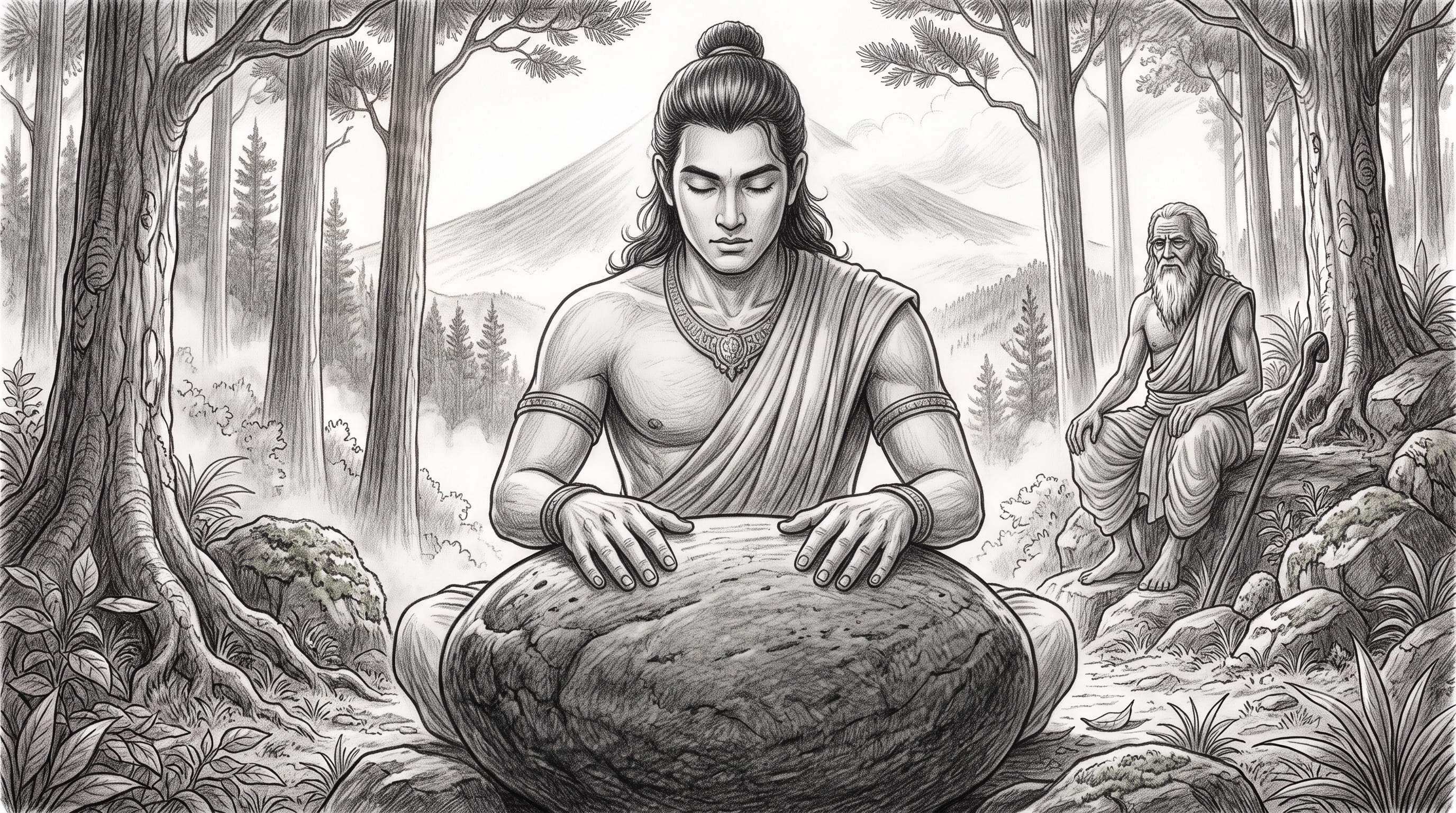
Instantly, a vibration traveled into his body.
That vibration was not loud, not shaking, yet its depth was infinite. It traveled from the stone's surface, entering through the pores of his skin touching the stone—entering through his hips, through his thighs, through his spine—rising to his chest, and finally stopping at the center of his belly, exactly where his Wiji Daya resided.
Kertabhumi held his breath for a moment.
That vibration was different from the vibration he had felt before—the vibration he felt when he first touched that stone with his palms. The previous vibration was one that startled, that made him feel warmth sweeping his entire body. But this vibration was deeper, more ancient, more demanding. As if that stone was no longer merely welcoming him, but was drawing him in, trying to unite him, trying to make him part of itself.
He felt heat rising from the stone's surface.
That heat was not burning heat—not heat from sun or fire. That heat originated from within the stone itself, from the depths where dahana fire churned, from the place where Semeru's breath first exhaled into this world. That heat traveled slowly through his skin, entering his flesh, his bones, until the center of his belly—until the place where his Wiji Daya resided.
And at that same moment—at the moment that heat met his Wiji Daya—Kertabhumi felt something that made him hold his breath.
His Wiji Daya—the golden-red seed he had guarded since the previous night—began to pulse with a different rhythm. A faster rhythm. A stronger rhythm. A rhythm as if responding to the heat coming from the stone, as if recognizing it as an elder sibling long separated.
"Feel it," Dewamatra's voice came from beside him—a voice low, calm, like the flow of a small stream winding between ancient stones. "Feel how earth's heat enters your body. Feel how it meets your Wiji Daya. And understand that what you feel is not merely physical heat—this is a greeting from the earth itself. A greeting that can only be felt by those who have learned to hear with the soul, not with the skin."
Kertabhumi closed his eyes.
He let that heat flow through his body, letting it seep into every muscle fiber, every bone, every strand of his breath. He let that warmth sweep his entire body, letting it dispel remnants of night cold still trying to cling to his skin, letting it fill him with strength greater than himself.
And amid that flow of heat and warmth, he heard something.
Not a voice.
Not words.
But a rhythm—a rhythm extremely slow, extremely deep, extremely ancient. A rhythm like the heartbeat of a giant pulsing once for every thousand seasons. A rhythm Kertabhumi immediately recognized as the same rhythm he felt at his belly center—rhythm Dewamatra called the rhythm of Tunggal Pancer, rhythm mountain sages called the rhythm of sang hyang.
"Good," Dewamatra's voice was heard again, this time firmer. "You have felt its breath. You have felt its pulse. You have let yourself be accepted by the Watu Gendheng. Yet all that is not enough."
Kertabhumi opened his eyes slowly.
His eyes, which had been closed, now gazed at Dewamatra with a look different from previous looks. A look deeper, clearer, firmer—the look of one who had passed through something great, something surpassing words, something inexplicable by logic.
"Not enough, Sang Resi?" he asked softly.
Dewamatra shook his head gently.
"You have heard the earth's breath," he said. "Yet your own breath you do not yet fully know. You still breathe like an ordinary human—with chest, with lungs, with habits you have carried since you first cried in this world. And chest breath, Kertabhumi, is limited breath."
He stepped closer—steps that made no sound, steps that seemed not to touch the ground. He stopped directly behind Kertabhumi, standing with back straight as an ancient pine, with staff now resting on his shoulder like a shepherd watching his flock.
"Chest breath is the breath of daily life," Dewamatra continued, his voice now lower, more solemn. "Breath for speaking. Breath for running. Breath for thinking. Breath for worrying. Breath for anger. Breath for fear. It is breath that serves your mind—breath that moves wherever your mind goes. When your mind is anxious, your breath becomes short. When your mind is angry, your breath becomes hot. When your mind is afraid, your breath becomes broken. Chest breath is breath that bows to mind—and because of that, it is weak breath."
Kertabhumi listened in silence.
Every word of Dewamatra felt like a stone placed one by one upon his chest—a stone that did not press, but built. Building something he did not yet fully understand, yet that he felt to be true within his soul.
"Then what breath must I learn, Sang Resi?" he asked softly.
"Navel breath," Dewamatra answered.
Those words sounded simple. Yet when Dewamatra spoke them, something changed in the air—something that made Kertabhumi hold his breath for a moment, something that made the hair on his neck stand, something that made him feel he stood at the threshold of something great.
"Navel breath," Dewamatra repeated, as if knowing those words needed to be spoken twice to sink into his disciple's soul. "Breath originating from your body's center—from the point ancient sages called Tunggal Pancer. The point located behind your navel, at your belly's center, at the place where you first connected with your mother when you were still in the womb. That point, Kertabhumi, has never been lost. It has only been put to sleep by your habit of breathing with your chest."
He placed his hand upon the oval stone—upon the stone's surface that had been pulsing beneath Kertabhumi's body. And instantly that stone's surface seemed to pulse more strongly—rising and falling with a clearer rhythm, like the chest of someone awakening from a long sleep.
"Navel breath differs from chest breath," Dewamatra continued. "It does not break. It does not tire. It does not bow to your mind. It flows even when you sleep, even when you faint, even when your body is near death. It is breath originating from your core—from the place where your soul resides, from the place where your Wiji Daya grows. And when you succeed in uniting your navel breath with this Watu Gendheng's breath..."
He paused briefly.
His eyes gazed at Kertabhumi with a deep look—a look that seemed to see to the deepest bone, to the seed of light newly grown in his disciple's belly.
"Then you will no longer breathe alone," he continued softly. "You breathe with Semeru. You breathe with the earth. You breathe with all life flowing on these mountain slopes. And when you breathe with the cosmos, Kertabhumi, then no storm can topple you. No blade can cut you. No shadow—not even Suraprabhawa's shadow—can drown you."
Kertabhumi swallowed.
He felt small upon that stone—small, yet not afraid. Rather, a deep reverence grew in his chest, a sense that he stood before something sacred, something that had waited thousands of years to be touched by someone ready to listen to it.
"How do I begin, Sang Resi?" he asked softly.
Dewamatra smiled faintly.
A smile this time containing teaching, a smile containing patience, a smile that comes only when a teacher is ready to share the most sacred knowledge with his disciple. A smile mountain sages called the smile of sang hyang—smile that came not from lips, but from the soul, smile that could only be given when a teacher saw his disciple was ready to step past a threshold not all disciples could cross.
"Moving your breath," Dewamatra answered. "You must move your breath's center from chest to navel. From lungs to Tunggal Pancer. From habit to new awareness."
Kertabhumi frowned.
"Forgive me, Sang Resi," he said softly. "Yet my lungs are in my chest, not in my belly. How can I move my breath to a place that has no lungs?"
Dewamatra laughed softly.
A laugh rarely heard—laugh that came only when a teacher heard a question showing his disciple was thinking seriously, not merely obeying orders. That laugh sounded like the chime of a bronze bell—chime that was soft, deep, echoing within the Silent Plain like the song of an old bird greeting its newly hatched chick.
"Lungs are merely tools, Kertabhumi," he said, his voice now softer, more patient. "Tools used by chest breath. Yet true breath is not in the lungs. True breath is at your body's center—at the point where you first connected with your mother when you were still in the womb. That point, as I have said, has never been lost. It has only slept. And your task today is to awaken it."
He approached, standing directly behind Kertabhumi. Kertabhumi could feel the sage's presence behind him—presence that did not press, yet that made him feel small, feel humble, feel that he stood before something greater than himself. He could smell Dewamatra's robe—aroma mixed between pine scent, damp earth scent, and scent of something more ancient, more old, something mountain sages called the aroma of sang hyang—aroma possessed only by those who had long united with nature.
"Close your eyes," Dewamatra commanded softly. "Place both your hands on your belly—directly above the navel. Feel its pulse."
Kertabhumi obeyed.
He placed both palms on his belly—placing them carefully, with reverence, as if placing his hands upon the surface of something sacred. Beneath his palms, he felt a subtle rising-falling movement—movement he had never truly noticed before. His belly moved every time he breathed, yet he had never truly felt that movement. He had only considered it a result of chest breath—as something happening automatically, without need for attention, without need to be felt.
Yet now, with hands placed upon his belly, with awareness sharpened since the previous night by darkness and by the small ember at his belly center, he began to feel something new.
That movement was not merely physical movement.
That movement had rhythm—rhythm that was slow, deep, like the heartbeat of an ancient creature sleeping. That movement had warmth—warmth not from sun's heat or from fever still remaining in his body, but warmth originating from within, from a place behind the navel, from the point Dewamatra called Tunggal Pancer. That movement had feeling—feeling that seemed to say to him: "I am here. I have always been here. Yet you have never paid attention to me."
"Good," Dewamatra's voice was heard from behind him. "Now, when you draw breath, do not let your chest expand. Let your belly expand—like a balloon filled with air. When you exhale, let your belly deflate. Your chest must remain still. Completely still."
Kertabhumi nodded gently.
He closed his eyes, focusing his awareness on his belly—at the point where both his palms were placed, at the point where he felt the subtle pulse that had been accompanying him. He tried to follow Dewamatra's command—trying to let his belly expand when he drew breath, trying to keep his chest still.
He drew breath.
And by reflex—reflex he had carried since he first cried in this world—his chest expanded.
"Wrong," Dewamatra cut in. His voice was not loud, yet firm. Firm like a keris blade newly sharpened—sharp, cold, knowing no mercy. "Try again."
Kertabhumi tried again.
This time he tried hard to press his chest so it would not move. He focused all his attention on his belly, imagining his belly like a balloon being filled with air, imagining his chest like a stone that could not move. He drew breath slowly—slowly like a river's flow that had just found its path—and his belly expanded slightly.
Yet at that same moment, his chest moved too.
"Wrong," Dewamatra cut in again. "You still breathe with your chest, only you have added belly movement. That is not navel breath. That is chest breath forced."
Kertabhumi gritted his teeth.
He tried again. And again. And again. Every time, the result was the same—his breath always returned to his chest, to the habit he had carried since birth. His body seemed to refuse to change. His chest muscles were too accustomed, too strong, too wanting to take over. Every time he tried to let his belly expand, his chest seemed to scream: "I am here! I am the one who should move! I am the one who has kept you alive all this time! Why do you want to replace me?"
"You are fighting your body," Dewamatra said softly. His voice was now softer, more patient—voice mountain sages called the voice of the teacher—voice that did not command, but guided. "Navel breath cannot be forced. It must be dropped—like a stone falling into a well. You do not throw it. You only release it, and gravity will do the rest."
Kertabhumi closed his eyes.
He tried to release.
He tried to let his breath fall downward—to the navel, to his body's center, to the Tunggal Pancer point Dewamatra called the place where his soul resided. He imagined his breath like a small stone held in his hand—stone that only needed to be released, that would fall by itself to the well's bottom. He did not need to throw it. He did not need to force it. He only needed to release it.
Yet every time he tried, his breath became more chaotic.
His chest felt tight. His belly felt stiff. His entire body felt like a battlefield between old habit and new effort. His chest muscles tensed, refusing to be still. His belly muscles tensed, refusing to expand. And amid that battle, his breath—which should have been the bridge between body and soul—instead became the victim, becoming something broken, short, hot, painful.
And then—came the first pain.
It did not come with warning.
It came like a blind strike to the chest—sudden, fierce, merciless. Kertabhumi was drawing breath—drawing too deep, too hard, too trying—and suddenly his chest felt as if struck by something invisible. That pain was sharp, piercing, making him cough hard. His body bent, his hands gripped his belly, and he felt something rising from within his chest—not air, but heat burning his throat.
He gagged.
Not gagging on water.
Not gagging on food.
But gagging on something stranger—something inexplicable by logic, something only felt by those standing at the threshold between the real world and the inner world. As if sulfur sand had suddenly appeared in his throat—sand that was sharp, hot, making him cough without cease. Sand that was not ordinary sand—sand that seemed to originate from within Semeru's belly, from an old crater long extinguished yet still retaining remnants of its fire.
His eyes watered.
His nose ran.
His entire body trembled.
"Sang Resi..." he coughed, his voice hoarse, barely audible. "I... I cannot..."
Dewamatra did not move.
He stood in his place, his face calm, his eyes gazing at Kertabhumi with an unreadable expression—not pity, not anger, not disappointment. Expression mountain sages called the face of sang hyang—face showing no feeling, yet containing all feeling, face possessed only by those who had long passed through all suffering and all triumph.
"You have not failed," he said softly. His voice was low, yet firm. "You are only being forced by your own body to surrender. The question is: will you surrender?"
Kertabhumi lifted his face.
His eyes were red—red not from sadness, but from unbearable pain. His cheeks were wet with tears coming not from weakness, but from his body no longer able to withstand the pain coming from within. His body trembled—trembling not from cold, but from every muscle fiber screaming to stop, to rest, to surrender.
"But... I truly cannot," he whispered, his voice barely audible. "My breath... it will not go down. It remains in the chest. It refuses."
"Because you still treat your breath like a servant to be commanded," Dewamatra answered. "Navel breath is not a servant. It is the master. You do not command it. You surrender to it."
Those words struck Kertabhumi harder than the pain in his chest.
He bowed his head.
The pain in his chest had not faded—it was still there, still burning, still making it hard to breathe. Yet amid that pain, he began to understand something—something deeper than mere breathing lesson, something deeper than mere lesson he was following.
He had spent his entire life trying to control.
Controlling his body. Controlling his emotions. Controlling his mind. Controlling his fate as a prince. Controlling everything that could be controlled. He had been taught—by palace teachers, by tumenggung, by court attendants—that strength was the ability to command. That a prince must always hold control. That a future king must not surrender to anything—not to his body, not to his emotions, not to his fear.
Yet Dewamatra was teaching him the opposite.
That true strength is the ability to release.
That true leadership is not about commanding, but about surrendering—surrendering to something greater than oneself, surrendering to earth's breath, surrendering to the cosmos's will. That to become a whole human, he must stop trying to be a human who controls everything.
"Good," he whispered softly. His voice was hoarse, yet contained a new resolve—resolve born not of desire to control, but of desire to release. "I will try again."
He sat upright again.
Placing both his hands on his belly—above the navel, above the Tunggal Pancer point he had been seeking. Closing his eyes. And this time, he did not try to force his breath down. He did not try to command it. He did not try to control it.
He only released.
He let his breath flow—wherever it wanted to flow. He did not command. He did not control. He only became a witness—witness observing his breath with full attention, yet without desire to change it.
One breath in.
His chest moved slightly.
He was not angry. He was not annoyed. He only observed.
One breath out.
His belly deflated slightly.
He was not satisfied. He was not disappointed. He only observed.
One more breath in.
This time, he felt something different—a subtle pull at his belly center, like a small hand pulling his breath downward. That pull was not strong pull—pull that was weak, barely audible, like a whisper of someone asking for attention. Yet it was there. And Kertabhumi—for the first time—felt it.
He did not fight that pull.
He let it be.
He let that pull draw his breath downward—to the navel, to his body's center, to the Tunggal Pancer point that had long slept. He did not command that pull. He did not force it. He only let it be.
And suddenly—
His breath fell.
Not fell in a physical sense.
His breath did not change place—air he inhaled still entered through his nose, still passed his throat, still entered his lungs. Yet its center moved. The heaviness in his chest vanished—vanished like mist swept by morning wind, replaced by warmth spreading from his navel. His belly expanded—not because he forced it, but because his breath itself chose to expand it. His chest remained still. Completely still.
Yet that victory did not last long.
Only a few breaths—only a few moments he felt relief he had never felt before—his breath rose again. Rose to the chest, returning to old habit, returning to the place he had long considered home. His belly deflated, his chest expanded, and the heaviness that had vanished now returned pressing his chest cavity like a great stone placed upon his heart.
"You have not dropped it," Dewamatra's voice was heard—voice that did not blame, did not praise, only witnessed. "You only touched it briefly. You have only recognized it from afar. To drop it fully, you must recognize it up close. You must become one with it."
Kertabhumi gritted his teeth.
He tried again.
Yet this time, the pain that came was heavier than before.
His chest felt as if struck by a sledgehammer—blow that did not come from outside, but from within, from a place behind his rib bones that seemed to be rebelling against the change he was forcing. That pain was sharp, piercing, making him cough hard. His body bent over the Watu Gendheng, his hands gripping that warm stone's surface, and he felt something rising from within his chest—something hotter than before, something seeming to burn his lungs from within.
He gagged again.
This time heavier.
The sulfur sand that had felt in his throat since earlier now felt sharper, hotter, more painful. He coughed without cease, his eyes watering, his nose running, his entire body trembling violently. That pain was not only in his chest—it traveled through his entire body, to his arms, to his legs, to his head, until the center of his belly, until the place where his Wiji Daya resided.
And at that same moment—at the moment that pain reached its peak—Kertabhumi felt something that made him hold his breath.
His Wiji Daya—the golden-red seed he had guarded since the previous night—began to pulse irregularly. Pulsing with a chaotic rhythm, panicked, as if participating in the pain assailing his body. That seed—which since earlier had pulsed with a stable rhythm, strong, alive—now pulsed like the heartbeat of a bird trapped in a cage, trying to escape, trying to find a way out.
"Sang Resi..." he whispered, his voice barely audible. "My Wiji Daya... it... it panics."
Dewamatra approached.
He knelt beside Kertabhumi—kneeling upon the golden moss covering the plain's ground, before his suffering disciple. He placed his hand upon Kertabhumi's belly—placing it carefully, gently, as if placing his hand upon the skin of a sick child.
"Calm," he said softly. "Your Wiji Daya is not panicking. It is only responding to your pain. It is only trying to tell you that what you are doing is not yet right. It is only trying to guide you to the correct path."
Kertabhumi gazed at Dewamatra with wide eyes.
"But... how can I find the correct path if every time I try, this pain comes?" he asked, his voice hoarse, barely audible. "How can I drop the breath if my lungs feel burned? How can I unite with the Watu Gendheng if my body refuses?"
Dewamatra did not answer immediately.
He gazed at Kertabhumi with deep eyes—eyes that seemed to see to the deepest bone, to the seed of light struggling to remain alight in his disciple's belly. He gazed in a way only possible for those who had long lived in the mountains, who had long heard the earth's breath, who had long been intermediaries between man and cosmos.
"Tell me, Kertabhumi," he said softly. "When that pain comes—when your chest feels struck by a sledgehammer, when your lungs feel burned by sulfur—what do you think?"
Kertabhumi was silent for a moment.
He tried to remember—trying to remember what he thought when that pain came, when his breath was broken, when his body trembled violently. And he realized something that made him hold his breath.
"I... I am afraid," he whispered softly. "I am afraid my breath will never go down. I am afraid I will never be able to do it. I am afraid... I am afraid I will fail."
Dewamatra nodded gently.
"That is why the pain comes," he said. "That pain does not come from your lungs. That pain does not come from your chest. That pain comes from your fear. From your doubt. From your desire to control."
He paused briefly, letting his words sink into Kertabhumi's soul.
"Navel breath," he continued, "is breath originating from your core—from the place where your soul resides, from the place where your Wiji Daya grows. It is breath that knows no fear, knows no doubt, knows no desire to control. And when you try to force it down with fear, with doubt, with desire to control—it will refuse. It will rebel. It will make you feel pain, not to torment you, but to tell you that you are doing something wrong."
Kertabhumi listened in silence.
Every word of Dewamatra felt like a stone placed one by one upon his chest—a stone that did not press, but built. Building something he did not yet fully understand, yet that he felt to be true within his soul.
"Then... what must I do?" he asked softly.
Dewamatra smiled faintly.
A smile this time containing teaching, a smile containing patience, a smile that comes only when a teacher knows his disciple has begun to understand—yet who also knows that understanding is still new, still fragile, still needing to be tempered by time and by trial.
"Stop trying," he said softly. "Stop forcing. Stop controlling. And listen—listen to what your body, your breath, your Wiji Daya are saying. Listen with the soul, not with ears. Listen with feeling, not with mind."
He withdrew his hand from Kertabhumi's belly, then stood slowly.
"And if you feel unable—if you feel that pain is too heavy to bear—remember one thing."
He paused briefly.
His eyes gazed at Kertabhumi with a sharp look—a look that seemed to see into the future, into the destiny written for his disciple.
"Remember why you came to this place," he continued softly. "Remember why Semeru has called you. Remember why your father—Rajasawardhana, the king who taught you that true strength comes not from muscle, but from soul—has trusted you to tread this path."
Those words struck Kertabhumi harder than the pain in his chest.
He bowed his head.
PART 3 — The Whisper of the King and the Union of Soul
His tears fell—not from sadness, not from pain, but from fullness. Full of memories he had long kept within his soul, memories of his father, of words once spoken by the king on a distant morning at the palace, memories of his father's gaze that had accompanied him in every step he took.
And amid those memories—amid tears falling upon the Watu Gendheng's warm surface—Kertabhumi heard something.
Not Dewamatra's voice.
Not the wind's voice.
Not Semeru's voice.
But his father's voice.
A voice that did not come from outside, but from within—from a place within his soul, from a place he had long kept, from a place he called the father's space. Space that since childhood had been his refuge when the world outside was too harsh, too cruel, too demanding. Space that since childhood had been where he heard calming words, strengthening words, reminding him that he was not alone.
"Kertabhumi," that voice was heard—voice that was low, calm, like the flow of a small stream winding between ancient stones. "Know that a leader who wishes to endure amid the world's storm... must first be able to stand within the storm of his own flesh."
Those words—words once spoken by his father when he was still small, when he was first taken hunting in Semeru's jungle, when he first faced real danger—now sounded again within his soul. Words he had long kept, he had long forgotten, he had long asleep in the deepest corner of his memory.
"Your body will always be your first enemy," that voice continued. "It desires comfort. It rejects suffering. It begs to stop before its time. And the ancestors taught that anyone who lets his body rule... will never be able to rule others."
Kertabhumi lifted his face.
His tears still fell, yet now his gaze was different—gaze that was deeper, clearer, firmer. Gaze of one who had found again something long lost, something he had long sought, something that had long awaited him in the deepest corner of his soul.
"If today you lose to your body," his father's voice continued, "then how will you withstand Suraprabhawa's attack that comes not with wind, but with blood?"
Those words—words once spoken by his father when he was facing bodily austerity, when his body nearly collapsed from suffering, when he nearly surrendered to pain—now sounded again within his soul with a clarity he had never felt before. Words he had long kept, he had long forgotten, he had long asleep in the deepest corner of his memory.
And at that same moment—at the moment those words sounded again within his soul—Kertabhumi felt something new.
He felt that the pain in his chest—pain that since earlier had made him cough, that since earlier had made him tremble violently, that since earlier had made him want to surrender—now began to change. Changing not into something weaker, but into something different. Something that no longer pressed, but supported. Something that no longer hurt, but taught him. Something that no longer made him want to surrender, but made him want to endure.
He drew a long breath.
And this time, he did not try to force his breath down. He did not try to command it. He did not try to control it.
He only released.
He let his breath flow—wherever it wanted to flow. He did not command. He did not control. He only became a witness—witness observing his breath with full attention, yet without desire to change it.
One breath in.
His chest moved slightly.
He was not angry. He was not annoyed. He only observed.
One breath out.
His belly deflated slightly.
He was not satisfied. He was not disappointed. He only observed.
One more breath in.
This time, he felt something different—a subtle pull at his belly center, like a small hand pulling his breath downward. That pull was not strong pull—pull that was weak, barely audible, like a whisper of someone asking for attention. Yet it was there. And Kertabhumi—for the first time—felt it.
He did not fight that pull.
He let it be.
He let that pull draw his breath downward—to the navel, to his body's center, to the Tunggal Pancer point that had long slept. He did not command that pull. He did not force it. He only let it be.
And suddenly—
His breath fell.
This time, his breath fell in a different way.
Not fell like a stone released into a well—not fell with movement that was fast, sudden, startling. But fell like water flowing downward—fell with movement that was slow, gentle, natural. Fell like dew dripping from a leaf's tip—fell with rhythm that was calm, regular, as if planned by the cosmos since the beginning of time.
Kertabhumi felt his breath enter through his nose, pass his throat, enter his lungs—yet this time, it did not stop there. His breath continued to flow downward—flowing through his chest, through his belly, until the center of his belly, until the Tunggal Pancer point he had been seeking. And there, at his belly center, that breath stopped—stopped not because blocked, but because it had found its home.
He felt his belly expand—not because he forced it, but because his breath itself chose to expand it. He felt his chest remain still—still not because he pressed it, but because his breath itself chose not to move it. He felt his entire body relax—relax not because he forced it, but because his breath itself chose to calm it.
And at that same moment—at the moment his breath had found its home at his belly center—Kertabhumi felt something new.
He felt his Wiji Daya—the golden-red seed that since earlier had pulsed irregularly—now begin to pulse with a different rhythm. Rhythm that was slower, deeper, calmer. Rhythm that seemed to be adjusting to his new breath, to his breath that had fallen to his belly center, to his breath that had found its home.
Those two pulses—the pulse of Wiji Daya and the pulse of breath—now lived side by side within him, like two rivers flowing together toward the same sea. They had not yet merged, yet they had already come to know one another. They had already greeted one another. And between them, a subtle bond was woven that Kertabhumi immediately understood as a bond that could not be severed by anything.
He opened his eyes slowly.
"Sang Resi..." he whispered, his voice hoarse, yet containing a resolve previously absent. "I... I feel it."
Dewamatra nodded gently.
A faint smile adorned his face—smile this time containing pride. Pride he rarely felt, pride coming only when a teacher sees his disciple pass a threshold not all disciples can cross. Smile mountain sages called the smile of acknowledgment—smile that said: "You have done it. You have passed the first door."
"You have dropped it," he said softly. "For the first time."
Kertabhumi drew breath again—this time with awareness, with intent, letting his breath enter through his navel, filling his belly, then exiting with a slow and deep rhythm. It felt different from chest breath—different like the difference between day and night, between heat and cold, between the world he knew and the world he had just discovered. This breath was heavier—heavier like a stone that had found the well's bottom. This breath was deeper—deeper like a well that never dries. This breath was fuller—full like a cup filled to the brim, needing no more addition.
As if every inhalation not only filled his lungs, but also filled his entire body—from the top of his head to the tips of his feet. As if every exhalation not only expelled air, but also expelled all fear, all doubt, all burden that had long accumulated in his chest.
"Yet this is only the beginning," Dewamatra continued. His voice was now firmer, more serious—serious like a teacher who knows the hardest lesson has not yet begun. "You have only succeeded in dropping your breath once. To become true navel breath, you must be able to maintain it—in every circumstance. In every movement. In every pain. In every fear. In every storm."
He pointed at the Watu Gendheng beneath Kertabhumi's body—the oval stone that had been pulsing beneath his body, stone mountain sages called the navel of Semeru, point where this mountain's earth breathed.
"And for that," Dewamatra continued, "you must unite your breath with this stone's breath. Because this stone's breath never breaks. It is eternal breath. It is breath that has flowed since Semeru first rose from the earth's belly, since this mountain first drove its peak into the sky. If you can align your breath with its breath, then you will have breath that never ends—breath that will support you in every trial to come."
Kertabhumi gazed at the oval stone—stone he had been sitting upon, stone pulsing beneath his body, stone that had been his teacher. Stone whose surface was warm from within, pulsing with a slow yet regular rhythm, seeming to breathe with him. Now he must become one with that stone—become one breath, one rhythm, one pulse. Now he must not only drop his breath to his navel—he must unite his navel breath with earth's breath.
"How do I begin, Sang Resi?" he asked softly.
Dewamatra sat before him—sitting with back straight, with legs folded neatly, with staff placed on his lap. He sat in a way mountain sages called the sitting of sang hyang—sitting that was not merely sitting, but sitting that became an intermediary between earth and sky, between man and cosmos.
"Place your hands back upon the stone," he said softly. "Close your eyes. And listen to its breath—not with ears, but with your navel."
Kertabhumi obeyed.
He placed his palms upon the Watu Gendheng—upon that warm stone's surface, upon the surface that had been pulsing beneath his body. Yet this time, he did not place his hands on the stone's surface—he placed them on the stone's side, where he could feel the stone's pulse more clearly. That stone pulsed beneath his fingers—pulse that was slow, deep, like the heartbeat of an ancient creature sleeping. He closed his eyes, and focused all his awareness on his navel—on the Tunggal Pancer point he had just found, on the point where his breath now centered.
There, his breath flowed slow and deep—slow like a river that had just found its path, deep like a well that never dries. His breath was now no longer short, broken chest breath—his breath was long, regular navel breath, breath originating from his core, from the place where his soul resided, from the place where his Wiji Daya grew.
And slowly—very slowly—he began to feel the stone's pulse no longer in his palms, but in his navel.
That pulse traveled through his palms, up his arms, entering his chest, and stopping at his belly center—there, it met his own breath. Initially they were not in rhythm—his breath was too fast, the stone's pulse too slow. His breath was like a river's flow seeking its path, the stone's pulse like the heartbeat of an ancient creature long asleep. Both were like two strangers who had just met—not yet knowing each other, not yet understanding each other, not yet united.
Yet Kertabhumi did not force.
He did not try to match his breath with the stone's pulse—he knew, from Dewamatra's teaching, that union cannot be forced. Union must come by itself—like two rivers flowing toward the same sea, which eventually will meet at the estuary, which eventually will become one water.
He only let his breath slow.
Slow.
Slow.
Slow.
Until finally—
…both met.
One pulse.
One breath.
One rhythm.
Kertabhumi felt something he had never felt before—something surpassing words, something surpassing mind, something only felt by those who had learned to hear with the soul, not with ears. He felt deep unity—unity that was ancient, unity that seemed to have existed before he was born, unity that would remain after he died. He no longer breathed alone. He breathed with Semeru. He breathed with the earth. He breathed with all life flowing on these mountain slopes.
His tears fell.
Not from pain.
Not from sadness.
But from fullness—full of something too vast for his small body to contain, too deep for his young mind to comprehend, too ancient for the words he knew to explain. His tears fell upon the Watu Gendheng's surface—falling gently, with reverence, as if those tears were not human tears, but an offering he gave to the ancient stone that had accepted him as part of itself.
And at that same moment, he felt the small ember at his belly center—his Wiji Daya—pulse once strongly, warmly, as if saying: "I am here. I will guard you. You are not alone."
Dewamatra watched him in silence.
He sat before Kertabhumi, his staff placed on his lap, his eyes never leaving his disciple's figure sitting before the Watu Gendheng. He did not move. He did not speak. He only sat, like an old guardian who had waited thousands of nights to see a small light rekindled in a valley long dark.
He knew—his disciple had just stepped past a threshold not all humans could cross. The threshold between humans who hear with ears, and humans who hear with the soul. The threshold between humans who breathe alone, and humans who breathe with the cosmos. The threshold between humans still bound to the visible world, and humans who had begun to touch the unseen world.
And he knew—Kertabhumi's journey had just entered a deeper chapter.
A chapter that would carry him farther, deeper, higher toward the destiny written for him by the cosmos. A chapter that would test him not only as a prince, not only as Majapahit's heir, but as a human who had learned to hear the earth's breath—a human who one day would lead not only with power, but with wisdom born from unity with the cosmos.
"You have found the first door," Dewamatra whispered softly, his voice nearly inaudible to the morning wind. "Yet your journey is still long, Bhre Kertabhumi. Still very long."
Kertabhumi opened his eyes slowly.
His eyes, which had been closed, now gazed at Dewamatra with a look different from previous looks—look that was deeper, clearer, firmer. Look of one who had passed through something great, something surpassing words, something inexplicable by logic. Look of one who had learned that true strength comes not from outside, but from within—from unity with something greater than oneself.
"Sang Resi," he said softly. "What I just felt... was that...?"
He did not know how to finish his sentence.
He did not know what word could describe what he had just felt—a sense of deep unity, a sense of ancient oneness, a sense of fullness surpassing all words. He only knew he had touched something he had never touched before—something that had long awaited him, something that had long called to him, something that had now accepted him as part of itself.
Dewamatra smiled faintly.
A smile this time containing teaching, a smile containing patience, a smile that comes only when a teacher knows his disciple has begun to understand—yet who also knows that understanding is still new, still fragile, still needing to be tempered by time and by trial.
"That is the breath of the earth," he said softly. "Breath that has flowed since Semeru first rose from the belly of the earth. Breath that will continue to flow long after you are gone. Breath that knows no time, knows no space, knows no boundary between life and death."
He paused briefly, gazing at Kertabhumi with deep eyes.
"And now," he continued, "that breath has become part of you. Yet remember—that union is not yet perfect. It is still fragile. It can still be severed by fear, by doubt, by desire. Your task now is to guard it—to guard it in every circumstance, in every movement, in every storm to come."
Kertabhumi nodded gently.
He understood Dewamatra's words—understanding not just with his mind, but with his entire body, his entire soul, his entire being. He knew that what he had just experienced was not the end—but the beginning. The beginning of a longer, deeper, heavier journey. The beginning of trials to come—trials that would test not only his body, not only his mind, but his soul.
"And what is the next trial, Sang Resi?" he asked softly.
Dewamatra did not answer immediately.
He gazed far toward the pine trees surrounding the Silent Plain—gazing with eyes that seemed to see beyond the trees, beyond the valley, beyond time. He gazed in a way only possible for those who had long lived in the mountains, who had long heard the earth's breath, who had long been intermediaries between man and cosmos.
"The next trial," he said finally, his voice low yet solemn, "will come when you no longer sit before the Watu Gendheng. The next trial will come when you must maintain your navel breath amid the storm—amid fear, amid pain, amid threats coming from all directions. The next trial will come when Suraprabhawa sends his shadow to drown you."
He paused briefly.
His eyes gazed at Kertabhumi with a sharp look—a look that seemed to see into the future, into the destiny written for his disciple.
"And at that time," he continued softly, "your navel breath will be the only thing supporting you. Chest breath will be broken by fear. Mind breath will be chaotic by doubt. Yet navel breath—breath you have united with earth's breath—will continue to flow. It will remain alive. It will remain guarding you, even when the whole world tries to topple you."
Kertabhumi listened in silence.
Every word of Dewamatra felt like a stone placed one by one upon his chest—a stone that did not press, but built. Building something he did not yet fully understand, yet that he felt to be true within his soul. Building a foundation that would support him on the journey still long—journey toward Majapahit's throne, journey toward the destiny written for him by the cosmos.
"I am ready, Sang Resi," he said softly. His voice was hoarse, yet contained a new resolve—resolve born not of desire to control, but of desire to surrender. Surrendering to earth's breath, surrendering to the cosmos's will, surrendering to the destiny written for him.
Dewamatra nodded gently.
"Good," he said. "Yet before we continue, there is one thing you must understand."
He raised his staff—raising with a movement slow, full of reverence, as if that staff were not merely wood, but an extension of his own hand, an extension of his own breath.
"The navel breath you have found today," he continued, "is fragile breath. It can be broken by small fear. It can be extinguished by small doubt. It can be lost by small desire. And to keep it alive, you must guard it the same way you guarded the small ember at your belly center last night—with patience, with resolve, with willingness to endure when the whole body screams to surrender."
He placed his staff on the ground—placing it carefully, with reverence, as if that staff were an offering he gave to the earth.
"And for that," he continued, "you must practice. Practice every day. Practice in every circumstance. Practice even when you sleep, even when you eat, even when you walk. Until your navel breath becomes natural breath—breath you need not think of, breath that flows by itself, breath that has become part of you."
Kertabhumi nodded gently.
He understood Dewamatra's words—understanding not just with his mind, but with his entire body. He knew that what he had just experienced was not the end—but the beginning. The beginning of practice that would last for months, for years, for the rest of his life. The beginning of a journey that would carry him farther, deeper, higher toward the destiny written for him by the cosmos.
"I understand, Sang Resi," he said softly.
The sun had now risen higher.
Its light, which since earlier had pierced the branch canopy gently, now began to be brighter, warmer, more alive. That light fell upon the golden moss, making every strand of moss appear like golden thread woven by invisible hands. That light fell upon the ancient stones standing in a circle around the plain, making faint carvings on their surface appear clearer—carvings Kertabhumi immediately recognized as made by master artisans from the era before Majapahit stood.
Yet in the center of the plain, at the place where the Watu Gendheng lay, that light did not fall in the same way.
At that place, light seemed to stop—stop briefly, as if asking permission to touch that blue-black stone's surface. And when that light finally touched the stone's surface, it did not reflect—it was absorbed. Absorbed by the stone, entering its smooth surface, becoming part of the warmth that had been traveling from within the stone.
Kertabhumi felt that change.
He felt how sunlight—which since earlier had swept the entire plain—now stopped at the Watu Gendheng, becoming part of that stone, becoming part of its breath. And he felt how his Wiji Daya—the small ember at his belly center—began to respond to that change, pulsing with a rhythm slightly faster, slightly stronger, slightly more alive.
He opened his eyes slowly.
And he saw something that made him hold his breath.
The surface of the Watu Gendheng—which since earlier had been blue-black—now appeared slightly brighter. Not bright by reflection of sunlight, but bright by something deeper—something Kertabhumi immediately recognized as light originating from within the stone itself. Light that was soft, warm, that he immediately understood as the light of Wiji Daya—light same as he saw within his soul when he first found that golden-red seed.
"That stone..." he whispered softly, his voice barely audible. "That stone... it has Wiji Daya too."
He did not know if his words were heard by anyone—by Dewamatra who was sitting before him, by Semeru watching over him, by Sang Hyang Tunggal residing in all things. Yet he spoke them with full awareness—awareness that he was witnessing something great, something surpassing words, something inexplicable by logic.
Dewamatra smiled faintly.
A smile this time containing acknowledgment—acknowledgment that his disciple had seen something not all disciples could see, acknowledgment that he had begun to understand something great, acknowledgment that he was ready to step to the next lesson.
"True," he said softly. "The Watu Gendheng has its own Wiji Daya—Wiji Daya that has grown for thousands of years, Wiji Daya that has united with earth's breath, Wiji Daya mountain sages call the Wiji Daya of sang hyang. And now, your Wiji Daya has begun to recognize it—has begun to greet it, has begun to accept it as an elder sibling long separated."
Kertabhumi gazed at the oval stone with wide eyes.
He felt his Wiji Daya—the small ember at his belly center—begin to pulse with a faster rhythm, stronger, more alive. That ember seemed to be greeting the light originating from the Watu Gendheng, seeming to recognize it as an elder sibling long awaited. And at that same moment, he felt that the light originating from the Watu Gendheng also began to respond to his Wiji Daya. That light pulsed with a rhythm growing faster, stronger, more alive—as if greeting the small ember at Kertabhumi's belly center, as if recognizing it as a younger sibling long awaited.
Those two lights—Kertabhumi's Wiji Daya light and the Watu Gendheng light—began to approach each other, greet each other, know each other.
And between them, a bond was woven that Kertabhumi immediately understood as older than time itself—a bond that had existed before he was born, that would remain after he was gone, called by mountain sages the bond of sang hyang—bond that could only be felt by those who had learned to feel with the soul, not with the senses.
Kertabhumi closed his eyes again.
He let those two lights—his Wiji Daya light and the Watu Gendheng light—approach each other, greet each other, know each other. He did not try to control them. He did not try to force them to unite. He only let them—let them move with their own rhythm, with their own way, with their own time.
And slowly—very slowly—he felt that those two lights began to align.
Their pulse rhythm—which since earlier had been different—now began to approach each other. His Wiji Daya light—which since earlier had pulsed with a faster rhythm—began to slow, adjusting to the Watu Gendheng light's rhythm which was slower, deeper, more ancient. And the Watu Gendheng light—which since earlier had pulsed with a slower rhythm—began to accelerate its pulse, adjusting to Kertabhumi's Wiji Daya light rhythm which was faster, more alive, younger.
And when those two rhythms met—when those two lights began to pulse with the same rhythm—Kertabhumi felt something he had never felt before.
He felt unity.
Unity that was deep.
Unity that was ancient.
Unity that surpassed words.
He no longer felt as a human separate from the stone. He no longer felt as a prince separate from the earth. He no longer felt as a self separate from the cosmos. He felt as part of all things—part of Semeru, part of the earth, part of Sang Hyang Tunggal residing in all things.
His tears fell.
Not from sadness.
Not from pain.
But from fullness—full of something too vast for his small body to contain, too deep for his young mind to comprehend, too ancient for the words he knew to explain.
He let his tears fall upon the Watu Gendheng's surface—falling gently, with reverence, as if those tears were not human tears, but an offering he gave to the ancient stone that had accepted him as part of itself.
And at that same moment, he felt the small ember at his belly center—his Wiji Daya—pulse once strongly, warmly, as if saying: "I am here. I will guard you. You are not alone."
Outside the Silent Plain, the sun continued to rise.
Its light had now pierced the branch canopy brighter, warmer, more alive. That light swept the entire valley, swept the pine trees, swept the ancient stones, swept Dewamatra's figure sitting before Kertabhumi—gazing at his disciple with eyes full of pride.
Dewamatra did not move.
He only sat, gazed, witnessed.
He witnessed how his disciple—disciple he had tempered since the previous night with inner trials, with bodily austerity, with poisonous dew, with visions of burning Trowulan—was now stepping past a threshold not all humans could cross. The threshold between humans who breathe alone, and humans who breathe with the cosmos.
And he knew—Kertabhumi's journey had just entered a deeper chapter.
A chapter that would carry him farther, deeper, higher toward the destiny written for him by the cosmos. A chapter that would test him not only as a prince, not only as Majapahit's heir, but as a human who had learned to hear the earth's breath—a human who one day would lead not only with power, but with wisdom born from unity with the cosmos.
"You have passed the first torment, Bhre Kertabhumi," Dewamatra whispered softly, his voice nearly inaudible to the morning wind. "Yet your journey is still long. Still very long."
He raised his staff.
But this time he did not tap it upon the earth.
He only placed it on his lap, holding it gently, as if that staff were not a tool, but an extension of his own hand, an extension of his own breath, an extension of Semeru's breath flowing through him.
And he waited.
Waiting with patience.
Waiting with full acknowledgment.
Waiting with pride he rarely felt.
Waiting for the right moment to continue the next lesson—lesson that would carry Kertabhumi farther, deeper, higher toward the destiny written for him by the cosmos.
And in the center of that Silent Plain, Kertabhumi—who still sat before the Watu Gendheng, who still breathed with the earth, who still learned to become a whole human—felt that his time had come to end today's lesson.
He opened his eyes slowly.
And he saw Dewamatra sitting before him—sitting with back straight as an ancient pine, with black casuarina staff held gently, with eyes full of pride.
"Sang Resi..." he whispered softly, his voice barely audible. "I... I feel it. Navel breath... earth's breath... all of them... they have become part of me."
Dewamatra smiled faintly.
A smile this time containing pride—pride he rarely felt, pride coming only when a teacher sees his disciple pass a threshold not all disciples can cross.
"True," he said softly. "Yet remember—that union is not yet perfect. It is still fragile. It can still be severed by fear, by doubt, by desire. Your task now is to guard it—to guard it in every circumstance, in every movement, in every storm to come."
Kertabhumi nodded gently.
He understood Dewamatra's words—understanding not just with his mind, but with his entire body, his entire soul, his entire being. He knew that what he had just experienced was not the end—but the beginning. The beginning of a longer, deeper, heavier journey. The beginning of trials to come—trials that would test not only his body, not only his mind, but his soul.
"And what is the next trial, Sang Resi?" he asked softly.
Dewamatra did not answer immediately.
He gazed far toward the pine trees surrounding the Silent Plain—gazing with eyes that seemed to see beyond the trees, beyond the valley, beyond time. He gazed in a way only possible for those who had long lived in the mountains, who had long heard the earth's breath, who had long been intermediaries between man and cosmos.
"The next trial," he said finally, his voice low yet solemn, "will come when the sun has reached its peak. When midday heat has roasted Semeru's slopes. When the wind has stopped blowing. And when you must maintain your navel breath amid burning heat—heat that does not come from the sun, but from within yourself."
He paused briefly.
His eyes gazed at Kertabhumi with a sharp look—a look that seemed to see into the future, into the destiny written for his disciple.
"Yet for today," he continued softly, "you have had enough. You have passed the first torment. You have found your navel breath. You have united your breath with the Watu Gendheng's breath. And you have begun to become a whole human—human no longer torn by four forces, human no longer controlled by his body, human no longer conquered by his own shadow."
Kertabhumi listened in silence.
Every word of Dewamatra felt like a stone placed one by one upon his chest—a stone that did not press, but built. Building something he did not yet fully understand, yet that he felt to be true within his soul. Building a foundation that would support him on the journey still long—journey toward Majapahit's throne, journey toward the destiny written for him by the cosmos.
"Awaken," Dewamatra said finally, his voice now firmer. "Descend from the Watu Gendheng. And offer devotion—offer devotion to Sang Hyang Tunggal who has accepted your presence, who has accepted you as part of itself, who has blessed your journey with earth's breath."
Kertabhumi obeyed.
He withdrew both his hands from the Watu Gendheng's surface—withdrawing slowly, with reverence, as if releasing the grip of an old friend's hand. He lowered his feet from atop the stone—lowering them carefully, with gratitude, as if leaving a place that had been his teacher for the last few hours.
And when his feet touched the ground—touching the golden moss that since earlier had been the plain's base—he felt something strange.
That ground felt different.
Not different in a physical sense—the ground remained ground, the moss remained moss, the plain remained plain. Yet it felt different in a deeper sense—in a sense only felt by those who had learned to feel with the soul, not with the skin. That ground felt more alive, warmer, more welcoming—as if greeting Kertabhumi, as if acknowledging him as part of itself.
Kertabhumi knelt.
Kneeling upon the golden moss covering the plain's ground, before the Watu Gendheng that had been pulsing with a slow yet regular rhythm. He folded both hands before his chest, joining palms in a gesture of devotion, then bowed his head deeply—bowing in a way Dewamatra immediately recognized as that of a disciple coming with a clean heart, with pure intent, with true humility.
He offered prayer.
Prayer not spoken with lips, but with soul.
Prayer not heard by ears, but by spirit.
Prayer that by Sang Hyang Tunggal—who resided within the Watu Gendheng, who resided within himself, who resided within all things in nature—was immediately accepted.
When Kertabhumi raised his head again, the world around him seemed different.
The golden moss covering the plain's ground seemed more lustrous, the ancient stones standing in a circle around the plain seemed sturdier, and the Watu Gendheng—the oval stone pulsing in the center of the plain—seemed warmer, more alive, more welcoming.
He drew a long breath.
That midday air was warm, yet no longer burning. It carried with it the scent of dry earth, the fragrance of withered pine leaves, the aroma of wildflowers that since morning had bloomed among the underbrush. Yet among those scents, he felt something new—something he immediately recognized as the aroma of the Watu Gendheng.
An aroma that Kertabhumi immediately understood as older than time itself—an aroma originating from the earth's depths, from the place where dahana fire churned, from the place where Semeru's breath first exhaled into this world.
He turned toward Dewamatra.
The great sage still stood in his place, his black casuarina staff planted in the earth, his eyes gazing at Kertabhumi with an expression Kertabhumi immediately recognized as acknowledgment—an acknowledgment that his disciple had passed through something not all disciples could pass, an acknowledgment that he had been accepted by the Watu Gendheng, an acknowledgment that he was ready to step to the next lesson.
"You have passed the first torment," Dewamatra said softly, his voice low yet solemn. "Yet your journey is still long. Still very long."
Kertabhumi nodded gently.
He understood Dewamatra's words—understanding not just with his mind, but with his entire body, his entire soul, his entire being. He knew that what he had just experienced was not the end—but the beginning. The beginning of a longer, deeper, heavier journey. The beginning of trials to come—trials that would test not only his body, not only his mind, but his soul.
"I am ready, Sang Resi," he whispered softly. His voice was hoarse, yet contained a new resolve—resolve born not of desire to control, but of desire to surrender. Surrendering to earth's breath, surrendering to the cosmos's will, surrendering to the destiny written for him.
Dewamatra smiled faintly.
A smile this time containing pride—pride he rarely felt, pride coming only when a teacher sees his disciple pass a threshold not all disciples can cross.
"Good," he said softly. "Yet before we continue, there is one thing you must understand."
He raised his staff—raising with a movement slow, full of reverence, as if that staff were not merely wood, but an extension of his own hand, an extension of his own breath.
"The navel breath you have found today," he continued, "is fragile breath. It can be broken by small fear. It can be extinguished by small doubt. It can be lost by small desire. And to keep it alive, you must guard it the same way you guarded the small ember at your belly center last night—with patience, with resolve, with willingness to endure when the whole body screams to surrender."
He placed his staff on the ground—placing it carefully, with reverence, as if that staff were an offering he gave to the earth.
"And for that," he continued, "you must practice. Practice every day. Practice in every circumstance. Practice even when you sleep, even when you eat, even when you walk. Until your navel breath becomes natural breath—breath you need not think of, breath that flows by itself, breath that has become part of you."
Kertabhumi nodded gently.
He understood Dewamatra's words—understanding not just with his mind, but with his entire body. He knew that what he had just experienced was not the end—but the beginning. The beginning of practice that would last for months, for years, for the rest of his life. The beginning of a journey that would carry him farther, deeper, higher toward the destiny written for him by the cosmos.
"I understand, Sang Resi," he said softly.
Outside the Silent Plain, Semeru's wind blew harder.
Wind that since morning had blown gently—wind carrying pine and damp earth aroma, wind sweeping fallen leaves, wind that seemed to be breathing together with that plain—now blew harder. That wind carried a different aroma—aroma sharper, colder, that seemed to originate from Semeru's peak, from the place where eternal snow resided, from the place where ancient sages came to listen to the earth's breath.
Yet within the Silent Plain, that wind did not reach.
Within that plain, the air remained calm, remained clear, remained warm—warm by the warmth traveling from the Watu Gendheng, warm by earth's breath exhaling from Semeru's depths, warm by the presence of Sang Hyang Tunggal residing in all things.
And in the center of that plain, a young prince stood before an oval stone.
Breathing with the earth.
Learning to become a whole human for the first time.
Kertabhumi still stood before the Watu Gendheng—both palms still felt warm by the touch of that warm stone, his breath still flowed slow and deep, his pulse still aligned with the stone's pulse. Yet now there was something different within him—something new, something he had never felt before, something Dewamatra called the first door.
He had found that door.
Yet he knew—behind that door, there were still many doors. Doors that would carry him farther, deeper, higher toward the destiny written for him by the cosmos. Doors that would test him not only as a prince, not only as Majapahit's heir, but as a human who had learned to hear the earth's breath.
And he was ready.
Ready to pass through those doors.
Ready to face the trials to come.
Ready to become a whole human—human no longer torn by four forces, human no longer controlled by his body, human no longer conquered by his own shadow.
The journey toward the throne of Majapahit had just entered a deeper chapter.
And Semeru—eternal witness—accompanied every step with its ancient breath.
Outside the Silent Plain, the wind continued to blow—wind carrying pine and damp earth aroma, wind sweeping fallen leaves, wind that seemed to be breathing together with that plain. Outside the Silent Plain, the sun continued to rise—rising in a way only visible to those who had long gazed at the sky from the valley floor, rising slowly, rising with a rhythm slow yet regular. Outside the Silent Plain, the world continued to move—a world that did not know that within that plain, a young prince was learning to become a whole human for the first time.
Yet within the Silent Plain, time flowed with its own rhythm.
Time that was slower.
Time that was deeper.
Time that was more ancient.
Time that seemed to have stopped—stopped to give room for a young prince to find himself, to find his own breath, to find his own path.
And Kertabhumi—who still stood before the Watu Gendheng, who still breathed with the earth, who still learned to become a whole human—felt that time.
He felt time that was no longer his enemy.
He felt time that no longer pressed him.
He felt time that was now his companion—companion that was patient, companion that was gentle, companion that reminded him that a long journey need not be finished in one day.
And he smiled.
A smile seen by no one.
A smile he shared only with himself, with the small ember at his belly center, with the Watu Gendheng breathing with him, with Semeru watching over him.
A smile mountain sages called the smile of sang hyang—smile that came not from lips, but from the soul, smile that could only be given when one had made peace with oneself, when one had accepted all fragments of their soul, when one had stopped running from their own shadow.
And far atop Semeru, at the place where eternal snow resided, at the place where ancient sages came to listen to the earth's breath, the wind blew harder.
Wind carrying aroma sharper, colder, that seemed to originate from the future—future not yet seen, yet walking toward Kertabhumi with steady steps.
Wind that seemed to say to him: "Prepare yourself. Heavier trials will come. And you must be ready."
Yet Kertabhumi—who still stood before the Watu Gendheng, who still breathed with the earth, who still learned to become a whole human—heard that wind.
And he was not afraid.
He was not afraid because he knew he was not alone.
He was not afraid because he knew his breath had now united with the earth's breath.
He was not afraid because he knew his Wiji Daya—the small ember at his belly center—would remain alight, would remain guarding him, would remain accompanying him in every trial to come.
And he smiled again. A smile this time broader than previous smiles.
A smile containing courage.
A smile containing resolve.
A smile containing readiness to face whatever would come.
Dewamatra watched him in silence.
He stood at the plain's edge, his staff planted in the earth, his eyes never leaving Kertabhumi's figure standing before the Watu Gendheng. He did not move. He did not speak. He only stood, like an old guardian who had waited thousands of nights to see a small light rekindled in a valley long dark.
He knew—his disciple had just stepped past a threshold not all humans could cross. The threshold between humans who hear with ears, and humans who hear with the soul. The threshold between humans who breathe alone, and humans who breathe with the cosmos.
And he knew—Kertabhumi's journey had just entered a deeper chapter.
A chapter that would carry him farther, deeper, higher toward the destiny written for him by the cosmos. A chapter that would test him not only as a prince, not only as Majapahit's heir, but as a human who had learned to hear the earth's breath—a human who one day would lead not only with power, but with wisdom born from unity with the cosmos.
"You have found the first door, Bhre Kertabhumi," Dewamatra whispered softly, his voice nearly inaudible to the morning wind. "Yet your journey is still long. Still very long."
Outside the Silent Plain, the wind continued to blow—wind carrying pine and damp earth aroma, wind sweeping fallen leaves, wind that seemed to be breathing together with that plain. Outside the Silent Plain, the sun continued to rise—rising in a way only visible to those who had long gazed at the sky from the valley floor, rising slowly, rising with a rhythm slow yet regular. Outside the Silent Plain, the world continued to move—a world that did not know that within that plain, a young prince was learning to become a whole human for the first time.
Yet within the Silent Plain, time flowed with its own rhythm.
Time that was slower.
Time that was deeper.
Time that was more ancient.
Time that seemed to have stopped—stopped to give room for a young prince to find himself, to find his own breath, to find his own path.
And Kertabhumi—who still stood before the Watu Gendheng, who still breathed with the earth, who still learned to become a whole human—felt that time.
He felt time that was no longer his enemy.
He felt time that no longer pressed him.
He felt time that was now his companion—companion that was patient, companion that was gentle, companion that reminded him that a long journey need not be finished in one day.
And he smiled.
A smile seen by no one.
A smile he shared only with himself, with the small ember at his belly center, with the Watu Gendheng breathing with him, with Semeru watching over him.
A smile mountain sages called the smile of sang hyang—smile that came not from lips, but from the soul, smile that could only be given when one had made peace with oneself, when one had accepted all fragments of their soul, when one had stopped running from their own shadow.
The journey toward the throne of Majapahit had just entered a deeper chapter.
And Semeru—eternal witness—accompanied every step with its ancient breath.