Panembahan Wonokromo
Chapter 007 — When the World Speaks Too Loudly
Safar 40 AH / 661 CE — Enough tranquility to endure the first night under the sky of Madinah.
PART 1 — The Place to Lay Down the Day’s Burdens
The small courtyard gate closed gently behind them. The sound of its wood was light. Yet for some reason, in Abdullah’s ears, that sound felt different this evening. Because all day long, he had come and gone through that gate as usual—leaving, returning, leaving again. Small things that had always felt ordinary. But after this morning, after Shaykh Umar’s house, the market, and all the talk of the east—those ordinary things suddenly felt like a great, hidden blessing. Harith walked beside Abdullah. For some time, the two of them did not speak.
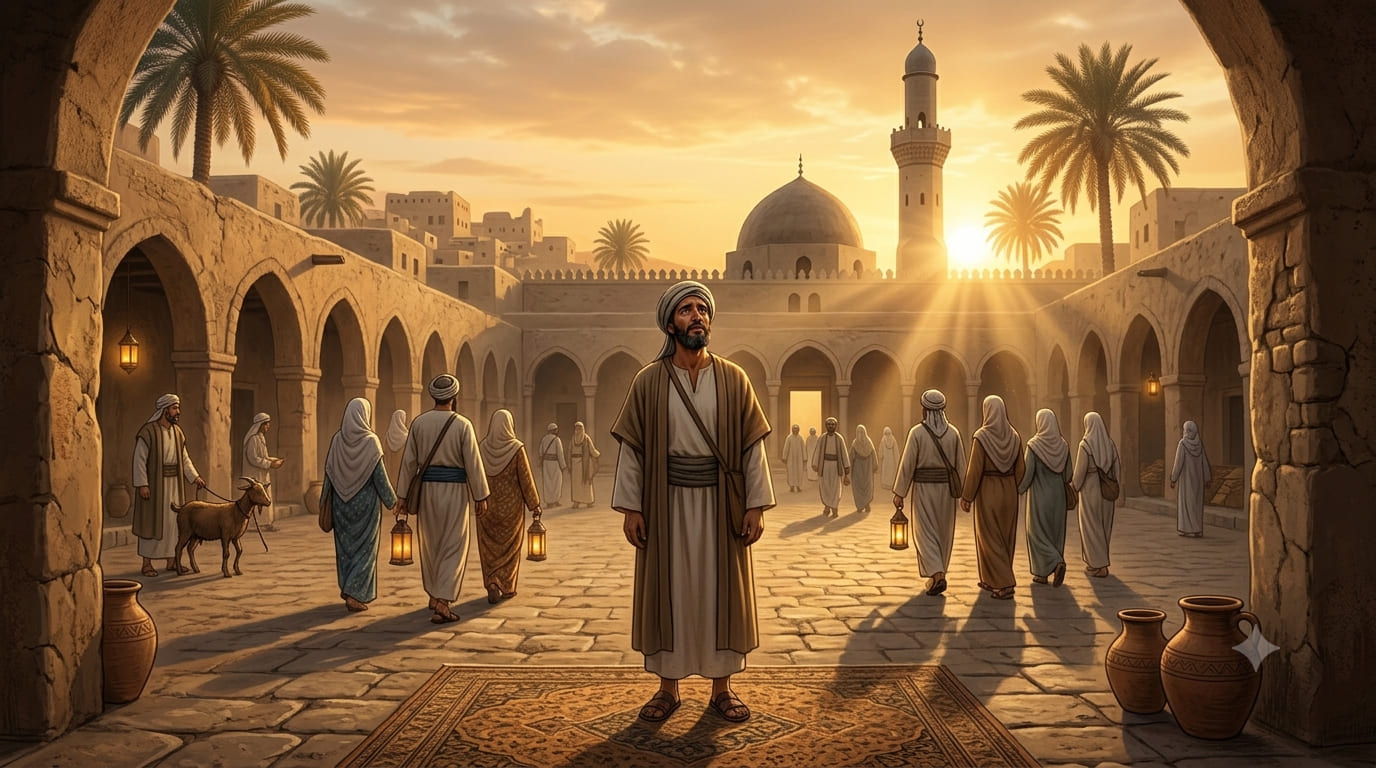
The evening breeze moved softly through the alleys of Madinah. In some houses, people began lighting their lanterns. A mother called her child home. Several men could be seen herding goats and sheep toward their pens. From afar, the voices from the market grew fewer. The City of the Prophet was moving toward night. And Madinah at this hour always possessed a different kind of tranquility. Not silence. Because the city was never truly silent. Rather, it was calm. Calm like a human being setting down the burdens of the day, one by one. Harith finally spoke: “You look better now.” Abdullah turned slightly. “Hm?” “Your face.” Harith pointed vaguely. “Earlier you looked like a man who had just lost ten camels.” Abdullah smiled faintly. “And now?” Harith observed him for quite some time. Then answered: “Now you look like a man who has lost five.” Abdullah shook his head while laughing softly. Harith smiled along. Then after a few steps, his face grew calmer again. “I’m serious.” Abdullah looked ahead. The sky of Madinah was beginning to change: gold, orange, and a hint of crimson at the western edge. Harith continued softly: “Your house has returned a part of you.” Abdullah’s steps slowed slightly. Because the words were true. Throughout the afternoon, amid the laughter of children, the sounds of goats, warm bread, and Maryam, something had indeed returned. Not whole. But it had returned.
And for the first time since leaving Shaykh Umar’s house, Abdullah began to realize: Perhaps tranquility does not always come after answers are found. Sometimes it comes when a human is reminded of what they are truly fighting for. They continued walking through the alleys of Madinah. The sky above the Prophet’s City slowly grew softer. The sunlight that had earlier filled the stone walls now slanted, casting long shadows along the streets. Evening always carried a different atmosphere. As if the city that had been busy speaking, trading, walking, and working since morning—began to lower its voice little by little. In front of a house, a father lifted his small child onto his shoulders. Not far away, two women were rolling up mats that had been used to dry wheat since afternoon. From another street, several shepherds herded their goats home while occasionally calling to one another. Small lives.
Things that Abdullah had rarely noticed before. But now, for some reason, his eyes seemed to catch more than usual. Harith walked while occasionally kicking a small pebble on the road. Then suddenly he said: “I’m thinking about something.” Abdullah turned. “What?” Harith furrowed his brow. “If one day we really have to leave…” he looked at the road ahead, “I don’t know how to explain to Iskandar that the goat might not come with us.” Abdullah laughed softly. “You’re still thinking about that?” Harith looked slightly offended. “I’m serious.” Abdullah shook his head while smiling. But a few steps later, his smile slowly faded. Because behind Harith’s words lay something far more real. If one day they truly had to leave… then there would be many small things that could not come with them. Not just the goat. Not just the house. But the trees planted over the years, the alleys their feet had memorized, neighbors, the sounds of the market, and the life that had grown slowly with time. And suddenly Abdullah understood something new: Hijrah is not only about moving to a new place. Hijrah is also about accepting that there are parts of life that cannot be brought along.
They kept walking. Then from afar, the roof of the mosque became visible. And at the same time, something in Abdullah’s chest changed slightly. Not yet calm. But like a man beginning to approach home after a long journey. The roof of the mosque grew clearer as they drew nearer. It was not the most magnificent building. Nor the tallest. But for Abdullah, that place had always held something difficult to explain in words. Because humans do not always return to a place merely because of its walls. Sometimes they return because their hearts recognize the tranquility there.
The alley leading to the mosque area grew busier. Several people were walking in the same direction: merchants who had just finished their day’s business, seekers of knowledge, travelers, and an old man walking slowly with a staff. The sun sank lower. The sky of Madinah was now filled with orange, gold, and a thin crimson line on the horizon. Then from afar, the sound of the adhan began to rise. Allahu Akbar… Abdullah’s steps halted for a moment. Not out of surprise—because he had heard that voice his entire life. But today it felt different. Because since morning, he had listened too long to the market, routes, news, and human anxiety. And now, for the first time that day, all those voices seemed to slowly fade away. Harith stopped as well. The two of them were silent. Around them, people also began to slow down. Some quickened their steps toward the mosque. Some lowered their heads. Some stopped their conversations. And suddenly Abdullah remembered something his father had once taught him: When the world speaks too loudly… seek the place where you can once again hear the Hereafter. The evening breeze moved gently. The sound of the adhan continued to echo. And under the sky of Madinah that was turning toward night, Abdullah felt something that had been missing since morning: his chest began to breathe more freely.
PART 2 — Shadows at the Threshold of the Courtyard
Harith glanced at Abdullah. “Better?” Abdullah looked ahead. Toward the mosque. Toward the people walking. Then answered softly: “A little.” Harith nodded slightly. He added nothing more. Because there are kinds of anxiety that do not disappear because of long advice. They only slowly diminish when the heart returns to its rightful place. They walked again, step by step. Closer. And the closer they got, the atmosphere of the mosque began to be felt: the sound of sandals on the ground, people greeting one another, and the soft recitation of verses by those who had arrived earlier. Just before entering the courtyard, Abdullah suddenly stopped. Harith turned. “What?” Abdullah gazed at the mosque courtyard. His eyes moved slowly. Because among the people entering, he saw something that felt strange: two men he recognized from Shaykh Umar’s house that morning. The Syrian merchant. And the Qurayshi man. Both stood somewhat far away in the shadow of the wall. They were not speaking loudly. But their faces looked too serious for ordinary conversation. And when Abdullah followed their gaze… his chest tightened slightly. Because in the hand of one of them was a familiar leather map scroll.
Abdullah narrowed his gaze. The distance was not too close. But close enough for him to recognize the scroll. Pale leather with a dark tie in the middle. The same map that had been opened that morning at Shaykh Umar’s house. Or at least very similar. Harith followed his gaze. After a few seconds, the Badawi man’s face also changed slightly. “I don’t like the face of men holding maps just before prayer.”
The adhan still echoed. People continued walking toward the mosque. And for a moment, Abdullah felt all the anxiety of the day threatening to return to his chest. But at that exact moment, he remembered: When the heart is anxious… do not run first to fear. He drew a slow breath. Then shifted his gaze away from the two men. Harith turned. “Not approaching?” Abdullah shook his head slowly. “Not now.” Harith observed his friend for a moment, then nodded. Because he understood. Since morning, Abdullah had walked too long following news, maps, and human anxiety. And this evening, he had come to the mosque not to chase those things again. He had come for something else. They stepped into the courtyard. Sandals were left at the edge. Voices lowered. And when Abdullah’s feet crossed the threshold of the mosque courtyard… for the first time that day, the world felt a little farther away.
The stones of the mosque courtyard still held the lingering warmth of the evening sun. Abdullah’s steps naturally slowed. As soon as he crossed that threshold, the atmosphere around him changed. Not because the sound suddenly disappeared. People still walked. Still greeted one another. Still spoke softly. But the rhythm was different. Calmer. Lighter. As if the people in this place slowly released something from their shoulders before going deeper.
Abdullah walked further in. Passing the pillars, small circles of people, and the evening light entering through the gaps in the building. Then he stopped. Silent. He gazed at the mosque space for some time. Because suddenly, after a day that felt so long—after Shaykh Umar’s house, Salman, the market, Maryam, the children, Basrah, and all the anxiety—he had finally reached the place he had most wanted to come to since morning. And for the first time since sunrise, Abdullah did not want to think about the future. He simply wanted to sit.
Abdullah walked deeper with slow steps. Not in haste. Nor looking around too much. As if his body already knew the way without needing to think. On one side, a group of students sat in a small circle. An old teacher recited hadith in a calm voice. Some listened with bowed heads. Others repeated softly so their memorization would not slip. On another side, several travelers spoke in low voices. And near one pillar, a man read the Qur’an with his head slightly bowed. Everything proceeded as usual. The mosque had not changed. And precisely because of that, something in Abdullah’s chest felt increasingly calm. Because since morning, he had seen too many people who had changed: anxious faces, careful whispers, and conversations filled with worry. But in this place, the Qur’an was still being recited. Knowledge was still being taught. And people still came bringing themselves to Allah. Abdullah finally chose a spot near one pillar. Not too crowded. Not too far. Then he sat down slowly.
And after sitting… he only then realized something: how exhausted his mind had been that day. Not his body. Because he had not even walked far. But his mind. Since morning, he had been running continuously: from one worry to another. Shaykh Umar’s house. Basrah. The market. Salman. Maryam. The children. And possibilities that had not yet happened but had already filled his chest. Abdullah exhaled slowly. Then lowered his head. And for the first time since morning… he stopped chasing his own thoughts. Nearby, an old reciter was reading the Qur’an in a soft voice. Not loud. Almost like a murmur. But the flow of the verses moved gently through the air of the mosque. And Abdullah did not lift his head. Because for some reason… today he only wanted to listen.
The recitation of the Qur’an continued to flow softly. Not high. Nor overly beautified. Just the voice of an old man reading verses he might have repeated thousands of times in his life. But precisely because of that, the voice felt calming. Calm like water that has flowed for a long time in the same place. Abdullah kept his head lowered. His eyes gazed at the stone floor before him. His mind was not completely empty. There were still Basrah, Shaykh Umar’s house, the map, and talk of the east. But now they no longer raced as before. Slower. Much slower. And for the first time, he began to see his own anxiety from a different distance. Then suddenly he realized something that made him remain silent longer: Since morning, he had been too busy asking: What if…? What if the extended family really had to leave? What if things got worse? What if Madinah changed? What if his family had to leave their home? But that day, not once had he asked: What does Allah want from me? That question came so calmly. It did not strike. It did not shake. But precisely because of that, it felt deeper. Abdullah closed his eyes slowly. Because suddenly he felt a little ashamed of himself. Since morning, he had been so busy thinking about ways out, possibilities, and fear. Until he almost forgot: that humans are not commanded to know the future. They are commanded to seek guidance. Nearby, the recitation of the Qur’an continued. And the evening breeze entered gently from the side of the mosque. Then Abdullah opened his eyes slowly. He drew a breath. Very slowly. And for the first time that day, he did not ask for answers. He only asked for guidance.
The mosque grew calmer as the sky moved toward night. The evening light that had entered through the gaps in the building slowly faded. Lanterns began to be lit. Their light was small. Soft. Glowing among the pillars, walls, and people who had come carrying their own affairs. Abdullah remained seated in his place. Unmoving. Silent. And strangely, for the first time since morning, he did not feel the need to chase his thoughts. Because some burdens do not shrink when chased. They shrink when humans stop holding them too tightly.
Not far from him, the old man who had been reciting the Qur’an slowly closed his mushaf. Then he looked at Abdullah for a moment. A brief gaze. But enough to make Abdullah nod respectfully. The old man returned the nod. Then said softly: “A long day?” Abdullah was slightly silent. Then smiled thinly. “Very.” The old man nodded slightly. As if the answer did not surprise him. Then he spoke again: “Sometimes humans come to the mosque seeking answers.” He paused for a moment. Then looked at a small lantern near the pillar. “But often…” his voice was calm, “Allah gives tranquility first.” Abdullah was silent. Because the words felt too close. Too precise. The old man did not ask what the problem was. Nor who Abdullah was. He only stood slowly, adjusted his garment, then smiled faintly. “And sometimes…” he looked at Abdullah once more, “that tranquility is already enough for the first day.”
The first day. Those words made Abdullah lift his face slightly. The first day. As if the old man knew: something had just begun. Not a move. Not a journey. But something inside himself. The man then left slowly, leaving Abdullah near the pillar. And for some time, Abdullah only gazed at the small lantern whose light moved gently in the breeze. Then for the first time that day, he asked in his heart: Is this truly the beginning of something?
That question lingered for some time in Abdullah’s heart. Unanswered. Not chased. Because for the first time that day, he did not feel he had to immediately find answers for everything. Outside the mosque, night began to descend slowly over Madinah. The sound of human footsteps grew fewer. Small lanterns glowed in several corners. And from the direction of the houses, the wind occasionally carried the aroma of bread, firewood, and the night life beginning to gather again within each family. Abdullah slowly lifted his face. He gazed at the portion of the sky visible through the gaps in the building. Darkness began to fall. And strangely, he felt lighter than when the sun was still high. The day that had begun with anxiety, maps, and suffocating news, now ended with something far calmer: the awareness that he did not have to carry everything alone. In the distance, people began preparing to straighten the rows. Several soft voices exchanged greetings between the mosque pillars. Then Abdullah lowered his gaze. And unconsciously, faces began to appear one by one in his mind: Maryam. Iskandar. Fatimah. Harith. Their small house. The courtyard. The pen. The little goat that kept causing trouble. Then he smiled to himself. Because suddenly he realized something: Since morning he had kept thinking about how to save his family. But he had not yet truly given thanks: that Allah had given him a family worth fighting for.
And in the midst of the Prophet’s Mosque that was growing calm, Abdullah slowly lowered his head. Then whispered very softly: “Alhamdulillah.” One word. Short. But that night, it felt wider than all the long conversations since morning. After that Abdullah spoke no more. He only sat. Silent. Letting the tranquility of the mosque fill the empty spaces that since morning had been filled with anxiety. Nearby, people began to stand slowly. Some adjusted their clothes. Some shifted their seats. Some walked slowly seeking their rows. The sound of footsteps on the stone floor was soft. Then someone said salam. Another replied.
The life of the mosque moved calmly, like a river flowing without haste. Abdullah slowly lifted his head. And suddenly, unintentionally, his eyes moved toward the outer courtyard. To the place where he had earlier seen the Syrian merchant, the Qurayshi man, and the map scroll. Empty. They were no longer there. Abdullah observed for a few moments. Then lowered his gaze again. And strangely… this time he did not chase that thought. He did not ask where they had gone. Nor did he think about who they were waiting for. Because today he had begun to learn something: that not every door must be opened in one day. And not every burden must be carried all at once. Beside him, a small child walked while holding his father’s hand. His eyes were sleepy. His steps were short. But his hand gripped tightly. Abdullah observed the scene for a moment. Then for some reason, he remembered Iskandar again. “Come home before night.” The words came again. And this time, Abdullah smiled faintly. Because suddenly he realized: Today had felt very long. But when he returned home later, Iskandar would probably only ask: “Father… has the goat become more obedient?” And for some reason, that thought felt far more calming than Basrah.
Not long after, the rows began to be straightened. People stood slowly. The sound of small conversations faded little by little. What remained were footsteps, short greetings, and the movement of humans seeking their place in the row. Abdullah stood as well. He adjusted his garment slowly. Then stepped toward the row. To his right and left, people stood: merchants, travelers, seekers of knowledge, workers, and people who might be carrying burdens unknown to anyone. And as always, when standing in the row, all differences disappeared. There were no extended families, small people, the rich, or owners of trade routes. Only servants. Abdullah drew a slow breath. And for a moment, he remembered again: Shaykh Umar’s house, the market, Salman, Maryam, the children, and the entire long day. Then he remembered something he had just understood: Humans too often think about how to protect their lives. But sometimes they forget: who has been protecting them all this time.
PART 3 — The Small Secret That Banished Basrah
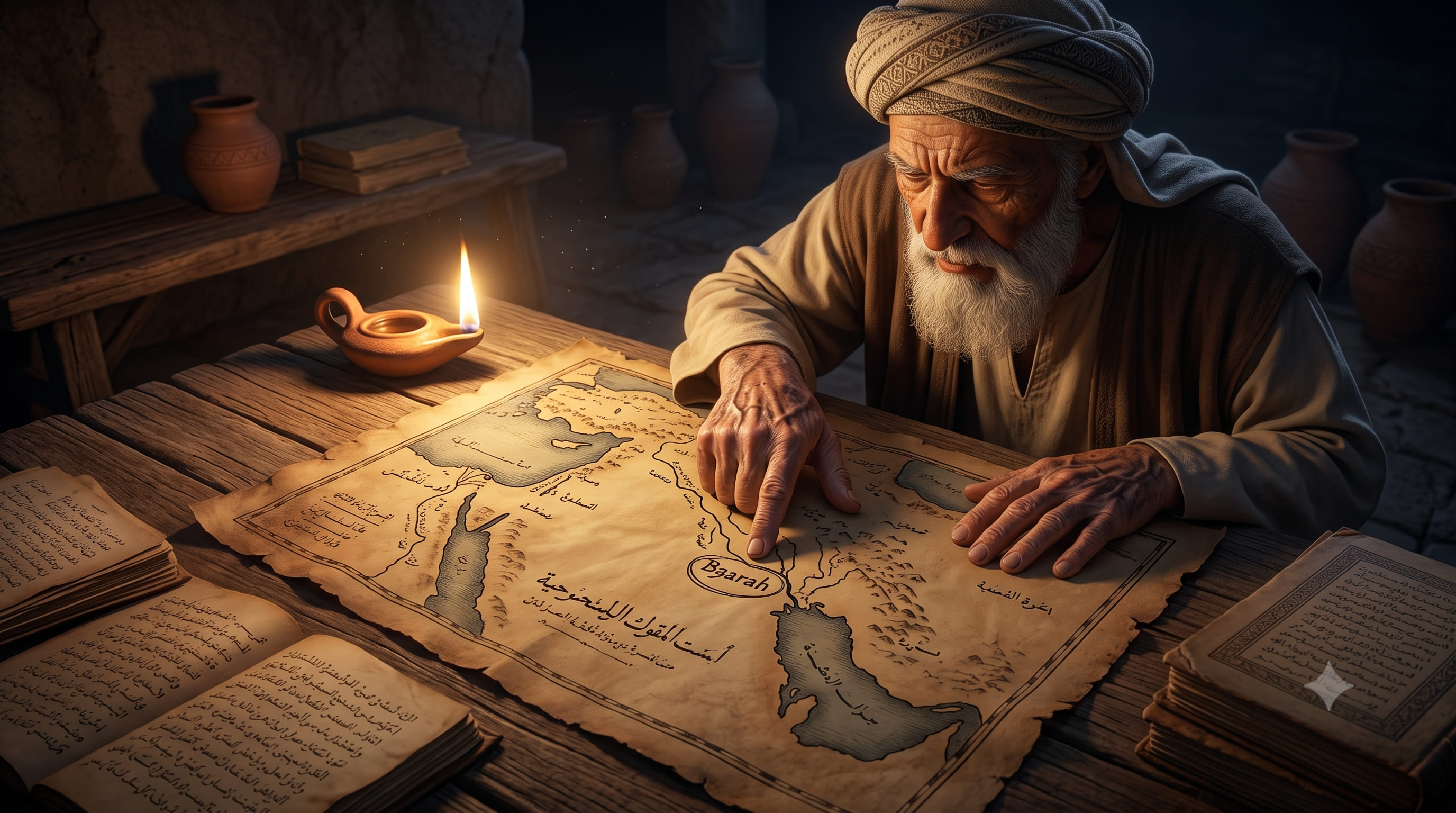
The takbir began to be heard. The rows became silent. And when Abdullah raised both his hands… for the first time since morning, he did not bring maps, Basrah, routes, or fear. He only brought himself. Outside the mosque, night descended more perfectly over Madinah. Lanterns glowed in the houses. People gathered with their families. And far in that calm city, in several closed houses, there might still be humans discussing eastern routes, stored metal, and the possibility of moving. But for tonight… for just a few moments… Abdullah chose to stop chasing all of that. Because tonight, he only wanted to be a servant. And without Abdullah realizing it, in another part of Madinah, someone had just opened another map on a small table illuminated by a lantern. And those old fingers stopped right on one name: Basrah.
The small lantern moved gently in the night breeze. Its light rose and fell on the walls of the quiet old house. The room was not large. Nor luxurious. Only a wooden table, several leather scrolls, a water jug, and a small shelf containing travel notes beginning to yellow with age. On the table, the map was spread out. Those old fingers were still resting on one spot. Basrah. For several moments, there was no sound except the small flicker of the lantern and the night breeze occasionally slipping through the cracks in the wall. Then another voice came from the back of the room: “Are you still looking at that place?” The old fingers did not move. They did not answer immediately. Until after several breaths, the heavy voice was heard: “I see the road.” The younger man approached slowly. He was younger in age. But the hair near his temples had begun to turn white. He looked at the map. Then at the old man before him. “Or are you seeing something farther than the road?” Silence fell.
The old man finally withdrew his hand slowly from the map. Then leaned back slightly. “Today…” his voice was low, “I heard the name Basrah too often.” The lantern moved again. The shadows of their faces shifted on the wall. “Houses have begun storing metal.” “Routes have begun to be asked about.” “And people have begun to speak softly.” The younger man was silent. Because he had seen it too. In the market. In the houses. In people’s faces. Then he asked: “Do you think the time is near?” The question hung. Long. Very long. Until finally the old man said softly: “I am not afraid when people begin to talk about leaving.” His eyes returned to the map. “I am afraid…” his voice almost became a murmur, “when people begin to prepare in silence.”
And the night of Madinah continued. In one place, Abdullah was standing in the row. In another place, children might still be laughing in the courtyard. And in this small room—some people had begun to look at the future not merely as a possibility. But as something slowly walking toward them. The younger man did not answer at once. He stood near the table, gazing at the map. His eyes moved slowly: from Madinah, to the northern route, to the trade route, then down toward the east. Basrah. That name stopped there once more. The small lamp moved again in the wind. The light's shadow danced softly upon the dulling skin of the map. Finally the man spoke: "Today I passed through the market." The old man did not lift his face. "And?" "People do not speak as they used to." A small silence fell. Then he continued: "Before, they spoke of:
- wheat prices,
- caravans,
- seasons,
- and livestock.
- safe routes,
- the situation in Kufah,
- and journeys to the east.
Then slowly rolled up the map. His movement was slow. Like a man closing something not yet finished. "Tomorrow." The young man lifted his face. "Tomorrow what?" The old man gazed at the lamp's flame. Then spoke very softly: "I want to meet Umar." Silence fell. Because in Madinah, that name needed no full mention. And that night... while Abdullah was seeking peace in the mosque, others were beginning to move in search of certainty. Night descended ever deeper over Madinah. Lamps were beginning to be the only light in many houses. The alleys that had been filled with footsteps that day now began to empty. Yet the city was not asleep. For Madinah at night was never truly silent. From afar could still be heard:
- the sound of wooden doors closing,
- the steps of men returning home,
- now and then the sound of a camel,
- and soft conversation from houses whose lamps had not yet been extinguished.
Abdullah was still in his place. Sitting. Silent. His hands upon his knees. His eyes gazing at the floor for a while. Because he did not yet wish to stand. Did not yet wish to return to:
- maps,
- Basrah,
- possibilities,
- and conversations about tomorrow.
Abdullah did not ask at once. Yet neither did he turn his gaze away. Because through years of knowing Harits, he understood one thing: that man was not one to give attention easily. But if he paid attention... there was usually a reason. Around them, the mosque was slowly emptying. Some went home. Some still sat reading the Qur'an. While the small lamp near the pillar continued to move gently in the night wind. Abdullah finally spoke: "Who?" Harits shook his head slightly. "I did not recognize him." Silence. Then he added: "Or perhaps I had seen him before." "But I do not remember." Abdullah waited. Harits rarely spoke in circles unless he was sorting something in his head. The Bedouin rubbed his chin slowly. "His clothes were ordinary." "Not like a merchant." "Nor like a wanderer." "But those two..." he paused, "treated him differently." Abdullah frowned slightly. "Differently how?" Harits was silent a long while. Then answered: "Like men waiting for an answer." The night wind entered through the side of the mosque. Bringing air colder than that of the evening.
Abdullah gazed at the stone floor before him. Then without realizing, the pieces of that day began to move again in his mind: Sheikh Umar's house. The map. Basrah. The metal beginning to be moved. The names of great families. And now... the third man. Yet a few seconds later, Abdullah instead exhaled slowly. Then shook his head slightly. Harits turned. "What?" Abdullah smiled faintly. "I have just realized something." "What?" Abdullah stared straight ahead. Then spoke softly: "I came to the mosque to calm my heart." He turned his head slightly. "Then Allah sent you bringing another map." Silence. One second. Two seconds. Then Harits snorted softly. "I should have just gone home." And for the first time since the conversation about the third man began, Abdullah laughed softly again.
That small laugh did not last long. But it was enough. Enough to break the tension slowly rising again. Harits shook his head with an exaggerated sigh. "See?" He pointed at Abdullah. "I have been saying it since morning." Abdullah raised an eyebrow. "What?" "Maps bring misfortune." Abdullah closed his eyes briefly, holding back a smile. "You are beginning to speak like an old man in the market." "No." Harits shook his head quickly. "I speak from today's experience." A small silence fell. Then both smiled faintly. Around them, the mosque grew ever quieter. Some lamps were being extinguished. An old man walked out carrying his staff. While some seekers of knowledge still sat far to the side. Night grew deeper.
Harits finally spoke more softly: "I do not know what it means." Abdullah turned. This time Harits' tone had changed. More serious. "It may mean nothing." "Perhaps I am only paying too much attention." He gazed at the courtyard. "But since morning..." he paused, "I do not like this feeling." Abdullah was silent. Because in truth he understood. Not only Harits. Since morning, all of Madinah seemed filled with the same feeling. A feeling hard to name. Not yet fear. Not yet certainty. But also not peace. More like a man standing before a storm.
The wind had not yet come. The sky had not yet darkened. But the birds had already begun to fly lower. Then Abdullah exhaled softly. Then said: "Tomorrow." Harits turned. "What?" "Tomorrow I want to meet Sheikh Umar again." Silence. Harits watched Abdullah's face. Long. Then: "So you truly are not at peace." Abdullah smiled faintly. "No." He gazed at the lamp moving gently. Then spoke more softly: "I only want to be sure whether what is moving is news..." His eyes turned toward outside the mosque. Toward Madinah beginning to drown in night. "...or history."
After that sentence, no one spoke at once. Harits watched Abdullah for a while. Then turned his gaze outside the mosque. Toward Madinah now fully covered by night. Small lamps appeared lit in the distance like points of light scattered among the houses. And for a moment, the two friends were silent. Because there are sentences better left to linger a while before being answered. Is this news... or history? Harits finally exhaled a long breath. Then rubbed his face slowly. "I hate it when you start speaking like the wise old men." Abdullah turned slightly. "Why?" Harits shrugged. "Because usually after that, something truly happens." Abdullah laughed softly. Brief. Yet this time lighter. Because for the first time since afternoon, he felt he could speak of his restlessness without drowning in it.
Harits stood slowly. Adjusted his garment. Then looked at Abdullah. "Home?" Abdullah did not answer at once. His eyes moved outside. Night. Lamps. Dark sky above Madinah. Then without meaning to, that small sentence came again: Come home before night. Iskandar. Abdullah smiled to himself. Then stood. "Home." Harits raised an eyebrow. "That quick?" Abdullah stared at him flatly. "There is a goat being trained." Silence. Then Harits turned his face away. "I do not believe it." "What?" "Basrah has changed you." Both walked out of the mosque. And Madinah's night welcomed them with colder wind. Yet this time, Abdullah's steps felt different from when he had arrived. Because he had not brought back answers. But he was returning with something he needed more that day: peace enough to carry him through the first night.
They left the mosque with slower steps. Night had now fully descended. Madinah's sky was dark and vast, filled with stars that seemed closer than in the great cities of the north. The night wind moved gently through the alleys. Bringing the cold air of the desert slowly replacing the day's remaining warmth. Some houses still had lamps lit. From some, could be heard:
- families speaking softly,
- small children laughing,
- and the sound of kitchen tools being put away.
Near the well, two old men were still speaking softly. Not far away, a mother was waiting for her child to come inside. And at the end of the alley, a small cat darted quickly between wall shadows. Small life. Life that continued even when men were filled with worry. Harits walked beside him, occasionally glancing at the sky. Then said: "I am thinking of something again." Abdullah immediately exhaled a long breath. "No." Harits frowned. "I have not spoken yet." "Still no." "Why?" Abdullah stared straight ahead. "Because every time you think of something today..." he turned slightly, "my life grows more complicated." Silence. One second. Two seconds. Then Harits laughed. Truly laughed. "Fine." He raised both hands in surrender. "Then I will save it until tomorrow." Abdullah closed his eyes briefly. "That is even worse." They laughed softly again. And for the first time that day, the road home felt closer than usual. Because at the end of that journey... there was a house waiting.
They continued walking through Madinah's alleys growing quiet. Their footsteps sounded clearer now. Because the day's sounds had truly descended. What remained was only night. And Madinah at night had a different face. Not busy. But alive. In some houses, lamps still burned. Their shadows moved gently behind door cracks. From one house, the sound of someone reading the Qur'an in a soft tone could be heard. From another, a mother appeared calling her child who had played too long outside. And in the distance, guard dogs barked softly now and then.
Harits walked, yawning slightly. "I am hungry again." Abdullah did not even turn. "You have been hungry since sunrise." "Because today has been too long." "You ate three times." "My body works hard." Abdullah raised an eyebrow. "Doing what?" Harits appeared to think. Long. Very long. Then answered: "Watching maps." Abdullah closed his eyes briefly. "I regret bringing you." Harits looked satisfied. Truly satisfied. And for the next few steps, both were silent again.
Yet this silence was different. Not heavy. Not filled with restlessness. Only two friends returning home after a long day. Then in the distance, Abdullah began to recognize the alley leading to his house. The small fence. The date palm. The house wall. And the small lamp lit near the door. His steps slowed slightly. Because suddenly he realized something: That lamp had not been extinguished. Maryam was still waiting. And somehow— amid:
- Basrah,
- maps,
- the third man,
- and a whole day of restlessness,
The small lamp swayed gently in the night wind. Its light was not great. Not bright. Yet from afar, Abdullah recognized it at once. Because since long ago Maryam had indeed kept this small habit: if Abdullah came home a little late, she let the lamp stay lit. Not because Abdullah could not find his way home. Nor because their courtyard was hard to find. But because sometimes men do not light a lamp so someone can find the house. They light it so someone knows: there is one waiting. Harits watched the lamp. Then raised an eyebrow. "I am beginning to understand something." Abdullah turned at once. "No." "I have not spoken." "Still no." Harits looked offended. "I only wanted to say..." he pointed at the house, "now I understand why you keep wanting to go home."
Abdullah's steps slowed slightly. Because for a moment, he did not know how to answer. Then Harits continued: "Your house is noisy." Silence. Abdullah stared at him flatly. Harits nodded seriously. "Very noisy." "There is Iskandar." "There is Fatimah." "There is that thieving goat." "And sometimes there is you." Abdullah closed his eyes. "Sometimes?" "But..." Harits paused briefly. This time his tone changed. Softer. "Your house is alive." A small silence fell. Because those words did not sound like a joke. Nor like praise. Only a simple sentence. Yet enough to make Abdullah gaze at the small lamp before his house a little longer.
Then without realizing, he remembered again Salman's words: "Children make men afraid of losing their home." Before, he had understood that sentence only with his mind. Today... he was beginning to understand it with his heart. And as his steps drew nearer to that small gate— from within came the sound: "FATHER IS HOME!" That voice was followed by the sound of small running feet. Fast. Too fast. Then: "Slowly!" Maryam's voice was heard from inside the house. "Iskandar— do not run—" Too late. The small courtyard door opened. And a few seconds later Iskandar had darted out like an arrow. His hair was messy. His shoulder cloth askew. And his face was filled with something that since morning had never lessened: joy. "Father!" Abdullah had not even opened his arms when— thud! that small body had already crashed into him. Harits immediately turned his face away. "He is doing it again." Abdullah held his child's body while laughing softly. "Did Father not say to be slow?" "I forgot." The answer came too quickly. Too honest.
Then Fatimah appeared from behind, hugging the small goat. Truly hugging it. As if afraid someone would take it away that very night. "Father." Abdullah turned, smiling. "Hm?" Fatimah looked very serious. Very serious. "He is better." Silence. Abdullah blinked. Harits blinked. Then Iskandar cried quickly: "No! He is not!" "He is." "He is not." "He is." "He is not!" Harits gazed at the sky. Then exhaled a long breath. "I have walked all across Madinah..." he said softly, "and it turns out I am coming home to the same battle."
From the house's threshold, Maryam stood holding back a smile. The small lamp near the door moved gently in the night wind. And Abdullah watched it all silently. Then without realizing... he smiled longer than on his usual days. Because that night he came home without answers. But he came home to something far more important: the reason those answers must be sought.
The courtyard came alive again. As if all afternoon and evening, that house had been waiting for one thing: Abdullah's return. Iskandar still held his father's hand. Tightly. Very tightly. As if afraid Abdullah would suddenly change his mind and leave again. While Fatimah walked on the other side, still carrying the small goat. Though the animal was clearly too large to be carried like a baby. Yet Fatimah did not seem to care. Harits entered last. Then stopped in the courtyard. His eyes moved: to the pen, to the house, to the lamp, to the children. Then he shook his head slightly to himself. Abdullah turned. "What?" Harits exhaled a long breath. "I am thinking of my fate." Silence. "Your fate?" "Hm." He pointed at Iskandar. "This child." Then at Fatimah. "This child." Then at the goat. "And this creature." He closed his eyes briefly. "They speak to me too often." Fatimah frowned. "Because you come." "I know." "Then why complain?" Silence. Harits stared at Abdullah. Abdullah stared back. Then Harits said softly: "I have lost." And the courtyard filled with laughter again.
Maryam stood at the threshold watching them all. Since Abdullah had returned, her husband's face had changed. Slightly. Not much. But she saw it. His shoulders were lighter. His steps calmer. And the eyes that since afternoon had held something distant now felt closer. Then Abdullah's eyes met hers. Only briefly. Yet Maryam understood at once. The problem was not yet finished. Basrah had not vanished. The restlessness was still there. But something had changed. Abdullah had not come home with answers. He had come home with peace. And sometimes... to get through the first night, that was enough.
Night moved ever deeper. Bit by bit the house's sounds lessened. In the kitchen, utensils had been put away. In the pen, the animals had grown quiet. The small lamp in the courtyard still burned, but its flame was gentler now. Harits finally left after being long enough the victim of:
- Iskandar's questions,
- Fatimah's defenses,
- and the small goat that somehow kept following him.
Not long after, Iskandar began to yawn. Once. Twice. Then still insisted he was not sleepy. Fatimah too had begun hugging her small goat while speaking ever more softly. Her sentences growing unclear. And in the end Maryam only smiled faintly. "Enough." "Come in." "Tomorrow there is still morning." Iskandar paused to turn to Abdullah. "Father." "Hm?" "Tomorrow the goat will surely be more obedient." Abdullah smiled faintly. "God willing." Then the small child nodded satisfied, as if the world's great problem had been solved. A few moments later, the sound of small footsteps vanished into the house. Then silence descended slowly.
Now only remained:
- Abdullah,
- Maryam,
- the lamp,
- and Madinah's night.
After that, Abdullah was silent. Truly silent. Did not continue his sentence. Nor try to fix it. Because sometimes the most honest sentences are the shortest. I am afraid of losing all this. The small lamp near them moved gently. Its light rose and fell in the night wind. Their shadows shifted softly on the house wall. Maryam lowered her gaze for a while. Did not answer quickly. Because she knew: there is a kind of confession that does not need an immediate answer. It only needs to be received first. In the distance, a guard dog barked briefly again. Then the atmosphere grew calm once more.
Maryam lifted her face slowly. Gazing at:
- the courtyard,
- the pen,
- the lamp,
- and the small house they had built bit by bit over the years.
- food was scarce,
- work was not yet steady,
- and the future was unclear.
The night wind moved softly through the courtyard. The small lamp swayed again. And for some time, no one spoke. Not because there was nothing to say. But because after honesty comes, sometimes men need a little silence. Abdullah gazed at their courtyard. That afternoon it had been filled with:
- small footsteps,
- goat sounds,
- laughter,
- and endless commotion.
Abdullah turned. Maryam smiled faintly. "That is what our family has done since long ago, is it not?" When given ease... they gave more charity. And when difficulty came... they gave more of:
- reading the Qur'an,
- prayer,
- and dhikr.
Abdullah's laughter this time was different. Not loud. Not long. But truly laughter that came without force. Because all day, Basrah had indeed felt like an uninvited guest. Entering:
- Sheikh Umar's house,
- the market,
- conversations,
- his thoughts,
- and nearly his own home.
Night continued on. The lamp grew smaller. The wind felt colder. In the distance, Madinah's sounds grew quieter. Abdullah gazed at the sky. Stars filled the darkness above the Prophet's city. And he suddenly remembered something: This morning. It felt as if it had happened days ago. Yet the same sun had only just set. Sheikh Umar's house. The map. The Sham merchant. Salman. The mosque. Harits. The children. A long day. A day that changed something within him without his truly realizing it. Maryam followed the direction of his gaze. Both gazed at the same sky. Then Abdullah said very softly: "I feel something is drawing near." Maryam was silent. She did not ask: what. Because she understood. Abdullah did not know either.
A few moments later, Abdullah lowered his gaze to their small courtyard. Home. Lamp. Night. And a peace that felt so simple. Then for the first time that day, he understood something: Great change rarely comes with loud sound. Sometimes it comes like wind— soft. Nearly unheard. Until men realize... their lives have already begun to change.