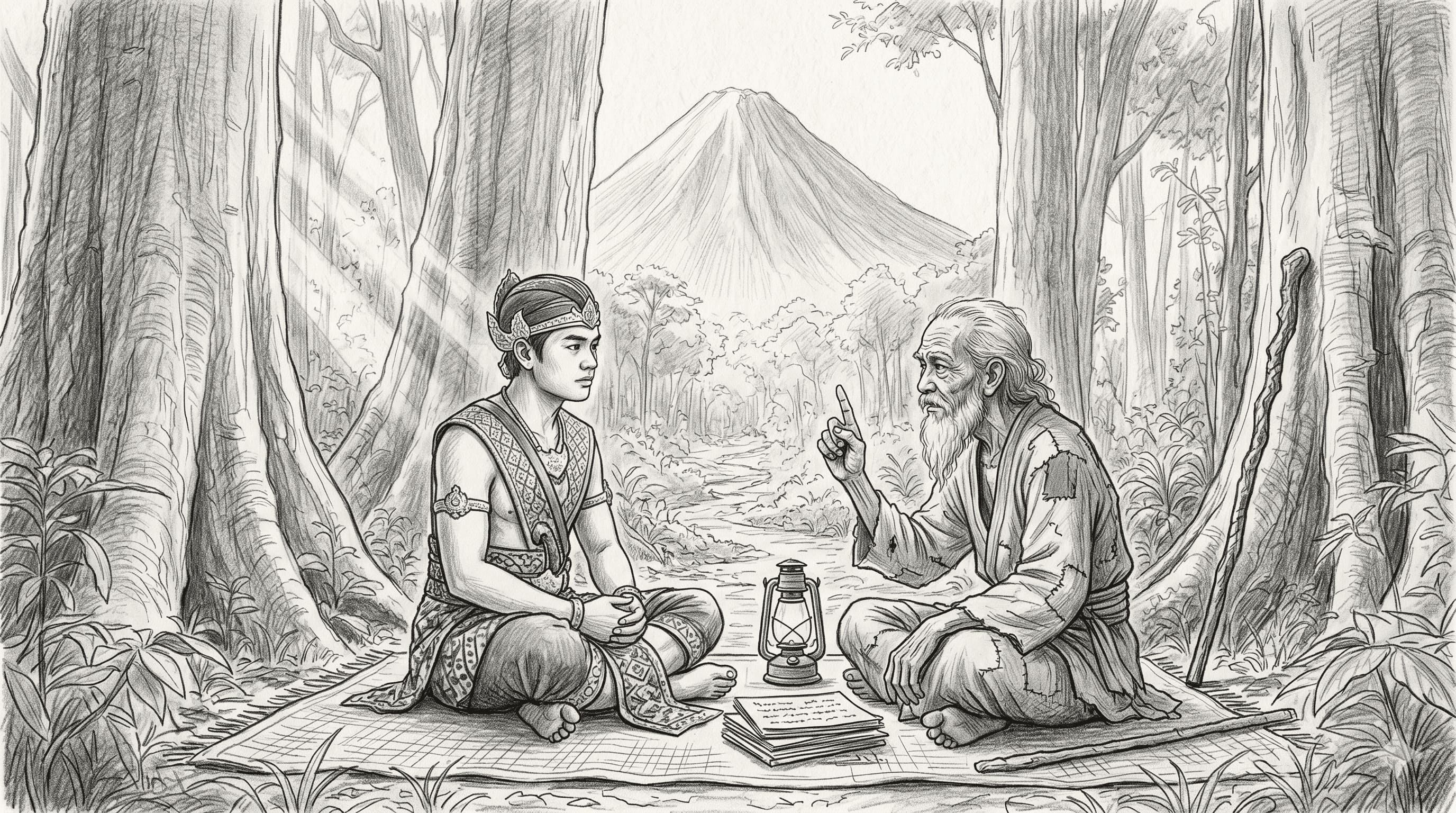
Bhre Kertabhumi
Chapter 001 — SEMERU GUIDES THE PRINCE'S JOURNEY
The Foothills of Mount Semeru — The youth of the Prince before destiny summoned him back into the vortex of Majapahit.
PART 1 — THE HUNT IN THE WILDERNESS OF SEMERU
A thin mist still clung to the trunks of ancient pines, for the sun had yet to fully reveal its face upon the eastern horizon. Dew fell from interweaving leaves with a soft, rhythmic patter, as though the earth of Semeru were sighing awake from its nocturnal slumber. The wilderness at the mountain's foot seemed a realm possessed of its own living consciousness: the trees stood unmoving in the stillness, the grasses bowed with dew-laden faces, and the rustle of the wind bore the scent of damp earth, marking the gentle transition from night to morn—a subtlety understood only by those intimate with the wild. As the fog slowly dissolved, the silhouettes of several figures emerged, moving with calculated stealth; they maintained their distance from one another, yet their gazes remained anchored to the young man who led the vanguard. He was none other than Bhre Kertabhumi, a youthful prince of Majapahit, who chose more often to immerse himself in the secrets of the untamed forest than to dwell within the heavily mandated walls of the royal court.
Kertabhumi’s tread was exceedingly light, as though his frame had been fashioned from the mountain air of Semeru rather than the bloodline of kings. His footsteps left scarce a sound upon the earth, though the damp morning grass would typically emit a soft crunch if trampled in haste. He moved like a shadow gliding between the trees—leaving no echo, sowing no unrest among the wild beasts that were still preoccupied with seeking warmth. The guards who had trailed him since setting out from the lower slopes were forced to hold their breath lest they lose track of their prince, for Kertabhumi never walked like a courtly noble accustomed to being shielded. He moved like a true huntsman, like a son of the mountain who had woven his spirit with the knots of the roots, the morning air, and the whispers of wild birds darting through the high canopy.
Three days prior, this small retinue had departed Majapahit. It was said among the tumenggung who had once escorted him that Kertabhumi knew the forest trails as intimately as a slope-dwelling peasant who had labored there for decades. He could discern the murmur of running water, the shifting currents of the wind, and the subtle mutation in the scent of the earth left by a deer passing through the brush less than a quarter-hour before. In his tender youth, having not yet completed twenty winters, he possessed an acuity of instinct that surpassed that of most seasoned warriors. “Our prince is not cast from the same mold as common men,” the guards within the small company would often whisper among themselves. “He is more akin to the bayu—the wind that sweeps down from Semeru’s peak, unbound by any pillars of the royal court.” And on this journey, as on those that came before, Kertabhumi walked in profound silence. He audited the markings upon the earth: a fractured twig, the track of an old basket wheel half-swallowed by mud, and the overlapping imprints of wild beasts. He read them all like the script of life, inscribed by nature for those who possessed the wisdom to understand.
In the distance, the faint, shrill chattering of a monkey troop scattering through the canopy echoed, prompting Kertabhumi to raise his hand slowly—a silent command for his guards to halt. Without turning his head, he lowered his frame close to the earth, pressing his ear against the cold grass. "Something is ascending from the direction of the river," he murmured softly. The guards exchanged bewildered glances, for only the young prince possessed the acuity to catch so faint a vibration. And as Kertabhumi rose to his feet once more, his eyes gleamed with the sharp intensity of a young eagle newly initiated into surveying the valleys below. Amidst the drifting fog of the half-lit morn, the silhouette of the young prince seemed more than merely an heir to Majapahit—he appeared a true son of the Semeru earth itself, rising with every dawn to greet the stillness of the wild and marking the day with strides that no mortal could bound. Behind the thick morning mist that crept slowly down from the ridges of Semeru, Bhre Kertabhumi’s countenance remained as tranquil as the surface of a mountain lake undisturbed by the wind. As the small retinue ventured forward once more, the guards trailed his footsteps with utmost gravity, yet not a single soul among them could match the acute sensitivity of the young prince. With every stride he took, it appeared as though nature itself yielded to give him passage; the grasses bowed more gently, the fragile twigs refrained from fracturing as he brushed past, and the currents of the wind—which typically shifted capriciously at the foot of the mountain—seemed purposefully to dissolve the fog along the path he chose. At so tender an age, Kertabhumi had already manifested a quality that defied simple description: a profound spiritual harmony with the wild, completely alien to the children of the court who grew up amidst the rhythmic striking of gamelans and the heavy scent of incense within the royal audience halls. He had never been tutored by any master in the art of traversing the forest, yet his frame moved as though he had been sired in the very heart of the dew-drenched wilderness.The seasoned guards often wondered in their hearts from whence such deftness arose. Perhaps, they mused, it sprang from the bloodline of his ancestors, which still harbored the residual glory of the Singhasari warriors; or perchance from the rudimentary disciplines imparted by the court brahmins when he was but a child. Yet, such explanations never truly sufficed. For Kertabhumi’s prowess was no mere product of physical training; rather, it was something that germinated from deep within his being—a faculty untutored by human hands. Those who had accompanied him on hunts over the years realized that the young prince seemed possessed of ears that could catch sounds far beyond the reach of ordinary men, eyes that could distinguish the shadow of a stag from the silhouettes of the trees, and a stride capable of evading brittle branches even in pitch darkness. More than once had the guards lost his trail as the sun began to sink; yet always, without fail, Kertabhumi would reemerge from behind the trees, bearing his quarry with a countenance as serene as though he had merely taken a leisurely stroll through the palace gardens.
On that day, his stride halted at the edge of a damp earthen furrow where the faint tracks of three does were visible, partially erased by the previous night’s rain. He crouched down slowly, examining the imprints with the tips of his fingers, then gave a soft nod. "They are not far," he whispered, leaving the guards to stare in utter marvel. The does might have passed nearly two hours prior, yet the prince read the direction of their flight as though he had just witnessed them bound past. He arose, turned his frame toward the northwest, and advanced with a swifter pace. The guards strained to keep stride, but soon they lagged several spear-lengths behind. Not a soul dared request the prince to slacken his speed, for they had long known his temperament: Kertabhumi did not hunt to display his prowess, but rather to quiet the restlessness of his spirit—a turmoil that resurfaced each time he returned to the palace.
Therein lay the profoundest divide between himself and the other princes. To them, the wilderness was an alien realm fraught with peril; to Kertabhumi, it was a living sanctuary that granted him deliverance. Within the untamed forest, he could breathe unbound by courtly protocol, far from the hushed conspiracies of ministers clad in fine silks yet burdened with murky hearts. Within the wild, he could truly feel his own existence. He could simply be a man, walking beneath the canopy of ancient trees that seemed to have known him since his infancy. Thus, with every stride that drew him deeper into the heart of Semeru, he felt as though he were returning home. He felt as if he were reclining once more in the embrace of Mother Nature—a stark contrast to the mother who awaited him with mounting anxiety back at the palace. And on that morning, still shrouded in the remnants of fog, Kertabhumi’s accelerating pace seemed to signify that the further he broke away from the court, the closer he drew to his truest self.
The morning mist began to thin as the small retinue reached a slightly open slope, where the first rays of sunlight pierced the gaps in the foliage, casting lines of luminescence through the humid air. At this juncture, the guards were forced to halt for a fleeting moment—not from exhaustion, but because their bodies could no longer match the swiftness of the young prince. Bhre Kertabhumi had surged far ahead, darting past wet boulders and leaping over the roots of giant trees with movements that seemed precisely calculated by his own instincts. Even the slick earth, freshly churned by the previous night's downpour, failed to falter his stride. He glided across the steep incline with an uncanny balance for someone raised within the heavily mandated confines of the royal court. From afar, his silhouette resembled the shadow of a mountain eagle sweeping over the ridges, occasionally vanishing behind dense clusters of leaves, only to reemerge as if the wilderness itself were shielding the prince from the eyes of the world.
The lagging guards exchanged weary glances, their breaths coming in heavy gasps. They had long grown accustomed to the prince's rhythm on the hunt, yet on this day, Kertabhumi moved with a velocity far exceeding his usual pace, as though an unseen force were summoning him from deep within the wild. "Our prince seems to be pursuing something hidden from our eyes," muttered one of the senior warriors, wiping the sweat from his brow. The other two guards merely nodded in agreement, for they too sensed the peculiar nature of the chase. It was not uncommon for Kertabhumi to outpace his retinue, but the manner in which his frame pierced the morning forest today suggested he was following a current known only to himself. He was not merely tracking the imprints of a deer; he seemed to be guided by an ethereal whisper creeping from behind the ancient trees—a summons that could only be caught by those who held a profound spiritual bond with the earth of Semeru.
Kertabhumi himself did not entirely comprehend what propelled his strides that day. A subtle tension rippled through his chest—a vibration that originated not from the sounds of the forest, but from something far deeper. Each time he inhaled the crisp, cold air of Semeru, he sensed an invisible presence, as though an eye were observing him from afar. It was not the gaze of an enemy or a predatory beast, but the eye of nature itself, recognizing him and beckoning him to venture further. His instinct whispered that the wilderness of Semeru was no longer merely a sanctuary of escape from the clamor of the court; it felt like a secret home harboring a fragment of his destiny. Thus, even as his guards fell far behind, Kertabhumi did not slacken his speed. He followed a faint trail that led him toward the murmur of a river beneath the ridge, descending the wet, earthen path and allowing his frame to move like water flowing without obstruction.
Upon reaching the bank of a narrow river, Kertabhumi came to a halt. It was not from exhaustion, but because he sensed an extraordinary tranquility. The water murmured as it coursed between slick, black boulders, and a shroud of thin mist hovered over the river's surface like a veil guarding the secrets of nature. There, for a fleeting moment, he stood motionless and closed his eyes. His breath slowed, matching the cadence of the rushing water, and his frame seemed to dissolve into the cold of the stones and the fragrance of the damp earth. He realized that it was in places such as this that his soul found peace—a peace he had never once discovered within the grand halls of the palace. When he opened his eyes again, his gaze was sharper, clearer, as though the small river had whispered something into his very being. It was something he could not yet comprehend, yet he knew that this day was no ordinary one. Something was waiting beyond this journey—be it a quarry, an unforeseen event, or a fragment of destiny slowly and invisibly drawing near.
When the guards finally caught up and arrived at the bank of the small river, they found Bhre Kertabhumi standing erect, gazing at the current coursing between the black boulders. They did not immediately approach him, for they had long understood that there were moments when the young prince wished to dissolve into the stillness of the wild, undisturbed by the sound of another human voice. They merely stood several spear-lengths behind him, keeping their distance while holding their breath, as though fearful of fracturing the subtle communion between Kertabhumi and the spirit of Semeru. In that silence, it became starkly evident how greatly he differed from the other nobles of Majapahit. Most princes would carry petty luxuries into the wilderness—specially prepared delicacies, soft places to rest, or minor grievances whenever the trail grew too steep. Yet Kertabhumi never asked for anything. Nor did he ever command his retinue to bear unnecessary burdens. He trod upon the bare earth and drank from the river waters like a common peasant; he demanded nothing from the world, save for the freedom to breathe.
A moment later, he was in motion. With a single, effortless leap, he glided across the river, his feet landing upon a massive boulder without causing so much as a ripple in the water. The movement was so fluid that the guards, who had only just arrived, could do nothing but exchange glances of mingled awe and anxiety. "Our prince is truly the incarnation of the wind," muttered one of the warriors, carefully attempting to cross lest he lose his footing. Yet by the time they had made it halfway across, Kertabhumi had already vanished behind a dense thicket on the western bank. There was no echo of a stride, no snapping of a twig—as though his frame had dissolved into the rustle of the wind sweeping through the foliage. For a stretch of moments, the guards could only listen as the voices of the wilderness reclaimed the air: the chattering of small birds, the sighing of the breeze, and the distant, muffled rumble from Semeru’s peak, like thunder held captive deep within the belly of the mountain.
Amidst that silent advance, Kertabhumi ventured deeper into a narrowing trail. He allowed his fingers to brush against the moss-covered trunks of the trees, feeling the chill pierce his skin. Beneath the interwoven canopy, the sunlight no longer fell in solid beams, but fractured into slender ribbons of light that danced to the swaying of the foliage. Kertabhumi moved without a shred of hesitation, for he had known the contours of Semeru's earth since an age when it was not yet fitting for him to wield a spear. He knew by heart where the massive roots sprawled, where the slick stones lay waiting to entrap a careless stride, and where the paths of wild beasts crossed while the morning was still young. Yet it was not the prowess of his memory that made him appear a true son of the wild, but the sharpness of his instinct. He could sense the subtlest shift in the wind's direction, catch the vibration of the earth when a barking deer bounded far ahead, and even distinguish the rustle of a falling leaf swept by the breeze from the snap of a brittle twig trodden upon by some other living creature.
Yet something was different that day. As he ventured deeper into the heart of the forest, his body caught a faint vibration that did not originate from any quarry. The sensation came as a subtle pull, awakening an urge within him to move toward a specific direction. It was not threatening, yet it could not be ignored. The surrounding atmosphere shifted slowly; the voices of the wilderness seemed to dim, supplanted by a denser stillness, as though the giant trees were holding their breath. Amidst this peculiarity, Kertabhumi came to a halt—not out of hesitation, but because he knew that whatever awaited him beyond this journey was no mere beast requiring a huntsman's skill. Something was summoning him, something intertwined with the course of his life, something he might only truly comprehend far in the future. With a chest that remained calm and eyes that grew sharper still, he lifted his face and gazed into the dark forest trail ahead, then took another stride—without looking back, without doubt, unaware that this very step would become one of the genesis points for a great upheaval in the journey of his life to come.
Bhre Kertabhumi’s stride into the narrow trail flanked by towering trees felt as though he were crossing an invisible threshold. The moment he ventured deeper, the chill of the forest grew denser, and the fragrance of the damp earth mingled with the scent of decaying leaves that formed a soft carpet beneath his feet. The shafts of sunlight that had previously pierced the gaps in the foliage began to recede, supplanted by long shadows enveloping the path ahead. Yet Kertabhumi did not slacken his pace. Instead, he felt an extraordinary tranquility, as if the wilderness recognized him not as a prince of Majapahit, but as a part of its own entity. Semeru seemed to be opening a portal to a hidden depth rarely unveiled to any mortal. The young prince drew a deep breath, letting the crisp air fill his chest, and within that stillness, he caught something that could not be detected by ordinary ears: a subtle sound resembling the sigh of the earth, or perhaps the rustle of ancestral spirits residing within the belly of the mountain.
He came to a brief halt. His gaze swept the surroundings, seeking the source of the sound that had केवल flashed through his inner being. The forest remained still, yet its stillness was not an empty one—it was more like a silence that was deeply observant. The giant trees lining the path stood erect like ancient guardians harboring memories of a bygone era, when Majapahit still illuminated the whole of Java with the radiance of its glory. And Kertabhumi, without fully realizing it, stood amidst those shadows like the incarnation of an unborn future. Though he knew not what awaited him at the journey's end, he sensed that his strides on this day would touch the very first threads of his destiny. Suddenly, the wind swirled gently, bearing the fragrance of wild flowers blooming upon the forest floor, and a single leaf fell directly before him—floating down as if to deliver a sign. Kertabhumi gazed at the leaf, then bowed his head slightly in a gesture of reverence to the nature he never took for granted.
Slowly, the voices of the guards began to filter in from the distance, anchoring him back to the reality that he was not alone. Yet before they could draw near, Kertabhumi raised his hand, signaling them to maintain their distance. He wished to savor that stillness for just a moment longer—a silence far more honest than any discourse that had ever echoed within the grand audience halls of the court. In that quietude, memories of his life within the palace resurfaced—a place where every word had to be guarded, every stride calculated, and every movement perpetually scrutinized. He did not harbor hatred for the palace, yet neither did he love it with all his heart. There were walls that stifled his breath, glances devoid of sincerity, and a burden far too immense for someone of his years. It was here, in the wilderness of Semeru, that he truly felt like himself. Here, he was no prince weighed down by mandated duties, but a young man treading honestly upon the soil of the motherland.
PART 2 — ECHOES FROM THE DALEM KEPUTREN
The Dalem Keputren of Majapahit welcomed the morning with a stillness vastly different from the clamor of Semeru. There, no mountain breeze swept in bearing the scent of damp earth, nor did any chorus of wild birds scatter through the high canopy. The inner court possessed only the soft, hushed footsteps of maidservants traversing the long corridors, the fragrance of kenanga flowers offered before the break of dawn, and the trembling shadows of oil lamps flickering behind silk curtains. In one of the inner chambers, Dyah Kusumadewi—the mother of Bhre Kertabhumi—sat upon the edge of a couch layered in fine damar cloth. Though her posture remained regal, her fingers tightly unraveled the edge of her sash, as if straining to hold back the tide of anxiety that had flooded her chest since daybreak. Her clear eyes gazed out toward the dew-kissed window, yearning for any tidings of her son, who three days prior had departed the palace to venture into the wilderness of Semeru with only a handful of chosen guards.
Two maidservants, Sri Sambi and Ninis Wulan, stood a short distance away. They occasionally exchanged glances, understanding that this morning was not the right time to offer soothing words. They simply waited, just as other consorts before them had waited for word of royal sons who loved to breach the boundaries of the palace world. Yet Dyah Kusumadewi’s plight was different. Bhre Kertabhumi was not a predictable prince. He harbored habits unusual for those of royal blood: he found greater solace walking among ancient trees than stepping through the grand audience halls. Because of this, the absence of any news was nothing new, yet it remained a sharp thorn in a mother’s heart. When Sri Sambi finally stepped forward bearing a warm spiced drink, Dyah Kusumadewi merely shook her head gently. "Leave it be," she murmured softly. "My heart is not yet at ease." Her voice was tender, but it bore a tremor she could not entirely conceal.
"Has there been no message sent by Tumenggung Lembu Kadhita?" she asked then. Tumenggung Lembu Kadhita was the leader of the retinue tasked with accompanying the prince. The maidservant Ninis Wulan bowed her head deeply. "Not yet, Gusti. They said this journey ventures into the western trails of Semeru, further out than usual." That answer caused Kusumadewi’s delicate brow to furrow slightly. She knew well that the western trails of Semeru were a wild and desolate expanse, a realm where many brahmins retreated for meditation, and where old hunters claimed that nature possessed a different kind of eye. Her son might know that forest better than anyone in the palace, but a mother could never truly banish her unease. "He always chooses the path that is further away… more desolate," she whispered. "As if he longs to distance himself from the court." Hardly had those words slipped from her lips when the sound of heavy yet steady footsteps echoed from the outer corridor. The maidservants immediately stepped back, and a moment later, the figure of King Rajasawardhana, the father of Bhre Kertabhumi, appeared. His robe was modest by a sovereign's standard, yet the authority radiating from his gaze compelled the maidservants to bow deeply. Dyah Kusumadewi rose to welcome him, but before she could speak, the king raised his hand, signaling her to remain seated. "You are anxious once more," Rajasawardhana said softly, yet firmly. "Our son is in no danger." He stepped closer, looking down at his wife with a gaze fraught with conviction. "Kertabhumi was born with blood that refuses to be confined within walls. The spirit of Semeru knows him better than any of us." Dyah Kusumadewi lowered her gaze, letting her voice drop to a whisper. "But he is still our child." "True," replied the king, "and that is precisely why we must have faith in his strength."
Dyah Kusumadewi fell into a long silence upon hearing Rajasawardhana’s words. Though her breathing began to steady, her eyes still harbored a lingering shadow of worry. For a mother, and most notably the mother of a Majapahit prince, anxiety was not a thing easily erased by mere reassurance. Kertabhumi was not the only royal son raised within those grand palace walls, yet he was the only one who never wished to dwell beneath the protection of towering battlements and armed guards. Since his infancy, he was more often discovered sprinting across the palace backyards, climbing the guava trees of elderly court retainers, or slipping outside alongside young warriors who secretly tutored him in the art of tracking. Kusumadewi still remembered when Kertabhumi was a boy of but eleven years and vanished for an entire day; the whole of the keputren was thrown into an uproar, the tumenggung searched every corner, and when night fell, the boy returned caked in mud, grinning as he displayed a river fish he had caught with his bare hands. That was the first night Kusumadewi realized her son would never live out his days like other princes. Rajasawardhana strode slowly to the side of the window, parting the silk curtain slightly so that the morning light pierced the chamber. "Look," he said, his voice soft yet steady, "the day is bright. This is a favorable omen for the journey of anyone currently in the wilderness." He then turned to Kusumadewi and added, "Including Kertabhumi's journey." Yet the mother's countenance shifted little. "You always say that," she murmured under her breath. "Each time he departs, you say he will be well. But you do not see the state of my face every night, waiting for tidings from the warriors."
Rajasawardhana drew near, and for the first time that morning, he sat beside his consort. His hand, strong yet warm, touched the back of Kusumadewi’s. "I do not say this merely to appease you," he murmured. "I say this because I have witnessed it with my own eyes." His gaze drifted to the far wall of the chamber as though recalling a memory. "When Kertabhumi was fifteen, I brought him on a hunt alongside Tumenggung Badhra Wisesa. I wished to see if his frame was as resilient as his spirit. As it mirrored… it was I who grew weary trying to keep pace with him. He was not merely swift; he seemed to know the course of every breath of wind. Even when we became lost along a dim, obscured trail, it was he who found the path home. That boy possesses something that transcends the teachings of the court masters." Kusumadewi drew a slow breath. Hearing that old tale only left her heart more deeply conflicted. She was proud, yet plagued by fear. "I know he is gifted," she said at last. "But must his gifts always carry him so far away from me?" Her voice was faint, almost like a lament she had harbored for far too long. "He is our eldest son, the one destined to inherit your mantle, my lord. It is not fitting for him to continuously toy with peril in the wilderness."
Rajasawardhana shook his head gently. "He is not toying, Kusumadewi. He is tempering his spirit. A boy like Kertabhumi cannot be reared solely upon the treatises of statecraft and courtly protocols. He requires the expansive earth to fortify his strides. And Semeru… Semeru makes him resilient." The king’s expression softened. "If we confine him perpetually to the palace, it is then that he will truly lose himself." Kusumadewi closed her eyes for a fleeting moment, letting those words seep slowly into her chest. She knew her husband never spoke without profound deliberation. She knew Rajasawardhana understood their son from a facet she had never witnessed. Yet a mother’s instinct—above all, the mother of a prince—was not easily conquered by logic or the convictions of a sovereign. When she opened her eyes once more, the morning radiance was dancing upon the brick floor, softening the light upon her anxious face. "Very well," she said at last, her voice more at peace though her words still harbored a trace of unrest. "I shall have faith… for this once."
Rajasawardhana fell silent for a moment, letting the morning light touch his consort's face before he resumed a tale known to only a few within the palace. "There is another matter I have never before revealed to you," he murmured, his voice low yet saturated with conviction. "This transpired when Kertabhumi had just turned fifteen. He was not yet permitted to wield a long spear, yet his strength already rivaled that of the young warriors trained in the outer courtyards of the keputren." Dyah Kusumadewi turned slowly, observing her husband with a gaze full of silent questions. Rajasawardhana continued, his eyes fixed on the distant past, as though piercing the long-settled mists of time. "At that time, he insisted on joining me and Tumenggung Badhra Wisesa for a trial along the western trails of the Bang River. We were tracking the prints of a stag when suddenly a low growl echoed from behind a thicket. A massive black panther bounded out, its eyes glowing like red embers, its spine arched and primed to strike." Kusumadewi caught her breath, not daring to interrupt the tale. "I prepared to wrench Kertabhumi back behind me," the king said, "but the boy did just the opposite—he stepped forward."
He drew a long breath, recalling the very moments that had caused his own heart to cease its beating. "Kertabhumi did not flee. He stood directly before the beast. His frame was as motionless as a tree trunk, yet the glint in his eyes… was sharp. Utterly piercing. I know not from whom he inherited such a gaze. Tumenggung Badhra went so far as to stay my hand when I made to wrench the young prince away. ‘My Lord,’ he said, ‘let us witness what this young blood possesses. At times, the instincts of youth can rival the proficiency of our training.’ I never anticipated Badhra would utter such words, yet there was a resoluteness in his voice that compelled me to hold back." Dyah Kusumadewi gripped her sash even more tightly. "Kertabhumi stood without a shred of fear," the king continued. "The distance between him and the panther was a mere few paces. The wind did not stir; even the rustle of the leaves seemed to die away. The beast growled, baring its massive fangs. I thought it would spring without hesitation. Yet something entirely unexpected transpired." He leaned his frame forward slightly, his voice dropping as though he were relaying a secret meant only for the ears of the palace walls. "When the panther leaped, Kertabhumi did not retreat. Instead, he darted to the side with an uncanny velocity, evading the initial strike. His hand cut through the air, wielding the short kris he always kept tucked into his waist—the kris gifted to him by Badhra. The movement was not flawless, not like the techniques of the old masters, yet the boy’s instinct was remarkably sharp."
He closed his eyes, remembering that very instant. "With a single pivot of his frame, he evaded the panther's claws and delivered a swift strike, landing precisely upon the beast's neck. It was not deep, nor was it fatal, yet it was enough to make the panther halt. The beast staggered, caught between two minds—whether to strike again or to flee. Then, it turned and vanished without looking back." Dyah Kusumadewi stared at her husband, her eyes wide with a mixture of shock and disbelief. "Is that truly what happened?" she whispered. Rajasawardhana gave a slow nod. "That is precisely why I do not fret for him as you do. He possesses not only courage, but an instinct that few princes can claim. And Semeru… that wilderness seems to recognize his very existence." Kusumadewi bit her lower lip, torn between pride and fear. She now began to understand that her anxieties as a mother would have to walk hand in hand with the conviction that her son was indeed destined to bear a momentous mantle.
The quietude within the chambers of the keputren deepened further once the tale was spoken, as though each brick comprising the ancient walls of Majapahit bore witness to the vastly different path being carved out for their eldest son. Dyah Kusumadewi bowed her head, allowing the faint shadows of the morning light to rest upon her face. She envisioned her son—Bhre Kertabhumi—the child she had carried in serene grace and reared amidst the splendor of the court, now standing to block a black panther with nothing but a short kris and a courage unnatural for a boy of his years. A sense of pride swelled within her chest, yet that pride was mingled with a subtly creeping dread, like the thin mist that blanketed Semeru at dawn. "If it is true that he possesses such an ability," she said at last in a low voice, "why does he not use it to remain close to us? Why does he always choose the wilderness as the place he calls home?" Rajasawardhana did not answer immediately. He gazed out the window, watching the sunlight begin to climb and reflect upon the small lotus pond in the inner courtyard. "Because that boy… was not born to be kept within confined spaces," he said softly. "There is blood within him that recognizes no boundaries of brick and stone. Have you not seen how he grows? He has never feared the height of the palace battlements. He climbs trees swifter than the court retainers who have labored here for decades. He mastered the tracking of beasts before he could read a single script. He comprehended the direction of the wind long before he ever knew the meaning of the word 'throne'." The king drew a sigh. "A boy such as that cannot be caged."
Kusumadewi lifted her face, her eyes reflecting an anxiety that had yet to recede. "But the throne awaits him," she murmured. "Majapahit does not require a son of the wild. Majapahit requires a prince who is strong, yet cautious. One who understands statecraft. One who can be present whenever the people have need of him." She looked at her husband with a gaze that pleaded for an answer, as though she herself were searching for certainty regarding a future she could not read. "What if these habits cause the high officials to look upon him with disdain? What if, in the days to come, he is regarded more as a wild child than the legitimate heir?" The king turned, his gaze hardening yet remaining gentle. "Kertabhumi is not wild, Kusumadewi. He is free." His voice was resolute, carrying a conviction forged from long experience as both a sovereign and a father. "In the future, when he sits upon the throne, he will rule not merely with law books, but with the instinct of a guardian of the earth. He will understand the sorrows of the common folk, because he has breathed the very same air they breathe. He will know how nature works, how the rains fall, how the rivers carve through the villages, and how the earth provides sustenance. Not every king understands such things."
He arose slowly, his hand touching Kusumadewi’s shoulder with a warmth that caused the agitation in the consort's chest to ease a little. "That boy was fashioned with two wings: one wing is the blood of kings, and the other is the soul of the earth. If we clip either one, he will never soar high." Kusumadewi closed her eyes, repeating her husband’s words within her heart. She knew Rajasawardhana was right. She knew Kertabhumi was no ordinary prince, even if her heart had always resisted accepting that truth entirely. Yet on that morning, behind the thin drapes of the keputren, she began to sense something different—not merely the anxiety of a mother, but a premonition that her son’s life would carry Majapahit along a path never before trodden by the sovereigns of old.
Dyah Kusumadewi slowly loosened her grip on the sash that had, until now, borne the brunt of her agitation. Rajasawardhana’s words echoed softly within her chest, like the muted striking of a distant gamelan—unobtrusive, yet permeating gradually into the innermost sanctuary of her being. She opened her eyes, looking up at her husband with a clearer gaze, though still shadowed by the instinctive fear natural to a mother. "Very well," she said at last, her voice tender yet imbued with fortitude. "If you yourself have witnessed how he confronts peril, then I too must learn to have faith in him." Those words were no mere surrender, but rather the initial step of a difficult acceptance. For Kusumadewi understood that a mother must eventually permit her child to venture into a world where she cannot shield him forever. Rajasawardhana offered a faint smile—one that rarely surfaced, but whenever it did, always carried the warmth of a father alongside the majesty of a king. "You are not losing him," he murmured gently, straightening his wife’s sash. "Kertabhumi is merely traversing his own path. A path not chosen by us, but one ordained by the earth and the heavens." He drew a long breath, turning his gaze for a moment toward the window, where the morning sunlight glinted across the red terracotta tiles of the keputren. "In time, when he returns, he will return as one far more mature. He will be no mere strong prince, but a young man who comprehends the very pulse of the Majapahit earth."
Outside the chamber, the footsteps of the court retainers began to sound, signaling that the morning routines of the palace were gradually unfolding. Yet within the room, the atmosphere remained hushed, as though time itself were holding its breath along with them. Kusumadewi arose slowly, stepped to the window, and drew the curtain a little wider. The incoming light now illuminated her entire face, revealing a newfound resolve that was steadily supplanting her prior unrest. "I only hope he does not forget the way home," she whispered. "Though the cosmos summons him, though Semeru becomes his master… I hope he still remembers that a mother waits for him here." Rajasawardhana drew near, standing by her side as he gazed out into the courtyard. "He remembers," the king said with absolute conviction. "Kertabhumi is not a child who departs without looking back. He always knows who loves him." Then, after a few moments of silence, he added in a lower register, "Yet you must also be prepared: one day, the path he chooses will venture further than anything you can imagine."
Kusumadewi lowered her gaze, letting those words wash over her, even if she could not entirely comprehend them. Within her eyes, far beneath her lingering anxiety, something new was gradually taking root: a premonition that her son's destiny would demand a momentous sacrifice—not only from her, but from the entirety of the royal house. As the morning breeze slipped through the crevice of the window, gently swaying the silk drapes, Kusumadewi drew her shoulder wrap tighter and exhaled a long breath. "May the gods protect him," she uttered softly. "Wherever his strides may lead." Rajasawardhana gazed at the light falling upon the brick floor, then gave a slow, measured nod. "And may the earth of Semeru keep him safe." Out there, while the palace stirred to welcome the unfolding day, far away in the western wilderness of Semeru, Bhre Kertabhumi ventured ever deeper, guided by a summons he had yet to understand—marking the genesis of a long journey toward a grand destiny that would one day alter the face of Majapahit forever.
PART 3 — THE PRINCE'S TAPA BRATA
The thin mist still hanging over the western slopes of Semeru moved slowly, like a delicate drape pulled by unseen hands. Behind it, Bhre Kertabhumi stood atop a massive boulder that jutted slightly toward the valley, letting the cold mountain wind strike his face with a gentleness understood only by those who had known the breath of the wilderness since childhood. The sunlight had not yet fully cascaded to the valley floor, leaving the entire world around the young prince looking as though it hovered on the precipice between dream and reality. Leaves swayed softly, as if greeting a frame that had been a part of Semeru for years. It was here that Kertabhumi always returned whenever the monotony of the palace trapped his chest; it was here that he felt the world demanded nothing of him other than to be himself. There were no stares from high officials, no whispers from court retainers regarding intricate protocols and politics, and no obligation to become something he had yet to comprehend. There was only he, the wilderness, and the earth breathing beneath his feet.
He closed his eyes slowly. The rustling of leaves, the chirping of small, newly awakened birds, and the distant rumble from the depths of Semeru coalesced into a tapestry of sounds that pierced through his ears and echoed into the core of his heart. These were melodies that never graced the halls of the palace. Within the grand audience chambers, the only sounds filling the air were the echoes of the high officials' discourses, the heavy footsteps of guarding warriors, and a hum of activity that never truly knew silence. Within the keputren, he caught the rustle of brushed silk, the shifting of thin pallets laid upon reed mats, and the hushed whispers of ever-watchful maidservants. But here—at the very heart of nature's life—the sound he heard was the voice of his own soul. His heart, long burdened by the strictures of the court, slowly opened, like a door released from its latch.
The crisp air brushed against his skin, slipping into his pores and seeping into his very bones. Yet it was not the chill that caused him to draw a long, deep breath. There was something in the atmosphere of Semeru that day carrying an obscure message—a message originating neither from mortal nor beast, but from the earth that had sustained the ancestors long before Majapahit was ever founded. Kertabhumi felt a subtle vibration course from the soles of his feet through his entire frame, a tremor born not of a minor quake or the shifting of soil, but from the inner being of the mountain itself. He did not fully comprehend it, yet he knew one thing: Semeru was speaking. Not with words, but through sensation. With his posture remaining erect and his eyes closed, he deepened his breathing, following the rhythm taught to him by a mountain brahmin when he was but a child. "Draw in the air, and let the spirit of the earth fuse with your blood," the brahmin had told him then. "Do not resist. Listen. The earth does not speak to just anyone." Since that day, Kertabhumi had memorized every step of the inhalation, every pause, every vibration. And now, in his ripening youth, he began to understand why the brahmin had been so earnest in imparting that lesson. Semeru was no mere mountain. Semeru was an ancient entity—a keeper of secrets.
Kertabhumi opened his eyes. Before him, the valley stretched out wide, adorned by a ribbon of a small river reflecting the faint light of the morning sun. He felt at peace, yet that tranquility was accompanied by an inner unrest he could not comprehend. It was as if something awaited him in the distance: a journey, a trial, or perhaps a summons he would only truly understand after venturing far beyond the spot where he currently stood. "If it is true that the cosmos has a design for me," he murmured softly, "I wish at least to know where I must begin." Yet Semeru answered only with the wind. The wind of Semeru blew gently, bearing the damp scent of moss clinging to the boulders and the fragrance of earth newly touched by the morning light. Bhre Kertabhumi opened his eyes slowly, letting the world enter his vision once more. Yet his mind remained anchored in the stillness that had just enveloped his inner being. He felt a profound void—not a painful emptiness, but a vacuum that instead unlocked a space for a more delicate sensitivity. In moments such as this, he felt he was not merely observing the wilderness; he was feeling its entire pulse of life. Every moving leaf, every small stream trickling between the black stones, every little bird darting across the branches of the towering trees—all seemed to merge into a single entity, breathing in unison with him.
Yet intertwined with this revelation came a sensation that had long harbored a dwelling within him—a profound estrangement from the palace that had reared him. Beneath all the grandeur of Majapahit, Kertabhumi always felt the presence of an invisible wall separating him from that other world. It was a realm saturated with strictures, etiquette, and political discourses that perpetually echoed the word "power." To him, it all felt like garments tailored far too tight. Each time he stood within the grand audience halls, he felt his breath stifled by the compulsion to be the flawless prince. Every step had to be calculated, every word chosen with utmost sagacity, and every glint of the eye scrutinized as a sign of either strength or frailty. He was like a fledgling eagle cast into a golden cage—exquisite to behold, yet forbidden to soar. Kertabhumi wiped his face, brushing away the remnants of the clinging dew. Memories of the other princes who had grown alongside him flashed through his mind. They studied legal treatises, statecraft, and literature under the vigilance of stern tutors. They sat erect for hours on end, mastering royal lineages and extensive customary laws. They matured with their sights fixed invariably upon the throne, upon ancestral legacies, and upon the hierarchy that had to be upheld. Meanwhile, he—Bhre Kertabhumi—was more often found sitting by the riverbanks, dipping his feet while listening to the yarns of grizzled warriors, or scaleing small hills just to gaze at the forest line stretching into infinity. He never harbored hatred for the courtly knowledge imparted to him, yet neither did he ever feel that his soul truly belonged there.
"I am different from them," he murmured within his heart. "But is this difference a strength… or a curse?" He frequently pondered this question when night descended and the oil lamps were lit along the palace corridors. There was a reality that bred a profound unrest within him: he felt he was born of the flesh of a king, yet the true vocation of his life originated from the mountain soil. Those two worlds never truly converged. On one hand, he was the heir destined to lead a great empire; on the other, he was a youth who felt far more alive listening to the rustling of leaves than to the resonance of ceremonial gamelans. Yet on that morning, along the mist-shrouded slopes of Semeru, that unrest did not manifest merely as an obscure sensation. There was something more potent, something akin to an invisible compulsion, drawing him further into the stillness. He knew not whether this presence arose from the depths of his own being or from the spirit of Semeru itself. All he knew was this: each time he returned to this sanctuary, his heart grew increasingly certain that his destiny would never mirror the fate of the other princes of Majapahit.
And for the very first time, he permitted himself to question: "If it is not the palace… where does Semeru intend to lead me?" Bhre Kertabhumi lowered his frame slowly, sitting cross-legged upon the massive boulder that had grown warm beneath the gentle touch of the morning sun. He rested his palms face-up upon his knees, then drew a long, measured breath just as he had been taught by a mountain brahmin named Resi Wangsadipa—one of the ancient ascetics who dwelt far upon the western slopes of Semeru. This resi was no court preceptor, nor was he a priest dispatched by the crown; he was a hermit who lived amidst the mists and the ancient trees, whose very frame seemed fashioned from the spirit of the mountain, and whose eyes reflected a depth impossible for an ordinary mortal to possess. Kertabhumi had encountered him when he was a boy of twelve—an unplanned intersection, yet one that would become a genesis point for the shaping of his soul. Resi Wangsadipa tutored him in matters he could never acquire within the palace walls: how to listen to the subtle heartbeat of the earth, how to perceive the flow of the wind, and how to read the unwritten portents of nature. The lore he imparted was neither the art of warfare nor the science of political stratagem. "Master the breath," the sage had told him when he first unveiled the mountain breathing technique. "For the breath is the bridge linking your physical frame to the wilderness. If you can catch the breath of the earth, you will comprehend the movements of the cosmos before it ever shakes you." Those words, simple as they were, became deeply embedded within Kertabhumi. And now, several years after that encounter, he comprehended the meaning behind them more profoundly than ever before.
He drew a slow, deep breath, letting the crisp air of Semeru fill his chest. This air felt entirely different from the warm atmosphere of the palace, which was always laced with the fragrance of incense. The breath of Semeru bore something far more pristine—an ancient quietude that permeated to the very marrow of his bones. As he released his breath slowly, his lungs seemed to engage in a silent discourse with the surrounding air, and he felt his frame grow increasingly weightless, as if the threshold separating his own entity from the wilderness was dissolving. In such a state, the world appeared to slow down. The song of a small bird in the distance resonated with greater clarity; the flutter of an insect's wings passing near his ear felt like a miniature pulse in the air; even the subtle vibration of a massive tree standing a short distance away seemed perceptible upon the surface of his skin. He maintained that posture for a considerable time, until the morning dew clinging to his eyebrows gradually evaporated. And it was within that profound quietude that he sensed something impossible to articulate with words. Semeru seemed to speak—not with a voice, but through a vibration coursing from the core of the earth into the open air. The tremor was exceedingly gentle, yet potent enough to awaken a primal instinct within him. It was as though the mountain were uttering: I am watching you, young man. Your path is long, and the hour is drawing near.
Kertabhumi opened his eyes slowly. Within his vision, the world appeared slightly altered: brighter, sharper. He felt an energy coursing between his fingers, not a conspicuous force, but a power deep and unyielding like the roots of a giant tree. He knew this discipline was not meant to fashion him into a warrior or a master swordsman. This practice forged a center of tranquility within his being—something he would inevitably require when the world outside the wilderness demanded that he act as the heir of Majapahit. "If the cosmos truly summons me," he uttered softly, "then I must be ready to heed it." And at that very instant, a breeze blew from the direction of the valley, bearing a faint sound that caused the hairs on the nape of his neck to stand up—a portent that this inner conditioning was no mere preparation, but an invitation from nature to step into a grander journey. As Bhre Kertabhumi opened his eyes fully, the world around him was no longer the same as when he had closed them. There was a subtle yet sharp shift—as if the morning mist, usually so gentle, now harbored something moving slowly behind its white drapes. The massive leaves hanging from the high branches no longer swayed to the rhythm of an ordinary wind; their movements were far too slow, too deliberate, as though they were waiting for something. Even the small birds that were usually boisterous at that hour seemed reluctant to chirp. A silence blanketed the slopes of Semeru, not a soothing silence, but a quietude that bred a heightened vigilance.
Kertabhumi felt the hairs on the nape of his neck prickle. Instantly, his instincts flared to life—instincts tempered over years by the wilderness, by arduous climbs, and by Resi Wangsadipa, who had taught him the significance of inner sensitivity. He lifted his face, inhaling the air slowly. Something had shifted. The scent of damp earth was mingled with the fragrance of pine trees, yet beneath those two aromas, he detected something foreign: the scent of metal. It was faint, yet unmistakable. A smell that had no reason to manifest this deep within the forest unless another human had recently passed through… or was currently lying in wait. Someone is here. Without making any broad movements, he lowered his frame, shifting his weight onto the balls of his feet, listening more intently. He pressed his palm against the massive boulder he had been sitting upon. The stone still harbored the warmth of the morning sun, yet beneath it—deep within the earth—he felt a faint pulse that should not have been there. It was a tremor akin to distant, muffled footsteps, like the subtle pressure generated when someone tries desperately to conceal their presence. "Whoever it is..." he murmured within his heart, "...they have not come to enjoy the silence."
The memory of his preceptor's words, Resi Wangsadipa, resurfaced with absolute clarity: ‘If nature alters without cause… if sound vanishes without a wind… if shadows move without a light… then know this: the earth is warning you.’ Kertabhumi arose slowly, his movements so fluid that even the foliage behind him did not rustle. His hand reached for the kris tucked into his waist—a short, dark blade, unadorned yet exceedingly sharp. It was the weapon gifted to him by Tumenggung Badhra Wisesa, the companion that had never left his side since the day he first confronted the black panther at fifteen. He sharpened his hearing. From behind a dense thicket situated roughly a few dozen paces down the slope, a faint sound drifted: the snapping of a small twig. It was so minute, nearly imperceptible… yet it was more than enough for Kertabhumi. "Not a beast," he reasoned within his heart. The creatures of the wild would never move with such deliberate calculation. This was the movement of a man—a man striving to walk in silence, yet still unaccustomed to the mountainous terrain of Semeru.
Kertabhumi glanced toward the valley. The sun was now hoisting its frame higher above the horizon, casting a light that pierced slightly through the fog. Beyond the line of trees, he caught sight of silhouettes moving slowly. Two—no, three figures. Clad in dark attire. Advancing in a disciplined formation. And though the mist shrouded the greater part of their forms, he recognized a striking detail: the glint of metal at their waists. Pursuers. "They have finally found my prints..." he whispered, his face remaining tranquil though his inner being stood poised. He knew not who had dispatched them—whether they came from the faction of his uncle Suraprabhawa, from a cabal of court officials seeking secretly to undermine his father, or from an even darker hand. Yet one thing he knew with absolute certainty: the spirit of Semeru had granted him a warning swifter than any mortal could provide. And that portent was clear. Today was no longer a day for contemplation. Today was the day the young Kertabhumi must choose for the very first time between standing to fight… or vanishing into the wilderness like a shadow.
PART 4 — THE FIRST ENCOUNTER WITH REAL PERIL
The mist began to dissipate as the sun climbed higher, and within that pale light, Bhre Kertabhumi could see the silhouettes of the three men with greater clarity. They moved slowly yet deliberately, like hunters who had studied this terrain for years. Yet Kertabhumi knew one thing: not a single one of them truly understood how Semeru breathed. That was his advantage. This mountain was no mere location to him—this mountain was a master. Upon this very soil, he had learned to track the wind, read the voice of the earth, and know precisely when danger crept without a word. He stepped back half a pace, allowing his frame to merge with the shadow of the massive tree beside him. He slowed his breathing, just as Resi Wangsadipa had taught him, until his entire body felt weightless yet acutely sensitive. He bowed his head slightly, letting his ears catch the minute sounds that an ordinary mortal might miss. In the next instant, he caught the faint rustle of footsteps—a portent that the pursuers were not alone. Two more were advancing from the right flank of the slope. They were spreading out. A flanking formation. Ordinary trackers would never be capable of executing such a maneuver.
"I am not confronting ordinary hunters," he reasoned within his heart. "They are trained. Prepared." And there was only one person who could have dispatched elite warriors into the domain of Semeru to hunt him down: Suraprabhawa, his father's younger brother—the uncle who had long shown signs of a thirst for power. Kertabhumi unsheathed his kris without a sound. The blade did not gleam; instead, it was matte, like a stone long weathered by the wind. Yet that was precisely what made it dangerous—a weapon that did not reflect light would never betray its position. His hand gripped the hilt firmly, his fingers shifting automatically, recalling the minor drills he had learned from the veteran warriors at court and from small skirmishes within the wilderness. The sound of a snapping twig echoed once more, closer this time. He sharpened his gaze. From behind the thicket, a man emerged with a muscular build, his dark face adorned with a small line of a tattoo beneath his eye—the distinctive mark of the shadow warriors from the northern coast of Branglor, a force notorious for knowing no mercy. The man advanced stealthily, his eyes combing the terrain. Shortly after, two others followed, each wielding a long knife wrapped in black cloth. "All of them are tracking warriors," Kertabhumi thought. "And they have not come to take me alive."
He knew he could not engage five men simultaneously in open ground. He required a terrain he could manipulate. He required the wilderness that recognized him like a son. And precisely as he concentrated his awareness, Semeru once more granted him a portent: a minor gust of wind from the north bore the scent of wet soil and the murmur of trickling water—a narrow stream enveloped by the roots of giant trees. The perfect place to vanish. A sanctuary that could only be reached if one knew the specific footwork to navigate the wild, interlocking roots. "I understand," Kertabhumi whispered. "You wish for me to move now." In an instant, without a sound, he shifted his frame behind the massive tree, then glided down a small slope, slipping through the dense thickets. His movement was so fluid that even the forest birds did not take flight in alarm. His body moved like a shadow—swift, weightless, leaving no trace of sound behind.
Yet he had glided a mere three paces when a gravelly voice echoed from behind him: "Prince… I have found you at last." This was no ordinary voice. Within its tone harbored a sneer, absolute certainty, and a raw intent to kill. Kertabhumi halted. His hand tightened around the hilt of his kris. His eyes narrowed. "So they truly have come entirely prepared to hunt me down." Then, he drew a slow breath—a deep inhalation, saturated with resolve, and filled with the realization that today was no mere day of discipline. Today was the day the blood of the Majapahit lineage would first be tested by the dark designs of his own kin.
Bhre Kertabhumi did not pivot immediately upon hearing the voice. He allowed the thin mist to keep obscuring a portion of his frame, permitting his mind to race faster than the beating of his heart. The voice—nasal, gravelly, saturated with arrogance—belonged to someone entirely convinced of his own supremacy. It was no voice of an ordinary tracker. It was the voice of the group's commander, one accustomed to ordering warriors and eliminating adversaries without a shred of hesitation. "Come out, Prince," the voice commanded once more. "There is no need to hide. This earth may be your playground, but we have been mapping it for days." Kertabhumi recognized the falsehood in those words. No outsider could map the expanse of Semeru in a mere matter of days. Yet that lie provided crucial intelligence: they were attempting to fracture his composure. It meant they knew he was young, but they remained entirely ignorant of what the mountain had taught him. With a slow, calculated movement, he turned around.
From behind the veil of mist, a powerfully built man materialized. His frame was encased in a leather vest reinforced with thin metal plates, his face bore a network of scars, and in his grip he held a short sword with a wavy blade—the signature weapon of the shadow splitters, a guild of assassins operating under the payroll of dark political figures. Two other men emerged in his wake, forming a semicircle to seal off his escape. Kertabhumi regarded them without a shred of fear. "I did not anticipate Suraprabhawa would dispatch warriors of your caliber," he uttered coldly. The leader of the trackers raised an eyebrow slightly, taken aback that the young prince could discern the mastermind behind the pursuit. "It turns out you are not as foolish as we were led to believe," the warrior said, lowering his shoulders into a combative stance. "A pity your intellect will be of little use to you today." Kertabhumi lowered his frame, holding his kris in a poised, ready position. "If you wish to return home with your bodies intact, this is your final opportunity." For a fleeting second, the three warriors exchanged glances. And in less than the blink of an eye, the leader of the pack unleashed his sword and lunged forward, flanked simultaneously by his two subordinates from the left and right. It was a synchronized assault—undeniable proof that they were indeed highly trained assassins. Yet Kertabhumi did not retreat. Instead, he stepped forward.
In the theater of combat, a small step forward when everyone expects a retreat is the precise movement that shatters the balance. With a swift motion, he ducked beneath the initial sweep of the sword. The blade sliced through the air just above his hair. Kertabhumi spun his frame, leveraging the minor incline of the slope to shoot sideways like an arrow. The second warrior attacking from the left lost his momentum. And in a flash, Kertabhumi thrust his kris into the man's arm—not to claim his life, but to incapacitate him. A muffled cry echoed. The leader of the trackers cursed, "THE BOY IS CUNNING!" He lunged again, this time with absolute force. His short sword swung from the flank, aiming directly for the neck. Kertabhumi leapt backward, his heel planting firmly against a massive boulder—and in that exact microsecond, he pirouetted in mid-air, driving a kick into his opponent's shoulder with a force that sent the warrior staggering back several paces.
"You thought I only knew how to read the wind?" Kertabhumi called out, his breathing perfectly measured. "I also know how to fight." The warrior hissed in fury, his eyes bloodshot with a bruised pride at being bested by a youth. Yet before he could mount another assault, the mist shifted—as if Semeru itself were drawing a heavier breath. A gust of wind cascaded from above, sweeping up the leaves and displacing the shadows. In that split second, two things occurred simultaneously: —Kertabhumi spotted a gap to escape. —The warriors lost their focus due to the sudden, sharp shift in the wind. He wasted no time. With a single, powerful leap to the right, he dove into a narrow passageway between two massive boulders that only he knew of. His frame slipped inside, then descended rapidly toward the small stream hidden beneath the giant roots. Behind him, the voice of the trackers' leader roared in absolute fury: "CHASE HIM! DO NOT LET THE BOY LEAVE HERE ALIVE!"
But Semeru had already chosen. The wilderness swallowed Kertabhumi's frame as it would the morning mist—silently, swiftly, and impossibly for those who were not at one with the mountain to follow. Bhre Kertabhumi darted down the narrow slope blanketed by giant roots, moving like a shadow that knew every crevice between darkness and light. Behind him, the voices of the trackers echoed in fragmented bursts—shouts, curses, and the clink of swords striking tree trunks—all sounding distant, as if muffled by layers of fog and dense jungle. This was one of the paths known only to him and Resi Wangsadipa, a trail that even wild game hunters seldom trod. It was steep, slick, and choked with roots jutting out like ancient hands. Yet for Kertabhumi, every twist and turn was like a childhood verse memorized by heart. His feet landed upon a damp, moss-covered boulder, and he glided down, using a slanted tree trunk as a foothold. He bent his knees, bracing his frame to keep from being carried too quickly by the momentum of the slope. His breathing remained disciplined—slightly accelerated from the rush of adrenaline, yet entirely focused. This was the fruit of years practicing the mountain breathing technique taught by Resi Wangsadipa. Without that discipline, this escape would have been nothing more than a blind, fatal plunge. With it, his body stayed weightless, his vision remained sharp, and his mind kept vigilant. Arriving at a flatter clearing, he halted for a fleeting moment. His ears caught a sound—the rush of rapid footsteps from the upper left. They had divided their forces, fanning out to match the terrain. It meant the leader of the trackers was not merely formidable, but clever. They would not rest until they had claimed the head of the young prince.
Kertabhumi assessed the terrain before him. The small stream he sought was not far—only a few dozen paces below—but the path to it was anything but a straight line. Between him and the water lay thorny thickets, haphazardly strewn boulders, and small burrows where forest creatures typically sought refuge. Yet to him, all of this was an advantage. A terrain like this was a natural labyrinth that could only be navigated by someone who understood the rhythm of the wilderness. He leapt onto a large boulder ahead, using it for a single foothold, then rolled to the right to evade the jutting briars. His movements were almost like those of a wild animal—swift, low, and supple. Behind him, the voice of a warrior rang out with greater clarity: "OVER THERE! I SAW HIS SHADOW!" Kertabhumi did not look back. He knew looking back would only disrupt his body's momentum. He kept moving, following the softer contour of the earth—a sign that the small stream was close at hand. The moment he heard the rippling of water, his heart felt a surge of relief. The stream was not merely a source of water; it was a path to erase his tracks. The flowing current could wash away his footprints, and the massive roots lining its banks offered a natural sanctuary.
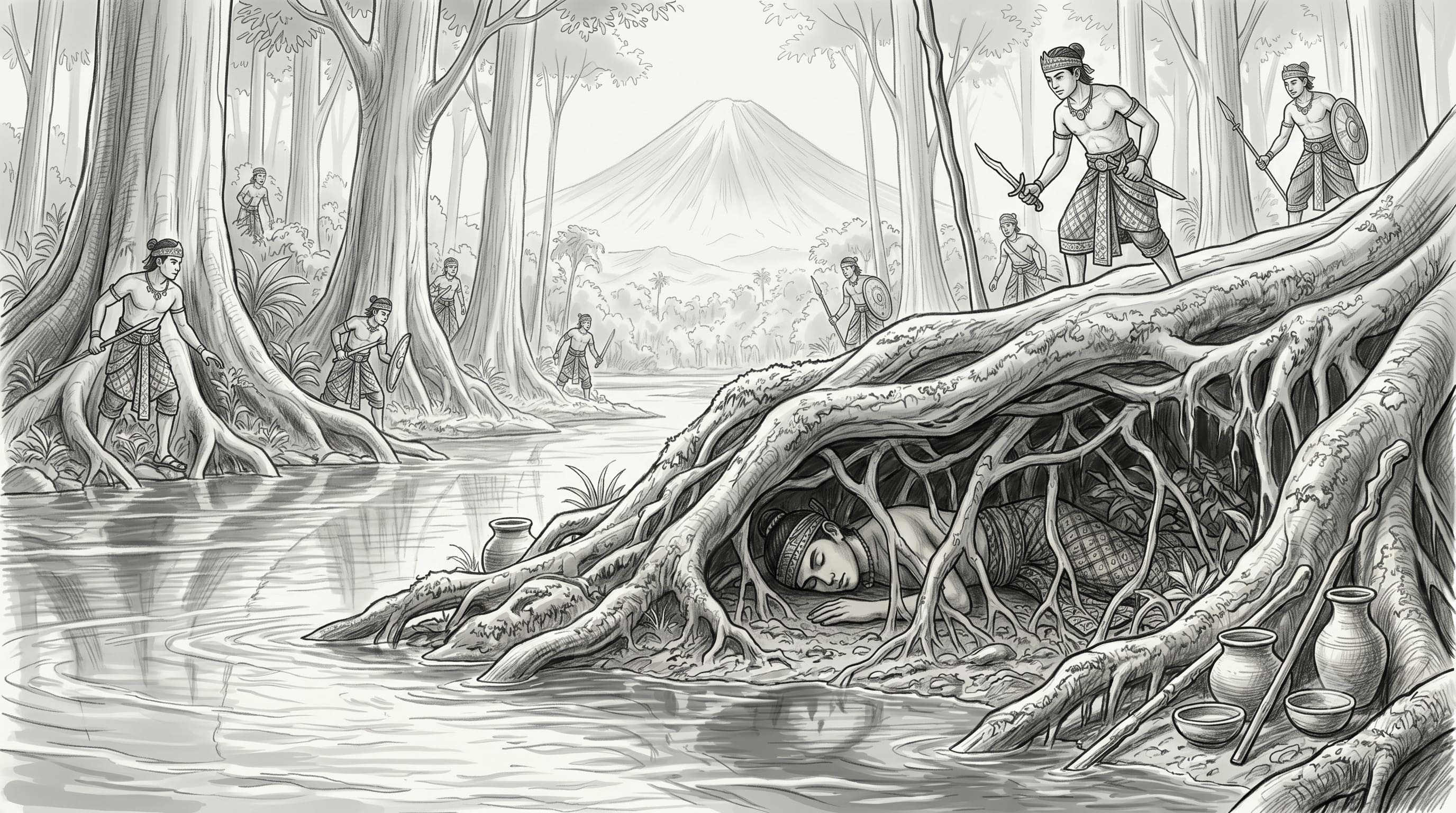
Upon reaching the riverbank, he immediately leapt onto a massive, protruding root of a gayam tree that stretched across the water. The root formed a hollow cavern beneath it—spacious enough for a person's frame to take refuge without being seen from the outside. Kertabhumi slipped inside at once, lying completely flat, holding his breath. The stream rippled gently just a few inches from his face, while the ancient root shielded him entirely from view above. Second after second ticked away. Heavy footsteps could be heard drawing near. "WHERE DID HE VANISH?" "HIS TRACKS END RIGHT HERE!" "THERE'S A CURRENT, COULD HE HAVE—" Kertabhumi closed his eyes, merging his entire being with the dampness of the surrounding earth. He channeled all his energy into his breath. Silence the breath. Silence the heartbeat. Silence your physical form, so went his preceptor's teachings. He executed it flawlessly. He became a part of the root, a part of the soil, a part of the darkness.
The shadow warriors scrambled to the riverbank, some even bending low to scan for any signs of life. One of them stood directly atop the root where Kertabhumi lay hidden. The ground shuddered slightly. The warrior's boot pressed right against the surface of the root. Kertabhumi did not stir. Did not blink. Did not breathe. A few long moments later, the leader of the group hissed: "THE BOY HAS VANISHED. Split up! Search until you find him!" The sound of footsteps receded. The mist descended once more. The stream returned to its tranquil state. And Kertabhumi opened his eyes slowly… realizing that this was merely the prelude to a protracted hunt that would demand every ounce of his sharpness and courage. Bhre Kertabhumi waited far longer than necessary. He waited until the sound of footsteps had entirely faded, until the earth stopped its subtle trembling, and until the songs of small birds could be heard once more in the distance—a portent that the presence of the hostile outsiders had truly moved away. Only then did he move his fingers slowly. It was not out of hesitation, but because he knew a single rushed movement could cause the root sheltering him to crack, inviting disaster if any stray enemy still lingered nearby.
He emerged slowly from behind the massive root, crawling like a small creature newly venturing out of its burrow. The crisp air of the stream brushed against his cheek, while the sunlight, filtered through the foliage, fell softly across his back. Once his frame was entirely clear, he stood cautiously atop the giant root that formed a natural bridge over the water. He observed his surroundings once more. There was no sound of man. There was no scent of metal. There was no subtle pressure upon the earth. All these portents pointed to a single conclusion: the pursuers had moved far away. Yet that did not mean they had surrendered. Kertabhumi lowered his hand, letting his fingertips graze the crystal-clear river water flowing gently past. The water was icy, bearing fragments of currents from higher springs. He closed his eyes for a moment. Feeling. Listening. Nothing speaks as clearly as nature when a person's destiny begins to shift. And for Kertabhumi, Semeru that day uttered something far more definitive than before: Be watchful.
He withdrew his hand and walked along the riverbank, carefully choosing footholds that would leave no prints behind. For some time he moved soundlessly, following the flow of the stream northward, toward a darker and deeper valley. In that sanctuary, the massive boulders were blanketed in ancient moss, and the trees possessed roots as wide as the embrace of two grown men. It was an ideal place to shield oneself from the eyes of the trackers. Yet as he walked, he pondered. This pursuit was far too calculated. Too seamless. Too swift. It was impossible that they had accidentally materialized in the precise area where he was training this morning. It was impossible that they knew the trails of Semeru, which had never been trodden by the feet of palace warriors. And most suspicious of all: They moved in a flanking formation. A maneuver that could only be executed by someone who knew his style of movement. "Uncle Suraprabhawa..." he murmured softly, his jaw tightening. "This means it is no longer a mere minor threat. This has already become a life-and-death hunt."
He paused for a moment beneath the limb of a colossal tree that overhung like a celestial canopy. From there, he detected an obscure imprint—not of human footsteps, but the telltale shift of air currents. Bent twigs, flattened leaves, and fine dust still drifting lazily in certain pockets. These were portents that the pursuers would not stop. For the very first time since his flight began, Kertabhumi experienced a sensation that transcended mere vigilance: a profound realization that today he had crossed the threshold into a chapter he could not simply walk away from. He stood in absolute stillness for a considerable time, allowing nature to impart its subtle messages. Then, drawing a deep breath, he uttered: "If it is true that Suraprabhawa demands my life… then I must be ready. There is no longer any room for doubt." He gripped the hilt of his kris more firmly. His stride grew more resolute. His gaze sharpened. Today, for the youth destined to become Prabu Brawijaya, was no ordinary day of self-preservation—it was the day he began his descent into the grand conflict that would test the absolute limits of his soul and flesh. And Semeru, the eternal witness, accompanied his every stride with a crisp wind that swept across his face.
PART 5 — AN ENCOUNTER WITH AN OLD TRAIL
The further Bhre Kertabhumi ventured northward along the flow of the stream, the denser the silence that trailed him became. Yet this was no spirit-crushing silence—rather, it was a silence that brought absolute clarity. He could discern every minute detail: the splash of water rebounding off stone, the rustle of leaves brushed by the wind, the drone of a bee passing high above his head. Semeru, in its stillness, afforded his mind the space to operate with sharper precision. A few dozen paces later, the terrain shifted. The stream began to curve toward the west, carving out a small basin shrouded by a thicket of wild bamboo. It was a place foreign to most, but not to Kertabhumi. He had traversed this region years ago—during his wanderings with Resi Wangsadipa when he was twelve. Yet something was different that day. There was a new portent that caused him to freeze in his tracks. Upon the trunk of an ancient waru tree growing near the water's edge, there was a faint, spiral-shaped groove, nearly imperceptible unless one knew precisely what to look for. The mark had been carved with the tip of a fingernail or a blunt dagger. Simple, yet exceedingly distinctive. Kertabhumi drew closer, tracing the mark with the tip of his finger. His heart gave a subtle tremor. "This… is the master's mark."
The spiral groove was a travel cipher Resi Wangsadipa had once taught him—a sign used exclusively by the mountain brahmans and elder ascetics when leaving messages for chosen disciples. The mark signified: ‘Direct your steps toward the northeast. There is something you must witness.’ He surveyed the area. There were no other markings. No footprints. No remnants of a campfire. Nothing whatsoever to indicate a human presence. Yet he knew the mark had been made recently. The bark of the waru tree was still fresh, and thin shavings from the scratching still clung to the edges. Resi Wangsadipa never acted without a purpose. If the resi had left a sign in the midst of this perilous hunt… It meant this was no coincidence. This was guidance.
Kertabhumi drew a deep breath, observing where the spiral pointed. Northeast. A steeper, more grueling, and far more desolate trail. A path he had rarely ever trodden. A route utilized only by ascetics who wished to vanish entirely from the realm of mortals. Yet at that exact moment, a realization struck him: If Resi Wangsadipa knew he was being hunted, it meant the mountain brahmans had caught the scent of this dark political intrigue long before he himself had even realized it. "Master," he spoke in a low murmur, "have you already foreseen what will befall me?" There was no reply. Only the rubbing of the bamboo stalks, producing a rhythmic clack… clack… clack like a vague answer from the spirits of the mountain. Kertabhumi raised his head, gazing at the northeastern trail. A decision had to be made. If he followed the safer path to the west, he could escape temporarily, but those trackers would continue to hunt him down to his very roots. If he followed his preceptor's mark, he might uncover something far more vital—understanding, sanctuary, or perhaps even the esoteric knowledge that would become the key to his long journey ahead. It did not take him long. He turned his frame toward the northeast. "If my master calls," he said resolutely, "then I shall come."
With a steady stride, he left the small stream behind, entering a steeper, darker path—a trail that triggered a subtle vibration within his chest. It was not fear, nor was it anxiety… but a premonition that he was drawing near to something that would alter his life forever. And Semeru… once more welcomed that decision with a gust of wind cascading from the summit, like a greeting from a world far older than Majapahit itself. Bhre Kertabhumi advanced toward the northeast, guided by his instincts and the spiral cipher left by his master. The trail instantly revealed its true nature: a terrain far wilder than the regions of Semeru he customarily explored. The earth was damp and uneven, choked with the roots of colossal banyan trees that jutted out like primeval serpents. The mist descended slowly, hanging so low that visibility was reduced to a mere few spear-lengths. Yet to Kertabhumi, the fog was no obstacle—rather, it was a portent that he was crossing into a guarded domain.
The incline beneath him grew steeper. Each stride had to be calculated, every foothold tested with the balls of his feet. He brushed aside foliage heavy with dew, feeling small twigs catch against his arms and attire. Though his body was well-conditioned, beads of sweat began to form on his temples, an indication that this was no ordinary trail. The higher he ascended, the quieter the world around him became. Even the songs of the birds vanished. At a certain juncture, he halted. There was something… something anomalous. He knelt, touching the earth with the tips of his fingers. The soil was packed, yet it was not a natural compaction; there was a pressure, a rhythm, as if someone's stride had once traversed this exact spot. Yet it was not the stride of Suraprabhawa's warriors. It was too weightless. Too deep. Too… orderly. "This is the imprint of an ascetic," he murmured softly.
The imprint of someone engaged in a walking meditation—a trail that left behind a subtle vibration, akin to the invisible glow of a burning incense stick. He felt a gentle current ascend from the earth into his palm, flowing up his arm before settling in his chest. The sensation was weightless, like touching ice-cold water in the early morning. It was a potent sign that someone possessing profound inner power had traversed this path not long ago. His heart beat faster, not out of fear, but from a surge of hope. If this truly was the trail of a great ascetic, then perhaps he was—unwittingly—heading directly to his master's sanctuary. Or perhaps… to someone even older, deeper, and more formidable than Resi Wangsadipa. He pressed onward.
After navigating a path of stone forming natural terraces, he entered a pine forest where the trunks towered like the pillars of an ancient palace. The wind began to shift. It was no longer bitingly cold like in the valley, but warm, akin to the breath of someone watching from a distance. The pine needles drifted down slowly, floating aimlessly as if welcoming an expected guest. Then, something manifested. Not a human form. Not a sound. But an aroma—the fragrance of agarwood, exceedingly subtle yet unmistakable. It was a scent impossible to emerge on its own within the wilderness of Semeru, unless from a specific incense used by high resis during rituals of breathing and concentration. An incense ignited only when a master intended to open an inner sanctuary for his disciple… or when delivering a warning of an approaching peril. "I am drawing closer…"
He accelerated his pace, yet maintained his vigilance. He passed through a fissure between two massive boulders that formed a natural gateway. The moment he stepped through, the fragrance of agarwood intensified, mingling with the scent of damp earth and ancient moss. The mist shifted lazily, clearing a small line of sight. In the distance, faintly, a golden light reflected from beyond the trees. Kertabhumi sharpened his gaze. His breath caught for a fleeting second. Someone was there. Or… something. He knew not whether it was his preceptor, Resi Wangsadipa… or another entity entirely, one he had only ever heard of in the tales of the mountain brahmans. Yet one thing he knew with absolute certainty: His next stride would carry him to a critical juncture in his life—the defining moment that would determine whether he would endure merely as a fugitive… or begin his tempering as a future great leader of Majapahit. With a resolve hardening within his chest, Kertabhumi stepped forward. Semeru held its breath.
PART 6 — AN ENCOUNTER WITH THE GOLDEN-ROBED FIGURE
Bhre Kertabhumi stepped closer toward the golden glow emanating from behind the trees. The mist parted slowly, as if gently pushed back by an unseen will. The sounds of the wilderness dissolved—not because they vanished, but because they submitted. It was as if Semeru were holding its breath. Even the wind ceased to graze the leaves. The small universe around him froze in absolute reverence. He drew near, his strides slowing down without him even realizing it. It was not out of fear—rather, it was a profound sense that this space was a sacred sanctuary, a realm he must not tread upon recklessly. His body registered a gentle vibration ascending from the earth, flowing into the soles of his feet, traveling up his shins, rising to his chest, and settling precisely at the core of his breathing. He had felt this exact sensation once before when he first studied under Resi Wangsadipa… yet this was far more potent, more ancient, more profound. As he broke through the shadows of the trees, the golden light revealed its source.
In the center of a small clearing enclosed by towering stones that formed a primeval circle, stood an old man clad in robes of golden-yellow cloth. His head was covered by a simple hood, yet his frame radiated an undeniable authority. He did not stir, yet the entire natural world around him seemed to revolve gently about his presence. Kertabhumi felt a sensation that made his knees want to buckle: an aura possessed only by those who have pierced through the inner layers of the spirit that ordinary men could never reach. The figure turned his face slowly. And in that precise microsecond, it felt to Kertabhumi as if the world had lost all sound. The old man's eyes… were like two deep lakes, reflecting the sunlight despite being shrouded beneath the shadow of his hood. Eyes that saw without staring. Eyes that knew without being told.
"You have arrived," the figure spoke, his voice weightless, yet carrying a resonance that seemed to emanate from the very depths of the earth of Semeru itself. "Just as the wind has written." Kertabhumi swallowed hard. "What greeting is this…? Do you know me, O Resi?" his voice trembled slightly, despite his efforts to restrain it. The old man offered a faint smile—a smile that was not warm, but deeply calming. "Bhre Kertabhumi," he uttered. "Son of Rajasawardhana. Heir to the royal bloodline. Holder of the trail that Semeru has guarded since the moment of your birth. Of course I know you." That name—his own name—slipped from the old man's lips without a shred of hesitation. Kertabhumi bowed in deep reverence. "Are you Resi Wangsadipa?" he inquired. The figure shook his head slowly. "Wangsadipa was your first preceptor upon the mountain trail. He instructed you in how to listen to the breath of the earth. But I… am merely a keeper of the silent realm. Among the mountain brahmans, I am known as Dewamatra."
That name caused the air around Kertabhumi to grow taut. He had heard this name before—in the most obscure of tales. The resi of resis. The preceptor of the supreme ascetics. A figure who reputedly never anchored himself to a single place, but instead shifted alongside the energy meridians of Semeru. A character regarded as half-legend, for rarely could any mortal ever locate him. Kertabhumi gazed intensely at him. "If you have been waiting for me… then I must know why." Dewamatra advanced a single step—a movement so weightless it produced no sound whatsoever. "Because Semeru has spoken," he uttered softly. "Because the peril that pursues you is no ordinary danger. Because your bloodline will ignite a great conflagration across Java. And before that fire blazes… you must be prepared." Kertabhumi felt a burning sensation surge within his chest. "Prepared… for what?" Dewamatra's faint smile vanished. What remained was an absolute gravity that made the very air tremble. "To confront the shadow of your own kin. To defeat Suraprabhawa. And to tread the path toward the throne of Majapahit." The mist drifted lazily between them. Semeru drew another breath. Kertabhumi lowered his head—not out of fear, but from a profound awakening: His true journey had only just begun.
The air around the stone circle grew heavier, as if every molecule of oxygen were waiting for the great resi's next word. Bhre Kertabhumi stood resolute, yet within his heart he experienced a sensation he had never felt before—a confluence of fear, wonder, and a readiness to confront whatever was to come. Dewamatra raised his right hand slowly, and at that exact moment, the wind died down entirely. Silence. A silence so profound that Kertabhumi could hear the beating of his own heart. "Majapahit," Dewamatra spoke, his voice like an echo in a distant valley, "is entering an era where the shadow looms larger than the light." Kertabhumi furrowed his brow. "What you mean… is the political turmoil within the court?" "Not merely that," Dewamatra replied. "The chaos manifested in the audience hall is but the surface. What transpires beneath it is far darker. Suraprabhawa is not simply a prince thirsty for the throne. He carries with him something far more perilous." Kertabhumi's gaze sharpened. "What do you mean, O Resi?"
Dewamatra walked slowly to the center of the stone circle, and with a fluid motion, he touched the surface of the earth. Remarkably—the golden light that had been emanating around him just moments ago now dimmed, replaced by shadows that shifted gently like ripples upon water. The ground projected a faint illusion: the silhouette of a man with a piercing gaze and a posture that exuded raw ambition. "This—" Dewamatra spoke, "—is the shadow of Suraprabhawa." The silhouette shifted, transformed, and appeared to expand. "Since his youth, he has thirsted for power. Yet something has altered… since his return from a journey to the far north, to a realm untouched by ordinary men." Kertabhumi narrowed his eyes. "The northern realm… a sanctuary of ascetics? Or the domain of foreign priests?" "Far worse," Dewamatra said, his voice dropping. "He encountered those who master the dark arts of manipulation, twisting the minds of men and brewing ambition into a lethal poison. Those who desire to turn Suraprabhawa into an instrument to fracture Majapahit from within. And Suraprabhawa accepted it all… with open arms."
Kertabhumi felt his blood turn cold. "So it is true… he has been targeting me for a long time." "Because you are the legitimate heir," Dewamatra countered swiftly. "Because Rajasawardhana gave place to the light, while Suraprabhawa gave place to the shadow. And to the shadow… you are an obstacle." Dewamatra gazed at Kertabhumi, his eyes this time sharper, more piercing. "You must no longer view today's pursuit as a minor incident. This is a declaration. Suraprabhawa has decided that you must vanish from this world so that his path to power remains unobstructed. Therefore, from this moment on, your every stride is no longer that of a young adventurer… but the stride of someone ordained by the universe to determine the destiny of Java." Kertabhumi drew a heavy breath, yet his gaze remained unwavering. "If that is the case, then I must confront it all. Whatever form it takes." Dewamatra offered a faint smile, this time with a warmth he had not shown before. "That is precisely why Semeru brought you to me. You possess courage, but courage alone is not enough. You must possess inner sharpness, physical strength, and the wisdom to perceive what others cannot. And all of that… I shall temper." The wind began to stir gently once more, as if in agreement with that decree.
"Kertabhumi," Dewamatra uttered, "from this day forward, you are no longer merely an heir to Majapahit. You are the future keeper of the light—who must one day stand against the shadow of your own kin." Kertabhumi bowed his head, not out of fear, but as a token of his willingness to accept the long path that now stretched before him. And at that exact moment, the mist descended slowly like a curtain closing upon an old chapter… and opening a new one in the life of a young prince destined to be known as Prabu Brawijaya. Dewamatra stood tall in the center of the stone circle, his frame motionless, yet the aura around him surged like an invisible, gentle wave. Bhre Kertabhumi watched him with absolute focus. He assumed the resi would begin with the instruction of combat stances, hand movements, or rigid tenets. Yet Dewamatra simply closed his eyes… and without warning, the air around the circle shifted drastically. The temperature plunged. The mist thickened. This, even as the sun still blazed beyond the crests of the trees.
Kertabhumi felt the air pressing against his chest, not with physical force, but with the weight of an inner spiritual power. It was as though Semeru itself were placing its palm upon his heart. His heartbeat resonated louder—not out of fear, but because nature was beginning to read his soul. Dewamatra opened his eyes. "The first lesson," he uttered in a voice deeper than before, "is not about how to combat an enemy. It is not about how to vanish from trackers. It is not about how to wield a kris or fight with bare hands." He advanced a step, and the heavens seemed to follow his stride. "The first lesson is..." He raised a single finger. "...to recognize who you truly are." Kertabhumi held his breath. "I am the son of Rajasawardhana. The heir of Majapahit," he answered resolutely. Dewamatra shook his head. "That is merely a worldly title. That is not who you are." Kertabhumi furrowed his brow. "I am... a disciple of Resi Wangsadipa?" "Not that either." "A youth hunted by his own uncle?" "Nor is it that."
Dewamatra closed the distance until he stood a mere single stride away. The eyes of the great resi seemed capable of piercing through to his very bones. "Tell me… stripped of titles, devoid of power, without your father's protection, and bereft of royal blood… who are you? What is the essence of your soul?" The question struck Kertabhumi with greater force than any physical blow ever could. He parted his lips to reply—yet no words emerged. He lowered his head, frustrated. "How am I to know such a thing?" Dewamatra answered gently, "Because before a great leader can reshape the world… he must first master himself. Without understanding the essence of your soul, all the knowledge you are to learn from me will become nothing but a burden, not strength." The great resi then raised both his hands slowly, and the earth trembled. The small valley became filled with faint acoustics: the moaning of the wind, the rustling of leaves, and even an echo from deep within the ground that felt like a whisper from the past. "Semeru holds the answer. Not I," Dewamatra uttered. "Your task is to listen."
The mist around Kertabhumi thickened, forming a vast white void that completely enveloped the stone circle. He could no longer see Dewamatra. He could no longer see the trees. There was no direction. No sound. No light. Only himself. This was no mere sorcery. This was a trial of the soul. "What… is happening…?" Kertabhumi whispered. Dewamatra's voice echoed from afar, though his form remained unseen. "Before you stands nothing but your own self. If you wish to become a leader—not a puppet of power, not a mere heir to a lineage, not a shadow of your kin—you must find the center of your soul." Kertabhumi stood resolute in the midst of that white fog. His heart pounded violently. His hands trembled slightly. He realized, for the very first time in his life: He was entirely alone. There was no father. No mother. No palace. No wilderness to shield him. No master to guide his steps. Only himself. And the truth he had to uncover.
The mist swirled slowly. And Dewamatra's voice resonated once more: "Find yourself, Bhre Kertabhumi. For without that… you will not survive the shadow of Suraprabhawa." The white fog churned with increasing density, closing off the outer world until all forms blurred into obscurity. Bhre Kertabhumi stood in the center of a silent void that possessed neither beginning nor end. For a brief moment, he attempted to take a step, yet each stride merely brought him back to the exact same spot. This was no physical space; it was a realm of the mind, a mirror of his own soul. Yet he did not yet comprehend how to read that mirror. His breath grew shallow and rapid. "Is this some kind of trap…?" There was no reply. Instead, the mist suddenly writhed as though it possessed a life of its own. From within the fog, a small silhouette emerged. Its steps were light, its frame diminutive, and its wide eyes radiated an innocent curiosity. Kertabhumi froze. He recognized the figure despite the many years that had passed. "This… is me as a child."
The young child—himself at approximately seven years of age—looked toward him with a smile. It was a smile he had never shown again after crossing into adulthood. A smile devoid of burdens. Devoid of pressure. Devoid of the obligations binding the heir of Majapahit. Devoid of hidden terror. The small figure ran toward him, yet abruptly halted just a few paces away. His eyes gazed directly into the eyes of the adult Kertabhumi—sharp, honest, and stripped of any mask. "Why do you no longer smile?" the little one asked in a crystal-clear voice. Kertabhumi fell silent. He attempted to open his mouth—yet his voice was drowned out by a sudden internal resonance that reverberated from within the fog. The mist writhed once more, shaping another silhouette. This time, it was a tall figure wearing a simple crown… his father, Rajasawardhana. The figure stood serenely—yet the eyes projected by the mist were not his father's gentle eyes, but eyes heavy with profound expectation. "Father..." Kertabhumi hissed. But the figure did not smile. It merely observed him in absolute silence.
A third figure materialized: his mother, Dyah Kusumadewi, her countenance lined with the same anxiety she bore whenever he ventured too far from the palace walls. Her distress was so palpable that Kertabhumi felt a familiar pang of guilt resurface—the lingering sense that he was a constant source of worry for her, that he could never truly settle down and be the compliant prince the court expected him to be. The fourth figure emerged more slowly than the rest. Its form was indistinct, yet Kertabhumi felt a sudden chill envelop his frame. A colossal shadow. Dark. Faceless. Presenting only a pair of faint, crimson eyes—the very eyes that had been tracking him from afar. He knew instantly whose shadow it was. Suraprabhawa. His ambition. His malice. His murderous intent. And in that singular moment, the four figures stood in a circle around him: the innocent child of his past—his lost identity; his father—the weight of expectation; his mother—the embodiment of fear; and the shadow of Suraprabhawa—the looming threat. The mist thundered.
Then Dewamatra's voice manifested, echoing from all directions: "This is the state of your inner self, Kertabhumi. You are fractured by four forces: your childhood, your obligation, your guilt, and the shadow of your threat. As long as you fail to unify these four, you will never become anything—you will merely be dragged along by one of them." Kertabhumi gazed at the four figures. He watched his innocent childhood self offer a faint smile. "You abandoned me too quickly." He watched his father observe him without a word, yet those eyes radiated immense expectation. "Can I ever fulfill your hopes, Father?" He looked toward his mother, whose fear was so palpable. "Forgive me for always causing you unrest." And he faced the shadow of Suraprabhawa. For the very first time… he did not recoil. "If it is my life you seek… you must contend with the whole of who I am. Not just my fear." As those words left his lips, the mist violently shuddered. The figure of his childhood self smiled broadly—then merged into his frame like a beam of light. The figures of his father and mother faded slowly, dissolving into his chest, not as a burden… but as a source of strength. The shadow of Suraprabhawa hissed—and then shattered into black dust, swept away by the wind. The mist receded. The earth materialized once more beneath his feet.
And Dewamatra's voice resonated in a softer, deeper tone: "Now… you begin to recognize the essence of your soul. Merely the beginning. Yet it is enough for today." Kertabhumi opened his eyes. And the world felt different—clearer, calmer, more grounded. The first trial of the soul had been surpassed. The white fog that had previously engulfed the entire space slowly dissolved like a sheer curtain drawn from its edges. Sunlight once more pierced through the gaps of the ancient pine trees, refracting a gentle golden shimmer onto the damp earth. Bhre Kertabhumi drew a long breath—a breath that felt fundamentally altered from before. The air entered his chest with a weightless ease, yet filled his entire frame with a warmth he had never experienced. It felt as though a burden that had long clung to his shoulders was being lifted away. Dewamatra stood at the edge of the stone circle, as if he had not moved an inch since the trial commenced. Yet the eyes of the resi were no longer as unyielding as mountain stone; there was a faint glint of pride, or perhaps acknowledgment. He nodded once, a sign that Kertabhumi had emerged victorious from something not all disciples could survive. "Sit," Dewamatra uttered, his voice returning to a gentle cadence, like the flow of a small stream. "The soul you have just pieced together is still fragile. It must bind itself firmly to your physical form before you venture any further."
Kertabhumi complied with the command. He sat cross-legged upon a flat stone, feeling the subtle pulse of the earth beneath him, like the breath of Semeru transmitted through tree roots and ancient rocks. Dewamatra drew near, and for the very first time, he gazed directly into Kertabhumi's eyes without the shroud of mist or the influence of spiritual power. "You have succeeded in unifying the four parts of your self," the resi spoke. "Yet make no mistake… that unification is not the end. It is merely the threshold that allows you to enter the true chamber of your soul." Kertabhumi nodded slowly. "I never realized that I carried so many… fragments." "Every human being carries them," Dewamatra replied. "Yet not everyone is afforded the opportunity to behold them. Many live merely as shadows of the childhood they left behind. Many others live drowned in the expectations of their parents. Many live in guilt. And not a few live in fear of an enemy who has yet to draw his sword." Kertabhumi lowered his gaze. "Suraprabhawa…"
"He is merely a shadow," Dewamatra interrupted. "A shadow pursuing the void within your spirit. When a man carries a fracture in his soul, an enemy has no need for a sword to defeat him. It is enough to simply blow shadows into that breach." Kertabhumi raised his face once more. "Then… what is the true essence of my soul, O Resi?" Dewamatra offered a faint smile. "The essence of your soul is a courage born not of ambition, but of fullness. Born from the equilibrium between the clarity of your childhood, the expectation of your father, the love of your mother, and the fortitude to face your threat. Semeru calls to you not because you are powerful… but because you are whole." Kertabhumi felt something vibrate within his chest—an acknowledgment that brought a profound warmth to his heart. Yet Dewamatra was not finished. "But remember," he continued, "this wholeness will be tested time and time again. Physical strength can be shattered by a blade. Prowess can be bested by a swifter foe. But if your soul remains unyielding, there is no power on earth that can tear you down."
He gazed far out toward the trees, as if glimpses of a future were revealing themselves—a future legible only to those who have trodden the path of silence. "Soon, Kertabhumi, you shall enter another discipline. A discipline far more grueling. One that will set you apart from ordinary youths… and forge you into the man destined to challenge Suraprabhawa, defend your people, and one day sit upon the throne of Majapahit." Kertabhumi bowed his head, yet this time it was not out of fear. He bowed as a token of readiness. Dewamatra gave a slow nod. "Arise, Kertabhumi. Your spiritual trial has only just begun. Now is the hour to undergo tapa raga—the tempering of the physical form." A gentle wind cascaded from the summit of Semeru. The heavens seemed to voice their assent. Dewamatra stood tall before the stone circle, then cast his gaze toward a forest trail that ascended sharply toward the east. The air grew colder, yet it simultaneously felt sharper—as though all the trees were awaiting the great resi's next command. Bhre Kertabhumi rose slowly from his seat; his body, having just endured the trial of the soul, felt weightless, yet it was not entirely grounded. Something pulsed subtly within his chest, like a newly formed core of energy.
"Kertabhumi," Dewamatra spoke, "spiritual wisdom without physical fortitude is akin to a light without a wick. It will extinguish before it has the chance to illuminate anything." The resi walked slowly toward the foothills before them, and Kertabhumi followed. The path there was nothing like the standard climbing trails; the terrain was rocky, slick, and choked by ancient roots that spread out like frozen rivers. To their left yawned a minor chasm, revealing a valley floor shrouded in mist. To their right rose a towering wall of stone—cold, damp, and blanketed in thick moss. Dewamatra came to a halt at a spot that appeared remarkably unassuming: a patch of flat earth only a few paces wide, featuring a massive, flat stone at its center. "This is where your tapa raga begins," the resi declared. Kertabhumi scanned the surroundings. "Is this a training ground?" "This place is not for mere training," Dewamatra corrected. "This place is the second mirror. The mirror of the flesh." The resi raised his hand, and instantly the wind whipped up with greater intensity, encircling the two of them. Pine needles rained down, spinning in a small, bizarre vortex that somehow never grazed either of their bodies. Then the wind subsided, but the biting chill remained—piercing to the bone, yet not entirely painful.
"You shall stand atop that stone," Dewamatra instructed, gesturing toward the massive flat rock. "Without moving. Without bending your knees. Without uttering a sound. Until your body collapses… or until your heart finds absolute steadfastness." Kertabhumi stared at the stone, then turned his gaze back to Dewamatra. "How long must I endure?" The great resi offered a faint smile, a smile that made the surrounding forest feel older and more profound. "There is no reckoning of time. Time is an illusion. Only your body will know when you are truly prepared for the next step." Kertabhumi stepped up onto the stone. Its surface was cold, unyielding, and vibrating subtly—as if preserving the echoes of the mountain's million-year-old history. He stood erect. His spine straight. His hands at his sides. His eyes fixed straight ahead. At first, there was nothing. Only silence and the chill. Yet moments later, the first challenge manifested: the wind. A gust swept in from the east, pressing against his chest. He anchored his frame to prevent himself from shifting. Shortly thereafter, the wind whipped in from the west, then from the north, and then from all directions simultaneously—as if systematically testing his balance from every conceivable angle. His muscles locked tight. His knees began to tremble. Yet he remained standing.
Then came the second challenge: a chill that penetrated straight into his bones. It was a cold that arose not from the weather, but from deep within the earth, surging up through the stone and flowing into his feet, his shins, and then his waist. His body reacted with a subtle tremor, yet he strictly maintained his stance. A cold sweat broke out across his back. Dewamatra observed without uttering a single word. "The tempering of the physical form," the resi spoke at last, "is achieved when you do not merely fight your body… but transcend it." Kertabhumi closed his eyes for a brief moment, then reopened them with a renewed resolve. He understood now that this discipline was not meant to build muscular strength. It was an exercise to force his physical vessel to submit to the will of his soul—the soul he had just integrated through the spiritual trial. Every passing second felt like a grueling hour. Yet he did not yield. The wind danced violently around him. The chill surged up from the stone. The body trembled. But the spirit stood tall. And far within the depths of Semeru—where the primordial voices lay dormant—a subtle vibration arose, as if the mountain itself acknowledged that a future leader of Majapahit was being forged.
The tempering of the flesh had only just begun. And Kertabhumi had absolutely no intention of retreating even a single step. The wind rushing from the summit of Semeru suddenly altered its nature: no longer a common draft of the elements, but a gale that seemed possessed of its own volition. The air, initially freezing, now turned razor-sharp, like thin blades grazing his skin. Bhre Kertabhumi remained anchored atop the flat stone, even as his knees began to shudder and the muscles of his calves felt as though they were being wrenched from opposite directions. He drew his breath slowly, attempting to regulate the rhythm of his respiration so his frame would not collapse under the pressure mounting from all quarters. Dewamatra stood a mere few paces away, yet his figure appeared immensely distant—like a guiding phantom at the far end of a long voyage. The great resi's eyes remained perfectly serene, tracking every minute tremor racking his disciple's body. "Kertabhumi," Dewamatra spoke, his voice unhurried yet carrying distinctly through the roaring wind, "know that a leader who wishes to endure amidst the storms of the world… must first be capable of standing firm through the tempest of his own flesh." The vortex spun with greater ferocity. Strands of Kertabhumi's hair whipped wildly about. His breath escaped in ragged gasps. Yet he did not shift his feet. He did not bend his knees. He did not break his gaze from the distant point ahead.
Dewamatra closed the distance slightly, yet maintained enough space so as not to disrupt the training energy. "Your body," he continued, "will always be your first enemy. It craves comfort. It rejects suffering. It begs to surrender before its time. And the ancestors taught that anyone who allows their flesh to rule… will never be capable of ruling over others." Kertabhumi let out a low groan. The muscles across his back felt as if they were on fire. His ankles bore a weight that felt as though a mountain stone had been piled upon them. Yet he recalled the mist of the spiritual trial from before—remembering his fractured self, remembering the young child who had integrated with him, and remembering the faces of his father and mother, which were no longer a burden but a source of strength. He drew a deep breath… and focused his mind onto a single point: steadfastness. Without him realizing it, his body ceased its trembling. Dewamatra caught this shift and offered a subtle nod. "Just so," he uttered softly. "When the spirit leads, the body follows. Remember that." Yet the discipline was not yet complete.
A sudden wave of intense heat emanated from the stone beneath his feet. It was a heat that arose not from the sun, but from the depths of Semeru—a geothermal warmth that crept like slow-burning embers beneath his skin. The sensation was jarring: his lower body registered a rising, scorching heat, while his upper body was lashed by a deathly cold gale. These two extremes collided at his core, making his chest tighten painfully. Cold sweat dripped from his temples, mingling with the biting air. He clenched his jaw. His frame began to lean forward—he was on the verge of collapsing. "Do not let your body choose," Dewamatra's voice resonated again, sharper this time. "It is you who chooses." Kertabhumi corrected his posture, lifting his chin slightly, and stood erect once more. He gazed far out toward the valley as if trying to pierce through the horizon line. He uttered not a single word, but the look in his eyes made it entirely clear: he refused to be broken. Dewamatra offered a faint smile. It was the smile of a preceptor witnessing his disciple begin to tread the true path. "If you can endure today," the resi spoke, "then you will be capable of enduring when the world attempts to tear you down. Never forget this: a king is not the one with the most power… but the one with the highest tolerance for suffering." The wind gradually subsided. The stone beneath Kertabhumi's feet lost its searing heat. And as silence descended once more, Kertabhumi's body remained standing… even though every fiber of his physical vessel screamed to collapse. Semeru bore witness. And it acknowledged that steadfastness.
Bhre Kertabhumi felt as though his body no longer belonged to him. His muscles burned, his skin shivered, and his bones seemed to scream for release. The wind had died down, the searing heat of the stone had receded, yet the residual agony transformed into a subtler, far more lethal challenge: the urge to surrender. The sensation crept in like a gentle whisper from within his own flesh: “Enough. Step down. No one will blame you.” It was a whisper neither loud nor harsh, yet immensely persuasive. A delicate temptation far more perilous than any physical blow. Kertabhumi closed his eyes, attempting to anchor his mind. However, the agony radiating from his calves to his waist caused his thoughts to blur. His posture began to sag slowly, his shoulders drooping down. His chest heaved with heavy, uncontrollable gasps. He knew his body was nearing its absolute threshold—the critical point where ordinary men would collapse, unable to rise again.
Witnessing this, Dewamatra raised the wooden staff he had held from the very beginning—a short staff carved from dark cypress wood—and struck it firmly against the ground. The impact was not loud, yet its vibration reverberated throughout the entire valley. Birds scattered from the branches, and pine needles rained down like a gentle shower. "Kertabhumi," Dewamatra spoke, his voice dropping into a deeper resonance, "your body desires to yield. That is only natural. Yet I must ask you… does your soul desire to yield as well?" Kertabhumi clenched his teeth. He wanted to scream "no," but his tongue was completely paralyzed. Only a raspy, gutteral sound escaped his throat. Dewamatra drew closer, until the subtle draft from the hem of his robe brushed against Kertabhumi’s face. "Know this," the resi continued, "true strength is not a body that never tires, but a soul that lifts the body up when the body longs to fall." Kertabhumi forced his eyes open slowly. His gaze was strained and unfocused, yet beneath the exhaustion flickered a minute spark: raw volition. The very spark Dewamatra had been waiting for. The resi raised his hand toward the heavens. "Those ordained for greatness are not measured by their sinews, but by their willingness to conquer their own selves. You are no mere prince, Kertabhumi. You are a future leader who will confront tempests far more cataclysmic than this."
He lowered his voice to a whisper heavy with emphasis: "If today you are defeated by your own body… then how will you withstand the onslaught of Suraprabhawa, which comes not with the wind, but with blood?" Those words struck Kertabhumi right in the chest. Like a small spark of fire burning away the fog in his mind. He grit his teeth even harder. Slowly, his spine straightened once more. His breath steadied—even though each exhalation felt as if it were being crushed by a colossal boulder. Dewamatra retreated a single step and raised his staff once again. At that exact moment, a strange phenomenon occurred. The clouds above them shifted, parting to form a narrow fissure through which a beam of sunlight pierced straight down onto the stone where Kertabhumi stood. The light was not gentle; its hue was slightly crimson, like the morning embers reflected from a volcanic crater. The forest fell into absolute silence. The wind ceased. The birds in the distance suddenly went still. It was as if Semeru were watching. "Do you see that?" Dewamatra spoke in a low voice. "That is a sign that the mountain is beginning to acknowledge your resolve. Semeru will never grant its light to those whose hearts are fragile."
The light washed over Kertabhumi's face, infusing his nearly collapsing body with a deep, internal warmth. The residual tension in his shoulders eased. The agony in his legs did not vanish, but it no longer subdued him. With a raspy voice, he was finally able to utter a few words—faint, yet crystal clear: "I am… not… finished." Dewamatra offered a faint smile; the smile of a preceptor witnessing his disciple cross the most grueling threshold of all: the threshold of despair. "Excellent," the resi whispered. "From this moment on, you are no longer a youth fleeing from peril. You are a man prepared to stand and defy it." Semeru rumbled far up at its summit, a sound gentle yet profound—like the solemn benediction of the ancient mountain. The crimson light piercing the rift in the clouds was no mere accidental sunbeam breaking through the mist. Bhre Kertabhumi felt it directly upon his skin—its warmth was otherworldly, as if flowing as a subtle energy that permeated his bones and crept along the contours of his chest. The light sharpened his vision, even though his entire frame still shuddered violently. Yet that trembling no longer stemmed from weakness, but from alignment, as if his body were carving a path for a deeper, latent power to take hold.
Dewamatra observed the transformation with slightly narrowed eyes, as though deciphering something that only the mountain resis were capable of beholding. "This sign does not descend often," he murmured. "Semeru only grants its light to those whose souls have severed a layer of worldly exhaustion." Kertabhumi did not reply. He possessed no remaining strength to speak. Yet a minute glint flickered in his eyes—a glint revealing that he understood what was transpiring within him. The great resi then moved his staff slowly, tracing a sheer circle in the air. The crimson light followed the trajectory of his staff. Then, gradually, without any discernible wind, the pine needles surrounding the stone began to swirl. They did not scatter wildly, but moved in an orderly cadence, riding the current of energy that spiraled around Kertabhumi. "You are entering the stage of warasana raga—the harmonization of the flesh," Dewamatra declared, his voice dropping into a lower, resonant frequency. "At this stage, your body no longer resists… it begins to listen. Your body is learning to read the volition of your soul."
Kertabhumi remained standing, his eyes open, yet his focus was no longer tethered to the pain. His breathing stabilized, even though his chest felt as if it were enveloped in gentle embers. Instead, he experienced a paradoxical sensation: his body felt both heavier and lighter at the exact same time. Heavy, because the entire burden of the discipline demanded everything of him; light, because his soul seemed to lift his physical frame from within. Dewamatra tapped the ground with the tip of his staff. That single stroke triggered something entirely unexpected. The stone beneath Kertabhumi's feet vibrated subtly, and from deep within the earth emerged a gentle wave of energy—akin to the pulse of the world—surging slowly up through the soles of his feet. The wave reinforced his posture, restoring steadfastness to his nearly paralyzed knees, and causing his spine to snap straight once more. Then, the resi spoke: "Now, Kertabhumi… look into your soul once more. Do not look at your body. Do not look at the world. Look only at yourself." The command was simple, yet the moment Kertabhumi closed his eyes—his inner world instantly shifted color. It was no longer a vacant white void like the mist from before. It was no longer darkened by the shadow of Suraprabhawa. This time, he beheld a gleam of light within himself. The light was minute, no larger than a sesame seed. Yet its hue was identical to the light of Semeru outside: a crimson-gold, warm and alive. The light pulsed slowly, like a newly born spiritual heart. Dewamatra offered a small smile.
"The seed has manifested. Wiji daya… the core of personal power. Every human being possesses it, yet not all discover its form." He raised his staff high. At that exact moment— A gentle thud resonated from the direction of Semeru's summit. It was not loud, yet it echoed far down to the valley floor—like the sound of a giant exhaling a long, deep breath. The earth beneath them vibrated subtly. Small pebbles shifted as if coaxed by an invisible hand. Birds took flight in unison, not out of terror, but as if responding to a primordial summons. "You are accepted," Dewamatra declared with immense authority. "Semeru acknowledges your resolve." Kertabhumi opened his eyes. And for the very first time, he felt a power that did not stem from muscle, did not originate from training, and did not arise from anger or ambition—but from the profound depths of his own soul. The tempering of the flesh was not yet complete. Yet Kertabhumi had stepped through a threshold that few men are capable of crossing. He was no longer merely a prince pursued by peril. He was transforming into something far greater.
The subtle tremors rippling through the massive frame of Semeru gradually quieted, dissolving back into the absolute stillness unique to ancient mountains that guard the secrets of the ancestors. The crimson-gold light in the heavens was slowly veiled once more by a sheer layer of clouds, as if the sun had intentionally obscured its rays to show reverence to the silence of the valley. Bhre Kertabhumi remained standing atop that flat stone, yet his countenance had now transformed: it was no longer strained, no longer consumed by agony, but serene—as calm as the waters of a lake whose surface had just been graced by the first light of dawn. Dewamatra stepped closer. His strides were deliberate, yet each footfall left a faint resonance that pulsed down into the roots of the trees. When he stood directly before Kertabhumi, the great resi planted his staff firmly into the earth. "Step down from that stone," he commanded in a low, authoritative voice. For the first time in what felt like an eternity, Kertabhumi moved his feet. The sensation was jarring—as if his muscles were still bound by an energy his physical form did not fully comprehend. Yet his stride was steady, albeit slow. He descended from the stone, and the moment both his soles touched the common ground, his body shuddered once—a brief tremor, as though his physical frame were recalibrating to the calmer state of nature. Dewamatra observed him intently. "You have crossed the first threshold. Remember well what you felt when your body was on the verge of surrender… and what it was that ultimately carried you through." Kertabhumi drew a breath, recalling the warm current he had beheld as the wiji daya within his inner self. "My soul," he uttered softly, yet with absolute certainty. The resi nodded. "Yes. But understand this… that seed is still minuscule. It can grow into a light that guides your path. But it can just as easily be extinguished by a single, fleeting doubt."
Dewamatra then seated himself upon a low stone, gesturing for Kertabhumi to do the same. As he sat, his body once again registered the subtle pulse of the earth, yet this time it made no demands—it was entirely soothing. "Listen to me with utmost care, Kertabhumi," Dewamatra spoke, "for this counsel is the very heart of all the lessons I am to bestow upon you." He cast his gaze far toward the summit of Semeru, as though addressing not only Kertabhumi, but also the ancestors who abided within the mountain. "In the life of a leader, there exist three greatest adversaries: his own body, his own mind, and his own shadow. Today, you have confronted all three. Your body rebelled. Your mind nearly shattered. The shadow of Suraprabhawa attempted to seize dominion over your spirit. Yet you stood resolute against them all." Kertabhumi listened profoundly. Every word uttered by Dewamatra felt as though it were being etched into his heart. "Your path will not grow any easier," the resi continued. "In the days to come, you shall master the movements of the physical form, the science of breath, the alignment of energy, and how to read the trajectory of peril before it manifests before your very eyes. You shall also learn to lead—not with a roaring voice, but with absolute steadfastness." He looked directly into Kertabhumi's eyes. "And when the hour arrives… you will be brought face-to-face with the shadow that seeks to drown Majapahit." The name was left unspoken. Yet Kertabhumi knew exactly who he meant.
Dewamatra then arose slowly, running his palm along the length of his staff. "Arise, Kertabhumi. Your first trial is complete. Beginning tomorrow, you shall enter the second phase of your tempering. A phase that will forge you no longer as a fugitive fleeing the court… but as a man who will one day return to challenge that very court." Kertabhumi stood up, feeling the earth of Semeru rise up to support his every step. There was no longer any trepidation in his gaze—only absolute steadfastness. Dewamatra gave a single nod, a faint smile gracing his features. "Declare who you are." Kertabhumi drew a deep breath. His voice emerged heavy, yet resonant and clear: "I am Bhre Kertabhumi. Son of Rajasawardhana. Future successor of Majapahit. And disciple of the Great Resi Dewamatra." Semeru rumbled softly—as if voicing its assent. And so, the journey toward Kertabhumi's forging advanced into a higher chapter, one that would lead him to the very pivotal moments destined to shape the future of Majapahit.