Panembahan Wonokromo
Chapter 004 — Calculations at the Brink of Dawn
Safar 40 H / 661 CE — Secret preparations and grand plans woven in the silence of the night.
PART 1 — The Secret Cipher Behind Seasonal Activities
Maryam's question hung heavily in the house for a long time. No one was immediately able to answer it lightly. Because everyone in the room knew the Hijaz desert: its scorching heat, its biting nights, its distant wells, and the long trails that could slowly kill a man if they miscalculated their provisions.
Harits finally let out a heavy sigh. "The children can cross the desert," he said slowly. "But such a journey must not be rushed."
Maryam lifted her face slightly. Harits continued: "A caravan carrying families must move differently from an ordinary trade caravan." His hands moved slightly, as if tracing a route in the air. "They require: strong camels, water bearers, known well routes, and safe places to rest."
Yahya listened with utmost seriousness now. Earlier, he had imagined the journey to Basrah like the adventurous tales of merchants. But as the night deepened, he began to understand: this journey could be a matter of life and death.
"How long from Madinah to Basrah?" Rafi' asked softly.
Harits looked at Abdullah for a moment before answering. "If the route is safe and the weather is favorable..." he said quietly, "a few weeks." He paused briefly. "But a large family cannot move as swiftly as light riders."
Abdullah slowly lowered his face. In his mind, things he had never truly calculated before began to emerge: how many water-carrying camels would be needed, how many workers could be trusted, how many dinars must be exchanged for dirhams, and which families might join them.
He began to understand a bitter truth: migration was not merely the courage to leave home. Migration required: planning, metal, routes, loyal men, and the ability to move before the situation became too late.
Outside the house, the night wind swept through the alleys of Madinah once more. From afar, the heavy snort of a camel was heard, then silence again. Harits turned slightly toward the sound. "We must also consider which livestock to bring and which to leave behind."
That sentence felt like a small knife in Iskandar's chest. "Not all of them?" he asked quickly.
Harits shook his head slowly. "A long journey requires strong camels." He looked at the boy calmly. "Too many goats and sheep will slow down the movement."
Iskandar immediately fell silent. The boy pictured the southern pen: the young goats, the old camels he often fed, and the small pasture where he used to run with the herders. For the first time, he began to understand that leaving Madinah also meant leaving behind many things he loved.
Maryam looked at her son with a gaze that was gentle yet sorrowful. "No decision has been made yet," she said softly again. But even now, those words were beginning to sound increasingly weak. Because their discussion that night had gone too far to be called a mere ordinary possibility.
Rafi' suddenly looked at Abdullah more seriously. "If the families of Mecca are already moving in secret..." he said carefully, "is it possible that some families in Madinah have already done so without our knowledge?"
The room fell silent again. Abdullah slowly lifted his face. And for the first time that night, he began to consider a possibility that had not yet crossed his mind: Perhaps they were not the first caravan preparing to leave Hijaz.
The thought that other families might already be secretly preparing to leave Hijaz made the atmosphere in Abdullah's house grow even heavier. Now, their discussion no longer felt like the isolated fear of a few individuals. It felt like the beginning of something larger, quieter, and moving slowly beneath the surface of Madinah's daily life.
Harits sat closer to the oil lamp now. The shadow of his large frame stretched long across the earthen walls of the house. "If we truly must move..." he said softly, "then preparations cannot be made in haste."
Abdullah gave a small nod. "Water and food," he murmured quietly.
Harits immediately continued: "And pack animals." He raised his fingers one by one. "Water camels, cargo camels, family camels, and spare animals in case any fall on the plain."
Yahya now seemed to be truly sinking into the discussion. He imagined a long procession moving across the desert: children, women, chests, water skins, and camels walking slowly through the heat of Hijaz.
"What kind of food is usually taken for a journey that long?" he asked softly.
Harits looked at him for a moment before answering. "Dried wheat. Dates." He paused briefly. "And preserved meat."
Maryam immediately lifted her face slightly. As a woman accustomed to managing a large household and pen workers, she instantly understood his meaning. "Jerky..." she whispered softly.
Harits nodded. "Thin meat dried for several days." His hands moved slightly to paint the picture. "Lighter to carry and durable for long journeys."
Iskandar looked somewhat gloomy upon hearing this. Because he realized: making such provisions meant some of their livestock would have to be slaughtered.
Abdullah himself was now calculating further: how many animals might need to be slaughtered, how much wheat could be carried, and how long the journey would truly take when moving a large family.
"The journey could take over a month if the routes are disrupted," Harits said quietly. "Especially if we must avoid certain main roads."
Rafi' immediately frowned. "That long?"
Harits looked at him calmly. "A family caravan does not move like a war party." He glanced at little Fatimah sleeping in the corner of the room. "Children make the journey necessarily slower."
Maryam gazed at her daughter for quite a while. She began to imagine: the midday heat, the desert dust, the water skins growing lighter, and little Fatimah possibly crying from exhaustion on the back of a camel. The image made her chest feel tight.
"We must also think about salt," she said softly, suddenly.
All eyes turned to her. Maryam continued, more calmly now: "For preserving the meat." She looked at Abdullah. "And for the long journey."
Harits gave a small, respectful nod. "True."
Abdullah watched his wife silently. As the night deepened, he realized more and more: the women in the houses of Madinah might be thinking about migration in a different way than the men. The men thought of: routes, surveillance, and politics. Whereas the women were beginning to think of: water, food, children, cloth, medicine, and how to keep the family alive during a long journey.
And it was precisely these thoughts that would ultimately determine whether a migration could survive or perish in the middle of the desert.
The night grew deeper over Madinah. The desert wind now felt colder as it slipped through the gaps in the roof of Abdullah's house. The small oil lamp in the center of the room began to dim as the oil ran low, making the shadows of the people on the walls appear vague and elongated.
Yet, no one in the house truly felt sleepy anymore. Their discussion had stepped too far that night. It was no longer about vague possibilities, but about: provisions, routes, livestock, food preservation, and how to guide a family across the desert toward the east.
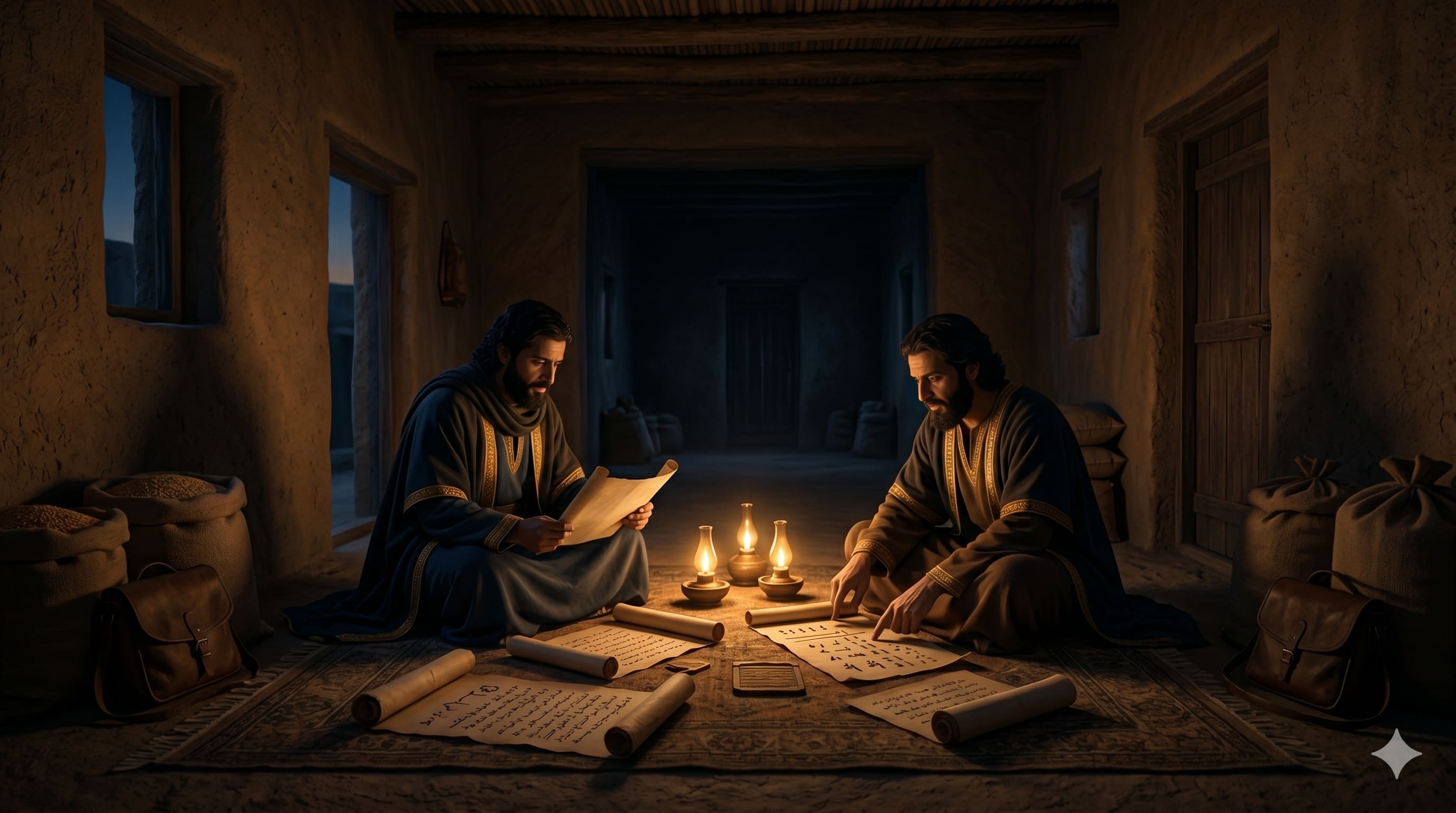
Abdullah slowly stood up and walked toward the wooden shelf near the eastern wall of the house. He opened one of the thick leather chests and took out a small bundle of cloth tied with string. Harits immediately recognized the object. "The livestock records?"
Abdullah nodded. He unrolled it slowly over the mat. Inside were simple records: the number of camels, goats, sheep, grazing routes, and the division of workers.
Yahya watched with eyes full of curiosity. Until now, he had only seen Abdullah's family as a prominent family of Madinah. But that night, for the first time, he understood: all that wealth was guarded by calculation and long, hard work.
Abdullah pointed to several parts of the record with his finger. "Old camels cannot be taken far." His voice was low, as if speaking to himself. "But the best water camels and cargo camels must be prepared."
Harits leaned in closer. "The brown ones from the southern route are still strong." He pointed to another section. "And those two Omani camels are more resilient for long journeys."
Rafi' watched the two men speak like those who had lived long alongside the desert and trade. "How many families can one caravan carry?" he asked.
Harits thought for a moment. "If it is too large, it is easily seen." He glanced at Abdullah. "But if it is too small, it is easily robbed."
A brief silence fell again. That was the reality of the desert: too conspicuous was dangerous, too weak was also dangerous.
Maryam rose slowly and took a small pouch of dried dates from the food shelf. "Madinah dates are good enough for the journey," she said, placing the pouch near the rolled record. "But the wheat must be kept from moisture."
Harits nodded in agreement. "And the water skins must be made anew." He looked at Abdullah. "Some of those in the southern pen are beginning to crack."
Abdullah slowly wiped his forehead. The more they spoke, the clearer it became that migration was not merely a matter of the heart. It was a massive undertaking: metal, animals, water, food, workers, escort, and even the weather and the seasons.
"Summer will make it difficult," Harits added. "But winter brings harsh winds on some eastern routes."
Yahya let out a small sigh. "I never imagined leaving the city could be this complicated."
Abdullah offered a thin, small smile, though his face remained weary. "Because humans do not merely carry their bodies when they leave." His eyes moved toward Fatimah and Iskandar. "They carry their entire lives."
Outside the house, the distant sound of the night prayer call echoed faintly from the northern part of Madinah. Soft. Long. And touching the silence of a city that had not yet truly slept.
Everyone in the room fell silent, listening. And for a few moments, no one spoke of Basrah, migration, or surveillance. Because the night call to prayer reminded them of something deeper: that Madinah was still the Prophet's city, and leaving it would be a wound not easily healed.
The sound of the night prayer call slowly faded with the wind moving through the alleys of Madinah. Abdullah's house sank back into a silence different from before. Not a silence born of fear, but the silence of humans pondering something too vast to be spoken immediately.
Maryam slowly tidied the date pouch and the cloth roll near the food shelf. Her hands moved slowly and methodically, but her mind was clearly not entirely in the room. She was imagining: the long journey, water skins hanging from saddles, children sleeping atop camels, and the vast desert separating them from Madinah.
Abdullah slowly rolled up his livestock record. "If we truly must move," he said quietly without lifting his face, "then most of the preparation must be done without drawing the market's attention."
Harits immediately nodded. "If we buy too much salt or wheat at once, people will begin to ask questions."
"The same applies if too many camels are moved," Maryam added softly.
Rafi' looked at them one by one with a strange feeling. He had just realized: a large family like Abdullah's could not simply vanish from Madinah. Too many people knew them. Herders knew their livestock. Merchants knew their trade routes. Market people knew their workers. And the families supporting Ali knew Abdullah's house as one of the Banu Hashim homes still open to them.
Which meant: every small change could invite attention. "Perhaps some goods must be moved first," Harits said carefully.
Abdullah lifted his face. "To where?"
"To the pens outside the city." Harits pointed vaguely toward the south. "Or to the homes of trusted herders."
Maryam seemed to be thinking hard now. "Cloth and metal can be hidden," she said softly. "But large quantities of wheat and dates are harder to conceal."
Harits nodded. "That is why journey preparations are usually done little by little."
Yahya began to understand why the families of Mecca were moving their gold in secret. Not only to avoid thieves, but to avoid attention.
Abdullah leaned back against the wooden pillar of the house, gazing at the oil lamp that was beginning to dim. "I must meet Sheikh Umar again tomorrow."
Rafi' quickly lifted his face. "About Basrah?"
"About many things." Abdullah's voice sounded heavier now. "If families are indeed beginning to move east..." he paused, "then we must know who can be trusted on the Iraqi routes."
Harits immediately continued: "And who has already been bought by the ruler."
That sentence made the air in the house feel cold once more. Because in times like these, danger did not always come in the form of a sword. Sometimes it came in the form of: men who sold information, well guards who accepted metal, or caravan leaders who spoke too much in the market.
Maryam slowly wrapped her arms around herself. "I am beginning to feel as though all of Hijaz is listening to one another."
No one objected. Because that was exactly what was happening. News traveled: from the market to the desert, from the herders to the merchants, from Mecca to Madinah, and then toward the Iraqi and eastern routes.
And amidst all of this, Abdullah's family slowly began to realize: they might be standing on the brink of the greatest change in their lives.
PART 2 — The Invisible Soul of the House
The small oil lamp in the center of the house finally began to truly weaken. Its small flame flickered short and yellowish, making the shadows on the wall appear increasingly vague. The night had long passed its midpoint, and the air of Madinah now carried a sharper chill than it had a few hours prior.
Yet, their discussion was still not finished. Harits looked at the livestock record in front of Abdullah before speaking softly: "If preparations must be done in secret..." he paused, "then we need a plausible reason to move some of the animals."
Abdullah gave a small nod. He understood the Bedouin man's meaning. A family like theirs could not suddenly: sell livestock, buy salt, repair saddles, and prepare journey camels, without raising questions. Too many eyes knew their way of life.
"Trade season," Maryam murmured slowly.
All eyes turned to her. Maryam sat up straighter now. Weariness still showed on her face, but her mind was beginning to move as sharply as the men in the room. "If goods are being moved," she continued softly, "then let people assume it is part of seasonal trade."
Harits immediately nodded. "That is safer."
Rafi' seemed to begin understanding the direction of their discussion. "So..." he said carefully, "part of the preparation is hidden behind ordinary activities?"
"Yes," Abdullah answered quietly. Then he looked at his livestock record again. "Some camels do usually move to the Najd routes for leather and wheat trade." His fingers tapped the rolled record gently. "If some goods are moved along with them, people will not be too suspicious."
Yahya felt a slight chill run down his spine. That night, for the first time, he saw how large families survived in an era full of tribulation: not by the strength of the sword alone, but with patience, calculation, and the ability to hide their intentions behind daily activities.
Harits spoke again: "But there is another problem." Abdullah lifted his face. "Workers."
The room fell silent again. Because that was indeed a major matter. Abdullah's family had: herders, pen guards, leather workers, and several journey assistants. Not all of them could be told. But not all of them could simply be left behind either.
"I do not wish to drag along those who are not ready," Abdullah said quietly.
Harits looked at him deeply. "But some of them will still follow if you leave, Master."
Maryam turned slowly. She knew it was true. Some workers had lived with their family for too long: eating from the same kitchen, guarding the same livestock, and raising their children in the same environment. The migration of a large family like Abdullah's would not only touch the immediate family. It would drag the lives of many other humans along with it.
In the corner of the room, Iskandar was finally beginning to lose the battle against sleep. His body slowly leaned against his father's shoulder, his eyes half-closed. Abdullah automatically stroked the boy's head gently. A simple gesture of a father. Yet that night, it felt so heavy. Because the longer they spoke, the clearer it became: every decision to be made would determine not only the fate of one house, but the fate of the entire circle of humans around them.
Iskandar finally fell completely asleep, leaning on Abdullah's shoulder. The boy's breathing became steady and slow, as if his young body had finally surrendered after holding back too much adult anxiety since the afternoon.
Abdullah gazed at his son's face for a few moments. Then, slowly, he adjusted the small cloth on the boy's shoulder so he would not get cold. Maryam watched her husband's movements silently. On Abdullah's face, she began to see something different that night. Not merely the anxiety of a man regarding the city's condition. But: the fear of a father.
Harits finally leaned back more comfortably against the house wall, letting out a long sigh. "We must also think about the water routes." Abdullah gave a small nod. "The wells."
Harits pointed slowly toward the east, as if the desert lay just beyond their walls. "Some wells on the Najd route are not always full." He looked at Abdullah seriously. "If summer comes harder this year, some routes could become dangerous."
Yahya listened with an increasingly tense face. He was beginning to understand that the journey to Basrah was not just a matter of distance. But of: water, seasons, and desert knowledge.
"That is why herders are more important than many merchants," Harits continued quietly. "They know which wells are still alive."
Rafi' looked at the Bedouin man with growing respect. That night, he realized: the world of trade did not stand alone. It depended on: herders, route guards, saddle makers, water seekers, and the desert people rarely mentioned in grand tales.
Maryam then spoke softly: "If the journey takes a long time..." she thought for a moment, "the children will need extra clothing for the night."
Harits nodded. "And dust-covering cloths."
Maryam began calculating in her mind: cloth, needles, thread, simple medicine, oil, and women's supplies that men never thought of when discussing migration.
Abdullah watched his wife silently. He knew: without women like Maryam, a caravan of any size could perish in the middle of the journey.
Outside the house, the sound of camel footsteps was faintly heard passing through the distant alley. Perhaps a small caravan arriving late from the outer routes of Madinah. Harits turned slightly to listen. "Night travel has been getting busier lately."
Abdullah lifted his face. "Because of the heat?"
Harits shook his head slowly. "Because people do not wish to be seen too clearly."
That sentence made the room silent once more. Night caravans. Secret movements. Eastern routes. Gold. Preparation. All those pieces were now beginning to form an increasingly clear picture.
Madinah still appeared to live normally during the day. But beneath its surface, humans were beginning to move slowly: storing metal, moving goods, seeking routes, and weighing who could be trusted if the situation truly broke apart.
Abdullah finally spoke very softly: "We may have already started thinking about all this too late."
No one answered immediately. Abdullah's words hung in the middle of the room for a long time. The small oil lamp now only left a short, weak flame. The shadows of their faces on the earthen walls appeared increasingly blurred, as if the night itself was slowly swallowing the small house of the Banu Hashim family.
"It is not too late," Harits said finally. His voice was low, calm, and firm, like a man who had lived too long alongside the desert and the changing seasons.
Abdullah watched him silently. Harits continued: "Large families are indeed beginning to move." He slowly stroked his coarse beard. "But most are still hiding their intentions." His gaze hardened slightly. "That means they are not fully ready either."
Rafi' gave a small nod. It made sense. If everyone was still moving in secret, it meant no route was truly safe yet. "And the more families that move," Harits continued, "the harder it is for the ruler to watch them all at once."
Yahya, who had been silent, began to understand something: sometimes safety did not come because the situation was secure, but because too many humans were moving at the same time.
Abdullah slowly wiped his face. His mind was still racing: the Najd route, the wells, the herders, the families of Mecca, Basrah, and the possibility of surveillance against Banu Hashim.
"I must also know the situation in Kufah," he murmured quietly.
Harits immediately lifted his face. "Because of Ali's supporters?"
Abdullah gave a small nod. "If the Iraqi routes begin to fill with families supporting the Ahlul Bayt..." his voice was low, "then the situation there could change very quickly."
Maryam looked at her husband carefully. She knew Abdullah was no longer thinking about trade now. He was thinking of: politics, safety, and the future of their family. "Sheikh Umar might know more," she said softly.
"Yes." Abdullah stared at the earthen floor for a few moments before continuing: "He must have already heard of the movements of families from Mecca." His eyes slowly hardened. "And perhaps news from Kufah as well."
Outside the house, the night wind moved colder again. From afar, the sound of camel chains clinking softly was heard, followed by footsteps that quickly vanished. Madinah was still awake. But now the city felt like a human sleeping with one eye open.
Maryam rose slowly and took another small oil lamp from the shelf near the wall. "The oil is almost gone," she said quietly.
That simple sentence suddenly sounded strange to Abdullah's ears. Because that night, even a small thing like lamp oil began to sound like part of the journey's calculation. How much oil could be carried. How many water skins. How many sacks of wheat. How many animals must be slaughtered to make jerky. And how much of their lives they would have to leave behind.
Little Fatimah moved slightly in her sleep, then murmured faintly, calling for her mother. Maryam immediately approached and stroked the child's hair gently until she calmed down again.
Abdullah watched the scene without speaking. Then, slowly, he said: "Tomorrow..." his voice was very low, "I want to start seeing who around us can truly still be trusted."
And for the first time that night, Abdullah's words no longer sounded like mere worry. They sounded like the beginning of a step.
After Abdullah spoke those words, no one spoke immediately. They all understood: when a man like Abdullah began to calculate who could be trusted, it meant the situation had moved far beyond ordinary anxiety.
Harits finally stood up slowly. His large frame cast a long shadow on the house wall as he picked up his short herding staff near the back door. "I will start paying closer attention to the southern routes," he said quietly.
Abdullah lifted his face. "Do not be too visible."
Harits offered a thin, small smile. "Herders always look ordinary in the eyes of the city." And that was the advantage of desert men: they moved among the routes, the wells, and the caravans, without being too noticed by the city rulers.
Harits continued: "I will also speak to Sa'id again." His eyes narrowed slightly. "If the families of Mecca are beginning to move metal eastward, then certain routes must be starting to be considered safe."
Abdullah gave a small nod. That was important. Because in a journey like this, a route was more valuable than gold.
Yahya, who had been silent, finally asked softly: "Will the ruler truly chase after the families that leave?"
The room grew quiet again. Abdullah looked at the young man for quite a while before answering: "Not all of them." "Then who?"
Abdullah leaned slowly against the wooden pillar of the house. "Those considered dangerous." His voice was low and heavy. "Those who have influence." His eyes moved slowly toward the oil lamp. "And those who maintain ties with Ali's family."
Rafi' swallowed hard. Now everything was becoming clearer. Banu Hashim was not merely a prominent family. They were: a symbol, a historical connection, and a center of loyalty watched by many eyes.
Maryam sat back down slowly near Abdullah. "In that case..." she said very softly, "the faster the situation worsens, the harder it will be for us to move."
Abdullah did not answer directly. Because that was exactly what he feared most. They still had: a house, livestock, workers, metal, and trade routes. But all of that could turn into a burden if the situation broke apart too quickly.
Harits opened the back door slightly. The colder night air immediately entered the house, bringing the scent of straw and livestock from the backyard pen. "I will sleep near the pen tonight," he said.
Maryam immediately gave a small, grateful nod. Harits's presence always made the house feel safer. Before leaving, the Bedouin man stopped briefly and said without turning around: "Master Abdullah..." Abdullah lifted his face. "If the journey truly happens..." Harits looked into the dark backyard, "then it is better we start preparing before others panic."
Then he slowly stepped out into the backyard. The sound of his rough sandals grew fainter as he walked toward the pen, followed by the soft creak of a small wooden gate opening. The house fell silent again.
Now only remained: Abdullah, Maryam, Rafi', Yahya, the sleeping Fatimah, and Iskandar, still leaning heavily asleep on his father's shoulder. The small oil lamp continued to dim. And the night in Madinah felt increasingly long.
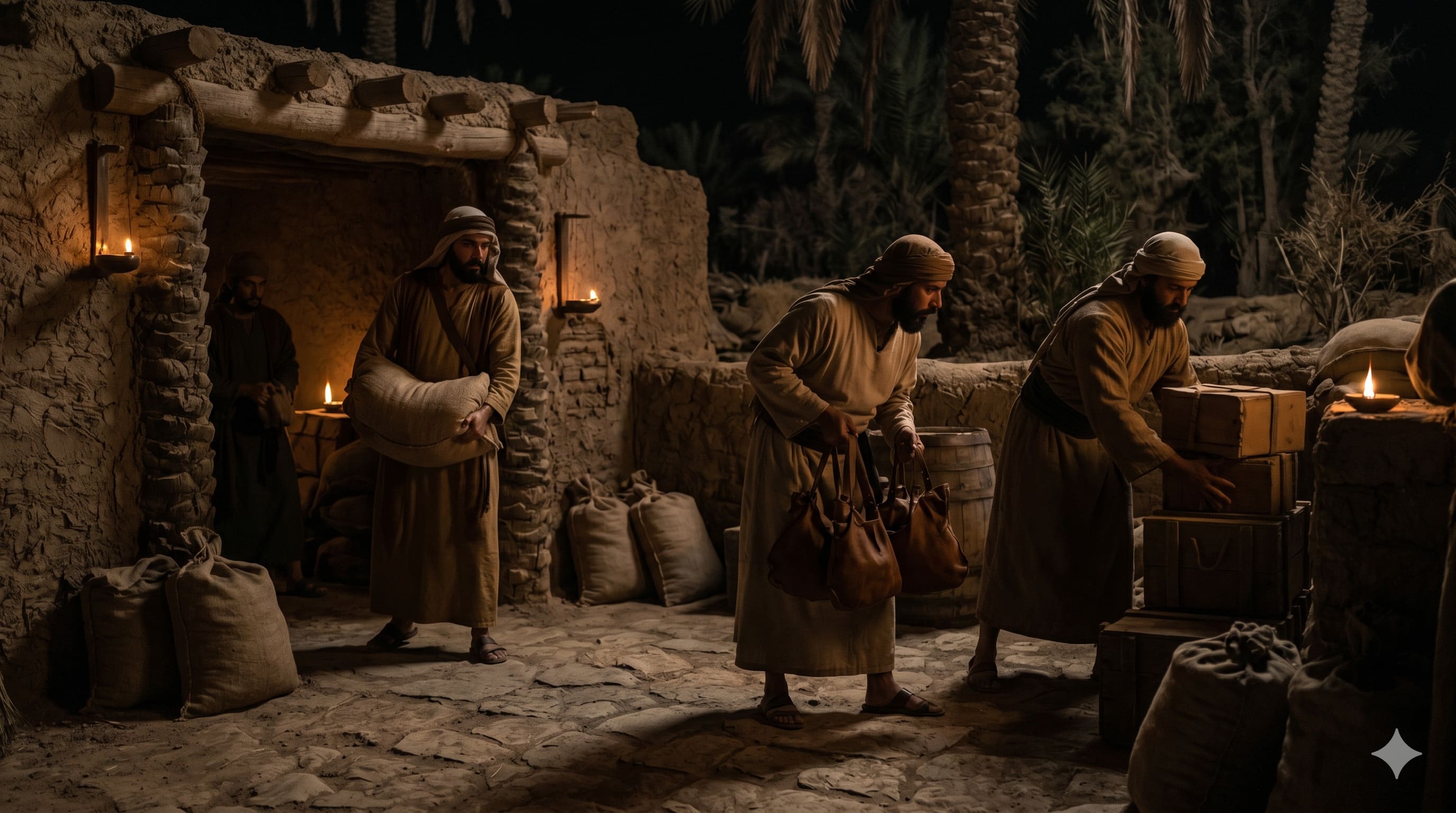
For a few moments after Harits went out to the pen, no one spoke. The sounds of the night slowly took over the house: the snorting of camels from behind, small chains occasionally clinking, and the rustle of wind moving through the alleys of Madinah.
Abdullah still sat silently with Iskandar asleep on his shoulder. The small oil lamp was now only half-burning, making his face look older and more tired than usual. Rafi' watched the man silently. Until now, Abdullah had always appeared: calm, steadfast, and hard to shake. But that night, for the first time, Rafi' saw the heavy burden of being the head of a large family in an era full of tribulation. Not just thinking of himself. But of: children, wife, workers, livestock, wealth, and the safety of the humans who depended on him.
Maryam finally broke the silence. "Rafi'... Yahya..." her voice was gentle but weary, "you should rest before dawn."
The two young men exchanged a brief glance. They actually wanted to stay longer. But they also knew: the night had gone too far. "We can help at the pen before sleeping," Rafi' said quickly.
Abdullah shook his head gently. "Harits is enough." He looked at them both. "You still need to move tomorrow."
Yahya gave a small nod. But before rising, he asked softly: "Will we start telling other families?"
That question made Abdullah fall silent again. Because that was the next problem. The more people who knew, the greater the danger. But the longer they waited, the less time they had to prepare.
"Not everyone yet," Abdullah answered finally. He looked at the earthen floor for a few moments before continuing: "First, we must know who is truly ready to keep their mouths shut."
Rafi' and Yahya immediately understood his meaning. In times like these, one person speaking wrongly in the market could destroy all preparations.
Maryam slowly lifted Iskandar from Abdullah's shoulder. The boy moved only slightly in his sleep before falling back into a deep slumber when his mother laid him down near Fatimah.
Abdullah watched his two children for quite a while. Two small children still sleeping peacefully, while the world around them slowly changed. "I will meet Sheikh Umar after dawn," he said finally.
Rafi' quickly lifted his face. "At his house?" "Yes." Abdullah took a long breath. "I want to know: who has already started moving, how the situation in Kufah is, and whether Basrah is truly still possible."
Yahya swallowed hard. Now all of it sounded increasingly real: no longer just a night discussion, but steps being arranged one by one.
Outside the house, the sound of Harits's footsteps was heard again briefly from the direction of the pen, then vanished once more. Maryam turned toward the back door before saying quietly: "If Harits has already started keeping night watch at the pen..." her eyes returned to Abdullah, "it means this house is truly beginning to prepare for something."
Abdullah did not object. Because in his own heart, he was beginning to feel: this night might be the beginning of the end of their old life in Madinah.
Rafi' and Yahya finally rose slowly from their seats. Both looked calmer than when they first arrived that night, but precisely because of that, their faces now looked more mature. They had come as young men wanting to know the news. But the night had made them share a portion of the adults' burden.
Maryam walked to the shelf near the door and took two thicker outer cloths. "The air is getting cold toward dawn," she said softly, handing the cloths to them.
"Thank you," Rafi' said respectfully. Yahya also bowed his head slightly.
Abdullah stood up slowly now. His body looked tired, but the look in his eyes was no longer as dim as it had been a few hours prior. Because that night, at least, the fog in his mind was beginning to take shape. He was beginning to see: the danger, the routes, and possible ways out.
"Go home via the western alley," he said to Rafi' and Yahya. "Do not pass through the night market." Harits had apparently conveyed more news than they realized.
Rafi' nodded. "Because of surveillance?" "Because there are too many strangers lately," Abdullah answered quietly.
Yahya frowned slightly. "Travelers?" Abdullah looked at him for a few moments. "Some." He paused briefly. "Others are men who listen too much."
That sentence made the air in the house feel cold once more. In times like these, even the market could turn into a place where humans sold: news, names, and loyalty.
Maryam opened the front door slowly. The night air immediately touched their faces. The alley of Madinah looked long and dim under the light of a few oil lamps hanging on the walls of the houses. Most doors were now tightly closed. Yet in the distance, one could still hear: camel footsteps, the sound of humans speaking softly, and occasionally the creak of small wooden wheels from a night cart. Madinah had not truly slept.
Rafi' stopped briefly at the door before saying softly to Abdullah: "If you meet Sheikh Umar tomorrow..." he seemed hesitant for a moment, "and if there are preparations that must be made..." his eyes hardened slightly, "I want to help."
Yahya immediately nodded quickly. "Me too."
Abdullah looked at the two young men for quite a while. He saw: courage, sincerity, and also the unpreparedness of youth that did not yet fully understand how heavy the road ahead would be. But he also knew: times like these forced humans to grow up faster.
"We will see tomorrow," he answered calmly.
Rafi' seemed to want to say more, but finally only bowed respectfully. "May Allah protect this house tonight," he said softly.
Maryam answered gently: "And protect your steps toward home."
The two young men then stepped out into the night alley of Madinah. The sound of their sandals slowly faded, merging with the cold night and the rustle of wind moving between the houses of the Prophet's city.
Abdullah stood for quite a while at the door, watching them leave. Then, slowly, he spoke very quietly, more like talking to himself: "They are still too young for all this..."
Maryam heard her husband's quiet murmur. She stood beside the door, gazing at the shadows of Rafi' and Yahya growing fainter in the Madinah alley. "We all feel too young when the times change," she said softly.
Abdullah did not answer immediately. The night wind moved through the alley, bringing cold air and the faint smell of desert dust from outside the city. In the distance, a dog barked briefly before everything sank back into silence.
Abdullah finally closed the house door slowly. The sound of the wooden door and the bolt being secured that night sounded heavier than usual. As if the house was locking itself away from the outside world.
Maryam walked back to the main room and began tidying the water bowls that had been left near the oil lamp. Her movements remained calm, but Abdullah knew his wife too well not to see the exhaustion beginning to show on her face.
"You have not slept since maghrib," he said softly.
Maryam smiled slightly without lifting her face. "Neither have you."
Abdullah chuckled quietly for a moment, then sat down slowly near his two sleeping children. Fatimah was now sleeping while hugging her brother's arm. Whereas Iskandar looked exhausted after trying to stay awake all night listening to the adults' conversation.
Maryam finally sat down near Abdullah. For a few moments, they only sat silently, watching their children. The atmosphere in the house slowly grew calmer after Rafi' and Yahya left. But it was precisely in that calmness that the burden of the night felt increasingly real.
"Do you truly believe Basrah could be a safe place?" Maryam finally asked quietly.
Abdullah slowly wiped his face. "I do not know if it is safe." He looked at the oil lamp that was almost extinguished. "But a port city always offers more paths than a desert city."
Maryam gave a small nod. She understood his meaning. In Madinah, if land routes were closed, humans were trapped. Whereas in a port city: the sea opened other possibilities.
"And Samir knows that route," Maryam said. "Yes." Abdullah leaned slowly against the wooden pillar of the house. "I am beginning to understand why Sheikh Umar keeps thinking of the east." His voice was very low now. "Not because he wants to leave Madinah..." his eyes moved toward the outside of the house, "but because he is beginning to see what will happen to Hijaz."
The night wind gently touched the roof of the house again. From behind, the sound of Harits coughing lightly near the pen was heard, followed by the slow movement of a camel afterward. Maryam closed her eyes for a moment, listening to the familiar sounds of their home. The pen. The livestock. The workers. The alleys of Madinah. This house. Everything felt so close and real.
And precisely because of that, the thought of leaving it felt increasingly painful. "If one day we leave..." her voice was almost a whisper, "I am afraid the children will forget Madinah."
Abdullah turned to her slowly. Then, for the first time that night, he offered a small, very faint, warm smile. "No."
Maryam looked at him silently. "Children of Banu Hashim may grow up far from the Prophet's city..." Abdullah's voice was calm and soft, "but they must not grow up far from the memory of it."
Maryam gazed at Abdullah for a long time after the man finished speaking. The small oil lamp in the main room swayed gently, blown by the night wind, making the warm light dance faintly on their faces. For the first time since the night's conversation began, a little tranquility entered Maryam's chest. Small. Very small. But enough to make her breathing feel lighter.
Because she knew: Abdullah was not just talking about a city. He was talking about: roots, honor, and their family's legacy. About how the children of Banu Hashim must still recognize: Madinah, the Messenger of Allah, and who they are, even if one day they grow up far from the land of Hijaz.
Maryam finally offered a thin, small smile. A smile that was weary, yet warm. "Iskandar will keep asking about this city," she whispered softly, looking at their sleeping son. "He never stops asking about the old wells and the mosque."
Abdullah chuckled quietly. "Because the blood of Banu Hashim is too close to the tales."
Maryam lowered her head slightly with a faint smile. Then her gaze shifted to Fatimah, who was sleeping while clutching her worn-out small cloth. "Fatimah is different," she said softly. "She loves the house more than the city."
Abdullah looked at his little daughter for quite a while. The child slept peacefully, completely unaware that the world outside their house was slowly changing. "Perhaps that is why women are stronger in facing loss," Abdullah said quietly.
Maryam lifted her face slightly. "Why?"
Abdullah leaned slowly against the wooden pillar of the house. "Because for men..." he paused, searching for words, "a place often becomes part of their pride." His eyes moved toward: the pen, the cloth shelves, the wooden chests, and the walls of their house. "Whereas women..." his voice grew even softer, "carry the home within their hearts."
Maryam was silent. Those words slowly entered her chest.
Outside the house, the rustle of the night wind moved through the alleys of Madinah once more. From afar, the sound of a camel snorting softly was heard, then silence returned. The night grew deeper. But for a few moments, Abdullah's small house felt like an ordinary home again: without talk of eastern routes, without surveillance, without fear. Only: a husband, a wife, and their two children sleeping peacefully under the light of a small Madinah oil lamp.
Maryam slowly lowered her face. Her fingers moved gently to tidy the small cloth covering Fatimah's body so the child would not get cold. "I hope nights like this do not disappear quickly," she whispered softly.
Abdullah understood her meaning without needing a long explanation. A simple night: children asleep, a quiet house, a pen still full of livestock, and Madinah still feeling like home. Small things that had always felt ordinary now began to seem so precious.
Abdullah looked at the ceiling of the house for a few moments. The roof of palm trunks and woven material had been with him for years: summer seasons, winter seasons, the births of his children, and long nights with Maryam. The house was not a grand house of the Quraysh nobles. But it was warm enough to be a place to return to.
"I used to think..." Abdullah's voice was low and calm, "I would grow old in this city."
Maryam slowly lifted her face. Abdullah smiled slightly, but there was a faint sadness behind it. "Managing the pen..." he continued softly. "Watching Iskandar grow up." His eyes moved to Fatimah. "Then one day, marrying off our little daughter in Madinah."
Maryam closed her eyes for a moment. Because that image felt so close, so simple, and precisely because of that, it felt painful.
Outside the house, the sound of a small chain from the pen scraping softly was heard, followed by Harits's footsteps moving to check the backyard. Ordinary sounds. But that night, everything sounded like something that might one day be only a memory.
Maryam finally asked very softly: "Do you regret staying in Madinah after everything began to change?"
Abdullah immediately shook his head slightly. "No." His answer came without hesitation.
Maryam looked at him silently. "This is the city of the Messenger of Allah." Abdullah's voice was calm yet full of conviction. "If one day I truly must leave it..." he took a slow, long breath, "I want to go after trying to endure as long as I can."
Silence fell again after that. But this time, their silence felt warmer. Because amidst all the fear and uncertainty, Maryam once again saw something that had always made her strong in accompanying Abdullah: his steadfastness, his loyalty, and this man's love for his family and for the Prophet's city.
The small oil lamp began to burn even shorter. Maryam noticed it and said quietly: "The oil is almost gone." Abdullah smiled slightly. "Like our night." Maryam chuckled very softly so as not to wake the children.
And for the first time since the discussion about Basrah began that night, a small laugh returned to life inside their house. That small laugh quickly sank back into the silence of the night. But its warmth remained in that simple room, like the lingering light of an oil lamp not yet fully extinguished.
Maryam looked at Abdullah for a few moments, shaking her head slowly. "Even in times like these, you still find time to joke." Abdullah smiled thinly. "If I did not..." he glanced at their children, "this house would turn into a courtroom." Maryam smiled slightly again. That was true.
Since the night grew late, their house had been filled with: talk of routes, surveillance, the movement of gold, and the possibility of leaving Madinah. As if the entire outside world had slowly entered and filled their family room. Whereas usually, nights in Abdullah's house were much simpler. Sometimes Iskandar would force his father to tell tales of old trade routes. Sometimes Fatimah would fall asleep listening to Maryam recite small Hijazi poems. And sometimes Abdullah himself would fall asleep early from exhaustion after a whole day at the pen.
That night felt different. Too long. Too heavy. And too full of thoughts.
Maryam finally stood up slowly and took a small jug near the water shelf. She poured a little water into an earthen bowl for Abdullah. "Drink." Abdullah took it with a small nod. The water was cold and fresh, bringing a little calm to his throat, which had been dry from thinking too much.
"Tomorrow will be long," Maryam said softly. Abdullah understood her meaning. The meeting with Sheikh Umar. Discussions about Kufah. About Basrah. About the families beginning to move. And perhaps: about decisions they had not yet dared to truly touch.
"I want to go before the city gets busy," he said quietly. Maryam gave a small nod. "I will prepare bread and dates before dawn." Abdullah looked at his wife for quite a while. He realized: even without being asked, Maryam had already begun adjusting their lives to the new possibilities. Small preparations. Small habits. But all of it was slowly moving in the same direction.
Outside the house, Harits's footsteps were heard again, moving slowly through the backyard. Then the sound of a camel snorting heavily, followed by the clink of a small water bucket being moved near the pen. Harits was indeed keeping watch that night.
Abdullah slowly lowered his face. He began to understand a bitter truth: even their own house no longer felt entirely safe without a guard.
The small oil lamp finally burned even shorter. Maryam approached and trimmed the wick so the fire would last until dawn. The room immediately grew dimmer. And in that almost-extinguished light, Abdullah suddenly said very softly: "I hope the children sleep with beautiful dreams tonight."
Maryam turned to him slowly. Because she knew: that sentence was not really about their children's dreams. But about the small hope of a father, that the world would not change too quickly before his children were ready to face it.
Maryam did not answer immediately. She only gazed at their two children for quite a while in the increasingly dim light of the oil lamp. Fatimah now slept more peacefully after moving slightly in her sleep earlier. Whereas Iskandar was still clutching his thin cloth, facing his father, as if even in sleep, the boy felt safe when close to Abdullah.
"Children always have beautiful dreams..." Maryam finally whispered, "as long as they still feel their home is intact."
Those words slowly entered Abdullah's chest. Their home is intact. How simple those words were. Yet that night, they felt so heavy. Because now Abdullah was beginning to understand: a home was not merely: walls, a roof, or a livestock pen. A home was: a sense of safety, familiar voices, and the certainty that tomorrow could still be lived peacefully. And all of that was slowly beginning to crack in many houses in Madinah.
Outside, the night wind moved colder now. The palm fronds in the backyard brushed against each other softly, producing a long, gentle sound. Abdullah looked at the oil lamp for a few moments before saying quietly: "I am not afraid of losing wealth." Maryam slowly lifted her face. "Nor am I afraid of starting over from the beginning." Abdullah's voice remained low and calm. "But I am afraid of watching the children grow up in a time that makes humans suspect one another."
Maryam was silent. Because she felt it too. Madinah, which was once open, was slowly changing: conversations grew quieter, doors closed faster, and humans began to be careful when mentioning the names of those they respected. Even families were beginning to move their gold in secret like thieves.
Whereas in the past, Madinah was a city where humans felt safe storing their trust. Maryam finally said very softly: "Do you think the situation will truly become that bad?"
Abdullah did not answer immediately. He took a slow, long breath, then looked toward the house door, which was now tightly closed. "I do not know." That answer was honest. And precisely because of that, it felt heavier.
"But when large families begin moving their metal in secret..." he continued quietly, "usually they are seeing something others have not yet seen."
Maryam lowered her face slowly. The families of Mecca. The eastern routes. Surveillance. Night travel. And the discussions about Basrah that had kept returning since the afternoon. All of it was beginning to feel like a great current slowly pulling their lives toward a direction they did not yet know.
The small oil lamp finally burned very short. Maryam approached and added the last bit of oil to it. The small flame lived a little brighter now. Abdullah watched his wife's movements silently. Then, in a very soft voice, he said: "Thank you for remaining calm tonight."
Maryam smiled faintly without looking at him. "If I panicked too..." she whispered softly, "who would keep this house feeling like a home?"
Those words of Maryam's made Abdullah fall silent for quite a while. The small oil lamp moved calmly between them once more, casting a soft glow on the simple yet warm earthen walls of the house. "Who would keep this house feeling like a home..." Abdullah repeated those words in his heart slowly. And the more he thought about it, the more he realized: all this time, it was Maryam who had been keeping all of that. Not with a sword. Not with trade. But with: tranquility, patience, and the ability to make the children feel safe even when the outside world began to change.
Abdullah smiled slightly, full of gratitude. "In that case..." he said softly, "I must ensure this house does not lose its guardian." Maryam glanced at him briefly and chuckled softly. "I am not a pen guard like Harits." "No," Abdullah answered calmly. "Harits guards the livestock." His eyes looked gently at his wife. "Whereas you guard the soul of this house."
Maryam immediately lowered her face slightly, holding back a shy smile. The long and heavy night finally gave them a little space to breathe. Outside the house, the sounds of the Madinah night continued to move slowly: the wind in the palm fronds, Harits's faint footsteps, and the snorting of camels occasionally heard from the backyard pen.
Abdullah closed his eyes for a moment, enjoying all those sounds. Sounds that had always felt ordinary. But now began to sound like something that must be remembered well. "I just realized..." he said slowly, opening his eyes again, "all this time I have been too busy thinking about the market and the livestock." Maryam looked at him silently. "I always thought my duty was only to ensure this family lived sufficiently." Abdullah offered a bitter, small smile. "But it turns out keeping the family calm is much harder."
Maryam shook her head gently. "No." Her voice was soft. "You have done both." Abdullah looked at his wife for quite a while. Perhaps because the night was too silent. Perhaps because fear made humans more honest. But that night, for the first time since the afternoon, the burden in Abdullah's chest felt a little lighter.
In the corner of the room, little Fatimah suddenly moved in her sleep and murmured softly: "Father... do not go far..."
Maryam immediately turned quickly. Abdullah froze for a moment. The little child was still asleep, her eyes closed, but her fingers now gripped her small cloth more tightly. The room suddenly fell silent again. A silence that this time felt piercing far deeper than all discussions about: eastern routes, surveillance, or the movement of gold by the families of Mecca. Because sometimes, a single whisper from a sleeping child could shake a father's heart more strongly than all the bad news from the outside world.
Abdullah slowly moved closer to Fatimah. His movements were very careful so as not to wake the little child. He then sat beside his daughter and stroked Fatimah's fine hair gently with his rough fingers, accustomed to holding camel ropes and saddles. "Father is here," he whispered very softly. Fatimah did not open her eyes. But her breathing slowly calmed, and her small grip on the worn cloth began to loosen slightly.
Maryam watched the scene silently. Her chest felt warm yet aching. Because that night, all their fears slowly changed shape: no longer about the journey, or Basrah, or surveillance. But about: how to keep their children's hearts intact when the world began to change.
Abdullah still sat near Fatimah for a few moments. Then, unconsciously, his eyes moved to gaze slowly around the small house: the cloth shelves, the water jug, the oil lamp, the old saddle in the corner of the room, and the shadow of the wooden pillar dividing the main space. So simple. Yet it was precisely that simplicity that made everything feel so heavy to leave behind.
"I am beginning to understand something tonight," he said quietly without looking at Maryam. Maryam waited patiently. "Humans may be able to leave a city..." Abdullah's voice was low and heavy, "but they are never truly ready to leave the small life they have built within it."
Maryam lowered her face slowly. Those words felt so true. Because the hardest thing to leave was not: the market, or the trade routes. But rather: the voices of children in the house, morning routines, the smell of bread, footsteps in the yard, and all the small things that had always been taken for granted.
Outside the house, the night wind began to move more slowly now. Perhaps because the night was nearing its end. Or perhaps because Madinah itself was beginning to sink deeper into its sleep. Maryam finally said very softly: "If one day we truly leave..." her eyes still fixed on Fatimah, "I want the children to take something from this house."
Abdullah slowly lifted his face. Maryam smiled faintly. "Not metal." She shook her head gently. "Not expensive cloth." Her hand touched the mat where the children slept. "Something that makes them still feel they have a home."
Abdullah was silent for quite a while. Because suddenly he realized: even in discussions about migration, Maryam still thought of their children's hearts first, before any wealth. And perhaps that was indeed how women kept a family alive: not just their bodies, but their memories.
The small oil lamp moved gently once more. Its light was now very dim, but still enough to illuminate the calm faces of their children sleeping in the middle of the Madinah night. Abdullah slowly nodded. "In that case..." his voice was low and calm, "Fatimah may take that small cloth."
Maryam turned and smiled faintly, looking at the worn cloth their daughter had been clutching all along. "That one?" Abdullah gave a small nod. "She never sleeps without it." Maryam chuckled softly. "Because you were the one who gave it to her when she had a fever." Abdullah looked slightly surprised. "I had almost forgotten." "Women rarely forget things like that," Maryam answered gently.
A warm silence fell between them once more. The night, which had been filled with discussions of: eastern routes, surveillance, and the movement of gold, slowly transformed into a night about their own small family. About: children, home, and simple memories that turned out to be far more precious than much metal.
Abdullah then looked at Iskandar, who was sleeping with one hand still gripping the edge of his father's cloth. "As for Iskandar..." he offered a thin, small smile, "he might take half the pen if allowed." Maryam held back a small laugh so as not to wake the children. "And maybe a few goats too." "Along with his old camel." They both finally laughed softly. A simple laugh. But it felt very human in the middle of that long, fearful night.
Outside the house, Harits apparently heard their faint voices. Because a moment later, the sound of the Bedouin man clearing his throat lightly was heard from the direction of the pen, as if relieved to hear the house still held a little life that night. Abdullah let out a slow sigh. "I hope Harits stays with us if all this truly happens." Maryam looked at him briefly. "He will come." Her answer came without hesitation. "Why are you so sure?"
Maryam looked toward the back door of the house. "Because some humans no longer stay for wages." Her voice was very soft. "They stay because they feel they have become part of the family." Abdullah was silent for quite a while after hearing that. Then, slowly, he bowed his head slightly, full of gratitude.
He realized: over the years, without truly noticing, their house had grown larger than just the immediate family. There were: Harits, the herders, the pen workers, and simple humans who had lived with them for years. And if one day migration truly happened, they might all be dragged into the same change.
The small oil lamp was now very dim. Maryam watched it and said quietly: "Dawn prayer is approaching soon." Abdullah nodded gently. The long night was nearly over. But both knew: the dawn that was coming might not bring tranquility, but rather the first step toward a great change in their lives.
The night approached its end.
PART 3 — The Sound of the Mushaf Calms the Storm
The air of Madinah now felt colder, and the sounds of the city grew increasingly rare. The small oil lamp in Abdullah's house only emitted a soft, almost golden light. Maryam watched it for a few moments, then slowly rose. Abdullah lifted his face slightly. "Are you going to sleep?" Maryam shook her head gently. "No."
She walked toward the wooden shelf near the wall and took the cloth wrapping their Mushaf with both hands, full of reverence. Her movements were calm. Accustomed. And done with the etiquette that had lived long in that house. Abdullah watched his wife silently. Then, without many words, he also stood up slowly. In the houses of Banu Hashim, when anxiety began to fill the chest, humans returned to the Qur'an before returning to the world.
Maryam slowly unwrapped the Mushaf cloth and placed it on a small mat near the oil lamp. The dim light of the lamp reflected softly on the pages of writing that had been read many times in that house: in times of ease, in times of sadness, when the children were sick, and when human hearts needed tranquility.
Abdullah sat down slowly near the Mushaf. For a few moments, he only looked at it silently. Then the sound of his long, slow breath was heard, like a man finally lowering some of the weight from his chest. Outside the house, Harits's footsteps were still occasionally heard near the pen. Whereas inside the house, Madinah felt distant once more. There was no: eastern route, surveillance, or movement of gold. Only: a husband, a wife, a Mushaf, and a long night they filled by seeking tranquility from Allah.
Abdullah finally began to read in a low voice. Soft. Clear. And full of caution. The sound of the recitation immediately filled the small space of their house like water slowly calming dry earth. Maryam sat not far from him, lowering her head. Her eyes slowly closed. Because for a long time, she had known one thing: as long as the sound of the Qur'an still lived inside the house, that house had not truly lost its direction.
In the corner of the room, Fatimah moved slightly in her sleep, then became still again. Whereas Iskandar slowly hugged his father's cloth tighter without waking up, as if the tranquility of the recitation also reached into the children's dreams. The night continued to move slowly. And for the first time since the discussion about Basrah began, the fear in that house began to subside little by little.
The sound of Abdullah's recitation continued to flow softly, filling the small house. Not loud. Not rushed. But calm, like a man calming himself before calming others. Maryam remained seated silently, listening. Her hand moved slowly over the small wooden prayer beads she usually kept near the Mushaf. Bead by bead shifted gently at her fingertips, while her lips moved softly in dhikr that was almost inaudible.
In the houses of Banu Hashim, a night like this was not a night to drown in panic. Because they were taught: when the world began to feel narrow, the heart must be closer to Allah than ever before.
The night wind moved across the roof of the house again. The small oil lamp swayed gently, making the shadows of Abdullah and the Mushaf before him move softly on the earthen wall. Outside the pen, Harits, sitting near the wooden fence, faintly heard the recitation carried by the night wind. The Bedouin man slowly lowered his head. Then, unconsciously, his rough lips also moved softly, uttering dhikr. Because after living with Abdullah's family for years, he knew one thing: a house filled with the Qur'an always felt different. Calmer. More alive. And stronger in facing difficulties.
Inside the house, Abdullah finally stopped reading for a moment. A soft silence fell for a few seconds. Then Maryam said very softly: "My heart is calmer now." Abdullah closed the Mushaf slowly with both hands, full of reverence. "Because Allah never abandons His servants," he answered quietly. Maryam gave a small nod. Those words were simple. But that was precisely what had kept them strong all this time: the certainty that Allah's help was greater than human fear.
Abdullah then looked at their two children, who were still sleeping peacefully. "I want Iskandar to grow up loving the Qur'an more than he loves trade." Maryam smiled faintly. "And Fatimah?" Abdullah looked at his little daughter for quite a while. "I want her to grow up to be a woman who keeps her home always alive with dhikr."
Maryam lowered her face slightly, full of emotion. Because she knew: that was the true legacy Abdullah wanted to leave to their children. Not: the pen, metal, or trade routes. But rather: faith, etiquette, the Qur'an, and peace of heart when facing a changing world.
From afar, the sound of the first rooster was faintly heard breaking the darkness of the Madinah night. Dawn had not yet arrived. But the night was slowly beginning to surrender itself to the time of dawn prayer. That sound was soon followed by another from afar: the first human footsteps beginning to move toward the mosque before dawn. Madinah was slowly waking up. But Abdullah's house was still immersed in a tranquility different from a few hours prior.
The fear had not disappeared. The anxiety about: Basrah, the eastern route, surveillance, and the possibility of migration, still remained. But now their hearts no longer moved wildly as they had at the beginning of the night. The Qur'an and dhikr had slowly calmed the turmoil that had filled the house since the afternoon.
Maryam was still holding her wooden prayer beads when she said quietly: "I just realized..." her eyes fixed on the neatly closed Mushaf, "every time life feels heavy, we always return to the same place." Abdullah gave a small nod. "Because humans were not created strong enough to bear everything alone." Maryam looked at him silently. Abdullah continued in a low voice: "Wealth can run out." His hand touched the Mushaf cover gently. "Cities can change." His eyes moved to their children. "But as long as Allah still guards the hearts of this family..." he took a slow breath, "we have not truly lost anything."
Maryam lowered her face slowly, holding back her emotion. Words like those were what had always made her strong living alongside Abdullah: his conviction, his calmness, and his way of seeing the world not only with the eyes of trade, but also with faith.
Outside the house, Harits was now sitting leaning near the pen, gazing at the sky of Madinah, which was beginning to turn paler on the eastern horizon. The Bedouin man was still holding his simple prayer beads. Sometimes his lips moved softly in short dhikr he had learned years ago from Abdullah's family. In the desert, humans learned: water kept the body alive. But dhikr kept the heart enduring.
Abdullah finally stood up slowly. He closed the Mushaf with reverence, then wrapped it back in its cloth cover before placing it on the wooden shelf. His movements were careful, as if placing something more precious than gold. Maryam watched with a faint, small smile. Because in their house, children grew up seeing one thing since childhood: that the Qur'an was always placed higher than wealth. And perhaps that was why the house still felt alive, even when fear began to come from the outside.
Suddenly, from the direction of the mosque, the faint sound of humans chanting the first call approaching dawn was heard. Not yet the adhan. Just the soft voices of people beginning to wake the city for the last night prayer and dawn preparations. Abdullah looked toward the outside of the house for a few moments. Then he said very softly: "A new day begins..." But in his heart, he knew: that day might bring answers he had not yet dared to fully face.
The sky of Madinah slowly changed color. The pitch black of night began to break into a soft, dark blue on the eastern horizon. The cold dawn air entered slowly through the gaps in the house, bringing the scent of earth and thin desert dew. Abdullah walked toward the water jug near the wall and slowly poured water into the palm of his hand. The sound of water falling into the earthen bowl sounded clear in the silence of the house. Maryam understood that movement without needing to ask. Ablution. In the houses of Banu Hashim, the night was not closed with anxiety, but with worship.
Abdullah washed his face slowly. The cold dawn water touched his skin, weary after a long night full of thoughts. But it was precisely that coldness that made his chest feel lighter now. Maryam also stood up and prepared water for herself. Their movements were calm. Accustomed. And full of the order that had lived for years in that house. In the corner of the room, Fatimah was still sleeping peacefully. Whereas Iskandar moved slightly, then became still again while hugging his father's cloth. Abdullah looked at his son for a moment with a thin smile. "He is starting to sleep like a little herder," he murmured softly. Maryam smiled faintly while washing her hands. "Because every afternoon he spends more time at the pen than at home." Abdullah chuckled quietly.
For a few moments, the house felt like an ordinary home again: a father, a mother, and children growing slowly in the Prophet's city. Outside, Harits heard the sound of ablution water from inside the house. The Bedouin man immediately stood up slowly from near the pen and walked toward the outer jug to perform ablution as well. Because living with Abdullah's family, he was accustomed to this: when the house began preparing to welcome dawn, all worldly work was left aside for a moment.
Not long after, the sound of the dawn adhan finally echoed from the direction of the mosque. Long. Clear. And filling the air of Madinah, which was still shrouded in the remnants of the night's darkness. All conversations about: Basrah, surveillance, the movement of gold, and fear, seemed to step back a few paces when that call was heard. Because in the Prophet's city, the adhan always reminded humans of something greater than all the world's anxieties.
Abdullah stood silently, listening until the call to prayer finished. Then, in a very soft voice, he said: "Whatever is to come..." his eyes looked toward the east, which was beginning to brighten, "may Allah not strip the tranquility from this house." Maryam lowered her head slightly. "Ameen."