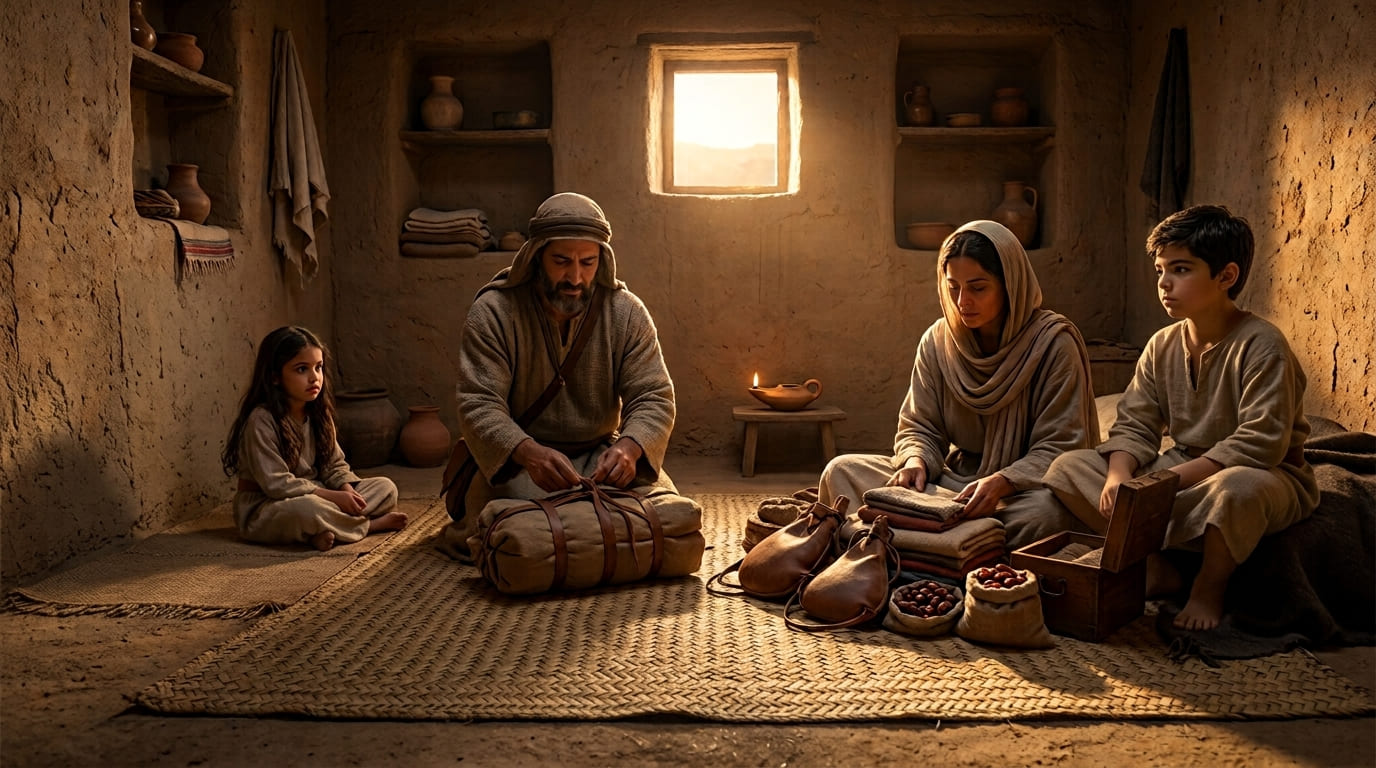
Panembahan Wonokromo
Chapter 008 — The Houses Begin to Count
Rabi' al-Awwal 40 AH / 661 AD — When every household begins to calculate what it is able to carry and what must be left behind.
PART 1 — Dawn at the House of the Spring Guardian
The dawn had not yet truly whitened the sky of Madinah when the first roosters began to crow from the backyards of the houses. The air still held the chill of the night descending from the Hijaz plains. Over the crests of the date palms, the stars had not entirely vanished. Only on the eastern horizon did a streak of pale light appear, slowly driving away the dark. From a distance, before the call to the Fajr prayer rang out, came the sound of a wooden bucket clashing against the brim of a well. A woman was drawing water for her family, while the wind carried the fragrance of the earth touched overnight by a thin dew.
The house of Hilal bin Rashid had awakened earlier than the other homes in that alley. Hilal sat cross-legged on the earthen veranda facing his small date palm orchard. Before him lay several simple tools: a hemp rope that had been mended over and over, a wooden well-depth marker, and a leather pouch filled with small stones he habitually used when estimating the condition of the earth. All these objects had accompanied him for years, long before people knew him as the finest water-finder in Madinah.
His calloused hand caressed the wooden rod slowly. Not because the wood was precious. Rather, because in every groove of its surface lay preserved the long journey he once undertook with his father, traversing the plains of Hijaz.
Small footsteps were heard approaching from the inner room. "Father..." That voice was still heavy with sleep. Hilal turned with a faint smile. Rafi' stood in the doorway with his cloak not yet fully straightened. His hair was still slightly disheveled, but his eyes were fully open. "You have woken earlier than usual." Rafi' sat beside his father without many words. For a moment, the two simply gazed at the sky slowly changing colors. "Father did not sleep?" Rafi' asked softly. Hilal let out a long breath. "I did." "Then why are you already outside?" Hilal did not answer immediately. His fingers still twirled the hemp rope resting in his lap. "There are times when a person is not awakened by human voices." "Then by what?" "By his own thoughts."
Silence descended once more. From the direction of the Prophet's Mosque, the voice of someone reciting the Qur'an began to drift on the wind. The recitation was subdued, yet clear enough to fill the youthful dawn. Rafi' gazed at his father's face for quite some time. "Are you thinking of Basrah?" Hilal nodded slowly. "Not of Basrah alone." "Then?" "All the springs I have never yet seen." Rafi' frowned. Hilal picked up a small stone from his leather pouch and placed it upon the earth. "A man who lives in the wilderness never asks where the road ends." He took a second stone. "He asks first..." "...where the next water may be found." Rafi' observed every movement of his father. "If a man misjudges even a single well," Hilal continued softly, "then a camel may perish." He took a third stone. "If two wells are discovered to have dried up..." "...then an entire family may lose hope."
The wind swept softly once more through the date palm fronds. Rafi' realized only then that he had always viewed journeys merely as the distance of a road. His father viewed journeys in a different manner. He viewed them through water. Through earth. Through the scent of the wind. Through the color of the foliage. Through the tracks of birds circling the sky. "That is why," Hilal said, gazing toward the eastern horizon, "Allah has made the earth full of signs for those who reflect."
Before Rafi' could reply, the house door slowly opened once more. Hafsah emerged carrying two small bowls filled with warm milk freshly milked before dawn. She did not speak at once. She merely placed the two bowls before her husband and son. "The air is still cold." Hilal nodded. "May Allah reward your kindness." Hafsah seated herself on the other side of the veranda. Her eyes followed the gaze of the two men toward the eastern sky beginning to pale. "I heard Lubna weeping last night." Hilal turned slowly. "Because of what?" "She dreamed this house was empty." No one answered right away. The crow of a rooster was heard once more from a distance. Followed by the bleating of sheep beginning to demand release from their pen. Hafsah lowered her gaze. "The children are beginning to hear the talk of adults." Hilal rubbed his beard slowly. "We have indeed spoken far too much of leaving." "Is that not truly what is happening?" "Not yet." "Yet it will happen."
Hilal gazed at his wife for a long time. Their eyes met in a silence that required few words. Both of them knew full well that the discussions in Shaykh Umar's house over the past few days were no longer mere guesswork. Slowly, it was turning into an inescapable path of life.
Right as the first sunlight began to emerge behind the eastern horizon and the Fajr adhan echoed from the Prophet's Mosque, Hilal rose to his feet. He gazed at the small date palm orchard beside his house. Every single one of those date palms had been planted with his own hands. Every irrigation trench he had dug himself. Every stone marking the orchard's boundary he had carried together with Rafi' when his son was still much smaller. For the first time since his birth in Madinah, a question that had never dared surface finally grew within his heart. "Shall I truly leave all this behind in order to protect the faith, my family, and the generations yet to come?"
And the dawn of Rabi' al-Awwal offered no answer. It simply continued to cast its slow light upon the city of the Prophet, which was preparing to face a new day. The three of them walked toward the Prophet's Mosque when the sunlight was yet no higher than a spear planted in the earth. The alleys of Madinah began to fill with people emerging from their respective homes with calm strides. Some carried water skins to draw water, others drove their sheep toward the pastures outside the city, while merchants had opened the wooden doors of their shops even though not all their wares had been displayed. Hilal walked at the very front. His pace was neither hurried nor sluggish. He knew almost every stone they trod upon, every date palm growing along the alley, even every wall of the houses that owners had repaired time and time again over the years.
"As-salamu'alaykum, O Hilal." That aged voice came from the courtyard of a modest house. An elderly man was sweeping away date leaves that had fallen overnight. His beard had turned entirely white, while his back had begun to bow beneath the weight of years. "Wa'alaykumussalam wa rahmatullah." Hilal approached him by a few steps. "How is your state this morning, O Abu Malik?" The old man smiled faintly. "As long as Allah still permits my feet to walk to the mosque, I possess many blessings." Hilal bowed his head in profound respect. Their conversation lasted only a moment. Yet Rafi' observed how his father always paused to greet the elders, as if time were never too narrow to display adab toward those who had lived before them. After bidding farewell, they resumed walking. A few steps later, Hafsah slowed her pace until she walked abreast of her son. "Rafi'." "Yes, Mother." "In time, when you become the head of a family..." Rafi' turned. "...do not be known merely as a man skilled at labor." The young man awaited the continuation of his mother's words. "Strive so that people also know you as one who preserves kinship ties." Rafi' nodded slowly. The counsel was simple. Yet that morning he stored it deep within his heart.
Following the Fajr prayer, in accordance with a custom maintained since the time of the Messenger of Allah ﷺ, a portion of the congregation did not immediately leave the mosque. They sat forming small circles. Some recited the Qur'an. Some engaged in dhikr. Others exchanged news concerning their families, commerce, or the state of their orchards. Hilal sat leaning against one of the mosque pillars. Not far from him, Qasim bin Thauban appeared to be speaking softly with Salman al-Katib. On the other side, Samir bin Wahhab observed two merchants who had just arrived from the north. His expression was calm, yet his eyes never ceased reading the movements of the people around him.
Rafi' sat with several youths of his age. Among them was Amr, Qasim's son. The two had been friends since learning to read the Qur'an under Shaykh Umar. "My father did not sleep last night," Amr opened the conversation while gazing at the mosque floor. "My father as well." The two exchanged a faint smile. A smile born not of joy, but of the realization that anxiety was visiting nearly every household. Amr lowered his voice. "I saw my father place several rolled writings into a wooden chest." "What writings?" "I do not know." "Did you not ask?" Amr shook his head. "Father merely said, there are writings better carried far away than fallen into the hands of the untrustworthy." Rafi' fell silent. Those words continued to echo in his ears. He now understood that what the elders were preparing was not merely provisions of food. There was knowledge. There were records. There was trust. There was a heritage that must not be lost.
Meanwhile, a few paces away from them, Hilal watched Shaykh Umar walking slowly out of the mosque portico. Advanced age made his steps ever shorter, yet his countenance still radiated a tranquility that was not easily disturbed. He paused momentarily upon seeing Hilal. "How is your household?" "Praise be to Allah, still under His protection." Shaykh Umar nodded. "And the children?" Hilal glanced at Rafi', who was conversing with Amr. "They are beginning to ask many questions." "That is a good sign." Hilal looked slightly surprised. "Are not their questions born of fear?" Shaykh Umar smiled gently. "A child who asks is learning to understand the world." He paused briefly before continuing. "What is dangerous is a child who stops asking." Hilal lowered his head. The counsel felt simple. Yet he knew Shaykh Umar never uttered a word devoid of wisdom.
Before long, the sound of swift footsteps echoed from the mosque courtyard. A traveler whose body was still covered in the dust of journey gave greetings to several members of the congregation. He carried a small leather pouch on his shoulder. His sandals were worn. His cloak revealed the marks of a long voyage. Several people immediately invited him to sit. Samir bin Wahhab observed the man closely. A merchant's instinct told him that this traveler had just traversed a vast distance. Perhaps from the east. Perhaps from the route leading to Basra. Yet Samir did not rush to question him. He chose to wait for the man to drink water first. For he knew a traveler's habit: the truest news often emerges after their thirst is quenched, not when their breath is still panting. And without the realization of anyone sitting upon the portico of the Prophet's Mosque that morning, the news brought by that traveler would later become one of the foundational stones altering the journey of entire families toward the east. The sun had risen as high as a spear when the congregation still lingering in the Prophet's Mosque began gradually to leave the portico. Morning light broke among the date palms growing in the mosque courtyard, casting long shadows upon the earth that still retained the lingering coolness of the night. Low-flying sparrows fluttered, pecking at grains of wheat scattered in a corner of the plaza, while several children sat surrounding an old man teaching the letters of the Qur'an with a piece of date frond as a pointer. Shaykh Umar had not yet stirred from his seat. He gazed upon the congregants departing one by one. Not a few among them intentionally drew near merely to kiss the hand of the elderly scholar before returning to their respective labors. His countenance remained serene, yet his eyes betrayed the bearing of one carrying a burden shared with no many. On the right side of the portico, Abdullah bin Yusuf appeared in conversation with Bilal bin Harits and Umar bin Jundab. Their dialogue was conducted softly so as not to disturb those still engaged in dhikr. From time to time Bilal pointed toward the main road leading to the marketplace, while Umar nodded slowly, stroking his beard. Abdullah listened far more than he spoke. His gaze shifted several times toward the group of newly arrived travelers, as though seeking to read the direction of their journey from the dust still clinging to their garments and camel saddles.
Not far from them, Samir bin Wahhab had already approached the traveler who came from the eastern direction. As a merchant, he was accustomed to recognizing men by the way they carried goods and tended beasts of burden. He did not inquire about their destination first, but rather invited them to drink water and wipe the travel dust from their faces. Only after the travelers' breathing grew steady did Samir sit cross-legged before them. "May Allah ease your journey. From which road have you come?" One of the travelers, whose age was not far different from Samir's, slowly lifted his face. "From Basrah." Samir nodded slowly, as though that answer had been surmised from the beginning. "What is the state of that land?" The traveler did not reply immediately. He looked around first, ensuring no ear was too near. Such behavior was now increasingly visible since the news from Kufa reached Madinah. "Basrah still lives as it always has," he said softly, "yet everyone feels they are waiting for something." "Waiting for what?" "A wise man waits for certainty." He paused briefly. "While the greedy wait for opportunity."
Samir fell silent. The words were simple, yet sufficient to describe the state of a city without need of elaboration. On the other side of the plaza, Rafi' and Amr still sat close together. Both observed the adult men speaking in small groups. "I have just realized something," Rafi' whispered. "What?" "Over the past few days, people no longer speak while laughing." Amr followed the direction of his companion's gaze. It was true. Conversation still took place everywhere, but laughter that once came easily now seemed reluctant to emerge. Even when someone smiled, that smile lingered only briefly before vanishing again, swallowed by anxiety. A few paces away from them, Qasim bin Thauban rolled up a parchment sheet he had just inspected. That scroll was then placed into a cloth pouch he invariably carried. Abdullah, watching from a distance, approached his companion with calm strides. "Is there still much left for you to copy?" Qasim smiled faintly. "Not as much as I must guard." Abdullah understood his companion's intent without need of further explanation. Those writings were not mere sheets of hide. Some contained records of knowledge. Others held family genealogies. There were also old letters serving as witnesses of brotherhood among the Muslims. If all those fell into the hands of the unjust, not merely ink would be read, but also the names inscribed therein.
Shaykh Umar gazed upon his disciples and companions from afar. Before him no longer stood men walking individually. What he beheld was a group of families slowly being prepared by Allah toward a journey whose end they did not yet know. Some among them were skilled at finding springs. Some were adept in commerce. Some guarded knowledge through writing. Some shaped wood into useful tools. Others prepared hides and vessels for the journey. They originated from different occupations, yet in time, all those abilities would mutually strengthen one another. Shaykh Umar lowered his head, seeking forgiveness in his heart. He began to perceive wisdom not yet fully grasped by his disciples. Perhaps Allah was not commanding a few individuals to leave Madinah. Perhaps Allah was preparing a community that one day would plant the seeds of civilization in a land they had never yet seen. And that morning in Rabi' al-Awwal continued toward Dhuha time, while the sun slowly climbed higher into the sky of Madinah, illuminating a city unaware that several of its finest families were entering a new page in the journey of history. The sun continued its upward crawl. The shadows of the Prophet's Mosque pillars, which earlier stretched westward, now began to shorten bit by bit. The cool morning air began to lose its chill. Sparrows left the mosque plaza toward the date orchards on the outskirts of the city, while merchants who had completed their prayers began to open their mats and merchandise chests along the road leading to the marketplace. Shaykh Umar slowly rose from his seat. He did not leave the mosque immediately. That habit had long been known by his disciples. Following the Fajr prayer, he often walked slowly around the plaza, greeting those who came seeking counsel or merely offering salutations.
"As-salamu'alaykum, O Shaykh." That voice came from Malik bin Atiah, who had just finished helping an elderly man tie back his camel's loose saddle girth. "Wa'alaykumussalam warahmatullah." Shaykh Umar smiled gently. "May Allah add strength to both your hands." Malik bowed his head in respect. "These hands are only capable of labor through His grace." A few paces behind Malik stood his son Umar, helping his younger brother Khalid lift a roll of hide to be brought home. The younger child repeatedly almost dropped it, yet the older brother showed no annoyance. He merely smiled while adjusting the roll upon his younger brother's shoulder. Shaykh Umar observed the two of them for quite some time. "Educate them with patience, just as you cure that hide." Malik understood his teacher's intent. Good hide never becomes good in a single day. Likewise a child. On the other side of the plaza, Abdullah, Bilal, Hilal, and Umar bin Jundab finally gathered beneath the shade of a decades-old date palm. Samir joined them after escorting the travelers to their resting place. They sat forming a small circle. Not a single person spoke first. The sound of the awakening marketplace reached as far as the mosque courtyard. From time to time the bray of a donkey was heard. Followed by the shouts of merchants offering late-season dates.
Bilal broke the silence. "I have never seen the people of the marketplace look at one another as they have these past few days." Samir nodded. "Traders are beginning to hoard goods they usually sell." "For what reason?" "They do not know tomorrow." Samir picked up a handful of fine sand near his feet. "These grains of sand have never feared the wind." He opened his palm. The sand fell slowly. "Yet men..." "...are ever fearful of uncertain news." Hilal rubbed his beard. "News travels faster than a camel." "And often sharper than the blade of a sword," Abdullah replied softly. All nodded. None disputed it.
Not far from them, the youths began to leave the mosque courtyard. Rafi' and Amr walked side by side. Behind them followed Yasir bin Umar bin Jundab, then Sa'd the son of Samir, and Umar the son of Malik. They had known one another long. Some had learned to read the Qur'an together. Some had pastured sheep in the same fields. Others had grown up playing in the same alleys. Yet that morning their conversation differed from usual. "Have you noticed your father falling silent often?" Yasir asked. Rafi' nodded. "These past few nights." "My father as well." Sa'd picked up a piece of date twig and snapped it in two. "My father goes to the marketplace before sunrise ever more frequently." "To trade?" Sa'd shook his head. "He says, to hear news." They walked on. None realized that unconsciously they were beginning to comprehend the world of adults. A world filled with decisions children had never before imagined. In the houses surrounding the Prophet's Mosque, the women likewise commenced their tasks. Maryam binti Salman had just finished sweeping her courtyard when Hafsah binti Malik arrived bearing a small earthenware jar.
"As-salamu'alaykum." "Wa'alaykumussalam." The two exchanged smiles. Hafsah handed over the jar. "Goat's milk from this morning." Maryam received it with deep gratitude. "May Allah reward your kindness." "Do not call it kindness." Hafsah smiled. "Have we not shared with one another since long ago?" Maryam nodded. Both then sat beneath the shadow of the house wall. Before long Salma binti Nafi' arrived, followed by Hindun binti Qais carrying several pieces of cloth she had just finished washing. Their conversation did not immediately touch upon politics or travelers, in accordance with the custom of the women of Madinah. They inquired first about the children. About wheat. About newly birthed goats. About orchards beginning to require water. Only after some time did Hafsah's voice grow softer. "Tell me, Maryam..." "...are you also beginning to prepare travel pouches?" Maryam did not answer immediately. Her gaze fell upon her own hands. A few threads remained caught at her fingertips. "I have not sewn them." She paused briefly. "Yet the cloth I have chosen."
Silence descended among them. Not a single woman desired that day truly to arrive. Yet as wives of men matured in faith, they understood that sometimes a journey is not chosen because it is desired. Rather, because that is the path opened by Allah. The breeze of Rabi' al-Awwal blew gently through the alleys of Madinah. The sun climbed ever higher. A new day had truly begun. And without the awareness of most of the city's inhabitants, in several modest homes near the Prophet's Mosque, the men gathered courage while the women began gathering provisions, for a journey that would one day alter history far across the eastern sea.
PART 2 — The Writings That Must Not Be Lost
The sun had risen nearly two spears high when bustle began to fill the alleys of Madinah. The heat was not yet piercing, but the dew that clung since dawn to the tips of date fronds had long vanished. Shepherds led their sheep and goats toward the pastures outside the city, while bakers began lifting their earthen ovens to the fronts of their houses for easier access by buyers. From the direction of the marketplace came the sounds of several donkeys pulling wheat carts, mingling with the calls of merchants offering olive oil, dates, and woven cloth from Syria. In a modest house situated not far from the Prophet's Mosque, Qasim bin Thauban sat alone in the rear room of his dwelling. That room was not large. Its walls were made of compressed earth, while its roof was constructed of date palm trunks covered by woven fronds. Sunlight entered through a small cleft at the top of the wall, sufficient to illuminate the mat spread in the center of the room. Before him lay stacked several rolls of parchment hide. Some were aged many years, their color turned yellowish. Others still looked fresh, having been copied not long ago. Several were bound with thin leather cords, while others were simply rolled carefully and stored within a small wooden chest built by Umar bin Jundab seasons ago.
Qasim unrolled one of those scrolls slowly. His hands moved with utmost care, as though what he touched were not mere sheets of hide, but a trust placed in his keeping. In another corner of the room, Salma binti Nafi' was folding several pieces of cloth. She had observed her husband for some time, yet chose not to disturb him. She had known Qasim since his youth. The man invariably grew exceedingly silent whenever confronted with writing. "I have made warm milk." Qasim lifted his face with a small smile. "May Allah reward your kindness." Salma placed the earthenware bowl beside her husband. Her eyes then fell upon the stack of scrolls filling the room. "You have been examining them since past Fajr." "I am not yet finished." "Still many?" Qasim sighed softly. "It is not a matter of many or few." "Then?" "I am choosing." Salma seated herself before her husband. "Choosing what?" Qasim did not answer at once. He gazed at each scroll in turn before speaking softly, "If one day I am only able to carry a portion of them..." "...I must know which ones must not be lost."
Silence descended upon the room. Salma understood her husband's intent. Not all wealth takes the form of gold. Not all heritage can be weighed on market scales. Some men leave behind orchards. Some leave behind livestock. Whereas her husband... ...might well leave behind his home in order to save knowledge. Before long, small footsteps were heard running from the front courtyard. "Abi..." That voice belonged to Amr. The youth, newly stepping into manhood, entered carrying a green date frond. "Father Hilal asked me to deliver this." Qasim accepted the frond. On one of its sides were several short incisions made with the tip of a knife. Qasim read them at a glance. Then he smiled faintly. "Is there news?" Amr shook his head. "No." "Then why did Father Hilal send this?" "He said, Father would understand." Qasim nodded. Indeed he understood. Those simple incisions were no ordinary writing. They were marks customarily employed by several close companions to announce that they would gather as the sun declined without drawing the notice of others.
Qasim placed the frond into the hearth where the fire was nearly spent. Before long those incisions turned to ash. Amr observed it all with wonder. "Why does Father burn it?" Qasim smiled at his son. "Because a message already understood needs no longer be kept than is necessary." The boy nodded, though without fully comprehending. Outside the house, Hafsah's voice was heard calling Lubna, who was helping Maryam dry cloth in the courtyard. Not far from there, little Fatimah laughed as a kid goat ran in circles around the water jar. That laughter caused several women to smile, as though for a fleeting moment they succeeded in forgetting the anxiety that had filled their hearts these past days. Qasim turned his gaze toward the courtyard. He looked upon the children still playing without fully understanding what the adults were preparing. "Salma..." "Yes?" "Let them play a little longer." "Because in a few days they may no longer be able to play in this alley?" Qasim did not answer. Yet his gaze provided a sufficient reply.
In the distance, from the direction of the Prophet's Mosque, Bilal bin Harits calling out to Abdullah could be heard faintly. The two walked together with Hilal and Samir toward the road leading to the marketplace. Behind them appeared Malik bin Atiah carrying several hides newly cleaned, while Umar bin Jundab bore a length of timber destined to be shaped into a travel chest. Each returned to his labor. Each appeared to live the day as usual. Yet beneath that identical labor, every household was now engaged in another labor invisible to the eyes of most men. They were learning to detach themselves little by little from everything they had called home for decades. The sun climbed slowly over the sky of Madinah. The shadows of house walls that since morning stretched westward now grew ever shorter. The air grew warm, although the breeze blowing through the date orchards still carried the lingering coolness of the night. In Qasim's house, parchment scrolls remained outspread upon the mat. Amr had not yet stirred from his spot. Since childhood he had been accustomed to seeing his father write, but only now did he observe each sheet with earnestness. To his eyes, all the scrolls appeared alike. Yet from the manner in which Qasim opened and rolled them back with utmost care, he knew each possessed a different value.
"Abi..." Qasim lifted his face. "Did you write all these yourself?" Qasim smiled faintly. "No." He took up one scroll smaller than the rest. Its hide had yellowed with age, yet its ties remained firm. "Some I wrote with my own hand." He then pointed to another scroll whose hide appeared older. "Others I received from righteous men before us." Amr drew closer. "Are all of them about religious knowledge?" Qasim shook his head slowly. "Not all." He opened one of the sheets. "This writing contains records of commerce from several seasons ago." Amr looked astonished. "Why store such things?" Qasim gazed at his son for a long time before answering. "So that men may not consume one another's rights." He took up another scroll. "This one contains the genealogies of several families." "For what purpose?" "So their children and grandchildren may know whence they came." Then he unrolled one final scroll, far thinner than the rest. "Whereas this..." "...contains several Hadiths I heard from trustworthy men." Amr nodded slowly. That day he came to understand that a writer is not merely transferring ink onto hide. A writer is guarding the memory of mankind.
In the house courtyard, Salma was winnowing wheat alongside Maryam, who had arrived carrying a small basket. "May Allah bless you." "And your household as well." Maryam seated herself beside Salma. The sound of the bamboo winnowing tray moved rhythmically. The cleaned grains of wheat fell back into the basket, while the chaff was blown away by the wind. For a time the two labored in silence. Only then did Maryam break the quiet. "Fatimah is beginning to ask why many adults gather often." Salma smiled small. "Zaynab as well." "What is your reply?" "I said that people are praying for one another." Maryam looked into her companion's face. "That is not a false answer." "Yet not entirely true." Maryam nodded softly. Both understood the children were not yet ready to bear the weight filling the hearts of the adults. Let them enjoy their childhood a little longer.
Not far from their homes, Abdullah and Bilal walked along the road leading to the marketplace. Hilal and Samir were a few paces ahead, while Umar bin Jundab occasionally stopped to greet people he had known long. "Are you intending to purchase something?" Bilal asked. Abdullah shook his head. "I wish to observe." "Observe what?" "Change." Bilal understood his companion's intent. The marketplace has ever been the first place to display the alteration of a land. If men's hearts begin to fill with fear, the marketplace will speak of it first.
Upon reaching the market, they observed that several shops had not yet been fully opened. A cloth merchant appeared to hang merely half his wares. An olive oil seller who usually filled his jars since morning now left the greater part of his stock in the back room. Samir observed it all closely. "Do you see it?" he whispered. Hilal nodded. "They are beginning to withhold goods." "Not because merchandise is scarce." "But because they do not know what tomorrow will bring." Abdullah gazed at the merchants' faces one by one. Among them were still many faces he had known since childhood. Yet that morning their conversations were briefer, their smiles thinner, and their eyes more frequently cast toward the roads entering the market. As though each man were awaiting someone who had not yet arrived.
Meanwhile, in the house of Malik bin Atiah, the sound of wood being hammered echoed back and forth. Tok... Tok... Tok... Umar, Malik's eldest son, was helping his father shape a small chest from dried date boards. "Hold it firmer." "Like this, Father?" "Not that board." Malik smiled. "Your mind." Umar chuckled softly. Malik picked up a wooden peg and fitted it slowly. "A craftsman must not be hurried." "Even when his labors are many?" "Most especially when his labors are many." He gazed at the chest they were fashioning. "A small error upon a chest..." "...can ruin all its contents when carried upon a journey." Those words sounded like counsel concerning labor. Yet Umar knew his father was speaking of something greater. Concerning the journey the men began to discuss ever more frequently upon returning from Shaykh Umar's gatherings.
As the sun slanted toward the west, the city of Madinah remained alive as in previous days. Children still ran in the alleys. Women still pounded wheat. Merchants still called to buyers. Shepherds began leading their sheep home bit by bit. To the eyes of a stranger, nothing appeared different. Yet to the families under Shaykh Umar's guidance, every passing second seemed to measure their distance from the day when that momentous decision must truly be taken. And without the awareness of most of Madinah's inhabitants, it was not merely provisions they were preparing. They were preparing their hearts to receive a parting that might well prove the hardest parting of their entire lives. The sun had leaned slightly from the midpoint of the sky as the heat began to press upon the city of Madinah. The air that since morning still bore coolness now turned dry. From the courtyards came the rhythmic sound of mortars, interspersed with the bleating of sheep newly returned from nearby pastures to be watered before being driven back at dusk. Fine dust swirled slowly in the narrow alleys whenever the wind crossed between the earthen walls flanking the road. Within Qasim bin Thauban's house, the atmosphere grew yet quieter. Salma had finished winnowing the wheat. Amr went out to the courtyard to help Zaynab gather date twigs fallen since morning. Qasim remained alone in the rear room, accompanied by sunlight entering through the small cleft in the wall. He opened the wooden chest once more before him. That chest was not large. Its length was barely a span longer than an adult man's forearm. Its wood had darkened with age, yet its joints remained tight. That chest had been built by Umar bin Jundab seasons ago, when Qasim began to be trusted by many to copy various notes and letters. Qasim lifted parchment scrolls from within one by one. His fingers moved slowly. From time to time he paused quite long, not from difficulty in reading the writing he had made himself, but because every scroll reminded him of someone. Some came from a seeker of knowledge who had passed away. Some were once recited by a traveler from Kufa. Others were copied from the notes of an aged scholar whose sight had begun to dim with years. Every sheet possessed a face. Every writing possessed an owner. And every owner possessed a story known only to Allah.
Qasim closed his eyes briefly. He remembered his father, Thauban. That old man was no writer. His hands held camel reins far more often than a quill. Yet whenever he saw his son copying writings late into the night, he invariably said, "O my son, gold passes from one hand to another. As for knowledge, it passes from one heart to another. Therefore guard that transference with trust." When his father passed away seasons ago, those words were the ones that lingered longest within his memory. Qasim opened his eyes slowly. Before him lay dozens of scrolls. Yet now he no longer viewed them as collections of writing. He beheld a trust. From the front courtyard came the sound of children's laughter. Zaynab was chasing Fatimah, who ran clutching a small kid goat. Lubna joined in laughing as the two children circled the water jar until Salma repeatedly had to warn them not to crash into it. Their voices entered the room where Qasim sat. He smiled involuntarily. Children's laughter ever possessed a strange power. It was capable of piercing the thickest wall of anxiety.
Yet that smile slowly faded when his gaze fell once more upon the wooden chest before him. He began to calculate inwardly. A camel is capable of bearing only a certain load. Water must be carried. Wheat must be carried. Children's garments must be carried. Cooking utensils must be carried. Water skins must be carried. Then... How many scrolls might still accompany them? That question made his chest feel oppressed. For the first time in his life, he was forced to weigh knowledge against physical weight. And there existed no scale capable of performing labor so heavy. As the sun began its movement westward, greetings sounded from the front courtyard. "As-salamu'alaykum." Qasim recognized that voice. "Wa'alaykumussalam warahmatullah." Abdullah bin Yusuf stepped inside, accompanied by Hilal bin Rashid. Both had just returned from the marketplace. Dust still clung to the hems of their cloaks, while their faces displayed weariness not caused merely by the heat of the sun.
Salma promptly invited both to sit. Water was poured into an earthenware bowl. Several dates were placed upon a small tray. There was no luxurious banquet. Yet in accordance with the custom of the people of Madinah, a guest was ever accorded a place before questions were asked. Abdullah sipped his water slowly. Then he gazed upon the wooden chest still open before Qasim. "You are still with your writings." Qasim nodded slightly. "I am learning to release a portion of them." Hilal, who had remained silent until then, lifted his face. "Have you chosen?" Qasim shook his head. "That is the difficulty." He rubbed one of the parchment scrolls slowly. "If I leave behind even a single sheet..." "...I feel as though I am leaving behind a person."
The room fell silent. Abdullah fully comprehended his companion's feeling. For everyone in that room faced a different loss. Hilal might well have to leave the wells he had known since childhood. Abdullah might have to leave the house where his children were born. Whereas Qasim... ...he might well have to leave the voices of righteous men still living through the writings now resting before him. Outside the house, the breeze of Rabi' al-Awwal blew gently once more. Date fronds rustled softly, as though joining to listen to the dialogue of four companions learning to accept that sometimes Allah tests men not by taking away what they do not possess, but by asking them to leave behind that which they most dearly love in order to guard a greater trust. Silence still filled the rear room of Qasim bin Thauban's house. The sunlight entering through the wall cleft had now shifted by several spans. That beam fell precisely upon the open wooden chest, illuminating the parchment scrolls neatly stacked within. Fine dust particles drifted slowly, rotating with the breath of air occasionally entering through the open door so the air might not grow too stifling. Not a single person spoke immediately. Abdullah gazed upon his companion with complete understanding, while Hilal lowered his head, gently rubbing his beard, which had begun to whiten in parts. Salma invited them to partake of the dates provided, then seated herself once more at the side of the room alongside Maryam, who had arrived shortly before bearing a small basket of freshly baked wheat bread. The aroma of warm bread filled the room. The fragrance of flour mingling with woodsmoke slowly drove out the scent of old leather and ink that had filled the place since morning. Maryam gazed at the wooden chest before Qasim. "Will all of these be brought along?" That question was uttered in a soft voice, as though fearful her own words would add to the heavy burden borne by their friend. Qasim lifted his face. "Had a camel been able to carry the entirety of my household, assuredly I would bring all." He smiled faintly. "Yet Allah has not ordained journeys thus." Hilal nodded slowly. "The wilderness teaches men to choose." "True," Qasim replied softly. "And choosing is often harder than walking."
Those words plunged the room once more into quiet. Each pondered a different matter. Abdullah recalled the date palm planted together with Iskandar seasons ago. Hilal recalled the wells that for decades formed part of his life. Maryam thought upon the courtyard where Fatimah learned to walk when small. While Salma gazed upon her husband with a heart slowly coming to understand that the man was not merely choosing parchment scrolls. He was choosing memories. From the courtyard came the sound of children's footsteps. Amr entered first, followed by Rafi', Yasir, and Malik's son Umar. Their faces were flushed with sweat after helping drive several goats to the small pen behind the house. Not long after came the voices of Fatimah and Zaynab, still recounting to each other the kid goat that had nearly escaped into the alley. The house, quiet but moments before, suddenly brimmed with life. Qasim gazed upon them one by one. Unwittingly, a faint smile graced his countenance once more. "Amr." "Yes, Abi." "Come here." The youth promptly seated himself beside his father. Qasim took up a parchment scroll smaller than the rest. Its hide had yellowed with age, yet its binding remained firm. "Hold this." Amr received it with both hands. "Is this Abi's writing?" "No." "Then whose?" Qasim gazed upon the scroll for quite some time before replying. "This is a copy of several Hadiths of the Messenger of Allah ﷺ which I received from a seeker of knowledge when my age was nearly the same as yours now." Amr widened his eyes. "Has Abi kept it for so long?" Qasim nodded. "Longer than the age of some date palms in our courtyard." He placed his palm upon his son's shoulder. "Listen well, O my son." Amr stared into his father's face without blinking. "If one day Allah decrees that I am no longer able to guard all these writings..." "...do not ask what their price is." He paused briefly. "Instead ask..." "...how many men are able to take benefit from them."
Abdullah lowered his head. Hilal closed his eyes momentarily. They knew that counsel was addressed not merely to Amr. Rather, to every person within that room. Knowledge is not wealth bequeathed to be hoarded. Knowledge is bequeathed so that it may remain alive. Outside the house, the sun had begun leaning toward the west. The shadows of the date palms lengthened gradually across the alley. Several shepherds were seen bringing their livestock home earlier because the day's heat felt more piercing than on previous days. From a distance came the sound of Malik bin Atiah's mallet still striking wooden pegs, interspersed with the bray of a donkey pulling a wheat cart toward the evening market. Madinah continued living its days as usual. There were no signs that the city stood upon the threshold of vast change. Children still ran. Women still pounded wheat. Merchants still opened merchandise mats. People still greeted one another when passing. Yet deep within those modest homes, family by family began to realize that what they were preparing was not merely travel provisions. They were guarding so that knowledge, faith, adab, and memory should not be severed by the long road they would presently tread. And in the house of Qasim bin Thauban, as evening light filled the room where those parchment scrolls were stored, there was born a decision never uttered aloud. When the time came to leave Madinah, their bodies might walk toward a distant land. Yet the knowledge they had guarded with absolute trust must not be left behind.
PART 3 — The Marketplace Beginning to Keep Secrets
The sun had leaned several spears westward when Samir bin Wahhab departed from Qasim's house. The midday heat had not truly subsided, yet the breeze coming from the date orchards began to feel cooler than moments before. House shadows stretched slowly toward the center of the alley, while shepherds who since morning had been in the fields began driving their sheep and goats toward respective pens to be watered before Asr time arrived. Samir walked alone. Slung from his shoulder was a small leather pouch containing dirham coins, a length of cord, and a simple ledger made of thin parchment sheets. Few men knew that the merchant almost never set out to the marketplace empty-handed. To his mind, a merchant must ever be prepared should Allah open the gates of provision through an unexpected path.
Yet that day his steps were slower than usual. His thoughts remained filled with the conversation in Qasim's house. "The wilderness teaches men to choose." Hilal's words continued to revolve within his mind. As a merchant, he fully comprehended the meaning of those words. Through years of trade in Madinah, Samir had learned that a man does not become poor merely through the loss of wealth. There are times when a man loses his entire orchard, yet stands tall because his family remains whole. Conversely, there are those possessing chests full of dirhams, yet whose lives are shattered through the loss of human trust. Upon reaching the alley end facing the marketplace, he paused momentarily. From that spot the entire bustle of Madinah appeared spread before him. Dozens of merchandise mats filled the sides of the road. Sacks of wheat were piled before the small warehouse of an aged merchant. Several olive oil sellers poured their goods into earthenware jars. A gray camel knelt chewing dry grass, awaiting its owner to finish unloading. All appeared as in previous days. Yet to Samir's eyes, that marketplace had changed. That change appeared in no building. Nor in the number of men. That change lived upon their faces. A cloth merchant who usually loved calling out to every passerby now sat mostly observing the street. The spice merchant from Yemen no longer opened all his merchandise chests. Merely a small portion was laid upon the mat. Even a date seller renowned for generosity checked the contents of his coin pouch repeatedly before serving the next buyer.
Samir drew a breath slowly. "Fear..." he murmured almost voiceless, "...changes a marketplace faster than a dry season." Before he could walk further, a voice called from behind a pile of wheat sacks. "As-salamu'alaykum, O Samir." Samir promptly recognized the owner of that voice. "Wa'alaykumussalam warahmatullah." It was Zubair, a merchant who had sailed many seasons carrying goods from ports in the Arabian Gulf toward the eastern coast. His facial skin was darker than most inhabitants of Madinah from lingering too long beneath the scorching sea sun. At the corner of his left eye appeared an old scar acquired when his ship once encountered a storm mid-voyage.
The two shook hands firmly. "It has been long since I saw you in the afternoon market." "I have just finished attending to affairs with several companions." Zubair nodded without inquiring further. In times such as those, every man learned not to question matters unnecessary to know. "I arrived just three days ago from the direction of Basrah." Samir gazed into his old companion's face. "How was the road?" Zubair did not reply at once. He instead led Samir to a shady spot beneath a woven date-frond awning belonging to an earthenware vendor. Only after ensuring few people stood near did he speak in a low voice, "The road remains the same." "Yet the people along the road..." "...are no longer the same."
Samir felt his nape stiffen. He did not interrupt his companion. Zubair continued, "In several places, travelers inquire of one another's tribal origins before their destination." "That has never happened before." "True." "What else?" "There are houses whose doors are ever shut before sunset." Samir stared straight into Zubair's eyes. "And Basrah?" The elderly merchant rubbed his beard slowly. "Basrah remains a bustling city." "Yet..." He paused awhile. "...I see men beginning to purchase more than they require."
Samir comprehended the intent of those words. A man buying beyond his needs is preparing to face something. Perhaps a famine. Perhaps warfare. Perhaps a journey. Or perhaps... an uncertainty more frightening than all of them. The breeze of Rabi' al-Awwal blew once more across the marketplace of Madinah, stirring the merchant wares hanging before the shops, lifting fine dust from the earthen road, and bearing along with it news not yet fully uttered by Zubair, yet sufficient to render Samir ever more certain that the tranquil days they had long known were moving slowly away from the Prophet's City. Samir did not immediately respond to Zubair's words. His gaze shifted to the road splitting the marketplace of Madinah. There the bustle of men still appeared as usual. Merchants called buyers with friendly voices, women selected wheat and dates, while several children ran between the knees of kneeling camels awaiting their loads to be lowered. To unaccustomed eyes, nothing seemed amiss. Yet a merchant learns to recognize change not from what appears, but from what begins to vanish.
"I observe several empty mats," Samir said, pointing toward the eastern side of the market. Zubair followed the direction of his finger. "You remain as sharp as ever." "Last year that spot was held by a perfumer from Syria." "True." "Beside him sat a cloth merchant from Hims." "True." "Now neither is present." Zubair drew a slow breath. "They still live." "Praise be to Allah." "Yet they choose to wait at home." Samir rubbed his beard. "Waiting for what?" Zubair smiled blandly. "That is the question now posed by all men." Silence enveloped them once more. From a distance came the voice of a potter offering water jars. Beside him, a blacksmith struck a glowing iron bar. The sound of clashing metal filled the air, mingling with the bleating of sheep and human footsteps that had never truly ceased since morning.
Zubair gazed into his companion's face. "Do you still trade beyond Madinah?" "On occasion." "Then how is it this year?" Samir did not answer immediately. He lowered his head for some moments. "I have not decided." "Unlike you." "Indeed." Zubair understood that brief answer harbored many matters unspoken. Throughout his acquaintance with Samir, never once had he seen his companion hesitate in determining a trade route. The man was ever capable of reading seasons, wind directions, and market conditions with tranquility. Today was different. What Samir weighed was not merely profit or loss. Rather, the safety of his household. On the other side of the market, Abdullah bin Yusuf walked alongside Hilal toward a shop selling ropes, water skins, and camel saddles. Bilal bin Harits was already there, conversing with the shop owner whom he had known since youth. Abdullah did not approach them right away. He observed several coils of rope hanging before the shop. Most were made of tightly twisted date fibers. There were also ropes made of goat hair, lighter yet lacking the strength of date fiber.
"You are pondering something." Hilal's voice broke his companion's reverie. Abdullah smiled small. "I am calculating." "Calculating what?" "Not the number of ropes." "Then?" "How many households may require all of them." Hilal followed Abdullah's gaze. Only then did he realize nearly everyone coming to that shop purchased identical goods. Water skins. Ropes. Needles. Small knives. Leather pouches. None purchased in excess. Yet when all those small purchases were summed up, an unusual alteration revealed itself.
Hilal whispered softly, "Are we alone in seeing this?" Abdullah shook his head. "A merchant sees it." "Who?" "Samir." Hilal smiled faintly. "True." "And perhaps..." Abdullah continued in a softer tone, "...men who have long traversed the wilderness see it as well." The two exchanged glances. Both knew full well that a traveler never purchases new water skins unless preparing for a long journey. Meanwhile, in Samir's house, Ruqayyah binti Yazid was drying several pieces of cloth in the back courtyard. Little Maryam helped her mother hang the cloth with her tiny hands, while Sa'd sat near the goat pen repairing a broken basket weave. "Father has not yet returned?" Maryam asked. "Not yet." "Still in the market?" "Insha Allah." The little girl nodded. She then gazed toward the small road before the house. "Father has often returned late lately." Ruqayyah paused momentarily. Her hands still held the end of the cloth not yet fully hung. She understood what her daughter felt. Not little Maryam alone. She herself began to sense that change. Samir fell silent ever more often as night fell. Stared longer at the sky following Isha prayer. And spent ever more time conversing with Abdullah, Hilal, and Shaykh Umar. Yet as a believer's wife, she chose to wait until her husband himself opened the conversation. For she knew there were matters not to be forced out before their proper time.
In the distance the adhan of Asr began echoing from the Prophet's Mosque. The muezzin's voice resounded across the date orchards, piercing narrow alleys, entering clay houses, and reaching the marketplace where Samir still stood alongside Zubair. Hearing that call, the two looked upon one another. Zubair smiled. "Let us go." Samir nodded. "Verily, this call is ever greater than all the affairs we discuss." Both then stepped toward the Prophet's Mosque. Along the road to the mosque, ever more people joined them. There was a date merchant still holding his scales. A cloth merchant who had not had time to unbind the cloth roll from his shoulder. Even a shepherd walked hurriedly, driving his goats toward his young son waiting by the roadside. Madinah possessed a beautiful custom. When the adhan rang out, men came from diverse directions with varied occupations, yet all stood within a single identical saf. There was no barrier between merchant and shepherd. There was no distinction between writer and carpenter. What distinguished them was solely piety in the sight of Allah.
Abdullah and Hilal arrived nearly simultaneously at the mosque plaza. Bilal bin Harits was already near the ablution area. Malik bin Atiah appeared washing both hands still retaining the scent of tanned hide, while Umar bin Jundab brushed off wood splinters clinging to his sleeve cuffs. Not far from them stood Qasim. He carried a small cloth pouch that had never left his side since earlier. Seeing Abdullah arrive, Qasim approached while offering greetings. "May Allah bless you this afternoon." "And may Allah bestow blessings upon you as well." Abdullah gazed at that small pouch and smiled. "You still carry it?" Qasim rubbed that pouch slowly. "My heart is unsettled if I leave it at home." Hilal smiled small. "Does it contain all your writings?" "No." "Then?" "Merely several sheets." "The most precious?" Qasim shook his head. "No." He gazed at the mosque courtyard, now filling with congregants. "Those I read most often." That reply brought a smile to Abdullah's lips. He understood his companion. There are writings of high value. There are writings deeply beloved. Frequently the two are not identical sheets.
Meanwhile, from the direction of the Ansar houses, Shaykh Umar walked slowly, accompanied by Ziyad and Harun. Advanced age made his steps no longer as long as formerly. Yet his countenance still radiated tranquility making all who beheld him feel at peace. Harun held his teacher's arm in profound respect. "Are our steps too swift, O Shaykh?" Shaykh Umar smiled. "It is not you who are too swift." "Then?" "My feet are beginning to learn to accept age." All three smiled. Behind them walked Miqdad, Naufal, and Salim. Those five disciples spoke little. They preferred observing people arriving from all quarters of the city. Salim, the youngest, gazed upon the faces of the congregants one by one. "Nearly all the inhabitants of Madinah are present," he whispered. Ziyad nodded. "This very mosque unites them." "Will it ever be thus?" That question caused Harun to turn. "Why do you ask thus?" Salim looked hesitant. "I was merely thinking..." He paused briefly. "What if one day we are very far from Madinah?" No one answered immediately. The question was simple. Yet these past few days, similar questions had silently begun growing within the hearts of many.
Shaykh Umar, hearing it, did not turn. He continued walking slowly while gazing toward the dome of the sky, beginning to change color beneath afternoon light. Then he spoke in a calm voice, "O Salim." "Yes, Teacher." "Mosques are built of stone and earth." He paused briefly. "Yet congregations are built of hearts united by Allah." The five disciples listened intently. "So long as those hearts preserve faith..." "...they shall lack no place of gathering, though separated by wilderness, seas, or towering mountains." No one spoke further. Those words continued living within each of their breasts as they stepped into the plaza of the Prophet's Mosque. There Abdullah, Hilal, Qasim, Samir, Bilal, Malik, Umar bin Jundab, and the other congregants stood waiting for the iqamah.
For a space, anxiety concerning journey, commerce, homes, and wealth seemed to melt into one. Before Allah, they were merely servants standing side by side, beseeching guidance for a road whose end they knew not. The iqamah had been proclaimed. Bilal's clear voice filled the space of the Prophet's Mosque, calling upon the Muslims to straighten their saf. Conversations heard moments before upon the portico and courtyard slowly faded. One by one the congregants stepped to their respective places, pressing shoulders without regard to status or occupation. Abdullah stood on Hilal's right. On his left stood Qasim bin Thauban. A few paces behind them appeared Samir bin Wahhab, Bilal bin Harits, Malik bin Atiah, Umar bin Jundab, and other men meeting nearly every day in that blessed city. In the succeeding saf stood Ziyad, Harun, Miqdad, Naufal, and Salim. Shaykh Umar chose his place as was customary, not far from his disciples. Though age had rendered his body ever more frail, he stood erect when the takbiratul ihram was proclaimed. For a moment, all anxiety filling each breast seemed lifted away. There were no merchants. No writers. No water-finders. There existed solely servants of Allah facing their Lord.
Following the final taslim, a portion of the congregation remained seated in their places. Some engaged in dhikr with heads lowered. Some recited verses of the Qur'an in subdued tones. Others shook hands while inquiring after families. Children waiting since earlier in the courtyard began running once more after being warned not to disturb those still supplicating. Abdullah remained seated for a space. His palms remained open upon both knees. His supplication was not long. Yet within it were stored so many names. Maryam. Iskandar. Fatimah. Shaykh Umar. The five families of his companions. And all Muslims facing an era whose end remained obscure. Beside him, Hilal concluded his dhikr slowly. He then turned to Abdullah. "Can you remain a moment after most have departed?" Abdullah nodded. "Insha Allah." Qasim, hearing that dialogue, glanced at both briefly, then resumed his wird. He had surmised that certain matters were best discussed when the mosque courtyard grew sparse. Little by little the congregants left the plaza. Women waiting outside the mosque began walking home accompanied by children. Maryam walked side by side with Hafsah and Ruqayyah. Behind them Salma appeared holding Zaynab's hand, the child glancing back toward the mosque as though still seeking her father among the congregants not yet emerged.
"Is Father not yet finished?" Zaynab asked. "He is still speaking with several companions." "Concerning the journey?" Salma halted her steps momentarily. That question came so abruptly she required several breaths before answering. "Why do you ask thus?" "Because these past few days..." The child lowered her head. "...Father often gazes toward the east." Salma smiled faintly. She stroked her daughter's hair with deep affection. "Your father is pondering many matters." "Are those matters heavy?" "At times." "Then why does Father not ask me to help?" That innocent question caused Maryam and Hafsah to exchange glances. Both smiled. Salma crouched so her face was level with her daughter's. "O my child..." "Your father has asked for your help." "Me?" "Yes." "I do not understand." Salma adjusted the small veil worn by her daughter. "Each time you study the Qur'an earnestly..." "...each time you show kindness to your younger siblings..." "...each time you obey Allah and His Messenger..." "...you are lightening your father's burden." Zaynab fell silent. She did not yet fully grasp her mother's words. Yet she nodded with an earnest countenance.
Maryam observed that dialogue without speaking. Within her heart grew gratitude. Not because they lived without hardship. Rather because Allah bestowed upon their children parents teaching adab before the world. Meanwhile, the courtyard of the Prophet's Mosque grew sparse. Remaining were several individuals conversing beneath the shade of the date palm. Abdullah, Hilal, Qasim, Samir, Bilal bin Harits, Malik bin Atiah, Umar bin Jundab, and Shaykh Umar sat forming a simple circle upon a woven mat. Not a single person opened the conversation immediately. They were accustomed to letting silence take its place first. The afternoon breeze blew gently from the north. Date leaves rustled softly, as though joining to listen to the dialogue of four companions learning to accept that sometimes Allah tests men not by taking away what they possess, but by asking them to leave behind that which they most dearly love in order to bear a greater trust. Shaykh Umar gazed upon their faces one by one. He saw no merchant. Saw no writer. Saw no carpenter. Nor did he see a water-finder. What he beheld were men whom Allah had brought together in a single congregation, each bearing differing strengths, yet being prepared to shoulder an identical trust.
He drew a slow breath. Then, for the first time in these past few days, he opened the dialogue with a calm voice. "O my brothers..." All eyes turned toward him. "I desire to ask you a question." He paused briefly. "Not concerning the journey..." "Nor concerning provisions..." "Rather concerning the heart." Silence descended once more among them. Not a soul knew what question Shaykh Umar would deliver. Yet from his gaze, they understood that afternoon was no mere gathering of companions. Rather, it was the commencement of a consultation that would test the conviction of every person seated within that circle. The afternoon breeze blew gently past the courtyard of the Prophet's Mosque. Sunlight beginning to slant toward the western horizon pierced the gaps in the date fronds, casting golden hues upon earth trodden countless times by the Companions of the Messenger of Allah ﷺ. Small birds began returning to nests, while several children playing earlier in the courtyard had been called home by mothers. That small circle beneath the date palm remained tranquil. No one hurried to speak. They had long known Shaykh Umar. When he chose silence, it signified he was granting opportunity to his disciples' hearts to speak first.
Shaykh Umar gazed upon them one by one. His gaze rested upon Abdullah. "O Abdullah." "Yes, Teacher." "Do you love Madinah?" That question sounded so simple. Yet Abdullah did not answer immediately. He lowered his head. His gaze fell upon the grains of sand near his knee. Then he lifted his face. "By Allah..." "...I know no land I love more than this city after Makkah." Shaykh Umar nodded slowly. He then gazed upon Hilal. "And how of you?" Hilal drew a long breath. "In this city my father is buried." He paused briefly. "In this city as well my mother taught me to recognize the scent of earth following rain." His eyes swept the mosque courtyard, now growing sparse. "I know nearly every well around Madinah." "I know the stones on the road to the orchard." "Indeed..." He smiled small. "I feel I could walk home blindfolded." Several smiled to hear that reply. Not because it was amusing. Rather because they understood an identical sentiment.
Shaykh Umar then shifted his gaze to Samir. "And you, O Samir?" The merchant rubbed both knees slowly. "I enter and leave this city often." "To Syria." "To Wadi al-Qura." "To various settlements." "Yet..." He gazed at the celestial dome beginning to change color. "...each time I behold the date palms of Madinah from afar, I ever feel as though I am coming home." Silence descended once more. Shaykh Umar offered no comment. He looked upon Qasim. "How of you?" Qasim smiled faintly. "I am different." "Why?" "Because what I love most in Madinah..." "...is not my house." All eyes turned to him. "Nor my orchard." "Then?" Qasim turned toward the Prophet's Mosque. "The gatherings of knowledge." He rubbed his beard's tip. "In this very place I heard many Hadiths." "In this very place I learned to write." "In this very place I met many righteous men." He paused briefly. "If I must leave my home..." "...perhaps I might yet bear it with patience." "Yet..." "...if I must leave this gathering of knowledge..." His voice grew gradually softer. "...that is the hardest of all."
No one interrupted. Abdullah turned to Qasim. Through years of companionship, only that afternoon had he heard his companion's heart spoken so deeply. In a corner of the circle, Malik bin Atiah, who had remained mostly silent until then, finally spoke. "O Teacher." Shaykh Umar looked upon him. "Speak." "I am merely a craftsman working wood and hide." He smiled simply. "I am not skilled in speech as they are." "Yet..." He gazed upon his calloused palms. "...so long as my hands can craft a chest..." "...I hope that chest may carry copies of the Qur'an, books, or provisions for those walking in the path of Allah." Those words caused Umar bin Jundab to nod. He then said, "Whereas I hope every board I cut today..." "...shall one day form part of a house filled with the remembrance of Allah."
The afternoon breeze blew once more. None felt himself nobler than another. They perceived anew that Allah had bestowed upon each differing abilities. Abdullah led with resolve. Hilal read earth and water. Samir read men and journeys. Qasim guarded knowledge. Malik guarded the instruments of life. Umar built shelters. And when all were united... they were no longer merely a group of companions acquainted by chance. They were slowly being shaped into a congregation. Shaykh Umar closed his eyes momentarily. He uttered praise to Allah in a whisper. Then opened his eyes anew. "Praise be to Allah." His voice was very soft. "I have heard your replies." He gazed upon their faces one by one. "Tomorrow..." "...I desire to hear a heavier matter." Not a soul asked. They knew their teacher never cast forth questions without intent. And as the sun sank upon the horizon of Madinah, every man seated beneath that date palm returned bearing a single identical realization. Hijrah is not merely leaving a land. Hijrah is testing what human hearts cherish most.
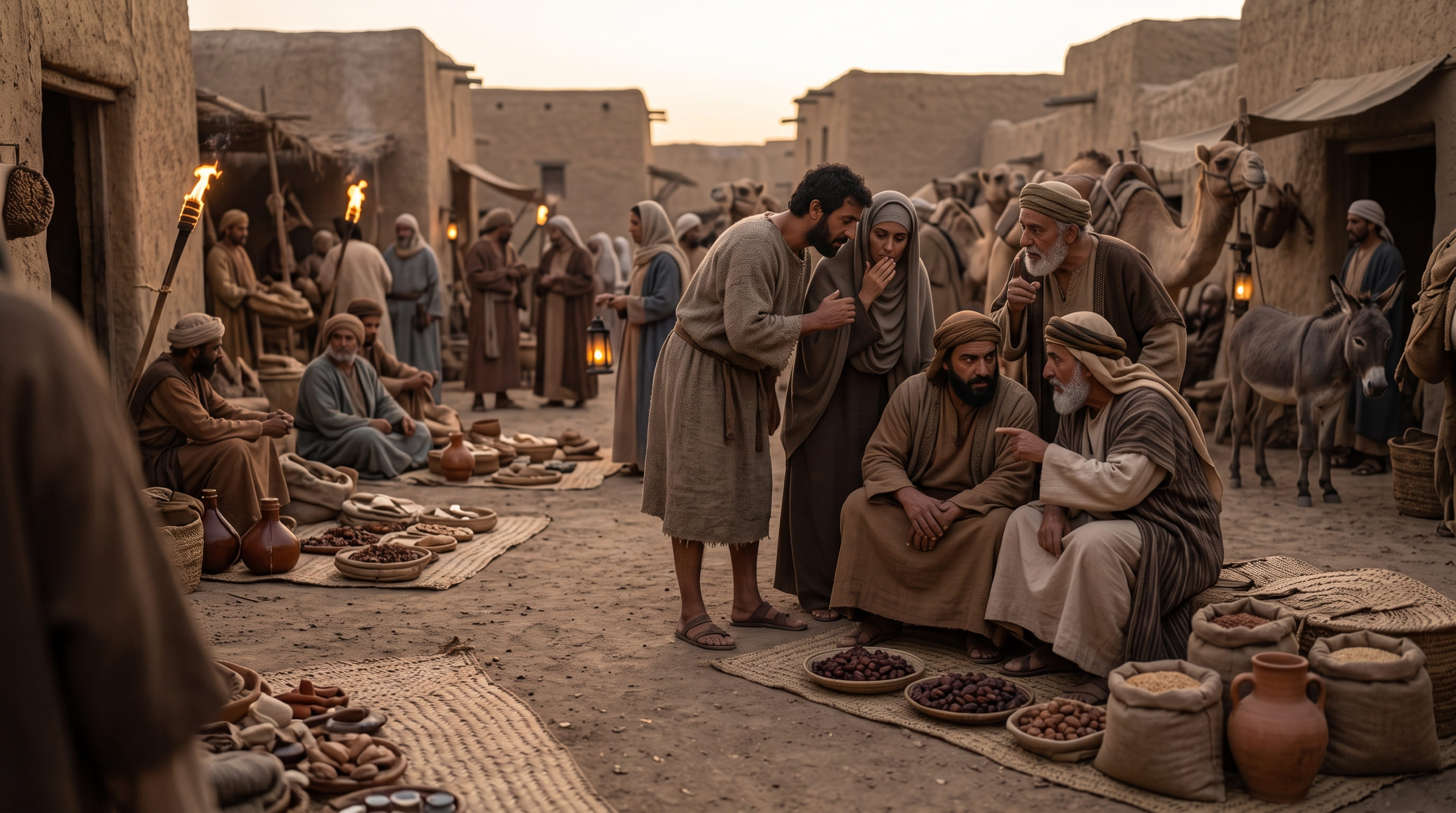
PART 4 — The Hands Preparing the Journey
The sun had plunged behind the rocky hills encircling Madinah. The red glow filling the western horizon moments before slowly faded, replaced by an ever-deepening bluish hue. From the modest minaret of the Prophet's Mosque, the Maghrib adhan had just been completed. The city's inhabitants filled the mosque once more to perform congregational prayer, then dispersed slowly toward respective homes as night began to enshroud the city. In the alleys, oil lamps began to be lit. Their light was not overly bright. Yet sufficient to illuminate earthen paths known to every resident of Madinah since childhood. Along one alley leading toward the southern portion of the city, the sound of wood being hammered echoed in succession. Tok... Tok... Tok... That sound was not loud. Yet sufficiently regular that anyone passing that alley straightway knew Malik bin Atiah was still at work. His house was modest. Beside the main hall stood a small structure roofed with date fronds, utilized by him for years as a workshop. Various tools were arranged neatly along the walls. There were chisels of diverse sizes, small knives for smoothing wood, wooden mallets, simple hand drills, and several pegs fashioned from samurah wood renowned for hardness. In another corner hung sheets of tanned goat hide. Some still possessed a sharp odor, others had dried and stood ready to be sewn into water skins or parcel wrappers.
Malik was bending over a length of date board. Beside him sat Umar, his eldest son, holding a chisel with both hands. "Do not be hurried." Malik's voice remained calm. "A knife blade never favors a hasty hand." Umar promptly slowed his movement. "Like this, Father?" "That is permissible." Malik nodded. "Yet look not solely at the chisel's tip." "Then?" "Observe the grain of the wood." The youth frowned. He examined the board before him more closely. Malik placed his palm upon the wood's surface. "Allah created every trunk with its respective path." He drew his index finger along the direction of the grain. "If you force a cut against its path..." "...the wood will split." He gazed upon his son with a smile. "Likewise men." Umar ceased chiseling. He understood his father was once more imparting something greater than mere labor.
In the courtyard, little Khalid was helping his mother, Hindun binti Qais, gather wood splinters into a woven basket. "Do not discard them," Hindun said upon seeing her son about to toss several small pieces of wood. "So small, Mother." "Small does not mean useless." Hindun picked up one of those pieces. "Look." She showed it to Khalid. "This can become a peg." She then took another piece. "This one can become a spoon handle." She smiled. "Whereas the smallest..." "...can still serve as firewood for baking bread." Khalid nodded earnestly. He placed all the wood fragments back into the basket.
Not far from them, greetings sounded from before the house. "As-salamu'alaykum." Malik halted his work. He recognized that voice. "Wa'alaykumussalam warahmatullah." Abdullah bin Yusuf stood before the modest fence alongside Hilal bin Rashid. Before long Samir followed from the direction of another alley, as though they had indeed agreed to meet following the Maghrib prayer. Malik promptly rose to welcome his companions. "Please enter." Abdullah observed that small workshop closely. The aroma of freshly chiseled wood mingling with the scent of tanned hide filled the air. He picked up one of the pegs resting upon the workbench. The peg was small. Its length was not even greater than a span of a man's hand. "How long does it take to make such a thing?" Abdullah asked. Malik smiled. "A brief while." "Then why do you craft it with such precision?" Malik took the peg from his companion's hand. He lifted it until level with the lamp's light. "Because a great chest..." "...at times depends entirely upon a small peg."
The room grew quiet once more. Abdullah gazed upon that peg for some moments. Then he smiled small. "By Allah..." "...this day I have learned from a writer, a water-finder, a merchant..." He looked upon Malik. "...and now from a carpenter." Hilal chuckled softly. "Verily Madinah harbors a teacher in every house." They all smiled. Not a soul realized that simple dialogue in that small workshop would later prove far more precious provisions than wood, pegs, or the chests they were preparing. For the long journey awaiting them demanded not merely strong hands, but likewise hearts understanding that in building a civilization, matters appearing small frequently prove the supports of greatness. The lamp hanging from one of the small workshop's pillars swayed gently as the night wind slipped through the gaps in the date-frond weave. Its light danced upon the earthen walls, making the shadows of the men seated within lengthen and shorten with the flickering flame. Hindun brought a wooden tray. Upon it rested several pieces of warm wheat bread, a small bowl of olive oil, several dates, and an earthenware pitcher of water drawn from the well shortly before sunset.
"Please partake." she said softly. "May Allah bless this meager provision." Abdullah promptly replied, "May Allah bless this house and all who dwell within it." They partaking as was the custom of Muslims. Little speech while hands still held food. What was heard was merely the whispering wind, the crackling of the lamp, and the sound of Khalid attempting to calm a kid goat bleating incessantly in the back courtyard. Upon finishing their meal, Malik poured water into earthenware bowls. He drank a sip, then set it down. "Abdullah." "Yes." "I desire to show you something." He rose toward the room's corner. Standing there were three wooden chests of varying sizes. The first chest was no larger than a wheat basket. The second was sufficiently large to store parchment scrolls, garments, and several tools. While the final chest nearly matched the height of a small child. Abdullah observed their joints closely. No iron nails were visible. What appeared were merely small wooden pegs fitted so tightly they nearly blended with the boards.
"How long have you labored upon all these?" Abdullah asked. Malik stroked the surface of the largest chest with his palm. "Nearly two seasons." "Nearly two seasons?" Hilal looked astonished. "For whom?" Malik smiled. "For whosoever may require them." He opened the lid of that chest slowly. Its hinges emitted no sound whatsoever. "I am accustomed to crafting several chests beforehand." "Why?" "Because there are labors that cannot be completed when men order them anew." Samir nodded slowly. "That is also a merchant's habit." All eyes turned to him. "I ever store slightly more wheat than is required." "Even when there are no buyers?" Samir smiled. "Precisely because there are none." Malik laughed softly. "It appears Allah teaches the identical lesson to a carpenter and a merchant."
The atmosphere grew lighter. For a time they forgot dialogue concerning journeys. In the corner of the room, Umar still held his chisel. He did not join the speaking. Since earlier his eyes had observed Abdullah far more. That man gave few counsels. Yet whenever he spoke, all men listened. His desire to ask could no longer be restrained. "O Abdullah." Abdullah turned with a smile. "What is it, Umar?" The youth looked hesitant. He glanced toward his father first. Malik nodded. "Ask." Umar drew a slow breath. "Is it true..." "...that we shall leave Madinah?" The room, warm moments before, grew once more silent. Hindun halted her hands folding cloth. Khalid, playing in the courtyard, even gazed toward the workspace, as though sensing altered atmosphere despite not grasping the cause.
Abdullah did not answer right away. He gazed into Umar's face for some moments. That face was still young. His gaze was honest. No fear appeared there. What existed was merely the desire to know truth. Abdullah then gazed upon Malik. Malik met that gaze calmly. He surrendered the answer to his companion. Abdullah turned back to Umar. "Tell me." "What do you comprehend of hijrah?" Umar thought a moment. "Hijrah is leaving a place." Abdullah nodded slowly. "That is true." "Yet not entirely." He paused briefly. "Hijrah..." "...is moving forth out of obedience to Allah." All remained silent. "This day..." "...not a soul among us has been commanded to depart." Abdullah's voice remained calm. "Therefore, do not fill your heart with matters Allah has not decreed." He smiled at the youth. "Fill this day with your labor." He pointed to the chisel still in Umar's hand. "Learn to craft a good chest." "Should Allah truly call us to walk one day..." "...may your hands be sufficiently skilled to aid your brethren." Umar lowered his head. "Insha Allah." That reply was brief. Yet uttered with conviction, causing Malik to smile with pride in his son.
Outside the house, the night of Rabi' al-Awwal grew ever denser. From a distance came the voice of someone chanting verses of the Qur'an from a dwelling not far off. That recitation was borne upon the wind, flowing softly among date orchards and narrow alleys of Madinah, as though accompanying the night slowly closing another day in the lives of families being prepared by Allah to walk a road whose end they had not yet seen. Night descended ever deeper upon Madinah. Upon the clear sky, stars filled the vault of heaven. The slender crescent moon hung low in the western horizon before slowly sinking behind the rocky hills. Lamp light from resident houses served as sole illumination in alleys growing sparse. From time to time sounded wooden doors closing, followed by footsteps of men returning indoors after verifying their goats were penned. In Malik bin Atiah's small workshop, conversations diminished. Not because there remained nothing to discuss. Rather because night reminded them every man possessed a household awaiting his return. Malik lifted his father's aged mallet once more. With utmost care he placed it upon the wooden rack, precisely beside the chisel and tanning knife cleaned previously. He performed all slowly, as though every tool possessed a place not to be altered.
Abdullah observed that habit. "You ever place them in the identical spot?" Malik smiled without turning. "For many years." "Why?" "Because my hands shall seek them there when dawn breaks." He straightened a coil of hemp rope. "If I displace them tonight..." "...then tomorrow I shall struggle myself." Hilal nodded slowly. "An orderly house aids its master." "True." Malik turned to Abdullah. "Likewise the heart." No more words were added. Those words settled quietly within each mind.
Hindun came forth bearing a thick piece of cloth. Night air began turning cold, particularly for those still seated within the open workspace. She placed that cloth near her husband. "Night wind is descending." Malik received that cloth with expressions of gratitude. Abdullah gazed upon that husband and wife with a smile nearly invisible. That house was not large. Filled with no precious goods. Yet every corner displayed something difficult to find in many places. Order. Every tool returned to its place. Every child knew his task. Every labor was completed before passing to the next. No voice was raised. No command was repeated. Everything flowed like water finding its own path. Samir seemed to read Abdullah's heart. He spoke softly, "I have observed Malik's house long." Abdullah turned. "And?" "If a man desires to know what manner of master dwells within..." "...look upon his tools." Hilal smiled small. "A water-finder looks upon earth." "A merchant looks upon the market." "And you..." Hilal glanced toward Malik. "...look upon tools." They all chuckled softly. That laughter was brief. Yet sufficient to warm the night.
In the back courtyard, Khalid slumbered upon Hindun's lap. The kid goat he had chased earlier now curled not far from his feet. Umar closed the pen door after ensuring all livestock had entered. He then extinguished the small lamp hanging near the pen so its oil might not exhaust swiftly. Upon returning to the workspace, he perceived the guests had prepared to take leave. Abdullah rose first. "May Allah bestow blessings upon this house." "Aamin." Malik replied. Hilal embraced his companion firmly. Samir clasped Umar's hand, then stroked the head of Khalid still sleeping soundly without awakening him. Harun, who had remained mostly silent until then, likewise rose. He offered greetings to all present in the room before sitting near the door.
"O Harun," Abdullah addressed him. "Does the Teacher send you?" Harun nodded. "He begs pardon for being unable to come tonight." "Is he well?" "Praise be to Allah." Harun smiled. "He merely bade me deliver a single message." All present turned toward him. Harun did not immediately extract the contents of the cloth pouch he carried. He placed it upon the floor first. Then spoke with tranquility, "The Teacher requests that beginning tomorrow..." "...every family write down everything deemed most vital to carry should Allah truly open the path of hijrah." The room fell silent. Not a soul imagined that request would arrive so swiftly. Harun continued, "He counsels..." "...write not that which is costliest." "...nor that which is most abundant." He paused briefly. "Write down what you most fear should it be left behind." Not a soul replied at once. Abdullah stared at the floor. Hilal gazed upon both palms. Samir drew a long breath. Malik looked upon chests unfinished. In the room's corner, Umar and Khalid exchanged glances without fully comprehending why adults had suddenly fallen silent once more. Meanwhile, the lamp burned on with tranquility. Their shadows swayed gently against the earthen wall. And that night of Rabi' al-Awwal witnessed the inception of reflection bringing every household into its individual journey of the spirit—before they truly set foot leaving the land they had loved since birth.
PART 5 — The Light Still Burning
Night had passed its first midpoint when Abdullah bin Yusuf walked away from Malik bin Atiah's house. His stride was calm, accompanied by Hilal and Samir until reaching the alley intersection. Following mutual salutations and supplications, each took the road toward his dwelling. The alleys of Madinah grew ever quieter. Lamps hanging before houses remained but a few. Some had been extinguished so their oil might not exhaust swiftly. From a distance came the voice of someone reciting verses of the Qur'an in a subdued tone. That recitation flowed softly, borne by the night wind sweeping through date orchards before vanishing among earthen walls. Abdullah walked alone. He knew every turn of the road he traversed. To the right stood the house of an elderly weaver. To the left rose the date orchard of an Ansar family who every harvest season frequently sent several fruit clusters to neighbors. Not far from thence stood a public well nearly deserted by midday, yet now retaining solely the sound of a wooden bucket swaying gently in the wind. He paused momentarily. Lifted his face to the sky. Stars spangled the vault of heaven. Among countless journeys he had undertaken, the sky of Madinah remained ever the sky he knew best. Each time he returned from a trading voyage, the first sight he yearned for was not his own home. Rather, the sky sheltering the Prophet's City. "Praise be to Allah..." he uttered softly. Then resumed his steps.
The door of his house was not yet closed. Lamp light still appeared from beneath the curtain covering the entrance. Abdullah smiled small. Maryam was still awake. He offered greetings before stepping inside. "As-salamu'alaykum warahmatullah." "Wa'alaykumussalam warahmatullahi wabarakatuh." Maryam welcomed him with a warm smile. Upon the mat stood an earthenware pitcher, a small bowl of warm goat's milk, and several pieces of wheat bread remaining from supper. "You have not rested?" Abdullah asked while removing his shawl. Maryam shook her head gently. "I awaited you." Abdullah seated himself upon the mat. He drank water first before touching the bread. "The children?" "Fatimah fell asleep not long after Isha." "Iskandar?" Maryam smiled. "He strove to remain awake." "And?" "Ultimately fell asleep holding the date frond he used earlier for writing." Abdullah chuckled softly. "Where is he now?" Maryam pointed toward the adjacent room. "Still there."
Abdullah rose slowly. He walked toward the room where both children rested. The small lamp still burned. Its light sufficed to reveal Iskandar's face sleeping sideways with a piece of date frond beside his hand. Near him, Fatimah hugged her small cherished cloth. The breathing of both sounded steady, presenting tranquility possessed solely by children. Abdullah crouched. With utmost care he lifted the date frond from his son's hand so it might not snap when the body stirred in sleep. He observed the scrawls of letters not yet fully formed. Some remained tilted. Others overly close. Yet there appeared the earnestness of a child learning. Abdullah smiled. Then stroked Iskandar's head slowly without awakening him. "May Allah make you one who cherishes knowledge," he whispered nearly unheard. He then gazed upon Fatimah. The child slept so soundly a lock of hair had fallen across her brow. Gently Abdullah brushed it aside. For a space he merely watched his children in silence. Outside the house, the night wind continued blowing softly. The sound of Qur'an recitation from a distant house remained audible faintly. And for a fleeting moment, all talk concerning journeys, provisions, markets, chests, and manuscripts seemed to recede. What remained was solely a father gazing upon his children, then asking within his heart with fervent hope: "O Allah, whithersoever Thou mayest hereafter guide our steps, never distance them from Thy Book and the Sunnah of Thy Prophet." Abdullah remained crouching beside his children's sleeping mat. The dim lamp light made the shadows of Iskandar's and Fatimah's faces appear to move slowly each time the flame flickered in the wind entering through the wall cleft. From a distance came the howl of a desert hound, then silence returned. Night had truly mastered Madinah. He straightened once more the thin blanket covering Fatimah's body. The little girl murmured softly in her sleep, then settled back into slumber without opening her eyes. Iskandar stirred slightly. His hand sought the date frond that moments before rested beside him. Upon failing to find it, his fingers grasped the edge of the mat, then grew calm once more. Abdullah smiled small. He placed the date frond near his son's pillow, sufficiently close to be reached should Iskandar awaken toward dawn. Then he stood slowly and returned to the front room. Maryam was folding several pieces of cloth dried since noon. Her folds were neat. Each piece was arranged by the wearer's size. Iskandar's garments were separated from Fatimah's. Abdullah's newly washed cloak was placed uppermost for easy retrieval when setting out for the mosque before Fajr.
Abdullah seated himself before his wife. For some spaces they did not speak. Such silence was no stranger between them. Through years of dwelling together, they had learned that not every togetherness must be filled with words. Maryam broke the silence first. "Did you gather at Malik's house tonight?" "Indeed." "How was his state?" "As ever." Abdullah took a piece of wheat bread. "That house ever makes me desire to learn." Maryam smiled. "I feel likewise frequently when conversing with Hindun." Abdullah nodded. "Every house holds a lesson." He dipped the bread into olive oil before consuming it slowly. "Hilal's house teaches patience." "Qasim's house teaches trust." "Malik's house teaches precision." Maryam gazed upon her husband. "And our house?" Abdullah smiled faintly. "That is what I pondered upon the homeward road."
Maryam did not immediately demand an answer. She knew her husband was still seeking it. The lamp flame flickered anew. Outside sounded footsteps passing the alley. Those footsteps were unhurried. Moments later greetings were offered to the household across the street, followed by a subdued reply. Life in Madinah had not yet truly fallen asleep. Maryam completed folding the final garment. She then lifted a small cloth pouch stored long within the chest. That pouch was not large. Its color had begun to fade. Yet its stitching remained strong. She placed it before Abdullah. "Do you still recall this?" Abdullah gazed upon that pouch for several moments. Then his smile gradually unfolded. "Assuredly." He received it with both hands. "This was sewn by my mother." Maryam nodded. "She bestowed it several days before our marriage." Abdullah untied its cord. Within lay merely several objects. A silver ring long unused. A small piece of cloth. And a simple rosary strung from dried seeds. He stroked that cloth slowly. "Mother ever stored fragrances within this pouch." Maryam still remembered it. Each time her mother-in-law opened that pouch, a gentle scent wafted forth, not the pungent fragrance of merchant perfumes. That fragrance had long since vanished. What remained was solely memory.
Abdullah closed that pouch once more. He did not place it inside the chest. Instead, he laid it beside the lamp. Maryam observed that movement. "Will you carry it tomorrow to the Teacher's house?" Abdullah gazed upon that pouch awhile. "Then for what purpose?" "I know not." Maryam smiled gently. "Perhaps because since earlier you have never placed it far from your sight." Abdullah smiled in turn. "Perhaps you are right." He lifted the pouch. Opened it once more. His fingers halted upon the silver ring within. It was not the ring catching his attention. Rather, the stitching along the pouch's interior. He recognized that stitch. His mother always knotted the final stitch slightly tighter than the rest. Once when small he had asked why his mother did so. His mother merely answered with a smile, "So that if this pouch falls upon the road, its contents shall not easily scatter." Recalling that answer caused Abdullah to draw a long breath. Not from sorrow. Rather because he realized anew that even within a small stitch, his mother ever pondered days yet unborn.
Maryam perceived the alteration in her husband's countenance. She asked nothing. Merely poured a little water into the earthenware bowl and placed it near Abdullah. Within that house they had learned through years that pleasant memories need not be severed with many questions. They are merely accompanied. Outside, night continued moving toward its final third. And across various quarters of Madinah, without knowing it, every household gathering on the morrow was completing final labors before closing their eyes, while their hearts slowly prepared to welcome the consultation that would unite all families within a single gathering at Shaykh Umar's house. Not long after Ziyad departed from Abdullah's house, the alley before it grew quiet once more. The sound of sandal steps heard slowly moments before had now vanished alongside the lantern's shadow he carried. The night wind blew ever more softly, stirring the doorway curtain woven from date fronds. In the distance, a camel uttered a long call before growing still once more, followed by the rustle of date leaves rubbing against one another. Abdullah closed the house door slowly. He made certain the latch was fastened as was proper, not because Madinah was filled with doers of wrong, but because the habit of guarding trust had long been taught in that city. Following that he extinguished the lamp near the door, leaving a single small lamp in the central hall so the house might not be wholly dark should any child awaken toward dawn.
Maryam still sat upon the mat. Before her lay a small basket containing garments finished folding. She re-examined each piece, ensuring none remained in the courtyard when the sun sank earlier. "Tomorrow morning I desire to go early to the well." she said softly. Abdullah gazed upon his wife. "Because of the Teacher's summons?" Maryam nodded. "Hafsah usually arrives before sunrise. Perchance Ruqayyah and Salma will likewise be early." Abdullah understood his wife's intent. The men frequently consulted upon the mosque portico or at Shaykh Umar's house. Yet the women possessed their own manner of strengthening one another. They met at the well. At the grinding stone. In the courtyard while drying cloth. Amidst labors appearing simple, yet frequently serving as the place where they exchanged supplications and steadied their hearts. "I shall awaken you before setting out for the mosque." Abdullah said. Maryam nodded softly. "May Allah awaken us prior to that."
In Hilal bin Rashid's house, the atmosphere differed little. Hafsah had just covered earthenware water jars with wooden lids so night dust might not enter. Rafi' finished inspecting the sheep's tether, while Lubna, drowsy since earlier, finally slumbered upon her mother's lap before completing the tale she desired to recount. Hilal sat in the doorway. His hands held an earthenware cup filled with water. He drank it not. His gaze instead sought the star-strewn sky. Rafi' emerged bearing a piece of cloth. "The air grows cold, Father." Hilal received that cloth. "Thank you." Rafi' sat beside his father. No conversation ensued for a space. The youth had learned his father cherished such tranquil moments. "Father." "Yes." "Shall we carry something tomorrow to the Teacher's house?" Hilal considered a moment. "We carry ourselves." "You mean?" "At times..." Hilal gazed upon his son. "...that is the most vital provision." Rafi' asked no further. He merely nodded, then gazed upon the sky alongside his father.
In Samir bin Wahhab's house, Ruqayyah wrapped little Maryam sleeping soundly beside her mother. Sa'd still sat near the door, smoothing the tip of a shepherd's staff using a smooth stone. Samir observed him. "It grows late." "I am nearly finished." "Do not strain your eyes." Sa'd smiled. "Only a little remains." Samir approached his son. He lifted that staff. Examined it from tip to tip. "You have smoothed it well." Sa'd smiled proudly. "Tomorrow carry this when pasturing." "Insha Allah." Samir returned that staff. He then stroked his son's shoulder before entering the house. No long counsel. No repeated admonitions. Merely a father's touch making his child's heart feel valued. Night continued moving. In Qasim's house, the wooden chest had been stored back in its place. In Malik's house, his father's aged mallet hung upon its peg. In Umar bin Jundab's house, wood shavings had been swept clean from the floor. In Abdullah's house, his mother's small pouch now rested beside the Mushaf always recited following the Fajr prayer.
One by one lamps were extinguished. One by one doors were closed. Yet within every house remained hearts not yet truly slumbering. Not from fear of tomorrow. Rather because they knew the gathering soon to transpire was no ordinary meeting of companions. Something moved slowly behind all consultations, supplications, and encounters experienced these past days. None had yet been able to name its shape. Yet each began to perceive it. Upon the sky of Madinah, stars continued shining as on previous nights. The Prophet's Mosque stood tranquilly amidst the city. The alleys grew quiet once more. And as the final third of the night drew near, one by one the inhabitants of the Prophet's City surrendered themselves to sleep, hoping Allah would reunite them with a dawn bearing blessings. Meanwhile, in Shaykh Umar's house, the lamp still burned. He sat alone upon the portico, accompanied by an open Mushaf before him. His lips moved slowly, chanting the verses of Allah. None disturbed that devotion. From time to time he halted his recitation, raised both hands, then supplicated in a voice heard solely by the Lord of all worlds. Night witnessed a teacher's supplication. While the unrisen dawn stood ready to bear answers that would hereafter alter the journey of those families.
[Next paragraph. Separate dialogue, atmosphere shifts, and scene transitions into new paragraphs.]