Bhre Kertabhumi
Chapter 002 — The Breathing Navel of the Earth
Western Slopes of Mount Semeru, 1453 CE — A body frozen by poisonous dew and the rise of a sacred vendetta.
PART 1 — Fever of the Body and Flashes of Trowulan's Fire
Night on the western slopes of Semeru did not descend as it did in the lowlands of Trowulan. In the capital of Majapahit, night was a disciplined ceremony—bronze bells struck three times from the main prayer pavilion, coconut oil lamps extinguished by court attendants moving with measured steps, and the scent of sandalwood incense rising from worship pavilions as a sign that the world would soon rest. There, night was time governed by the rhythm of gamelan and ancestral custom, arriving with a face predictable to every soul dwelling behind the red-brick walls of the capital.
But on Semeru's western slopes, night was an entirely different creature. It came not as a curtain gently falling, but as a black wave rising from the valley floor—ascending slowly, like a long breath exhaled from the mountain's very belly. When the sun last touched the crowns of ancient pines on the western horizon, its light did not fade softly. It was snatched away. That light was pulled back by darkness that had waited behind the tree trunks, like a hunter who had watched since noon, patient, unmoving, until its prey faltered for a fraction of a second.
The mist that had hung in the valley since morning—a soft, milky-white mist that made the trees appear like dreaming giants—changed color in a way only those who had learned to see could perceive. First, it turned bluish-gray, like old cloth washed too many times. Then that gray thickened, becoming dark gray, then pale purple, then pitch black that seemed to absorb all sound, all light, all hope. Stars emerged one by one through gaps in the branches—stars that in the lowlands appeared small and tame, but on Semeru's slopes seemed large, sharp, and cold, like the eyes of ancestors watching from immeasurable distance.
Yet that starlight did not reach the valley floor. There, where Bhre Kertabhumi and Dewamatra spent their first day, darkness had its own weight. It was not merely the absence of light—it was something alive, breathing, pressing. That darkness was heavy, damp, and filled with invisible breaths that could only be felt by those who had learned to listen. There was a subtle rustle among the pine trunks—not the rustle of wind, but something more ancient, like the sound of earth speaking to tree roots. There was a faint crack from a distant breaking branch, whether from the weight of a perched owl or the step of a civet hunting among the underbrush. There was the scent of wet earth mingled with the fragrance of wounded pine needles, a sharp scent that pierced the nose, stirring old memories from the depths of the soul unbidden.
And that night, something was different. Something Kertabhumi had never felt throughout his life on Semeru's slopes. Poisonous dew. It descended not as ordinary droplets of water. It fell as a fine mist carrying cold poison from the mountain's peak—a poison that did not kill the body, but froze the soul. That dew appeared when the sun had fully set, when stars began to twinkle with piercing cold, when wind from the crater changed direction and carried with it a faint yet sharp scent of sulfur. That dew moistened every leaf, every blade of grass, every stone on the slope—but it did not moisten with gentleness. It moistened in a way that made skin sting, that raised the hair on one's neck, that made breath short and broken.
Kertabhumi knew of poisonous dew from the tales of Resi Wangsadipa. "Poisonous dew falls only when Semeru is angry," the sage had said years ago, when Kertabhumi was still twelve years old and sat before him in a small hermitage on the northern slope. "It is the mountain's frozen tears—tears that demand a promise from those who dare tread its path without sufficient preparation. If you encounter poisonous dew, young one, know that your body will become a battlefield. Heat and cold will battle within your blood. Soul and body will repel each other. And only those with sufficiently strong wiji daya will survive that night."
Kertabhumi did not fully understand the meaning of those words when he first heard them. But this night—the first night after the inner trial that forced him to gaze upon the four fragments of his own soul, the first night after the bodily austerity that forced him to stand upon stone until his body screamed to collapse, the first night after he found wiji daya—that seed of golden-red light now pulsing weakly at the center of his belly—he began to understand. Poisonous dew was falling. And his body was becoming a battlefield.
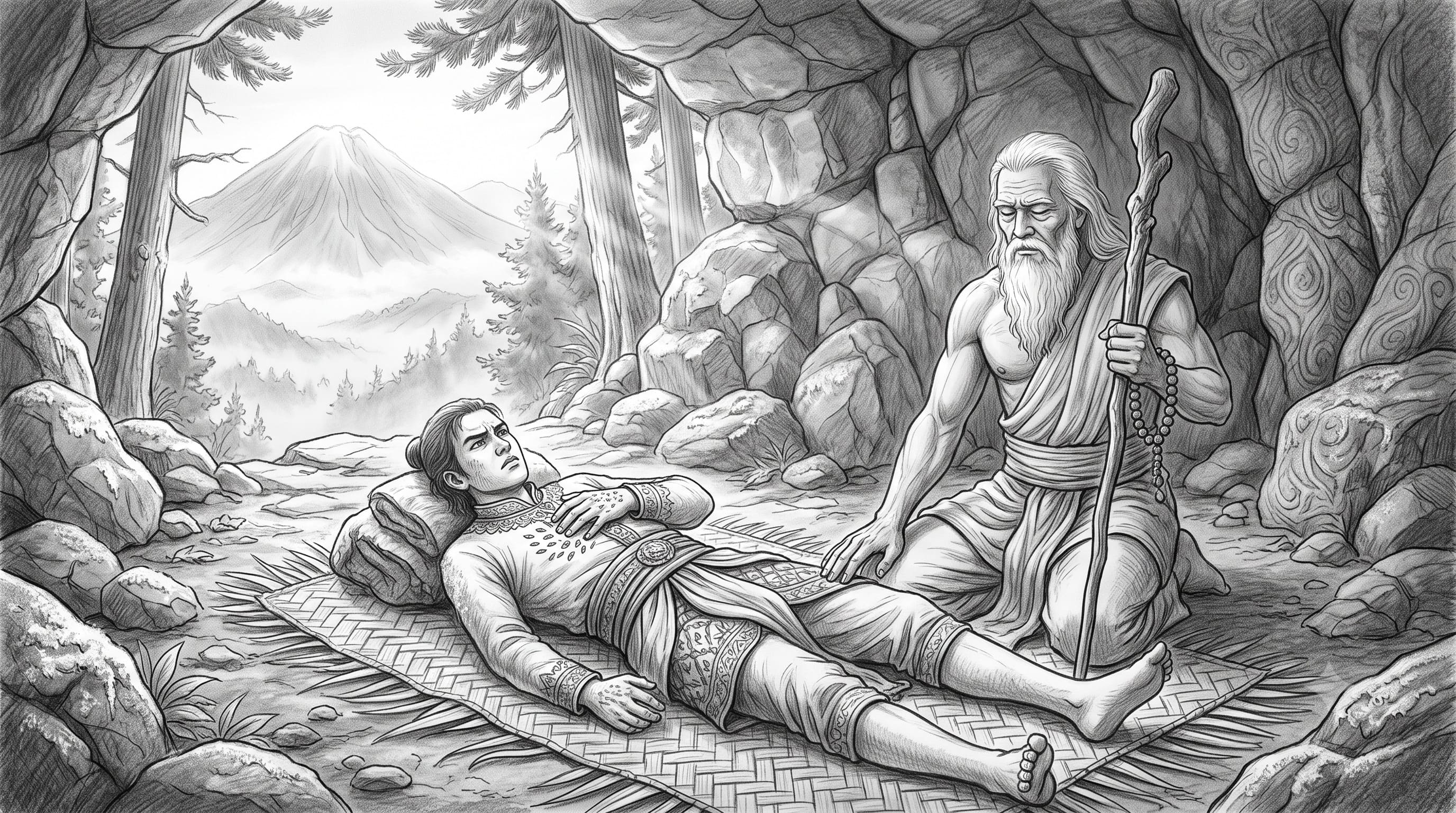
The rocky shelter where he lay was not a building. It was merely a stone hollow formed by thousands of years of rain and wind—a hollow wide enough to hold one curled body, deep enough to shield him from the cruel summit winds, yet open enough to let Semeru's night enter and demand its due. Its floor was lined with freshly plucked palm fronds—yellow fronds spread by Dewamatra himself with slow, reverent movements, as if the sage were arranging an offering for a long-abandoned altar. Those fronds were still fresh, still carrying the gentle scent of coconut sap, yet now—in the midst of poisonous dew falling without cease—they began to change.
Their leaves, which had been yellowish-green since morning, now began to blacken at their tips. The sap that had flowed gently between their fibers now thickened into a black liquid with a sharp odor—a scent resembling incense burned too long, a scent that mountain ascetics called the scent of bhuta—a scent signaling that nature was rejecting human presence in that place. And when Kertabhumi tried to move his body—trying to turn over, trying to find a more comfortable position—he felt that the fronds had become something foreign. They were no longer soft. They were no longer warm. They became stiff, hard, like skin dried by sun too long—but this time it was not sun that dried them, but poisonous dew freezing every fiber of the fronds from within. Kertabhumi tried to lift his hand to touch the fronds, but his fingers—which had trembled since earlier from the remnants of training—did not respond quickly. His movements were slow, stiff, like the movements of an old man who had long lived in the mountains. And when his fingertip finally touched the frond's surface, he felt something that made him hold his breath. The frond was cold. Not ordinary cold. Cold that pierced to the bone.
Cold that seemed to originate from the earth itself—from the depths where Semeru's fire resided, from the place where ancient stones stored undying heat, yet which now—because of the poisonous dew—had transformed into freezing cold. That cold crept from the frond to his palm, from his palm to his arm, from his arm to his chest, until it reached the center of his belly—to the place where his wiji daya pulsed weakly, like a small ember struggling to stay alight amid a storm.
Kertabhumi drew his hand back. But that cold did not fade. It clung to his skin like a thin layer of ice that could not be wiped away by any rubbing. It crept deeper, entering his muscles, his bones, his blood which had pulsed irregularly since earlier from the remnants of fever not yet fully gone. And at that same moment—as that cold crept inward—heat began to rise from within his body. Strange heat. Heat that did not come from ordinary fever. Heat that seemed to originate from a place deeper within—from the center of his belly, from the point Dewamatra called Tunggal Pancer, from the place where his wiji daya resided. That heat radiated outward, meeting the cold entering from outside, and at the point of meeting—at the point where heat and cold collided—a struggle occurred that made his entire body tremble violently.
He shivered. His teeth chattered against each other, producing a tak-tak-tak sound whose echo bounced off the rocky walls of the hollow. That sound seemed foreign in his own ears—like a sound coming from another's body, from another creature suffering within him. Cold sweat poured from his temples, moistening the fronds that had now grown hard beneath his head, making the flat stone serving as his pillow feel slick and cold when his cheek touched it. Yet he remained cold. That sweat was not relieving sweat—it was betraying sweat, emerging from his body not to cool, but to signal that his body was losing control over itself. And amid the battle between heat and cold, Kertabhumi felt something more terrifying. Pain that did not come from the body. Pain that came from the soul.
He did not know when that transition began. Perhaps when his eyes grew heavy from fever rising higher. Perhaps when his breath grew broken from cold growing more piercing. Perhaps when his wiji daya—the small ember at his belly's center—began to pulse irregularly, like the heartbeat of a bird trapped in a deep cave. All he knew was this: at some moment—a moment he could not pinpoint with certainty—the world around him began to change.
The stone hollow where he lay no longer felt real. The rocky walls that had sheltered him since earlier began to thin, becoming transparent, becoming like silk cloth stirred by wind—cloth that could no longer conceal what lay beyond. And beyond that cloth, Kertabhumi saw something that made him hold his breath. He saw Trowulan. The capital of Majapahit.
But not the Trowulan he knew—not the Trowulan magnificent with its soaring red bricks, not the Trowulan bustling with the steps of court attendants, not the Trowulan alive with gamelan sounds from prayer pavilions and the scent of sandalwood incense rising each morning. What he saw was Trowulan burning. Fire. Fire everywhere. Fire devouring the queens' pavilions—pavilions he had always imagined as the place where his mother, Dyah Kusumadewi, slept peacefully behind silk curtains. Fire devouring the assembly halls—halls he had always imagined as the place where his father, Prabu Rajasawardhana, sat upright upon the throne, gazing at kingdom maps with sharp eyes. Fire devouring the prayer pavilions—pavilions he had always imagined as the place where brahmins offered prayers, seeking protection from Hyang Widhi for the entire royal family.
And amid that fire—amid the blaze consuming everything he loved—Kertabhumi saw something that made him want to scream, yet no sound emerged from his throat. He saw his mother. Dyah Kusumadewi. His mother stood in the courtyard of the queens' quarters, half consumed by flames, her hair—usually neatly arranged—now disheveled, her silk garments—usually pristine—now stained with ash and blood—blood that was not her own. She held something in her hands—a shawl that had long been her outlet for anxiety, a shawl now torn in half, now a silent witness to all the destruction that had occurred. Her eyes—eyes usually clear and full of love—now widened with fear, with panic, with something deeper than fear: with despair.
"Mother!" Kertabhumi wanted to scream. But his voice would not emerge. He tried to rise from the fronds that had now grown hard beneath him, but his body did not respond. His body was paralyzed—paralyzed by fever, paralyzed by cold, paralyzed by something deeper than both: by an invisible force compelling him to witness, to see, to feel all that destruction without being able to do anything.
And he saw more. He saw the ladies-in-waiting—Sri Sambi, Ninis Wulan, and other attendants who had accompanied him since childhood in the queens' quarters—running among the flames, carrying water jars that had always held water to extinguish fires, yet which now—when that water was poured upon the blaze—only made the fire grow larger, more ferocious, more uncontrollable. He saw elderly court attendants—attendants who had taught him since childhood how to read tracks in the earth, how to distinguish the sound of falling leaves from breaking twigs—fallen to the ground, their bodies scorched by fire that knew no mercy. He saw small children—children who had played in the palace courtyards, who had laughed joyfully unaware that their world was collapsing—crying in corridor corners, searching for their mothers, searching for their fathers, searching for anyone who could save them from the approaching blaze.
And amid all that—amid all the destruction that made his heart want to stop beating—Kertabhumi saw something more terrifying than any fire. He saw a line of soldiers. Not ordinary soldiers. Not soldiers he knew—not soldiers who had protected him since childhood, who had taught him since childhood how to hold a spear, how to read wind direction before a storm arrived. What he saw were soldiers wearing dark garments, their faces covered by black cloth, their eyes—visible through that cloth—glinting with something that was not courage, but with something darker: with intent to kill.
And on their arms—on the left arm of each soldier—there was a strip of red cloth. Red cloth tightly bound around the upper arm, cloth that Kertabhumi—raised in the palace, taught all symbols and signs by the tumenggung—immediately recognized as a mark of betrayal. A sign that they were no longer soldiers of Majapahit. A sign that they had sold their souls to someone darker, more cruel, more ruthless than anyone he had ever imagined. The Royal Guard. The traitorous forces. Forces that—as he had been taught by palace instructors—appeared only when someone within the royal family itself had decided to betray their own blood, to sell their kingdom to darker powers, to sink Majapahit into shadows that would never fade.
And Kertabhumi—who since childhood had been taught to read all signs, to understand all symbols—instantly understood who stood behind those traitors. Suraprabhawa. The uncle who had long shown signs of power-hunger. The uncle who had long been envious of his father. The uncle who had long awaited the chance to seize what was not his.
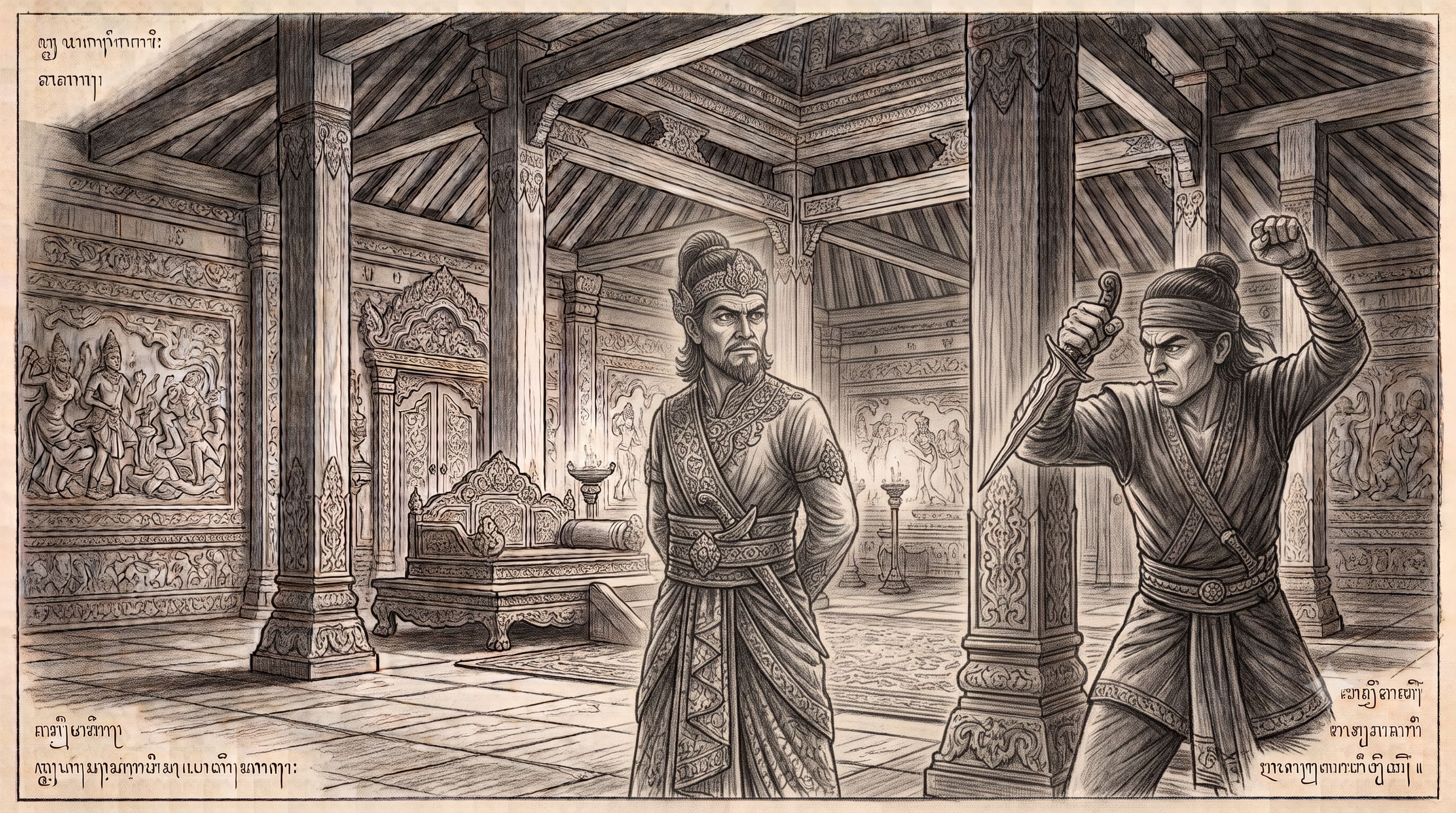
But what he saw next—what he witnessed with his inner eyes now wide open by invisible force—was something that would haunt his sleep forever. He saw his father. Prabu Rajasawardhana. King of Majapahit. His father stood in the center of Bangsal Witana—the sacred hall that for hundreds of years had been the place where Majapahit's kings received revelations from Hyang Widhi, the hall whose floor was made of polished black stone that gleamed, whose walls were adorned with Ramayana reliefs carved by Java's finest master artisans. His father stood upright—upright like an ancient pine that never wavered in any wind—with the royal robe he had always worn, with the simple crown that had always rested upon his head, with the royal scepter he had always held in his right hand.
But his father was not alone. Behind him—behind the king's body that had always stood upright unaware of the approaching danger—stood a man. That man was not large. That man was not muscular. Yet he possessed something that made Kertabhumi—who since childhood had been taught to read body language—immediately recognize him as an assassin of supreme skill. Something in the way that man stood—a manner too calm, too measured, too cold. Something in the way that man held the weapon in his hand—a weapon that was neither sword nor spear, but a keris dagger. A five-luk keris.
A keris whose blade did not gleam in the firelight burning around it, but rather absorbed that light—a keris that Kertabhumi immediately recognized as one forged by hands of masters who mastered not only metallurgy, but also dark arts. A keris that—as he had been taught by palace instructors—was used for only one purpose: to kill someone whose blood was too sacred to be spilled by ordinary weapons.
And that man—the man holding that five-luk keris—was Bharingan. That name echoed within Kertabhumi's soul like lightning striking at midday. Bharingan—a name he had only heard in the whispers of tumenggung, a name only spoken in the most dire circumstances, a name that palace elders called the shadow assassin—a man said to have slain dozens of nobles across Java, a man said never to leave living witnesses, a man said to work only for those with sufficient wealth and power to pay for his services.
And now—now Bharingan stood behind his father, with the five-luk keris in his hand, with eyes glinting with intent that could no longer be concealed. Kertabhumi wanted to scream. Wanted to warn his father. Wanted to leap from that stone hollow, from a distance of who-knows-how-far, from the inner world somehow connected to the real world, and strike Bharingan with his own keris before that man could harm his father. But his body remained paralyzed. His voice remained locked.
And he could only witness—with eyes wide with horror, with a heart beating so fiercely he could feel it in every vein, with breath broken by panic he could not control—what happened next. Bharingan moved. His movement was not fast—not like the rush of a hurried assassin. His movement was slow, measured, like the movement of a priest performing a sacred ritual. He raised his keris—raising it with his right hand, with fingers gripping the hilt with strange gentleness, as if that keris were not a weapon, but an offering he presented to someone he respected. And then—with a motion so subtle it was almost invisible—he thrust that keris into the back of Prabu Rajasawardhana. Precisely between the shoulder blades. Precisely where his father's heart resided.
Kertabhumi saw his father jerk—jerk like a tree struck by lightning, like a stone split by a giant hammer. The king's body that had always stood upright now began to waver—waver like an ancient pine finally yielding to wind too strong, waver like a mountain finally collapsing under tremors too powerful. But his father did not fall immediately. He still stood—stood with trembling legs, with hands still gripping the royal scepter, with head still upright though his blood had begun to flow from the wound in his back.
And then—then his father turned. Turned slowly, with a neck stiff from unimaginable pain, with eyes usually calm now wide with something that was not fear, but with something deeper: with betrayal. His father saw Bharingan. And Bharingan—with a face showing no emotion whatsoever, with eyes cold as a serpent watching its prey—drew his keris from the king's back. Blood. Blood deep red—blood that Kertabhumi immediately recognized as his father's blood, blood that had flowed within his own body, blood that had shaped who he was—spurted from that wound, soaking the golden-yellow robe his king had always worn, soaking the black stone floor of Bangsal Witana that for hundreds of years had witnessed all of Majapahit's glory and all its ruin.
His father fell. Fell with knees touching the floor first, then hands still gripping the royal scepter, then chest striking that black stone with a sound that—though Kertabhumi was in a different world, a different place, a different time—rang so clearly in his ears he could feel it in every muscle fiber. And then—then his father gazed toward him. Gazed not with physical eyes—but with inner eyes, with eyes that seemed to pierce distance, to pierce time, to pierce all barriers separating them. And in those eyes—in his father's eyes usually calm, usually wise, usually full of love—Kertabhumi saw something that would haunt his sleep forever. He saw a message. A message not spoken in words. A message that could not be spoken in words. A message that could only be conveyed through a gaze—a gaze that said: "Protect your mother. Avenge me. Become a king greater than I. And never—never—surrender to shadows." Then those eyes closed.
And Prabu Rajasawardhana—king of Majapahit, his father, the man who since childhood had been his exemplar, who since childhood had been his reason to become better—exhaled his final breath.
Kertabhumi screamed. A scream that did not emerge from his throat—a scream that emerged from his soul, from the depths of his inner being long locked by invisible force, from the place where all love, all respect, all devotion to his father had resided since he first opened his eyes in this world. That scream echoed within his head, within his chest, within every muscle fiber, until he felt his entire body tremble violently—tremble not from fever, not from cold, but from something deeper: from vendetta that had long begun to crystallize within his heart.
And then—then the world around him collapsed. The vision or dream of burning Trowulan vanished—vanished like mist swept away by morning wind, vanished like a dream dissolving when eyes open. The stone hollow where he lay reappeared before him—the rocky walls that had sheltered him since earlier, the fronds that had grown hard beneath him since earlier, the flat stone that had served as his pillow since earlier. And beside that hollow—at the rock's edge where Dewamatra had stood since earlier—he saw the figure of the great sage. Dewamatra.
The sage stood with back straight as an ancient pine, with his black casuarina wood staff planted in the earth beside him, with his golden-yellow robe that had been dampened by poisonous dew since earlier—dew that had now made that coarse woven cloth appear darker in places, heavier, colder. His deep eyes—eyes that seemed to see to the deepest bone, to the seed of light newly grown in his disciple's belly—gazed at Kertabhumi with an unreadable expression. Not pity. Not anger. Not disappointment. But something deeper—something mountain sages called the face of sang hyang—a face showing no emotion, yet containing all emotion, a face only possessed by those who had long passed through all suffering and all triumph.
Kertabhumi wanted to ask. Wanted to ask what he had just seen. Wanted to ask whether that dream was real—real in the sense that he was witnessing something happening in Trowulan at this very moment, or real in the sense that he was witnessing something that would happen in the future. Wanted to ask whether his father—his father he had always imagined standing upright in Bangsal Witana—still lived, still safe, still awaiting his return at the palace.
But Dewamatra did not speak. The sage only stood, gazing at him with deep eyes, with an unreadable expression, with a silence louder than any shout. And within that silence—within a silence Kertabhumi immediately understood as an answer—he felt something heavier than all the questions he wished to ask. He felt truth. Truth that could not be denied.
Truth that—though he was not yet ready to accept it, though he was not yet ready to face it—had begun to crystallize within his heart, like ice beginning to form on a lake's surface when winter arrives. His father had died. Or would die. And Suraprabhawa—the uncle who had long shown signs of power-hunger, the uncle who had long been envious of his father, the uncle who had long awaited the chance to seize what was not his—was the mastermind behind all that destruction.
Kertabhumi rose from the fronds now shattered by his own grip. Fronds that had grown hard from poisonous dew since earlier, that had grown stiff from freezing cold since earlier, had now broken into tiny fragments—fragments Kertabhumi did not realize he had crushed with fingers that had trembled since earlier from fever, from cold, from vendetta that had long begun to crystallize within his heart. Those fragments fell to earth, mingling with ancient moss that had long served as the stone hollow's floor, and Kertabhumi—who now sat with back straight, with head upright, with eyes wide not from fear but from resolve—gazed at those fragments with a look different from previous gazes. A deeper gaze. A clearer gaze. A steadier gaze.
The gaze of one who had passed through something great—something beyond words, something beyond thought, something inexplicable by logic. The gaze of one who had witnessed destruction he could not prevent, who had felt loss he could not replace, who had understood truth he could not deny. And within that gaze—within a gaze Dewamatra immediately recognized as that of one who had crossed a threshold not all humans can cross—there was something new. Something that had not been there before. Vendetta.
Vendetta that was not ordinary vendetta—vendetta not born of momentary anger, not born of desire to repay pain just felt. Vendetta born from the depths of the soul—from the place where all love for his father, all respect for his mother, all devotion to Majapahit had resided since he first opened his eyes in this world. Vendetta that Kertabhumi immediately understood as something not meant to destroy him, but to shape him—shape him into someone stronger, steadier, more ready to face whatever would come. He swallowed. It tasted bitter.
Bitter like bile that had long pooled in his throat, bitter like poison that had long crept through his blood, bitter like truth he had long wished to deny yet could not deny. "Sang Resi…" he whispered, his voice hoarse—hoarse like the voice of one who had passed a long night without a drop of water, yet that hoarseness now contained a resolve previously absent. "What I just saw… was that…?" He did not know how to finish his sentence. He did not know what word could describe what he had just witnessed—the dream of burning Trowulan, the dream of his mother standing amid flames, the dream of his father stabbed from behind by Bharingan in Bangsal Witana. He only knew he had seen something he had never seen before—something that had long awaited him, something that had long called to him, something that had now accepted him as part of itself.
Dewamatra did not answer immediately. The sage only stood, gazing at Kertabhumi with deep eyes, with an unreadable expression, with a silence louder than any shout. And within that silence—within a silence Kertabhumi immediately understood as an answer—he felt something heavier than all the questions he wished to ask. Then—then Dewamatra raised his staff. Raised it with a slow, reverent movement, as if that staff were not merely wood, but an extension of his own hand, an extension of his own breath, an extension of Semeru's breath flowing through him. The staff's tip touched earth—touching with a gentleness that made the golden moss around it not stir. Krek.
That sound was not loud. Yet its vibration traveled through stone, through tree roots, through damp earth—traveling in a way only understood by those who had learned to hear the language of earth. That vibration moved toward Kertabhumi, entering through the soles of his feet still planted upon moss, rising to his calves, to his waist, to his chest, until it reached the center of his belly. There, that vibration met the pulse of his wiji daya—and for a moment, both pulsed together, like two hearts learning to unite. Then Dewamatra spoke. "You have seen," he said softly, his voice low yet solemn. "You have witnessed what is happening—or what will happen—in Trowulan. And you have felt the vendetta that has long begun to crystallize within your heart." He paused briefly.
His eyes gazed at Kertabhumi with a sharp look—a look that seemed to see to the deepest bone, to the seed of light newly grown in his disciple's belly. "But know this, Kertabhumi," he continued, his voice now lower, more solemn. "That vendetta—that vendetta that has long begun to crystallize within your heart—is a double-edged sword. It can shape you into someone stronger, steadier, more ready to face whatever will come. But it can also destroy you—if you let it master you, if you let it blind you, if you let it transform you into someone no different from Suraprabhawa."
Kertabhumi swallowed. The bitter taste in his throat had not faded—but now, amid that bitterness, he felt something else. Something deeper, steadier, more enduring. Something Dewamatra called resolve—resolve not born of anger, but of awareness. Awareness that what he had just witnessed—what he had just felt—was something he could not change, something he could not undo, something he must face with head held high, with steady breath, with a steadfast soul. "I understand, Sang Resi," he whispered softly. "But… how can I face Suraprabhawa—someone who has dared betray his own blood—if I do not have vendetta within my heart?" Dewamatra smiled faintly.
A smile different this time from previous smiles—a smile containing teaching, a smile containing patience, a smile that came only when a teacher knew his disciple had begun to understand—yet who also knew that understanding was still new, still fragile, still needing to be tempered by time and by trial. "Vendetta and resolve are two different things, Kertabhumi," he said softly. "Vendetta is a burning fire—a fire that can light your path, yet that can also consume you if you do not control it. Resolve is a steadfast stone—a stone that can support you amid storms, yet that can also crush you if you do not know how to use it." He paused briefly.
His eyes gazed at Kertabhumi with a deep look—a look that seemed to see into the future, into the destiny written for his disciple. "Your task," he continued, "is not to extinguish your vendetta. Your task is to transform it into resolve—resolve that will support you amid the storms to come, resolve that will keep you standing when the whole world tries to topple you, resolve that will make you a king greater than your father." Kertabhumi listened in silence.
Every word of Dewamatra felt like a stone placed one by one upon his chest—a stone that did not press, but built. Building something he did not yet fully understand, yet that he felt true within his soul. Building a foundation that would support him on the journey still long—a journey toward Majapahit's throne, a journey toward the destiny written for him by the cosmos. "And for that," Dewamatra continued, "you must learn to breathe in a new way. A way that will keep you steadfast amid storms, a way that will keep you calm amid fear, a way that will keep you alive amid all trials to come." He pointed toward the eastern horizon—toward where dawn would soon appear, toward where the sun would soon reveal its face, toward where a new day would soon begin. "Rest briefly," he said softly. "For when dawn arrives, your true lesson will begin."
Kertabhumi did not sleep. He only lay—lay upon ancient moss that had now become his bed, upon the flat stone that had now become his pillow, within the rocky hollow that had now become his shelter from poisonous dew still falling without cease. He closed his eyes—closed not to sleep, but to witness again what he had just seen, to feel again what he had just felt, to understand again what he had just understood.
And within that silence—within a silence Kertabhumi immediately understood as living silence, breathing silence, silence possessing its own awareness—he felt something new. He felt that vendetta—that vendetta that had long begun to crystallize within his heart—begin to change. Change not into something weaker. Change not into something easier to bear. But change into something deeper, steadier, more enduring. Something Kertabhumi immediately understood as resolve—resolve not born of anger, but of awareness. Awareness that what he had just witnessed—what he had just felt—was something he could not change, something he could not undo, something he must face with head held high, with steady breath, with a steadfast soul.
And amid that resolve—amid resolve that had long begun to grow within his heart—he felt something else. He felt his wiji daya—the small ember at his belly's center—pulse more strongly. Pulse not with the irregular rhythm it had held since earlier that night. Pulse with a rhythm that was steady, strong, alive. An ember that seemed to have become part of himself—no longer a foreign object to be guarded, but a second heart that had grown within his body, that would accompany him in every step he would take from this day forward. And at that same moment—at the moment that small ember pulsed with a steady rhythm—he felt something deeper still.
He felt that he was not alone. Not Dewamatra he felt—though he knew that great sage was surely watching him from somewhere outside the hollow. Not Resi Wangsadipa, who had long departed to a place he did not know. Not his father—father who now was gone, who now had become memory, who now had become vendetta crystallizing within his heart. Not his mother—mother who now awaited him in the queens' quarters, who now anxiously awaited him behind silk curtains. What he felt was a presence older, deeper, more ancient. The presence of Semeru. That mountain was watching over him. That mountain was breathing with him. That mountain was singing an ancient song that could only be heard by those who had learned to listen with the soul, not with the ears. And Kertabhumi—for the first time in his life—heard it clearly.
Outside the hollow, Dewamatra stood upon a great stone. That stone lay on the ridge of a small hill overlooking the valley where Kertabhumi lay—a hill high enough to allow the sage to see the entire valley clearly, yet hidden enough by ancient pine trees to remain unseen by ordinary eyes. His golden-yellow robe fluttered gently in the night wind—wind that on this hilltop blew stronger than in the valley, carrying with it the scent of damp earth and sharp pine fragrance. Dewamatra did not move.
He stood with feet shoulder-width apart, with back straight as an ancient pine, with his left hand holding his black casuarina wood staff—a staff that had accompanied him for decades, a staff said to be made from a branch of a tree that grew upon the grave of a great sage from the Singhasari era. His right hand rested upon his chest, directly over his heart, in a gesture that mountain brahmins called anjalirasa—a gesture meaning "to feel with the heart".
His deep eyes gazed toward the rocky shelter where his disciple lay. He could not see Kertabhumi from this distance—the night darkness was too thick, the distance too great, and the stone hollow too deep. Yet he did not need to see. He could feel. He could feel the pulse of wiji daya newly born at the center of Kertabhumi's belly—a pulse that was weak, irregular, like the heartbeat of a newly hatched bird, yet that kept beating, that kept struggling, that kept refusing to fade though storms assailed it.
And he could feel something else. Something new. Something that had not been there since earlier that night. Vendetta. Vendetta that Dewamatra immediately recognized as vendetta not born of momentary anger, but from the depths of the soul—from the place where all love for father, all respect for mother, all devotion to Majapahit had resided since Kertabhumi first opened his eyes in this world. Vendetta that Dewamatra immediately understood as something not meant to destroy his disciple, but to shape him—shape him into someone stronger, steadier, more ready to face whatever would come. And Dewamatra—who had trained dozens of disciples in his lifetime, who had seen hundreds of youths come to Semeru's slopes with eyes glinting with ambition, with chests puffed with pride, with steps steady from conviction that they were destined to become great—knew that vendetta such as this was a double-edged sword.
It could shape Kertabhumi into a great king. But it could also destroy him—if Dewamatra did not succeed in teaching him how to transform that vendetta into resolve, how to control that fire so it did not consume himself, how to use that stone so it did not crush himself. And Dewamatra—who since earlier that night had decided to accept Kertabhumi as his disciple—had decided to try. He raised his staff. With a slow, reverent movement, he tapped it once upon the earth. Bruk.
That sound was not loud. Yet its vibration traveled through stone, through tree roots, through damp earth—traveling in a way only understood by those who had learned to hear the language of earth. That vibration moved toward the hollow where Kertabhumi lay—not to help, not to ease pain, not to provide warmth. That vibration was only to tell: Semeru still watches over you. But you must watch over yourself. Kertabhumi would surely feel it. Dewamatra knew this.
He knew that within that stone hollow, his disciple's body would tremble briefly—not from cold, not from fever, but from the earth's vibration saying: "I am here. You are not alone. But you must still struggle." And Dewamatra knew that Kertabhumi—in a mysterious way, in a way only understood by those who had royal blood and earth's blood within their bodies—would understand that message.
He lifted his face, gazing at the sky. Stars twinkled above him—stars that had witnessed thousands of nights like this night, stars that had witnessed thousands of youths come to Semeru's slopes to be tempered, to be tested, to be transformed into something greater than themselves. Some of those youths became kings. Some became sages. Some became legends. But far more failed, returning home empty-handed, returning to the palace as the same princes they had been when they arrived—princes who held titles but lacked soul, who held power but lacked wisdom. Dewamatra did not know where Kertabhumi would go after this night.
He did not know whether that youth would become a great king, or a wise sage, or a legend to be told by descendants for hundreds of years. All he knew was this: Kertabhumi possessed something rarely held by youths who came to Semeru's slopes. He possessed wiji daya born not only from training, but from blood—royal blood that had mingled with earth's blood for hundreds of years, since the Singhasari era, since the Kediri era, since the era before Java was known to the world.
And wiji daya such as this—wiji daya born from blood—was a rare seed, to be guarded with care, to be tempered with patience, not to be forced to grow faster than its time. Night continued. Dewamatra remained standing upon the stone. He did not sit. He did not rest. He did not move. He only stood, like an ancient guardian who had waited thousands of nights to see a small light rekindled in a valley long dark. His robe fluttered gently in the wind. His staff stood planted in earth. His eyes never left the direction of the stone hollow where Kertabhumi lay.
And far atop Semeru, the moon rose slowly—a thin crescent, its light gentle, making pine trees appear like silhouettes of giants kneeling to worship something not yet visible. That moonlight touched Dewamatra's face, making the wrinkles around his eyes appear deeper, older, wiser. He appeared like a statue carved by ancestral hands—a statue that had stood on Semeru's slopes for hundreds of years, that would remain standing though storms raged, though ages changed, though the world transformed.
Night continued. And within that rocky hollow, a young prince learned that true strength is not born from victory—but from willingness to endure when the whole body screams to surrender. And upon the hill, a great sage learned—once again—that a true disciple does not come when called. A true disciple comes when the cosmos sends him.
Approaching dawn, when the sky on the eastern horizon began to change color from black to dark gray, Dewamatra finally moved. He lowered his staff from earth—the staff that had stood planted in stone for hours, now leaving a small deep mark. He lifted his hand from his chest, moving fingers stiff from night cold. He exhaled a long breath—breath that emerged from his mouth as thin white vapor, vanishing instantly in the morning wind.
Then he descended from the stone. His steps were slow, yet steady. His robe damp from dew—dew that had fallen since midnight, that had moistened his entire body without his awareness—fluttered gently behind him. He walked down the hill, passing ancient pine trees, passing large moss-covered stones, passing roots extending like old hands begging. And when he reached the edge of the hollow where Kertabhumi lay, he stopped. He gazed at his disciple.
Kertabhumi still lay in the same position—but his face had changed. The face usually tense from pain had now relaxed. The face usually pale from fever had now gained a faint flush. The face that had seemed like that of a dying man now appeared like that of one sleeping soundly—a peaceful sleep, a deep sleep, a sleep achievable only by those who had made peace with themselves.
Yet Dewamatra knew Kertabhumi was not asleep. He knew his disciple's eyes—still closed—were moving beneath their lids. He knew his breath—now steady and deep—was the breath of one awake, not sleeping. He knew the small ember at Kertabhumi's belly center—which he could feel pulsing from a few steps away—now pulsed with a rhythm that was steady, strong, no longer like the heartbeat of a newly hatched bird, but like the heartbeat of a youth learning to become a whole human.
And Dewamatra—who since earlier that night had decided to accept Kertabhumi as his disciple—felt something new. He felt that his disciple—the disciple he had tempered that night with inner trials, with bodily austerities, with poisonous dew, with visions or dreams of burning Trowulan—had now crossed a threshold not all disciples could cross. The threshold between humans who hear with ears, and humans who hear with the soul. The threshold between humans who breathe alone, and humans who breathe with the cosmos. The threshold between humans still bound to the visible world, and humans who had begun to touch the unseen world.
And he knew—Kertabhumi's journey had just entered a deeper chapter. A chapter that would carry him farther, deeper, higher toward the destiny written for him by the cosmos. A chapter that would test him not only as a prince, not only as Majapahit's heir, but as a human who had learned to hear earth's breath—a human who one day would lead not only with power, but with wisdom born from unity with the cosmos. "You have passed the first night," Dewamatra whispered softly, his voice nearly inaudible to the morning wind. "And you will not awaken as the same person." He raised his staff.
But this time he did not tap it upon earth. He only placed it beside Kertabhumi's body—placing it carefully, reverently, as if that staff were an offering he gave to his disciple who had just passed the first trial. That staff was made of black casuarina wood—wood that was hard, enduring, said to possess power to repel all evil influences. And when that staff was placed beside Kertabhumi's body, the small ember at his disciple's belly center—his wiji daya—pulsed once strongly, as if greeting that staff, as if recognizing it as an old companion.
Dewamatra nodded in satisfaction. Then he turned, walking slowly away from the hollow, vanishing behind pine trees like a shadow choosing to return home. He would return at dawn. He would return when the sun first touched the pine crowns. He would return to begin the second lesson—a lesson that would carry Kertabhumi farther, deeper, higher toward the destiny written for him by the cosmos. But for now, he left his disciple alone. He let Kertabhumi enjoy his first victory—a victory over his own body, over his own pain, over his desire to surrender. For Dewamatra knew that victory such as this—a victory silent, unseen by anyone, uncelebrated by anyone—was the most precious victory. A victory that would become the foundation for all victories to follow.
And within that stone hollow, Kertabhumi—who still kept his eyes closed, who still lay upon ancient moss that had now become his bed, who still guarded the small ember at his belly center—felt something new. He felt peace. Peace he had never felt at the palace. Peace he had never felt in the forest. Peace that could only be felt by those who had made peace with themselves—who had accepted all fragments of their soul, who had united all their fears, who had stopped running from their own shadows.
And for the first time in his life, Kertabhumi felt whole. He felt whole not because he had become a perfect human—he knew he was still far from perfect. He still had fears. He still had doubts. He still had weaknesses. But he felt whole because he had learned to accept all that—not as enemies to be defeated, but as parts of himself to be valued. He felt whole because he had learned that true strength comes not from the ability to control everything—but from the ability to release. To release his breath to his navel. To release himself to earth. To release his soul to the cosmos.
And he felt whole because he had learned that he was not alone. He was not alone because Semeru was watching over him. He was not alone because his wiji daya—the small ember at his belly center—was accompanying him, was guarding him, was saying to him: "I am here. I will guard you. You are not alone."
And outside the hollow, as dawn began to reveal its face on the eastern horizon, Dewamatra—who had walked away from the valley, who had vanished behind pine trees—paused briefly. He turned back. Gazing toward the stone hollow where Kertabhumi lay—a hollow that since earlier that night had been his shelter, that since earlier that night had been where he was tempered, that since earlier that night had been where he learned to become a whole human for the first time.
And Dewamatra—who since earlier that night had decided to accept Kertabhumi as his disciple—felt something new. He felt that Kertabhumi's journey—a journey that since earlier that night had entered a deeper chapter—had now crossed a threshold not all humans could cross. The threshold between humans who hear with ears, and humans who hear with the soul. The threshold between humans who breathe alone, and humans who breathe with the cosmos.
And he knew—Kertabhumi's journey had just entered an even deeper chapter. A chapter that would carry him farther, deeper, higher toward the destiny written for him by the cosmos. A chapter that would test him not only as a prince, not only as Majapahit's heir, but as a human who had learned to hear earth's breath—a human who one day would lead not only with power, but with wisdom born from unity with the cosmos.
"You have passed the first night, Bhre Kertabhumi," Dewamatra whispered softly, his voice nearly inaudible to the morning wind. "But your journey is still long. Still very long." He lifted his face, gazing at the eastern horizon—the horizon where dawn would soon appear, where the sun would soon reveal its face, where a new day would soon begin. And at that same moment—at the moment dawn began to reveal its face on the eastern horizon—Dewamatra felt something else. He felt that Semeru—the mountain that since earlier that night had witnessed all of Kertabhumi's suffering and all his triumphs—was now preparing to give the next lesson. A lesson that would carry Kertabhumi farther, deeper, higher toward the destiny written for him by the cosmos. And Dewamatra—who since earlier that night had decided to accept Kertabhumi as his disciple—was ready to accompany him. Ready to test him. Ready to temper him. Ready to make him someone greater than themselves.
Dawn came. And with that dawn—with dawn revealing its face on the eastern horizon, with dawn bringing gentle golden light, with dawn making pine trees appear like silhouettes of giants kneeling to worship something not yet visible—Bhre Kertabhumi's journey entered a new chapter. A chapter that would carry him farther, deeper, higher toward the destiny written for him by the cosmos. A chapter that would test him not only as a prince, not only as Majapahit's heir, but as a human who had learned to hear earth's breath. And Semeru—eternal witness—accompanied every step with its ancient breath.
PART 2 — Golden Dawn and the Reborn Body
Dawn on Semeru's western slopes did not arrive with fanfare as dawn greeted the lowlands of Trowulan. In the capital, dawn was a disciplined ceremony—bronze bells struck three times from the main prayer pavilion, coconut oil lamps extinguished by court attendants moving with measured steps, and the scent of sandalwood incense rising from worship pavilions as a sign that the world would soon awaken. There, dawn was time governed by the rhythm of gamelan and ancestral custom, arriving with a face predictable to every soul dwelling behind the red-brick walls of the capital.
But on Semeru's western slopes, dawn was an entirely different creature. It came not as light sweeping the sky in haste, but as a whisper gradually transforming darkness's hue. The sky on the eastern horizon, pitch black since earlier that night, slowly began to fade into dark gray, like mori cloth washed repeatedly until its original color began to fade. Then that gray shifted to pale purple, a color visible only to those who had long gazed at the sky from the valley floor—a color mountain ascetics called the hue of sandikala, the color of transition between night reluctant to depart and morning not yet fully arrived.
And then, at last, golden radiance burst forth. That radiance did not appear all at once, but dripped slowly through gaps in ancient pine branches, like honey flowing from the tip of a wooden spoon. That light did not fall to earth in haste. It crept downward like a silk curtain drawn slowly by invisible hands, sweeping the thick mist still embracing the valley, transforming dewdrops clinging to leaf tips into tiny gems reflecting morning light with calming gentleness. Inside the rocky hollow where Bhre Kertabhumi spent a night full of torment, that golden light finally touched the tips of his feet.
That light came with extraordinary gentleness. It did not dazzle, did not burn, but caressed Kertabhumi's skin like a mother's hand stroking her feverish child's forehead. That light crept slowly from his feet, up his calves, his thighs, his waist, until finally touching his face dampened since earlier that night by cold sweat and dried tears.
Kertabhumi opened his eyes slowly. His eyelids felt heavy, not from sleepiness, but from remnants of tears dried at the corners of his eyes the previous night—tears he had shed when witnessing the vision of burning Trowulan, when witnessing his father, Prabu Rajasawardhana, collapse in Bangsal Witana from the thrust of Bharingan's five-luk keris. That image of betrayal still lingered within his soul, etching a vendetta that had now crystallized into resolve. Yet when he drew a long breath, filling his lungs with the cold, damp morning air, he noticed something strange.
The pain was gone. The previous night, his body had been a battlefield between fever's heat and the bone-freezing cold of poisonous dew. The previous night, every joint had screamed, every vein felt as if coursing with fire mixed with ice from the mountain's peak. The previous night, he had shivered violently, his teeth chattering producing a tak-tak-tak sound whose echo bounced off the rocky walls of the hollow. The previous night, cold sweat had poured from his temples, moistening the fronds that had long grown hard beneath his head.
Yet now, when he tried to move his fingers, those fingers responded with a suppleness he had never felt before. He slowly clenched his fist, feeling the muscles in his arm tighten. There was no stiffness. No trembling. No piercing pain shooting from joint to joint. His skin, pale and clammy the previous night, now appeared clean, faintly flushed from blood flowing smoothly beneath. He rose from his resting place.
The yellow fronds that had grown hard and shattered by his grip the previous night now remained only as dry fragments scattered upon ancient moss. Kertabhumi gazed at those fragments briefly—fragments he immediately recognized as silent witnesses to the battle he had endured the previous night. Each shattered frond held a memory: memory of bone-piercing cold, memory of chest-burning heat, memory of the small ember at his belly's center nearly extinguished, memory of the resolve that made him endure when his whole body screamed to surrender.
He gazed at both his palms. Palms that since childhood had held keris, had drawn bows, had read tracks in earth, had touched tree trunks in Semeru's wilderness. Palms that the previous night had crushed fronds to fragments, that had gripped flat stone until his fingernails whitened, that had held Dewamatra's black casuarina wood staff when the sage placed it beside his body as a sign of acknowledgment. Now those palms felt different. Not merely recovered from exhaustion, but as if dismantled and reassembled by nature's hands the previous night. He felt a subtle pulse at the center of his belly—at the point of Tunggal Pancer he had discovered the day before. Wiji daya, that golden-red seed of power born from royal blood and earth's blood, now no longer pulsed weakly like a bird trapped in a cave. It pulsed with a rhythm that was steady, deep, and warm, like a second heartbeat supporting his entire body.
Each time that seed pulsed, Kertabhumi felt a wave of warmth spreading to his chest, to his arms, to his fingertips, dispelling remnants of night cold still trying to cling to his skin. That warmth was not burning warmth, but calming warmth—warmth mountain ascetics called the warmth of sang hyang, warmth that could only be felt by those who had succeeded in uniting soul with body.
He closed his eyes briefly, focusing his awareness inward. There was new memory lodged within his muscles. Memory not stored in intellect, but in flesh and bone. His body remembered what it felt like to endure at death's threshold. His body remembered what it felt like to release control and let nature take over. His body remembered the vibration of Dewamatra's black casuarina wood staff traveling through earth, telling him he was not alone. This bodily memory made him feel heavier, as if his feet now planted upon earth with steadier weight, yet at the same time, he felt lighter, as if wind could lift him whenever he wished. Those two opposing sensations—heavy and light, steadfast and supple—now coexisted within him, like two rivers flowing toward the same sea.
Kertabhumi opened his eyes again, gazing outward from the rocky hollow. The forest before him appeared the same, yet his eyes now saw in a different way. He no longer merely saw trees; he saw the flow of prana rising from ancient roots toward branches damp with dew. He no longer merely heard wind's sound; he heard earth's whisper brushing against stone, heard the rustle of tiny insects hiding behind moss, heard Semeru's breath flowing slowly among valley crevices. He gazed at a fallen pine needle—a needle that since earlier that night had yellowed at its tip, now falling with such slow, graceful motion, as if that needle were dancing for the last time before touching earth. He saw how that needle twirled in air, how morning light reflected on its surface damp with dew, how finally that needle landed upon golden moss with a sound nearly inaudible.
The world had not changed. But Kertabhumi had changed. And now every leaf, every stone, every dewdrop had a quality he could read. Every rustle of wind, every birdcall, every drop of water had meaning he could understand. He no longer merely saw the world; he felt it, he heard it, he became part of it.
He rose slowly from his resting place now shattered. His movements were slow, measured, like those of an ascetic who had long lived in the mountains—movements unhurried because he knew time in the mountains flowed with its own rhythm. He gazed around the rocky hollow one final time—the hollow that since the previous night had been his shelter, that since the previous night had been where he was tempered, that since the previous night had been where he learned to become a whole human for the first time. The rocky walls that had sheltered him since earlier appeared different under morning light. Stones that since the previous night had seemed gray and cold now appeared warmer, more alive, as if morning light had awakened them from long slumber. Moss clinging to stone walls appeared greener, fresher, as if celebrating dawn's arrival in their own way. Continue new chapter content here.
Kertabhumi stepped out of the hollow. His feet touched earth carefully, feeling every inch of ground beneath his soles. That earth was damp with morning dew, cool yet not piercing like the previous night. He felt varying textures of earth with each step—earth more compact near stone, earth softer near tree roots, earth slicker near the small stream that since the previous night had flowed near the hollow.
He walked toward the cliff edge, where he could see the valley below. And there, beneath morning light now sweeping the entire valley, he saw beauty that made him hold his breath. The valley stretched wide, adorned by towering pine trees, by a small stream reflecting sunlight, by thin mist still hanging among trees like a silk blanket woven by invisible hands. In the distance, he could see Semeru's peak standing majestic, its summit veiled in thin clouds as if touching the sky.
He drew a long breath. That morning air was cool, yet no longer piercing. It carried with it the scent of damp earth, the fragrance of pine needles, the aroma of wildflowers that since the previous night had bloomed among underbrush. That scent entered his lungs, filling his entire body with freshness he had never felt before. He closed his eyes briefly, letting that morning air sweep his entire body, letting those scents enter his soul, letting that valley's beauty seep into his spirit. And at that moment, he felt something strange. Something that made him open his eyes quickly.
From behind the thin mist still hanging at the cliff edge, a figure slowly revealed itself. No sound of footsteps was heard. No branch snapped. No rustle of cloth brushing leaves. That figure appeared as if formed by the mist itself, condensing into human form, then solidifying into the figure of Resi Dewamatra. Kertabhumi gazed at that figure with wide eyes. That great sage wore the same golden-yellow robe he had worn the previous night. Yet, under dawn's light, that coarse woven cloth dyed with turmeric and forest roots now gleamed faintly, reflecting morning sunlight with calming gentleness. That robe was damp with dew, clinging to his shoulders and arms, yet Dewamatra did not appear troubled by the cold water seeping into the cloth's fibers.
He stood with back straight as a pine that had endured storms for hundreds of years. His left hand held his black casuarina wood staff—the staff that since the previous night had become an extension of his own hand, an extension of his own breath, an extension of Semeru's breath flowing through him. Meanwhile his right hand was hidden within his robe's folds. Dewamatra's face was calm. The ancient wrinkles around his eyes appeared deeper under morning light, holding thousands of mountain secrets he would never utter to just anyone. His black, deep eyes gazed at Kertabhumi without a look of pity, without excessive pride, but with a gaze of wening—a clear gaze possessed only by those who had long united with nature's silence.
That gaze seemed to say: You have endured. But the journey has just begun. Kertabhumi bowed his head, offering respect by folding both hands before his chest, joining palms in a reverent sembah gesture. "Good morning, Sang Resi," Kertabhumi said. His voice was still slightly hoarse, yet no longer weak. A new resolve now supported every syllable emerging from his lips.
Dewamatra did not reply to that greeting with words. On Semeru's slopes, words were often considered a burden disturbing morning's sanctity. Mountain brahmins believed dawn was when earth was speaking, and humans must learn to listen, not force nature to hear their chatter. Instead, Dewamatra only nodded gently—a nod so subtle, nearly invisible, yet containing acknowledgment that made Kertabhumi's chest feel warm. Then, the sage raised his black casuarina wood staff. That staff's tip was not tapped upon earth as the previous night. Dewamatra only directed it downward, toward the steep cliff hidden behind banyan thickets and giant roots extending into the ravine. That gesture was brief, concise, offering no room for questions. Follow me.
Kertabhumi gazed at that gesture with sharp eyes. He understood the message contained within—a message that need not be spoken in words, a message readable by those who had learned to read nature's language. Without waiting for Kertabhumi to move, Dewamatra turned and stepped toward the cliff edge. His golden-yellow robe fluttered gently, brushing the tips of damp fern leaves. His steps were so light, as if earth's pull did not apply to his body, as if he merely stepped upon mist's surface, not upon stone and earth slick with morning dew. Kertabhumi wasted no time. He adjusted the position of his short keris at his waist—the keris whose blade was still dull from remnants of blood and tree sap from yesterday's flight—then stepped out of the rocky hollow, following the sage's trail toward the steep cliff.
Before he stepped farther, he glanced back one final time. He gazed at the rocky hollow that since the previous night had been his shelter. He gazed at the shattered fronds, now remaining only as dry fragments scattered upon ancient moss. He gazed at the flat stone that since the previous night had been his pillow, its surface still damp from his dried tears. He gazed at all that with deep respect. Because he knew—that hollow was not merely a stone hollow. That hollow had become witness to the battle he had endured, to the resolve he had shown, to the silent victory he had achieved. That hollow had become his first teacher on Semeru's western slopes, a teacher that had taught him true strength is not born from victory, but from willingness to endure when the whole body screams to surrender. "Thank you," he whispered softly, his voice nearly inaudible to the morning wind. Then he turned, and stepped following Dewamatra.
His steps were steady, yet unhurried. He descended the cliff carefully, feeling every inch of earth beneath his soles. He passed ancient pine trees, passed large moss-covered stones, passed roots extending like old hands begging. Before him, Dewamatra moved without sound. That golden-robed figure occasionally vanished swallowed by mist, then reappeared at a turn of the lower path, always maintaining the same distance, always leading without ever looking back to confirm whether his disciple still followed.
Kertabhumi understood that on this path, a disciple must not be led like a blind child. He must learn to read tracks, to read wind direction, to read broken twigs deliberately left by his teacher as path markers. And he began to read. He saw faint scratches on a waru tree trunk, indicating the direction of a safe descent. He felt changes in air within stone crevices, signaling cavities or unstable ground to be avoided. He heard changes in the tone of distant water trickling, telling him they were approaching an ancient spring source. All lessons he had once received from Resi Wangsadipa—lessons that once felt like mere tales—now awakened alive within his soul, merging with his new instincts, guiding him down that deadly cliff with nearly perfect safety.
That descent took hours, or perhaps only some time that felt like eternity. Within Semeru's forest, time was not measured solely by the sun's position, but by the rhythm of the mountain's breath, by the thickness of mist, by the scent of earth changing as earth's temperature rose. Kertabhumi did not know how long he had walked—all he knew was that each step carried him closer to something he did not yet know, something awaiting him at journey's end. The farther he descended, the more the forest around him changed in form.
The tall, slender pine trees were gradually replaced by older, larger, darker trees. Giant banyan and gayam tree trunks dominated the view, their branches interlacing overhead, forming a natural dome blocking most sunlight from penetrating the forest floor. The air here felt heavier, more damp, and carried a different scent—not merely the fragrance of damp earth and pine needles, but the faint scent of incense, the fragrance of aged gaharu wood consumed by time, and the scent of kantil flowers that bloomed only in places considered sacred by ancestors. The forest's sounds changed too.
The calls of wild birds that had accompanied their journey since earlier gradually faded, replaced by dense silence. This silence was not an empty, frightening silence, but a dignified silence, like the silence within a great hall when a king meditated, or the silence within a subsidiary temple when brahmins offered prayers to Hyang Widhi. Kertabhumi felt he was entering a different realm—a realm no longer ordinary forest, but a realm touched by ancient power, a realm mountain ascetics called the realm of sang hyang, a realm that could only be entered by those permitted by nature. He glanced back, gazing at the stone passage he had just traversed. From outside, that passage appeared like an ordinary crevice between two giant stones. Yet from within, he realized that passage functioned like a gate—a gate separating the bustling world from silent space, a gate that could only be passed by those permitted by nature. And he knew—beyond that gate, something great awaited him. Something that would change his life forever.
Before him, Dewamatra paused briefly. The sage turned, gazing at Kertabhumi with deep eyes. That gaze contained a message that need not be spoken in words—a message saying: We are nearly there. Prepare yourself. Kertabhumi nodded gently, understanding that message. He drew a long breath, letting the damp air carrying incense and gaharu fragrance fill his lungs. He focused his awareness, preparing his soul to face whatever would come. Then Dewamatra turned, and continued his steps. Kertabhumi followed, with steps now steadier, firmer, more ready.
And at that moment, at the end of a natural passage formed by two giant moss-covered andesite stones, Kertabhumi saw it. Something that would change his life forever. Something mountain sages called the Silent Plain.
PART 3 — The Silent Path and the Stone Gate of the Punden
The Silent Plain was not yet entirely visible, yet Kertabhumi had already sensed its presence—present like the visage of an elder who had long waited behind a thick curtain, present like the manifestation of something primordial that required no introduction, for it was already known by the very blood that coursed through the veins of every descendant of Rajasa.
From the edge of the andesite stone corridor into which he had just peered, the golden light of dawn pierced through the fractures of the branches in an uncanny manner—it did not fall straight as ordinary sunlight does, but rather curved gently, as though drawn by something residing beyond the trees. The light was not blinding to the eyes, yet it greeted the innermost soul with a tenderness that made the hairs on Kertabhumi’s neck stand on end. In front of him, Dewamatra paused momentarily. The resi did not turn around, yet Kertabhumi knew—from the way the resi’s shoulders dropped slightly, from the way his staff of black cypress wood was brought to a halt with a subtle motion—that Dewamatra was waiting. He was not waiting for Kertabhumi to catch up, but rather waiting for something far deeper: waiting for permission from the very place they were approaching, waiting for the assent of the ancient earth that had long slept beneath the canopy of those giant trees.
"The place you are about to enter," Dewamatra’s voice finally resonated, low and measured, as though he himself were reluctant to shatter the stillness that had descended alongside the morning mist, "is not a place that can be breached by just any stride. It possesses its own ordinances. It possesses its own language. And it possesses its own memory—a memory longer than the memory of the kings of Majapahit, deeper than the memory of the brahmans who once offered prayers in the sacred shrines of Trowulan." Kertabhumi swallowed hard. The taste was bitter, like the taste of metal clinging to the tongue after one has run too far into the wilderness. Yet that bitterness did not stem from exhaustion—it arose from a sudden surge of reverence swelling within his chest, a reverence he felt every time he stood before something greater than himself. "What must I do, Sang Resi?" he inquired softly. Dewamatra finally turned his head.
His eyes, dark and deep, beheld Kertabhumi with a gaze that could not be read—a gaze that the mountain ascetics referred to as the sight of sang wening, a pristine gaze devoid of judgment, devoid of expectation, devoid of disappointment. A gaze that merely bore witness, like a lake that only reflects the face of whosoever approaches it, without choosing. "Your stride must become a prayer," Dewamatra uttered at last. "Every footstep you place upon the soil of this place must be set down with absolute awareness—the awareness that you are treading upon ground that has been sanctified by the feet of the resis before you. Every breath you draw must be inhaled with gratitude—gratitude because this place permits you to enter. Every beat of your heart must be listened to—listened to as a rhythm that you must synchronize with the rhythm of this place."
He paused for a moment, allowing his words to seep into Kertabhumi’s inner being like water absorbing into parched earth. "And most importantly," he continued, his voice now lower, dropping almost to a whisper, "do not bring the arrogance of a prince into that place. Leave your titles outside the gate. Leave your royal blood outside the stone corridor. Enter as a cantrik—a disciple who knows nothing yet, who possesses nothing yet, who comes with empty hands and an open heart." Kertabhumi bowed his head deeply. He understood the message—understanding it not merely with his intellect, but with his entire physical form, with his entire inner being, with his entire soul which since last night had been forged by the poisonous dew and by the vision of Trowulan’s fire that still lingered in his memory. He knew that what he was facing was not simply a physical trial, but a trial of humility—a trial that would determine whether he was worthy to receive whatever was waiting for him beyond that stone gate.
With deliberate slowness, he untied the short keris from his waist. That keris—the weapon bestowed upon him by Tumenggung Badhra Wisesa, the keris that had accompanied him since he first faced a black panther at the age of fifteen, the keris whose blade was still tarnished by the remnants of blood and tree sap from his flight yesterday—he placed with great care upon a flat rock beside the corridor. The blade of the keris gleamed faintly beneath the morning light filtering through the gaps in the branches, as though it were bidding farewell to its master, as though it were promising to wait with patience until the prince returned.
"You will have no need for iron in that place," Dewamatra remarked, as though he knew precisely what Kertabhumi was doing despite not looking back. "In that place, your weapon is your humility. Your shield is your steadfastness. And your strength is your breath, which has begun to learn how to merge with the breath of the earth." Kertabhumi nodded silently. He stepped forward, following Dewamatra who had begun to move toward the towering andesite stone corridor before them. The corridor was narrow—barely wide enough for a single adult to walk with caution—and tall, with stone walls overgrown with thick, blackish moss. Between the two walls, the morning light entered in a strange fashion—it did not fall straight down, but rather crept slowly, as if it were itself begging permission to touch the earth within the passage.
Kertabhumi’s first step into the corridor felt entirely different from the strides he had taken since dawn. The earth beneath his feet was no longer slick with dew, no longer soft with damp moss. The ground inside the corridor was dense and hard, as though it had been compacted by millions of footsteps that had traversed it over the centuries—the footsteps of ascetics, of resis, of mountain brahmans who came to this place to listen to the breath of the earth. Each time the sole of his foot touched the ground, he felt a subtle vibration reverberating up through his shinbones, to his waist, to his chest, reaching the very center of his abdomen—a vibration that Kertabhumi instantly recognized as a greeting. A greeting from the earth itself.
"You have come," it was as if the earth were speaking to him, not with words, but with a vibration propagating through his bones. "We have been waiting for you. Yet you must prove that you are worthy to walk upon us." Kertabhumi slowed his pace. He no longer walked in the manner he was accustomed to walking in the wilderness—walking with strides that were long, firm, and swift. Now he walked with steps that were short, deliberate, and steeped in profound respect. Each footprint was laid down with absolute consciousness—the consciousness that he was treading upon sanctified earth, ground that the ancestors called tanah sang hyang, soil that could only be stepped upon by those who approached with a pure heart.
Before him, Dewamatra moved in identical fashion. The resi’s stride was so light, so ethereal, that Kertabhumi—who since childhood had learned to read tracks upon the earth—could scarcely discern the imprints of his feet upon the hard-packed ground. His golden-yellow robes, damp with dew, fluttered gently behind him, brushing the walls of the corridor with a softness as if he were caressing the body of an elder who had long been asleep. His staff of black cypress wood was no longer tapped against the ground—he merely held it gently, as though the staff were not a tool, but an extension of his own hand, an extension of his own breath. The corridor grew deeper.
The morning light filtering from the openings above grew dimmer, supplanted by a gentle darkness—a darkness that was not terrifying, but rather soothing, like the darkness within a mother's womb awaiting a birth. The stone walls to the left and right grew closer, as though they were leaning in to welcome Kertabhumi, to embrace him, to whisper the secrets they had guarded for thousands of years. And upon those walls, Kertabhumi witnessed something that made him catch his breath. Carvings.
Faint carvings that had been eroded by rain and wind for centuries, yet could still be deciphered by an eye that had learned to truly see. These carvings were no ordinary reliefs—they were carvings wrought by the hands of master artisans from an era before Majapahit was founded, from a time when the kings of Singhasari and Kediri still ruled the land of Java, and perhaps from an even older epoch, from the time when the ancestors first set foot upon this soil. On the left wall, there were carvings of trailing lotus tendrils—the flower that the brahmans referred to as puspa sang hyang, the flower that blooms in sacred lakes, the flower used by ascetics as a symbol of pure consciousness. The tendrils twisted and turned with elegance, as though they were dancing upon the stone, as though they were narrating a tale that could only be read by those who had learned to decipher the language of stone.
On the right wall, there was an even stranger carving—a relief shaped like a circle with four arms curving in the same direction. Kertabhumi recognized that symbol—it was the swastika, the sacred symbol used by the ancestors as an emblem of the rotation of the cosmos, the emblem of the sun moving from east to west, the emblem of life that never ceases to revolve. Yet the swastika on that wall differed from the swastika he was accustomed to seeing in the temples of Trowulan. The swastika on this wall was not carved with stark rigidity, nor was it carved with pride—it was carved with gentleness, with profound humility, as though the master artisan who chiseled it were saying: "I am merely the instrument. The hand that carves is the hand of the cosmos. I only obey what this stone commands." Kertabhumi halted momentarily before the carving.
He raised his hand slowly—as slow as the hand movement of an ascetic who had long lived upon the mountain, who was never in a hurry because he knew he was approaching the sacrosanct. The tip of his finger touched the surface of the carving, and instantly he felt a vibration distinctly different from the vibration of the earth beneath his feet. The vibration was deeper. The vibration was more primordial. The vibration felt as though it originated from a place older than time itself—from a place where these stones were still molten fluid flowing from the belly of the earth, from a place where the first ancestor was still a seed yet to sprout, from a place where Semeru itself was still young and learning to become a mountain.
"Do not touch for too long," Dewamatra’s voice drifted from ahead, low yet firm. "These stones possess their own memories. If you touch for too long, that memory will enter into you, and you will lose yourself within it." Kertabhumi withdrew his hand. Yet the vibration still lingered at his fingertips—a vibration felt not only by his skin, but by his entire physical form, by his entire inner being, by his entire soul. A vibration that seemed to say to him: "Remember us. Remember those who have walked this corridor before you. Remember those who have listened to the breath of the earth in the place you are bound for. And when you arrive there, convey our greetings to the old stone that waits." Kertabhumi nodded gently, though he knew the stones could not see him. Then he resumed his stride, following Dewamatra who had drawn further ahead.
The corridor finally reached its end. Not with abrupt suddenness, but with gradual progression—the stone walls that had hemmed them in began to recede, began to lower, began to widen, until at last they emerged from the passage and found themselves standing on the threshold of something that caused Kertabhumi to hold his breath. Before him stretched a plain. The plain was a perfect circle—a circle so flawless that Kertabhumi—who since childhood had learned to measure all things by sight—instantly realized that this circle was not fashioned by ordinary human hands. It was fashioned by something far greater than man, by that which the mountain ascetics called the hand of sang hyang—a hand that works without sound, without tools, without time.
The diameter of the plain was approximately thirty paces—spacious enough to accommodate several people engaged in meditation, yet small enough to make whosoever entered it feel minuscule, feel humbled, feel that they were standing before something vastly greater than themselves. The ground of the plain was flat. Not flattened by hooves or by human hands, but leveled by something far more ancient—by the breath of the earth that had blown across this place for thousands of years, by the dew that had fallen and evaporated over thousands of mornings, by the footsteps of the resis who had traversed this ground over thousands of nights. The earth was blanketed by a carpet of thin, golden moss—moss that Kertabhumi immediately recognized as the kind that only grows in places touched by primordial forces, moss whose coloration never faded despite being subjected to rain and wind for centuries.
Encircling the plain stood ancient stones. Andesite monoliths, roughly hewn, stood upright in a circle like mute sentinels that had kept vigil in this place since an era before Majapahit was founded. The stones were not uniform in height—some reached the chest of an adult, some reached the head, and others stood even taller, towering like fingers pointing toward the heavens. Several of the stones were entwined with small roots that wrapped around them like veins, while others still retained faint carvings that had been weathered away by time.
Yet what left Kertabhumi spellbound was not the stones themselves, but rather what they emanated. From each stone, a different aura radiated. From the tallest stone in the north, there emanated a biting cold—a cold that did not originate from the wind, but from within the stone itself, a cold that Kertabhumi instantly recognized as the cold of Semeru’s peak, the cold of the eternal snows that reputedly could only be witnessed by those who had attained the highest state of purity. From the lowest stone in the east, there emanated a distinct warmth—a warmth that did not originate from the sun, but from within the stone itself, a warmth that Kertabhumi instantly recognized as the warmth of the earth's inner fire, the warmth of the primordial conflagration sleeping in the depths of Semeru.
From the other stones, various different temperatures emanated—a humid aura like that of a river, a dry aura like that of a plain, a sharp aura like the mountain wind, a gentle aura like the morning dew. All these elements swirled slowly around the plain, meeting, blending, then parting again, like dancers performing to a rhythm that could only be comprehended by those who had learned to listen to the language of nature. And in the very center of the plain, in the very heart of that circle of ancient stones, lay something that caused Kertabhumi’s heart to cease beating for an instant. Something whose presence he had sensed all along—a presence older than the guardian stones, deeper than the golden moss, more primordial than the carvings upon the corridor walls.
Yet before he could see it with clarity, Dewamatra raised his hand. "Halt." The voice was not loud, yet it possessed a sharp authority that caused the air surrounding Kertabhumi to grow tense. Kertabhumi froze instantly, his feet which had been striding forward now freezing upon the golden moss, his breath which had been steady now catching in his throat. "Do not take another step forward," Dewamatra continued, his voice now lower, more solemn. "Before you step into the center of this plain, you must understand one thing."
Kertabhumi gazed at the resi with wide eyes. Dewamatra turned, facing Kertabhumi with a countenance of utter gravity—a countenance Kertabhumi instantly recognized as that of a master imparting something sacrosanct, something that must not be heard by ordinary ears, something that could only be delivered in a place sanctified by time. "This place," Dewamatra uttered softly, his voice echoing gently among the ancient stones, "is called the Silent Plain by the mountain resis. Yet that name is merely a name bestowed by men—a name incapable of depicting the true essence of this place. This place possesses no name, because it is older than names. This place possesses no boundaries, because it is vaster than any boundary the human mind can conceive. This place possesses no time, because it existed before time itself began."
He paused for a moment, letting his words distil into Kertabhumi’s soul. "What you see around you—the stones standing in a circle, the golden moss blanketing the earth, the elements swirling in the air—all of it is merely the outward form of this place. The form that can be seen by the eye, heard by the ear, felt by the skin. Yet behind that form, lies something far deeper—something that can only be perceived by those who have learned to feel with the inner spirit, not with the senses." Kertabhumi listened in absolute silence.
Every word of Dewamatra felt like a stone placed one by one upon his chest—stones that did not oppress, but rather constructed. Constructing something he did not yet fully comprehend, yet felt to be undeniably true within his inner being. "In the center of this plain," Dewamatra continued, "lies that which the mountain resis call the navel of Semeru—the point where the breath of this mountain earth originates. The point where the breath of man and the breath of the earth arise from the selfsame source. The point where every boundary between the self and the cosmos, between the physical form and the soul, between man and the deities, grows blurred—becomes one."
He pointed toward the center of the plain—toward the exact spot where that which had caused Kertabhumi’s heart to skip a beat resided. "And it is at that very point," he proceeded, his voice now lower, more reverent, "that you will learn the most critical lesson of your life—the lesson that will transform you from a prince hunted by peril into a leader capable of confronting the shadow of his own family." Kertabhumi swallowed hard.
The bitter taste in his throat had not vanished—yet now, in the midst of that bitterness, he felt something else. Something deeper, more resolute, more enduring. Something Kertabhumi immediately understood to be fortitude—a fortitude that did not stem from anger, but from awareness. The awareness that what he was facing—what was awaiting him in the center of that plain—was something he could not alter, something he could not undo, something he had to face with head held high, with steady breath, and with an unshakeable spirit.
"What lies in the center of the plain, Sang Resi?" he inquired softly. His voice was barely audible—scarcely heard even within the profound silence of that plain. Yet he uttered those words with absolute consciousness—the consciousness that he stood on the brink of something monumental. Dewamatra smiled faintly. A smile that this time differed from his previous ones—a smile that carried instruction, a smile that carried patience, a smile that only comes when a master knows his disciple is ready to behold that which has hitherto been concealed from him. "Draw near," he instructed softly. "And see it with your own eyes."
Kertabhumi stepped forward. His stride was slow—as slow as the step of an ascetic who had long lived upon the mountain, who was never in a hurry because he knew he was approaching the sacred. With every footstep upon the golden moss, he strove to make no sound—a sound he instantly understood to be something that could defile the sanctity of this place, a sound that could disturb the slumber of whatever was awaiting him in the center of the plain.
He passed the guardian stones that stood in a ring around the plain. Each time he bypassed one of those monoliths, he felt a distinct aura—an aura he immediately understood to be a greeting from the stone, a greeting not spoken with words, but with a temperature that permeated his skin, his flesh, his very bones.
The first stone to his left breathed forth a sharp, biting cold—its aura was like the mountain peak on the coldest night, an aura Kertabhumi instantly understood to carry a message: "Prepare yourself. What you are about to see will test you."
The second stone to his right breathed forth a gentle, soothing warmth—its aura was like a fire sleeping within a hearth, an aura Kertabhumi instantly understood to carry a message: "Fear not. You are not alone."
The third stone, the fourth, the fifth—each breathed forth a different aura, each bore a different message, yet all those messages converged upon the selfsame truth: "You have arrived. We have been waiting for you. Now, see it with your own eyes."
And then, after passing the final guardian stone beside him, Kertabhumi at last beheld it. He saw something that caused his entire physical form to tremble—trembling not from fear, nor from astonishment, but from something far deeper than both: from recognition. The recognition that he was standing before something greater than himself. The recognition that he was standing before something that had long awaited him. The recognition that he was standing before something that would alter his life forever.
In the center of the plain, upon the expanse of golden moss that gleamed faintly beneath the dim light filtering through the domed canopy of branches, lay a stone. An oval stone. The size of an adult human's torso. The stone was deep blue-black—a black that held a trace of blue, like the color of the sky on the darkest night, like the color of the ocean at depths never touched by sunlight. Its surface was as smooth as skin that had been polished for thousands of years—smoothed by invisible hands, smoothed by the wind that blew across it, smoothed by the dew that fell every night and evaporated every morning. It lay in the center of the plain, as though asleep. Or as though waiting. Waiting for someone who had come to listen to it. Waiting for someone who was ready to unify their breath with its breath. Waiting for Kertabhumi.
Kertabhumi halted a few paces from the stone. He gazed at it with wide eyes—eyes that since last night had learned to see in a new way, eyes that could now perceive a presence invisible to ordinary sight. He felt a subtle pulsation from the stone—a pulse that was slow, deep, like the heartbeat of an ancient, slumbering creature. He felt a warmth emanating from the surface of the stone—a warmth meant not to burn, but to welcome, to acknowledge, to say: "You have come. I have been waiting for you."
Yet what left him most spellbound was not the pulsation, nor the warmth, but something far more profound—something Kertabhumi immediately understood to be respiration. The stone was breathing. Not breathing in a physical sense—there was no air entering and leaving its surface, no rising and falling motion discernible to the eye. Yet the stone breathed in a deeper sense—a sense that could only be comprehended by those who had learned to listen with the spirit, not with the ear. The breath was slow, deep, primordial—a breath Kertabhumi instantly recognized as identical to the breath he felt at the center of his own abdomen, the breath Dewamatra called the Tunggal Pancer breath, the breath the mountain resis called the breath of sang hyang.
And at that very moment—the moment he realized the stone was breathing—he felt something else. He felt that his wiji daya—the small ember at the center of his abdomen that he had guarded since last night—began to pulsate with a different rhythm. A swifter rhythm. A stronger rhythm. A rhythm that seemed to be greeting the breath of the stone, as though recognizing it as an elder kin from whom it had long been separated. "You feel it, do you not?" Dewamatra’s voice sounded from behind him—a voice low, tranquil, like the flow of a small stream trickling among ancient rocks.
Kertabhumi nodded slowly, without turning around. "I... I feel it, Sang Resi," he whispered, his voice barely audible—scarcely heard even within the profound silence of that plain. "The stone... it breathes. And its breath... its breath is like the breath within me." Dewamatra smiled faintly. A smile that this time carried pride—a pride he did not often feel, a pride that only comes when a master sees his disciple begin to comprehend something monumental.
"True," he murmured softly. "The stone breathes. And its breath is the selfsame breath as yours—a breath originating from the same source, the breath that the ancient resis called the Tunggal Pancer breath, which flows from the center of the earth to the center of the body of every human born into this world." He stepped closer, standing beside Kertabhumi, his eyes gazing upon the oval stone with an expression that defied reading—somewhere between reverence, longing, and something deeper still.
"This stone is called Watu Gendheng," he continued, his voice now lower, more solemn. "In the language of the ancestors, it signifies the Navel Stone—the stone the mountain resis refer to as the navel of Semeru, the point where the earth of this mountain breathes. The resis from the early days of Majapahit, from the era of Singhasari, and even from the time of the first ancient Mataram kings who set foot upon the land of Java, came to this place to listen to the breath of the earth." Kertabhumi gazed upon the stone with profound reverence. His chest stirred.
The wiji daya within his Tunggal Pancer seemed to respond to the presence of the stone, pulsating slightly faster, like a child recognizing the face of a grandfather he had never before met. "Why does this stone grow warm, Sang Resi?" he inquired softly, his voice reduced to a mere whisper, fearful of disrupting the sanctity of the place. "Because it breathes," Dewamatra answered succinctly. "Mount Semeru is no dead mound of earth and stone, Kertabhumi. It is a living creature that slumbers. Within its belly, the primordial fire continues to churn, maintaining the balance between heaven and earth. And this stone... this stone is the nostril of that mountain. Every warm exhalation you feel is the breath of Semeru. Every dewdrop that falls in the outer forest is the vapor of its cooling breath."
Dewamatra stepped closer, then slowly placed his right palm upon the surface of the Watu Gendheng. "Place your hand," the resi commanded. Kertabhumi did not hesitate. He stepped forward, raising both hands which trembled slightly—not out of fear, but from the immense reverence swelling in his chest—then placed both palms upon the surface of the deep blue-black oval stone.
Instantly, a vibration surged into his body. The vibration was not violent, nor did it violently shake him, yet its depth was infinite. It traveled from the surface of the stone, entering through the pores of Kertabhumi’s palms, ascending through the veins of his arms, flowing to his chest, and finally coming to rest at the center of his abdomen, precisely at the point where his wiji daya resided. Within his mind, Kertabhumi heard no spoken words. He heard a rhythm.
A rhythm immensely slow, immensely deep, and immensely primordial. The rhythm was like the heartbeat of a giant that pulsed once for every thousand rotations of the seasons. It brought with it faint visions that flashed behind his closed eyelids: he saw an ocean of fire churning in the depths of the earth, he saw the roots of trees piercing the darkness of the soil in search of water, he saw torrential rains lashing the mountain peak for centuries, he saw ancient resis sitting cross-legged in the selfsame spot, growing old and dying, while the stone remained, ever warm, ever breathing.
Tears spilled from the corners of Kertabhumi’s eyes, falling onto the warm surface of the stone, evaporating instantly into a thin mist. He wept not out of sorrow. He wept because of the sudden realization of his own insignificance. Before this stone, before the primordial breath of Semeru, all the titles he bore—Bhre Kertabhumi, heir of Majapahit, son of Rajasawardhana—felt so fragile, so fleeting, so utterly meaningless. He was merely a speck of dust standing upon the chest of a sleeping giant.
Yet at the same time, he felt accepted. The giant did not cast him out. The giant permitted him to stand there, permitted him to feel the warmth of its breath, acknowledging that this speck of dust shared the same blood as the earth that sustained him. "Enough," Dewamatra’s voice resonated, drawing Kertabhumi back from the depths of his meditation. Kertabhumi opened his eyes, withdrawing both hands from the surface of the stone with deliberate slowness, as though he were releasing the grasp of an old friend. His palms felt warm, and that warmth did not dissipate even though he was no longer touching the stone.
"You have felt its breath," Dewamatra observed, locking his sharp gaze onto Kertabhumi’s eyes. "You have felt how the earth breathes from its center, from a depth untouched by wind or rain. It is calm. It is slow. It is never hurried. Yet its power sustains the entirety of the island of Java." Kertabhumi nodded gently, still entranced by the grandeur of the experience he had just undergone. "True, Sang Resi," he whispered. "Its breath... is so deep. So full." "Yet your own breath remains chaotic," Dewamatra countered, his voice shifting to a firmer tone, bearing the cadence of a master ready to forge raw iron into a sharp blade.
Kertabhumi startled slightly, recognizing the truth of those words. All this time, his breath had been rising and falling in his chest, dictated by the rhythm of his astonishment, dictated by the emotions churning within his inner being. "The breath of the chest is the breath of mortal men," Dewamatra continued, walking around the oval stone, his staff occasionally tapping the golden moss beneath him. "It is the breath used for speaking, for running, for anger, for fear. The breath of the chest is easily severed by exhaustion. Easily strangled by terror. When you face Bharingan, or when you face the shadow of Suraprabhawa in the future, your chest breath will falter, and your physical form will grow rigid, waiting to be slaughtered."
Dewamatra stopped directly in front of Kertabhumi, staring straight into the pupils of the young prince. "If you wish to survive, if you wish to unify the wiji daya within your body with the fire energy of Semeru, you must shift your breath. You must learn to breathe like this stone. Breathe from the navel. Breathe from the Tunggal Pancer." Kertabhumi looked at the Watu Gendheng, then looked at his master. The fortitude in his chest hardened, displacing the remnants of emotion that had previously flooded his inner being. He knew that the time for reflection had drawn to a close. The true crucible of tempering had just begun.
"Teach me, Sang Resi," Kertabhumi spoke resolutely. "Teach me how to breathe like the earth." Dewamatra smiled faintly, a smile indicating that the raw iron was now ready to be struck by the forging hammer. "Sit before the Watu Gendheng," the resi commanded. "We shall begin the ordeal that will dismantle the arrogance of your physical form, before we reconstruct it into a vessel worthy of the breath of the deities."
Kertabhumi crossed his legs, sitting cross-legged upon the golden moss, facing the warm oval stone. He closed his eyes, centered his consciousness, and prepared to face the most brutal battle he had ever experienced: the battle against the long-held habits of his own physical form. Outside the Silent Plain, the wind of Semeru blew fiercer, swaying the branches of the giant banyan trees, as though the mountain itself were drawing a long breath, preparing to witness a young prince being forged by fire and absolute silence. The journey toward the throne of Majapahit had just entered a profounder chapter. And Semeru—the eternal witness—accompanied every step of that journey with its primordial breath.