Panembahan Wonokromo
Chapter 002 — Fear Fills the City of Madinah
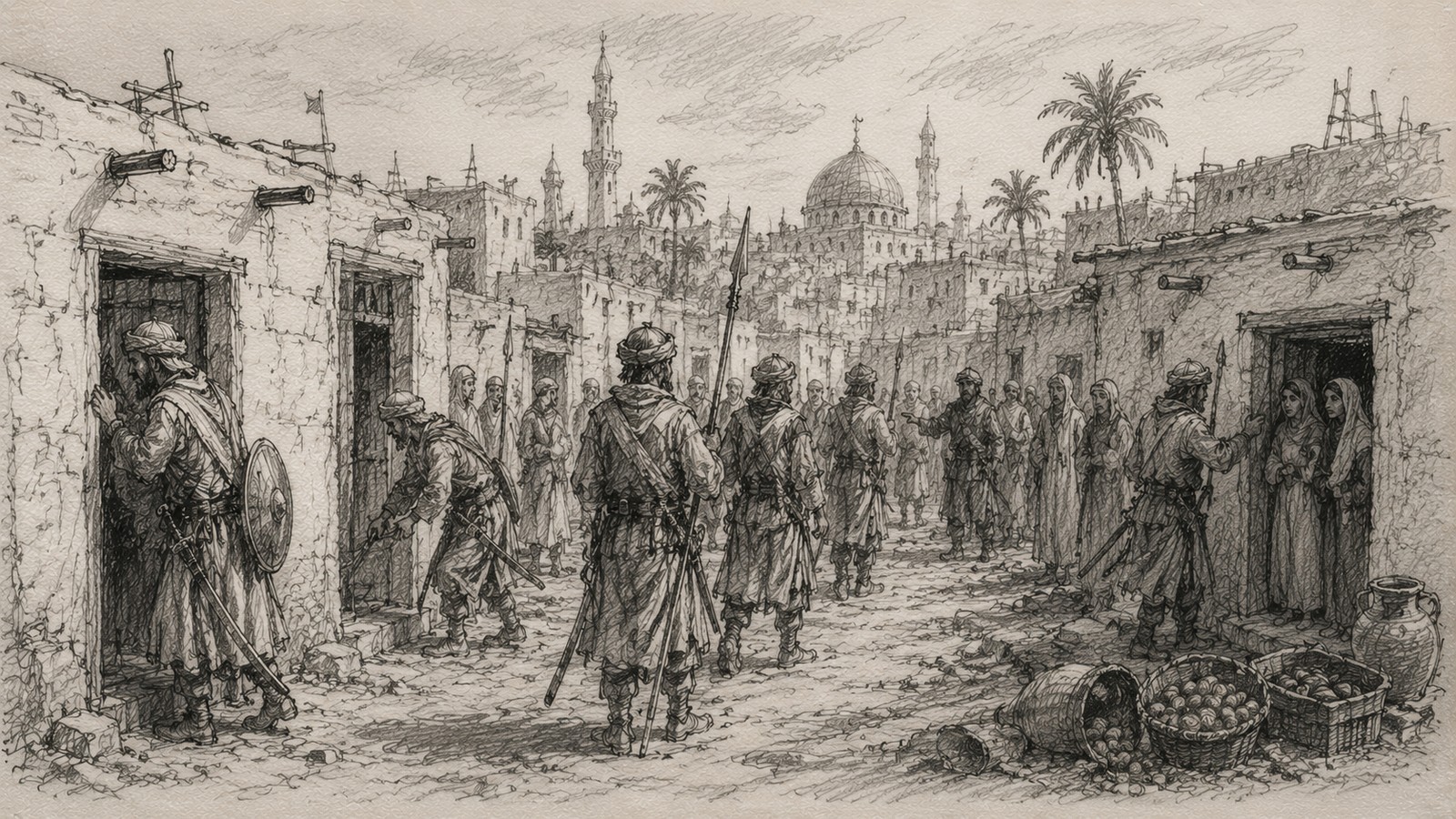
Muawiyah’s soldiers and supporters begin searching homes.
PART 1 — The Dread Borne upon the Wind Hath Entered the Dwellings
Without, the first crow of the cock did echo faintly from afar, a token that the night did softly wend toward its close. The air of Medina waxed colder as the dawn drew nigh, according to its wont, and the wind did bear the scent of earth and slender dew from the date gardens that lay behind the dwelling. Then did Sheikh Umar slowly straighten his posture, his movements serene yet heavy with the burden of his years. "Hearken unto me once more ere ye depart for your homes," he spake right softly. Every eye was turned anew upon the aged scholar. "From this day forth..." his voice was low, yet passing clear, "look ye no longer upon the state of Medina as it was in the days of old." Those words did fall with grievous weight upon their hearts.
"Guard well your womenfolk and your little ones." His gaze did move slowly toward Abdullah, Umar bin Jundab, and the other men who had taken wives and built families. "Diminish your journeyings by night. Speak not light nor heedless words within the marketplace. And if there come a missive from without the gates..." he paused for a brief space, "keep it not overlong in your possession." Qasim did bow his face yet lower. "I shall begin to convey certain scrolls ere the sun rideth high," he spake right softly. Salman al-Katib did give a slight nod. "And I likewise." "And thou, Zubair," Sheikh Umar continued, "cease not to seek tidings from the paths of trade." The merchant of the seas did bow in reverence. "I am acquainted with divers captains who are worthy of trust." "Perchance we shall have need of them," answered Sheikh Umar in a low voice. Hadi did lift his countenance swiftly upon hearing those words, yet this time he offered no further contention. For deep within his soul, he began to perceive that the discourse of this night was no longer a passing dread. This was the inception of a mighty upheaval.
Then did Musa al-Yamani arise and part the door of the dwelling a little space. The cold air of the dawning day did straightway enter, together with a right pale light from the eastern sky. The lane behind the date garden did appear desolate. No patrol was there, nor any sound of chiding. Naught but a city holding its breath ere the morn should break. "Ye must depart for your homes ere men begin to throng the paths," he spake right softly. One by one they did arise. Turbans were made straight, staffs taken up anew, and scrolls of parchment hidden beneath their cloaks. Abdullah stood the last of all. Ere he stepped forth, he looked upon Sheikh Umar for a brief season. "O Sheikh..." he said in a low voice, "dost thou truly believe that the path toward the east shall be a part of our destiny?" The aged scholar did not straightway answer. Nay, he rather gazed upon the pale light of dawn that began to peer through the cleft of Musa's door. Then did he speak right softly: "Perchance the Almighty doth save a seed by bearing it far from the soil wherein it was born."
The words of Sheikh Umar did continually echo within the mind of Abdullah as they began to depart from the dwelling of Musa al-Yamani. The sky of Medina did softly alter its hue; the pitch black of the night began to cleave before a streak of pale blueness upon the eastern horizon. The air of the dawning day was cold and moist, and the wind did move right softly through the date gardens, bearing the scent of wet earth and foliage that yet held the dew of the night. They did walk in utter silence. Not many words remained among them after that long assembly. The mind of every man was filled with thoughts of his kindred, his home, and the perils which they had never truly conceived before this hour.
Bilal did walk at the side of Abdullah, ever and anon wiping his weary countenance. Hadi was some few paces before them, his wooden staff yet grasped within his hand. The youth did appear more silent now, yet his gait did reveal that his mind was still filled with tumult. "I do abhor this night," he murmured of a sudden, turning not his head. "Many a man doth abhor the night when his life beginneth to alter," answered Bilal right softly. Hadi did give a slight kick to a stone upon the path, that it bounded to the side of the lane. "I cannot yet accept that we perchance must depart." "And I cannot yet accept that Medina beginneth to be filled with dread," replied Abdullah in a low voice.
They did pass through a narrow lane nigh unto the dwellings of the seekers of knowledge. Divers doors were yet fast closed, nevertheless within certain houses a small lamp did already burn, in preparation for the dawning prayer. From one such dwelling, the voice of an aged man was heard, reading the Qur’an in a low and trembling tone. That voice did cause the steps of Abdullah to slacken for a season. In the days of old, such a sound was ever wont to bring peace unto his heart. Yet upon this night, he did rather perceive a strange and wondrous sorrow.
They did arrive nigh unto the northern lane where the tumult had late arisen. Divers doors of the houses did appear partly open, and men began to come forth right softly to look upon their surroundings. Upon one of the walls was seen the fresh mark of a wooden impact, and a broken pitcher lay scattered near a small watercourse. And before the dwelling of Abdullah bin Harun, two men were seen cleansing a faint stain of blood from the earth with water from a bucket. Hadi did straightway stay his steps. "What hath befallen this place?" he questioned swiftly. One of the men did turn with a weary countenance. "They came at the midnight hour." "Who was borne away?" asked Bilal. "Abdullah bin Harun," the man did swallow hard. "And his nephew likewise." A silence did straightway fall among them. "Did they offer resistance?" asked Abdullah in a low voice. The man did shake his head. "Not overmuch." He looked upon the stain of blood on the earth. "Yet one of the soldiers did smite his mother when the aged woman sought to bar their way." Hadi did clench his jaw right fiercely, so that the veins of his neck waxed taut. Bilal did straightway lay hold of his arm right softly, ere the wrath of the youth should break forth anew. "Not in this hour," whispered Bilal. The air of the dawn did wax colder still.
The cocks began to crow from the sundry quarters of Medina. The sound of water buckets and the tread of men did softly begin to be heard within certain lanes. The City of the Prophet was awakening toward the morn, yet that morn did feel far otherwise than the morns of old. There was a restlessness that did move right secretly from house to house. There were whispers that began to multiply within the marketplace ere the sun was yet risen. And there were names of men that began to be uttered in low voices, for fear lest they should be heard by the wrong ears.
As they did once more wend along the path toward their own dwellings, Abdullah beheld a little child standing before the door of a house, looking upon the grown men with a bewildered countenance. His mother did swiftly draw the child back within, so soon as she espied certain men passing by. That small sight did pierce the heart of Abdullah more deeply than the chiding of the soldiers upon the bygone night. For he was well aware: when mothers begin to fear to suffer their children to stand before their own dwellings, then is a city altering into a place that is no longer truly safe. The eastern sky did now begin to flush with a slender crimson.
And beneath that first light of dawn, Medina did appear as a city striving to conceal her own wounds. The call to the dawning prayer did at last begin to echo from the Prophet’s Mosque, whiles Abdullah and the others yet walked through the lanes of the city. The voice of the muezzin was long and mournful, touching the walls of the earthen dwellings that were yet cold from the night. In the days of old, that sound was wont to make the hearts of men wax spacious. Yet upon this morn, the call did sound like a summons mingled with a sorrow that could scarce be told. “Hayya ‘alash shalah...” The tread of men began to throng the narrow paths of Medina. Certain of them did walk swiftly toward the mosque with bowed heads. Others did stay their steps nigh unto the wells to perform their ablutions, whiles whispering right softly one to another. Abdullah did catch fragments of the same discourse repeated time and again: • of houses that were searched, • of men who were borne away, • of the name of Muawiyah, • of Kufah, • and of the dread that began to creep into the City of the Prophet. Hadi did walk with a hardened countenance. Sundry times did his hand clench into a fist whensoever he heard men speak of the seizures of the bygone night.
"They have not yet attained full dominion within Medina," he murmured with bated breath. "Yet men do already begin to tremble." "Dread doth move more swiftly than a host of horsemen," answered Bilal right softly. They did at length part ways at the parting of the lanes. Umar bin Jundab did return unto his dwelling together with Sa’ad, who had remained silent all the while, observing all things around them. Qasim did walk with a swift gait, hiding his scrolls of parchment beneath his cloak. Salman al-Katib did move toward his home with aged yet hurried steps, as though every moment ere the sun should rise had now become passing precious unto him.
"I shall meet with you anew after the forenoon hour," spake Bilal unto Abdullah. Abdullah did give a slight nod. "Walk not alone upon this night," added Bilal ere he departed. Hadi yet stood some few paces from them, his eyes directed toward the Prophet’s Mosque, which began to be filled with the assembly of the faithful. "I desire to wend unto the mosque," he said right softly. "Go thy way," answered Abdullah. Hadi did turn his head for a brief moment. "Dost thou not accompany me?" Abdullah looked toward the direction of his own dwelling, which yet lay hidden behind the narrow lane. "I must first look upon my kindred."
Hadi did nod his head right softly, then walked toward the mosque together with the stream of other men who began to throng the path. Abdullah did observe the youth for a brief season ere he at length turned back toward his own dwelling. The lane wherein the house of Abdullah lay did now begin to quicken with the sounds of the morn: • the pulling of water buckets from the wells, • the tread of sandals upon the earth, • the goats that were beginning to be let loose, • and the womenfolk who did open the doors of their houses with countenances weary from the long night. Nevertheless, behind all that morning life, a certain thing was altered: men did no longer speak so loudly as they were wont to do in the days of old. Yea, even the greetings between neighbors did sound far softer.
When Abdullah did arrive before his dwelling, he beheld Maryam already standing upon the threshold, where she had tarried for a long season. Her veil was decently arrayed, yet her countenance did reveal that she had scarce slept throughout the night. Iskandar stood behind his mother, his eyes red from withholding his slumber. So soon as she espied Abdullah returning, little Fatimah did straightway run to embrace his legs. "Father..." she whispered right softly. Abdullah did lift up his daughter gently, and kissed her head, which was yet warm from sleep. Maryam did gaze upon her husband's face for a long space ere she at length questioned him in a very low voice: "Are matters more grievous than we did conceive?" Abdullah did not straightway answer. He merely looked upon the narrow lane behind Maryam, where divers neighbors did now begin to open the doors of their houses, whiles exchanging whispers and tidings one with another. Then did he speak right softly: "Upon the bygone night, they did bear away Abdullah bin Harun." The countenance of Maryam did straightway wax pale. "Inna lillahi..." she whispered softly. Iskandar did lift up his face swiftly. "He who was wont to teach the children to read?" Abdullah did give a slight nod. The youth did straightway fall into utter silence.
And upon the first morn following the death of Ali bin Abu Thalib, the kindred of Abdullah began to perceive that the tempest, which hitherto had been heard only from Kufah, had now truly reached the gates of Medina. The sun did begin to rise right softly behind the dwellings of Medina, its morning light touching the walls of the earthen houses with a pale yellowish hue. According to its wont, the morn within the City of the Prophet was filled with the voices of men wending toward the marketplaces, the gardens, and the wells of water with serene countenances. Nevertheless, upon that morn, the atmosphere did feel far otherwise. Men did yet follow after their labors, yet their steps were more hurried and their discourse was far softer.
Abdullah sat nigh unto the door of the dwelling, looking upon the narrow lane before his house. Little Fatimah had fallen into slumber anew upon the lap of Maryam, having been awakened throughout the night by dread. Iskandar sat near the wall, whetting his small knife upon a smooth stone, though his mind was manifestly not upon his labor. "Whet it not overmuch," spake Abdullah right softly. Iskandar did lift up his face. "Wherefore?" "A blade that is too slender is easily broken." The youth did tarry in silence for a brief space ere he at length laid down his knife right softly. Maryam did observe them both with eyes full of apprehension. She was folding small cloths and examining the store of food in the corner of the dwelling, yet her mind was manifestly troubled. "I did hear certain women weeping nigh unto the well this morn," she spake in a low voice. "Men begin to question one another who shall be borne away next." Abdullah did bow his head a little. "Dread doth cause men to look upon one another with suspicion," he murmured.
Without the dwelling, the sound of hurried steps drawing nigh was heard. Not long thereafter, Bilal did appear at the end of the lane together with Umar bin Jundab and Sa’ad. Their countenances did seem more grave than when they had parted ways after the dawning hour. "Enter within," spake Abdullah, arising from his place. So soon as they had entered, Bilal did straightway close the door of the house right softly, and spake without many words of prologue: "Matters within the marketplace begin to wax more grievous." Maryam did stay the movement of her hands. "What hath befallen?" asked Abdullah swiftly. Bilal did rub his countenance roughly ere he answered. "Certain men from Syria were seen discoursing with the chiefs of the lesser tribes this morn." "Concerning the oath of fealty?" asked Umar bin Jundab. Bilal did nod his head. "And concerning those who are yet deemed faithful unto the kindred of Ali." Silence did once more fill that small dwelling.
Sa’ad, who had maintained a heavy silence until now, finally broke his word. “I, too, heard the name of Sheikh Umar echoing through the marketplace.” Iskandar’s head snapped up instantly, his eyes wide. “What do you mean by that?” Sa’ad swallowed hard, a brief hesitation catch in his throat before he replied. “They have begun asking for a tally of his students. Every single one.” Maryam closed her eyes slowly, the blood draining from her expression. “Ya Allah…” she whispered, her voice a frail, trembling breath. Abdullah felt a cold, heavy knot tighten within his chest. The net of surveillance was no longer a distant shadow; it was actively tightening around the borders of their own inner circle. “Who was asking?” Abdullah demanded, his tone dangerously low. “Men I have never laid eyes upon,” Sa’ad replied, casting a fleeting, tense glance at his father before pressing on. “But some of the spice merchants whispered that they arrived alongside the caravan from Sham two days past.”
Bilal let his weight sink heavily against the earthen wall, his voice resonant with a sobering gravity. “I, too, have received word that the home of Salman al-Katib is now under constant surveillance.” “Because of his manuscripts,” Abdullah murmured, the deduction sharp and immediate. “And because his allegiance to Sheikh Umar is known to all.” Outside the dwelling, the morning marketplace was beginning to stir, its swelling symphony carried inward by the early dawn breeze. The distant, overlapping cries of date merchants and the dull, rhythmic plodding of camels drifted faintly from the main thoroughfare. On the surface, the daily life of Medina marched onward, pretending nothing had changed. Yet beneath that fragile veneer of normalcy, an encroaching terror was spreading—subtle and quiet, like a low flame consuming dry grass. Umar bin Jundab turned his focus toward Abdullah, his gaze searching and deep. “I am beginning the relocation of my tools this very morning,” he disclosed in a hushed tone. Abdullah knit his brow, his suspicion piqued. “Where to?” “To the abandoned storehouse near the southern orchard.” Umar drew a long, ragged breath. “I refuse to watch a lifetime of my craftsmanship vanish into thin air if they begin ransacking our homes.”
Maryam gazed at the hulking figure before her, her features heavy with sorrow. “Have we truly been driven to such extremes?” No one offered an immediate reply. The question hung like a shroud over the gathering. Then, Bilal spoke, his voice dropping into a profound, solemn register. “I am beginning to fear that Sheikh Umar is correct.” “Regarding what?” Iskandar asked, leaning forward. Bilal fixed a long, lingering gaze upon the boy before offering his answer. “That Medina may no longer remain a sanctuary for our kind.” Bilal’s words dragged the small room of Abdullah’s house back into a long, suffocating silence. The morning light now forced its way more clearly through the cracks in the door and the fissures of the earthen walls, illuminating the fine motes of dust drifting lazily through the stagnant air. From the thoroughfare outside, the grunts of a passing camel mingled with the rhythmic cries of a water vendor beginning his morning rounds through the winding alleys of Medina. The pulse of the city continued its relentless, indifferent march, yet for those gathered within the dwelling, the dawn bore a weight far more crushing than any day that had come before.
Iskandar slowly lowered his face upon hearing Bilal’s somber words. His slender fingers still loosely gripped the small carving knife from earlier, but the blade now rested idle and forgotten upon his lap. “If we are forced to leave…” he murmured, his voice cracking slightly, his gaze remaining anchored to the floor, “will we ever find our way back?” An agonizing stillness claimed the room; not a single soul ventured an immediate reply. Maryam gazed at her young son, her eyes glistening with a sudden, unshed veil of tears. Abdullah, meanwhile, could only stare out toward the narrow alleyway stretching before his threshold, as though the elusive answer lay hidden out there, buried somewhere amidst the indifferent footsteps of the people of Medina. Bilal finally broke the silence, drawing a long, ragged breath. “No man living holds that knowledge.” Little Fatimah, having just stirred from her slumber, crept closer and wrapped her small arms around her mother’s sleeve, looking up at the somber countenances of the adults with a quiet bewilderment. The child could not yet fully grasp the gravity of the shifting tides around her, but she possessed the fragile intuition to feel that the world surrounding her family was fracturing. “Will those cruel men come to our house as well?” she inquired in a tiny, fragile whisper. Maryam instantly pulled her daughter against her chest, holding her tight as she tenderly smoothed the girl’s hair. “Insha'Allah, they will not,” she whispered softly, though the unadulterated terror in her eyes told a devastatingly different story.
Umar bin Jundab let his heavy head fall forward, his massive frame appearing far more subdued and desolate than anyone had ever seen it. “Sa’ad did not close his eyes for a single heartbeat last night,” the craftsman disclosed in a raspy murmur. “He kept a ceaseless vigil at our threshold, refusing to let go of his wooden staff.” Sa’ad shifted uncomfortably, a flush of youthful self-consciousness rising to his cheeks as he cast his gaze downward. “I kept hearing footsteps, over and over,” the young man muttered defensively under his breath. “Every single scuffle of boots in the dark… it felt like it was them.” “That is the grim harvest when terror finally takes root within a city’s walls,” Abdullah remarked, his voice a low, sobering weight. “Men begin to fear the very wind, and start trembling at the mere ghost of a footstep.”
Outside the threshold, a sudden flurry of urgent female voices erupted near the neighborhood well. Their tones were clipped, sharp, and laden with anxious whispers. Maryam cast a nervous glance toward the heavy wooden door. Moments later, Hafsah binti Malik appeared at Abdullah’s threshold, her countenance entirely drained of color. Her headscarf was pinned in a frantic rush, uneven and loose. “May I enter?” she asked, her words tumbling out in a breathless panic. Maryam rose instantly, stepping aside to clear her path. The moment she crossed the threshold, Hafsah spoke in a strained, hushed torrent. “They returned to the northern alley at first light.” Bilal snapped his head up, his eyes narrowing. “To what end?” “They were hunting for a young scribe.” Hafsah’s breath was shallow and erratic. “The neighbors are whispering that the man managed to flee into the desert before the call to dawn prayer.” “What is his name?” Abdullah demanded. “Amir bin Khalaf.” Hafsah swallowed hard, trying to steady her voice. “He was the one who frequently assisted in transcribing correspondence for the factions of Kufa.” Qasim bin Thauban closed his eyes tightly for a fleeting moment, a shadow of grief passing over his features. “I know him well,” he murmured in a hollow whisper. “And now,” Hafsah pressed on, delivering the final, devastating blow, “the townspeople are beginning to dissect who among us was ever seen in his company.” And once more, a heavy, suffocating silence flooded the small room.
Terror had evolved, no longer relying solely on the blunt iron of arrests; it now rode upon the fragile, venomous vehicle of human whispers. Abdullah rose to his feet with measured slowness and strode toward the threshold. He peered out at the narrow alleyway of Medina, which was now swelling with the morning rush of townspeople and pack animals laden with trade goods. The sun had climbed higher into the Hijazi sky, burning with a fierce, blinding intensity. Yet, the holy city did not feel any brighter. Indeed, it felt entirely the opposite. As the morning matured, it became terrifyingly clear how suspicion had begun to cultivate itself among the populace—sprouting like a quiet disease between the men and women of Medina.
A merchant who typically boomed his greetings across the thoroughfare now spoke in clipped, hushed half-whispers to his neighbor. A mother abruptly seized her child's arm, pulling him behind her heavy curtain the moment two unfamiliar men loitered at the mouth of the alleyway. And several new, expressionless faces stood entirely too long near the narrow crossroads, lingering in the shadows, committing the structures of the homes to memory without ever making a move. Abdullah felt the creeping heat of the morning sun finally strike his face. And there, standing upon his own threshold, a question began to take root and blossom with terrifying clarity within his chest for the very first time in his life: Must he shepherd his family away from Medina, before the holy city transformed into a wilderness that no longer recognized its own sons?
The creeping heat of the sun slowly descended into the labyrinthine alleys of Medina as the morning marched toward the hour of Dhuha. A brilliant, golden glare brushed against the weathered mud-brick walls and the thatched roofs of woven palm fronds, which were already brittle and parched under the relentless advance of the Hijazi summer. Yet, the gathering warmth of the sun possessed no power to dispel the cold shroud of anxiety that had remained heavily suspended within the chests of men since the previous night. Abdullah remained stationed at his threshold, a silent sentinel at the boundary of his home. His eyes carefully traced the erratic pulse of the narrow thoroughfare stretching before him: Women clutching earthen water jars, their strides hurried and defensive, Children who usually ran wild through the dirt now clinging tightly to the sweeping hems of their mothers' robes, And men conversing in fractured sentences, their heads snapping back to scan the shadows behind them at every slight noise. Medina was still alive. And yet, the very breath of that life now moved with a fragile, terrified caution.
“Father…” Iskandar’s voice broke the silence, prompting Abdullah to turn his gaze slowly toward him. The boy stood near the threshold, a grim, austere solemnity upon his face—an expression far too heavy, far too mature for a lad of his winters. “Are all cities reduced to this when men contend for power?” he asked quietly, his young voice steady yet laden with a heavy curiosity. Abdullah held his son’s gaze for several quiet heartbeats before offering his reply. “Not all.” “Then why…” Iskandar pressed, his eyes searching his father's, “…why do the Muslims hunt one another?” The question fell softly into the room, yet it pierced the air like a cold blade. In the corner of the dwelling, Maryam froze, her fingers halting over the dried flatbread she was stacking. Even Bilal and Umar bin Jundab fell entirely still, the heavy truth of the boy's words hanging unspoken between them.
Abdullah finally drew a long, deliberate breath. “Because men,” he murmured, his voice heavy with a profound sorrow, “oftentimes grow to love dominion far more than they love brotherhood.” Iskandar grew quiet, turning the answer over in the deep recesses of his mind. “But do they not all prostrate themselves before the very same Allah?” he pressed, refusing to let the paradox rest. From his corner, Bilal offered a bittersweet smile, old wounds reflecting in his eyes. “My boy…” he said softly, “men can stand shoulder-to-shoulder in a single prayer row, yet their hearts may be worlds apart.” And once more, a profound, heavy silence settled over the small chamber.
PART 2 — The Bitter, Unimaginable Decree
From the dust of the thoroughfare outside, the frantic scuffle of approaching footsteps shattered the heavy quiet. Moments later, Rafi’, the son of Hilal bin Rasyid, materialized at the threshold, his face drenched in a thick sheen of sweat. The youth’s chest heaved violently, his breath coming in ragged gasps as though he had been running a desperate race against the blistering morning sun. “Abdullah!” he called out, his voice sharp with urgency. Abdullah took several swift strides into the blinding light. “Speak, what has occurred?” Rafi’ snapped his head left and right, scanning the perimeter of the alleyway before delivering his words in a low, choked torrent. “Sheikh Umar commands the heads of the prominent households to assemble immediately following the Dhuha hour.” Bilal rose instantly from his corner, his towering frame casting a shadow over the hearth. “Where?” “The estate of Hilal bin Rasyid,” Rafi’ replied, swallowing hard to moisten his parched throat. “But the Sheikh strictly decrees that men must arrive by separate paths—under no circumstances are we to move in groups.” Umar bin Jundab knit his brow, his jaw tightening into a grim line. “The decay deepens by the hour, it seems.” Rafi’ gave a somber nod. “My father claims that fresh intelligence has just arrived along the trade routes from Basra.” Abdullah felt a sudden, familiar knot harden inside his chest. Basra. The name of that distant Iraqi garrison city had begun to echo with ominous frequency since the setting of yesterday's sun. “Did the Sheikh disclose the nature of the dispatches?” Bilal pressed, his deep voice vibrating with a tactical focus. “He did not.” Rafi’ dragged his sleeve across his glistening forehead, wiping away the grime of his sprint. “But a handful of weary travelers from Iraq slipped past the city limits just before dawn. And it is whispered that the news they carry is grim.”
Maryam, who had overheard every word from the dim interior, fixed her gaze upon Abdullah, her features twisted with a raw, agonizing anxiety. “Must you depart once more?” she asked, her voice a fragile, aching whisper. Abdullah offered a tight, somber nod. Instantly, little Fatimah threw her small arms around her father's leg, clinging to him with all the strength her tiny frame could muster. “Do not stay away long…” the child whimpered, burying her face into his coarse robes. Abdullah managed a faint, melancholic smile, his large hand gently stroking his daughter’s hair to soothe her fears. Yet deep within the recessed chambers of his heart, a devastatingly bitter realization began to crystallize: Since the setting of last night's sun, each time he stepped across his own threshold, he did so under a terrible truth—there was now a looming possibility that he might never return to this home as the same man who left it. Outside, the scorching desert wind sighed heavily, sweeping its oppressive warmth through the silent, shifting alleys of Medina.
And high above the City of the Prophet, the sun continued its relentless, indifferent ascent, entirely unconcerned that the human souls crawling beneath its glare had begun to live in the shadow of terror—forced into the crucible of bitter choices that would irrevocably alter the course of their lives. Once Rafi’ dissolved into the dust of the outer lanes, an oppressive, leaden silence reclaimed the airspace of Abdullah’s dwelling. The mid-morning sun now hung high over Medina, its scorching rays reflecting harshly off the sun-baked earthen walls and the gravel-strewn pathways. Below, the thoroughfares began to swell with the daily movement of men and beasts, yet that familiar civic bustle had been stripped of its historic warmth. The marketplace was no longer a sanctuary of fellowship; men moved with a clipped, defensive urgency, as though lingering too long under the open sky was an invitation to a snare.
Maryam began assembling a modest ration for Abdullah, her hands maintaining a forced, deliberate composure even as her features struggled to mask the agonizing anxiety beneath. She packed a few pieces of brittle barley flatbread, a handful of dried dates, and a small portion of cured meat into a coarse linen travel cloth, knotting it with trembling precision. “You have not been permitted even a single moment of true rest,” she murmured, her gaze remaining fiercely anchored to her task, refusing to look up. “The days of tranquility may have already begun their final retreat from us,” Abdullah replied softly, his voice devoid of anger, bearing only a flat, sobering acceptance. His words caused Maryam’s hands to freeze over the cloth for a fraction of a heartbeat. Against the earthen wall of the dwelling, Iskandar watched his father in utter stillness. The boy no longer badgered the adults with his endless questions. Instead, his young eyes had begun to harbor a deeper, more desolate silence—the fierce, unyielding desire of a child trying to comprehend a fracturing world that was changing entirely too fast before his very eyes.
Bilal rose to his feet with measured slowness, readjusting the folds of his turban. “I shall seek out Samir bin Wahhab before making my way to the estate of Hilal,” he announced. Abdullah turned his head, his brow furrowing. “To what end?” “He maintains ties with several wealthy merchants who navigate the trade routes of Sham and Basra.” Bilal tightened the coarse linen sash around his waist, securing his robes for the walk ahead. “We must ascertain the true state of the highways. We cannot afford to walk blindly into closed gates.” Umar bin Jundab gave a somber, approving nod. “A wise calculation. Samir has always been quicker to catch the whispers of the bazaar than any spy in the city.” Maryam lifted her face slightly, a new layer of worry etching itself into her features. “Has the commerce of the city begun to fracture as well?” Bilal offered her a bittersweet, knowing smile. “When terror takes root in the breasts of men, my lady, the marketplace is always the first to alter its language.”
Not long after, the dull clopping of a passing donkey echoed through the narrow lane before the house. It was followed closely by the low, guarded murmurs of two men handling heavy sacks of grain. From his post at the threshold, Abdullah tracked their movements with a wary eye. One of the men lingered, his gaze scanning the surrounding dwellings entirely too long before he picked up his pace once more. Such behavior had broken out across the city like a fever since the first light of dawn. Medina had quietly transformed, now teeming with petty informants and unseen eyes: Men counterfeiting interest in trade, browsing goods they had no intention of buying, Men anchoring themselves at the market stalls for far too long without purpose, Men weaponizing conversation, asking questions that veered too close to a cross-examination, And men bartering their own ears, selling the secrets of their neighbors for a handful of silver or the promise of safe passage. “I find no comfort in those unfamiliar faces,” Umar bin Jundab muttered, his eyes narrowing as he peered out into the sunlit alley. “The lines have blurred entirely,” Bilal countered, his voice flat. “I can no longer discern where the honest merchant ends and the spy begins.”
Little Fatimah then toddled toward Abdullah, balancing a small earthen water jar between both of her tiny hands. “Are you thirsty, Father?” she asked, her voice a pure, untainted note in the heavy room. Abdullah managed a faint, tender smile as he took the vessel from her grasp. “May Allah keep your heart forever gentle, my sweet child.” Fatimah could not fathom the weight behind his prayer. She merely offered a small, bright smile before drifting back to sit by her mother’s side.
It was at that moment that Malik bin Atiyah appeared from the far end of the alley, treading closer with a long, slow stride. The tanner carried a massive bale of woven cloth hoisted high upon his shoulder. Tall, lean, and sinewy, he moved with the quiet poise characteristic of men whose hands did far more labor than their tongues ever uttered. His dark beard was dusted with coarse leather shavings and tiny, clinging fibers of raw textile. The moment he reached Abdullah’s threshold, he lowered the heavy bundle with deliberate, unhurried care. “I have received word that Sheikh Umar is convening the heads of households once more,” he stated flatly, wasting no breath on pleasantries. “The whispers of the lanes march swifter than the desert wind, it seems,” Bilal remarked, his tone dry. Malik did not offer a smile. “At the tanneries this morning, the men speak of nothing but the arrests.”
Abdullah held the tanner’s gaze for a long, searching moment. Malik was a man of few words, but his solitary arrival on their threshold was a testament in itself—it meant the encroaching dread had finally breached the sanctuary of his own life. “How fares your household?” Abdullah inquired softly. Malik drew a deep, ragged breath, his shoulders sagging under the weight of his thoughts. “Khadijah has begun hoarding wheat and cellaring water without a word to me.” He cast a bleak look out at the empty, sun-baked lane. “When a woman begins to make such covert preparations, it can only mean one thing: she no longer believes the walls of her own home can shield her children.” The tanner's words struck a painful chord, causing Maryam to lower her face in a wave of quiet shame. For since the first light of dawn, without whispering a syllable to a single soul, she had been doing the exact same thing.
A heavy, micro-silence fell upon the threshold immediately following the tanner's bleak admission. The scorching desert wind sighed through the narrow passage of Medina, stirring up fine eddies of dust that spun low and sluggishly around their ankles. From the distant belly of the city, the rhythmic, metallic ring of a blacksmith’s hammer beating against iron echoed over and over—a monotonous pulse that mingled with the strained cries of the water vendors and the guttural groans of pack camels arriving from the market roads. The ancient machinery of civic life continued its march. Yet now, every familiar sound of the city bore an ominous resonance, as though it were the sound of a shattering world, fracturing slowly from the inside out.
Maryam lowered her gaze, her fingers maintaining their rhythmic dance as she finished folding the linen travel cloth around Abdullah’s rations. Her movements were clean, practiced, and calm, yet her chest rose and fell with a breath that was far heavier than usual. Bilal watched the matriarch in quiet contemplation for several heartbeats before offering a soft, gravelly truth. “A woman’s intuition always detects the scent of wolves long before a man does.” “Because a woman’s mind is ever anchored to her hearth,” Malik countered flatly, his voice devoid of sentiment. “And to her cubs,” Maryam amended in a fragile whisper, her hands freezing over the knotted linen. Little Fatimah, who sat tethered to her mother's skirts, tilted her head upward, her innocent eyes darting between the adults in silent confusion as she heard the familiar cadences of her family's voices talking in circles around her since the dawn broke.
Meanwhile, Iskandar remained stationed near the threshold, tracking the movements along the thoroughfare with a gaze that grew noticeably sharper, harder, with each passing sun. “I wish to accompany you to the estate of Hilal,” he announced suddenly, his tone cutting through the ambient noise of the room. Maryam snapped her head up instantly, her maternal defenses flaring. “Absolutely not.” “I shall only walk beside my father,” the boy pressed, unyielding. “No,” Maryam repeated, her voice tighter this time, leaving no room for negotiation. Refusing to back down, Iskandar fixed his eyes upon his father, silently demanding a different verdict. Abdullah remained silent for several agonizing heartbeats before he finally spoke in a low, level tone. “Not yet, my son.” The boy clamped his small jaw shut, his teeth grinding in frustration. “How much longer must I merely sit idle within these walls while every soul in the city speaks of nothing but danger?” “Until you comprehend that true valor is not merely the act of marching blindly into the teeth of peril,” Abdullah replied with a calm, arresting authority. Iskandar fell silent, though the fierce, defiant glare in his eyes made it entirely clear that his spirit remained unsatisfied.
Umar bin Jundab tracked the boy’s tense stance, idly stroking his coarse beard. “Sa’ad began exhibiting that very same fire a few seasons back,” he remarked quietly to Abdullah. “Young lads always betray a desperate hunger to cross into manhood the moment the world outside grows loud and chaotic.” Sa’ad, lingering near the framing of the threshold, merely offered a thin, fleeting smile at the invocation of his name. Malik bin Atiyah then lowered his heavy frame onto a low bench against the earthen wall. He appeared vastly more spent than his usual rugged self. The weathered leather of his hands was mapped with a constellation of tiny, fresh scars—the occupational toll of the tanneries. “Talhah interrogated me last night,” Malik murmured, his eyes fixed on his knuckles. “He wished to know if the garrison’s soldiers would eventually march upon the tanneries as well.” Bilal let loose a long, slow exhalation. “Our children are beginning to harvest entirely too much knowledge.” “They have no need for ears to know,” Malik countered flatly. “The terror is already writ large upon the countenances of the elders.” And once more, a profound, crushing silence laid claim to the small room. The tanner spoke an undeniable truth. Children possessed a sharp, intuitive ledger; they could read the onset of panic in the jagged rhythms of their parents' speech, the tense urgency of their strides, and the lingering, fearful glances cast toward the heavy wooden door.
Beyond the confines of the alley, the two unfamiliar figures materialized once more, tracking a slow, predatory path through the lane. One hoisted a small burlap sack upon his shoulder, while his companion's gaze lingered heavily upon the surrounding dwellings, committing each structure to a prolonged, silent scrutiny. Iskandar’s eyes narrowed into dangerous slits. “I have never seen those faces within our quarters before,” he whispered, his body tensing against the doorframe. Bilal caught sight of them with a fleeting glance, instantly dropping his voice to a low, guarded register. “Because they do not belong to the blood or the dust of this lane.” Before vanishing into the turn of the thoroughfare, one of the strangers paused, his cold eyes anchoring upon Abdullah’s home for several suffocating seconds before he resumed his march into the golden glare of the morning.
And those few fleeting seconds were entirely sufficient to make the air inside the chamber turn thick, cold, and leaden. Without a word, Maryam slowly reached down and closed her fingers tightly around little Fatimah’s hand. It was a minute gesture. Infinitesimal. Yet Abdullah caught it. And that small, instinctive movement of maternal terror solidified the final, agonizing truth within his heart: sanctuary was leaking out from the homes of Medina, evaporating into the parched desert sky drop by single drop.
Not long after, the rapid, syncopated rhythm of rushing footsteps once more cut through the heavy air from the far end of the alley. This time, it was Yahya, the son of Samir bin Wahhab, who materialized at the threshold, his breath catching in short, ragged gasps. A nimble and resourceful youth, he had spent his winters assisting his father with the logistics of the trade caravans, navigating the chaotic currents of the grand bazaar since his boyhood. His hair was wildly disheveled by the hot desert wind, and a thick sheen of perspiration covered his brow. “Bilal!” he called out urgently, his voice strained. Bilal rose immediately, his towering frame cutting off the light. “What fresh tribulation brings you here?” Yahya cast a swift, paranoid glance over both shoulders, scanning the lane before stepping closer into the shadows of the dwelling. “My father sends a dire warning. You must exercise absolute caution.” He paused, struggling to master his erratic breathing. “Word has reached us that a list of names is currently being compiled at the registry office near the market stalls.” Abdullah’s face instantly hardened into a mask of stone. “Whose names?” Yahya swallowed hard, his throat dry with fear. “The names of those deemed sympathetic… to the house of Ali.”
Yahya’s disclosure caused the air within Abdullah’s dwelling to freeze entirely, as though time itself had suffered a sudden, violent arrest. Even the distant, ambient roar of the bazaar, which had hitherto seeped through the cracks of the walls, felt instantly miles away, muffled by an invisible shroud. The mid-morning sun climbed relentlessly toward its zenith over Medina, yet its blinding, oppressive heat was utterly powerless against the creeping frost that began to bind the chests of every soul gathered in the chamber. Bilal took a commanding stride toward the youth, his looming presence demanding absolute clarity. “Who presides over this registry? Who writes these names down?” Yahya shook his head slowly, a helpless gesture. “I know them not.” He dragged the frayed tail of his turban across his glistening forehead to wipe away the sweat. “But my father, Samir, whispered that several among them are functionaries arrived freshly from Sham.” “And the sons of Medina assist them in this treachery?” Umar bin Jundab demanded, his voice dropping into a guttural growl that vibrated with betrayal. Yahya hesitated, his eyes darting toward the floor before he finally delivered the bitter verdict. “Some act out of sheer, unadulterated terror. Others do so in the wretched hope of purchasing immunity from the new order.” He lowered his voice to a conspiratorial murmur, barely audible over the desert wind. “And a few… a few have harbored a quiet, venomous malice toward the house of Ali since the old days.” And with those words, a suffocating silence once more laid its heavy hand upon the room.
That realization cut far deeper, tasting of a bitterness more corrosive than any threat issued from a soldier’s blade. For the adversary did not always march through the city gates from some distant horizon. Oftentimes, it matured in utter secret, taking root among the very souls who had walked the selfsame pathways, sharing the dust of the identical lanes for generations. Maryam pulled little Fatimah tighter against her breast, a protective barrier of fabric and flesh. The young child had grown entirely still now, tracking the weathered, severe countenances of the adults with wide, uncomprehending eyes. Meanwhile, Iskandar shifted his weight, moving closer to the heavy timber of the doorframe. His gaze remained hard, anchored to the far end of the thoroughfare where the two strangers had long since dissolved into the morning haze. “I want to uncover their names,” the boy muttered, his small fists clenching at his sides. “I want to know who they are.” “And if you should possess that knowledge?” Abdullah asked, his voice a calm, anchoring weight amid the rising tide of the room's anxiety. “What then?” Iskandar did not deliver an immediate answer. For in truth, he knew not what action he would take—he possessed nothing but the raw, unshaped fury that had begun to cultivate its empire within his young chest.
Bilal fixed his eyes upon Yahya once more, his posture tightening. “Will Samir make his way to the estate of Hilal when the hour strikes?” “He will,” Yahya replied with a swift, definitive nod. “My father is currently assembling the latest intelligence regarding the mercantile highways leading toward Basra.” The name materialized once more, hanging like a heavy shroud over the room. Basra. With each invocation, that distant garrison city felt less like a far-off point on a merchant’s map and more like a looming shadow drawing closer to their reality—as though it were slowly marching inward to claim its territory within their very destinies. Malik bin Atiyah dragged his calloused hands roughly across his weathered face, a low groan escaping his chest. “I have found no comfort in the trajectory of our counsel since the setting of yesterday's sun.” “Because the abstract fears we harbored have finally begun to clothe themselves in bone and flesh?” Bilal pressed, his voice carrying the weight of a seasoned observer. Malik offered only a slow, heavy nod of assent.
Beyond the threshold, the rhythmic clop of a donkey’s hooves drifted through the lane, accompanied by the metallic clink of ironware carried by a wandering peddler. Two small children dashed past the opening of the alley, their fragile laughter trailing behind them like a brief spark, before the sharp, anxious call of their mother commanded them back inside, locking them behind heavy timber. That fleeting vignette struck Abdullah into profound silence. The grand mechanics of life refused to halt. Yet beneath the domestic surface, Medina was quietly fracturing, transforming drop by single drop into a fortress governed entirely by suspicion and defensive caution. “I shall take my leave ahead of you,” Umar bin Jundab announced, his imposing frame rising from the shadows. “I wish to ensure my household is not left unguarded for overlong.” Sa’ad moved in perfect, silent synchronicity, standing immediately at his father’s flank. “Bid Aisyah that she must not unbolt her doors to any stranger this day,” Bilal charged, his voice a heavy, tactical counsel. “She has already surpassed me in vigilance,” Umar replied, the corner of his mouth twitching into a grim, fleeting smile. Once Umar and Sa’ad dissolved into the blinding glare of the lane, the interior of Abdullah’s dwelling felt suddenly more confined, the walls pressing closer together. The oppressive morning heat had begun to bleed through the fissures of the earthen roof, blending the rich, comforting aroma of baked barley flatbread with the dry, choking dust swept inward by the restless wind.
Yahya remained anchored near the threshold, his features twisted in an agonizing knot of hesitation. “My father also relayed…” He broke off, his tongue faltering as though the next words were too heavy to release into the room. “Speak it,” Abdullah commanded, his voice a steady, unyielding anchor. Yahya swallowed hard, his throat working against the dryness of fear. “Several of the high merchants have begun to transport their commodities out of the city gates under the cover of darkness.” Bilal’s eyes narrowed into sharp, dangerous slits. “For fear of state confiscation?” “For fear that the coming storm will tear the very foundations away.” Once more, a suffocating silence flooded the chamber, thick and unmoving. Then Malik bin Atiyah spoke, his voice dropping to a spectral whisper, as though he were delivering a private eulogy to his own thoughts: “A man only begins to bury his treasure when he senses the roof above his children will not outlast the season.” The tanner’s grim prophecy continued to hang like an invisible shroud within Abdullah’s modest dwelling, persisting long after Yahya had offered his hurried farewells and departed for the bazaar. The frantic rhythm of the youth’s retreating footsteps slowly dissolved into the distance, swallowed whole by the swelling, indifferent roar of Medina as the city marched relentlessly toward the crucible of high noon.
Abdullah lowered his frame onto the rough stone threshold, his weary eyes tracing the sharp angles of the morning light as it fell obliquely across the parched soil of the lane. The mid-morning heat had begun to sting the flesh. With every passing beast of burden—whether a laboring donkey or a heavily laden camel charting its course toward the market stalls—a low, sluggish cloud of dust was kicked into the air, dancing briefly in the sunbeams before settling over the earth once more. Inside, Maryam tilted the water skin, carefully measuring a modest portion into an earthen bowl before offering it to Bilal and Malik. In the arid valleys of Medina, life had ever been bartered for water, and its preservation was never treated lightly—more so now, when the hearts of men were being hollowed out by a creeping dread. Even the hollow, liquid echo of the water being poured felt like a luxury against the tense silence of that morning. “I have begun to find a strange malice in the bazaar,” Bilal murmured, his calloused hands closing around the rim of the bowl. Malik lifted his gaze from the floor. “And since when has the marketplace offended you?” “Since the hour men began to converse far more with their eyes,” Bilal replied, his tone chillingly flat, “than with their tongues.”
From his post by the timber of the doorframe, Iskandar watched the two elders in absolute stillness. The boy was rapidly apprenticing himself to the unspoken grammar of the adult world, deciphering a language that required no dictionary: Truncated sentences that clipped the air like shears, Subdued voices that anchored themselves beneath the threshold of hearing, Gazes heavily freighted with unspoken verdicts, And a stark terror meticulously buried beneath the gravel of everyday speech. Not long after, the faint, warbling cadence of a private call to the Dhuha prayer drifted from the far horizons of the quarter. It was no official summons from the great minaret, but rather the fragile, familiar voice of an old crier who made it his life's work to remind the busy vendors near the market stalls of the passing hours and their duties to the Divine.
The sun had now climbed nearly to its zenith, hanging like a blazing shield directly over Medina. Bilal rose with measured slowness, shaking out his dust-laden robes. “We must make our move now, before the thoroughfares swell with the midday crowds.” Abdullah gave a silent, grim nod of assent, reaching for his outer traveling turban. Maryam tracked her husband’s every movement for several heavy heartbeats. Finally, she stepped into his space, her hands rising with a quiet, practiced tenderness to adjust the stray folds of his headcloth. It was an ordinary, domestic ritual—the timeless gesture of a wife preparing her husband for a routine day of labor or a journey across the sands. Yet on this day, the air between them bore a different, more fragile weight. There was a desperate, unspoken dread woven into the very fabric of her touch. “Do not tarry overlong,” she whispered, her voice barely a breath against his chest. Abdullah held his wife’s gaze for a long, unblinking moment, as if committing her features to memory. “I shall return to these walls before the sun begins its descent.” Maryam offered no spoken reply. She merely gave a faint, tight nod, though the anxious light within her eyes remained entirely unquenched. Before Abdullah could cross the threshold, little Fatimah scampered forward, throwing her small arms around her father’s leg in one final, clinging embrace. Abdullah gently unclasped her tiny fingers, then stepped out into the blinding glare of the lane alongside Bilal and Malik bin Atiyah, leaving the heavy wooden door to close behind them.
The labyrinthine arteries of Medina had awoken with far greater urgency than they had at dawn, the main thoroughfares now choking with the swell of midday commerce. Vendors aggressively staked their claims upon the roadside, while heavily burdened camels, their frames straining under massive sacks of grain, shifted past with a lumbering, indifferent stride, guided only by the rhythmic, sharp shouts of the caravan masters. The air hung thick and claustrophobic—a heavy, suffocating conciliation of pungent tanned leather, the sickly sweet aroma of overripe dates, and the dry, searing dust kicked up by a thousand passing feet. Yet beneath this frantic veneer of life, the structural rot of the city remained glaringly palpable. Something was fundamentally amiss. Abdullah’s gaze anchored upon a cluster of unfamiliar men stationed entirely too long near a common water stall. One of them knelt in the dirt, fastidiously feigning a struggle with the broken strap of his leather sandal, though his sharp, predatory eyes never ceased tracking the souls venturing in and out of the residential lanes. “They are clumsy,” Bilal muttered, his jaw set as he maintained his stride. “They lack the patience to even shroud their surveillance.” “Because hiding it is not their purpose,” Malik countered flatly, his voice devoid of cadence. “They want the populace to feel the weight of the leash. Paranoia is their weapon.” They turned a corner, marching past the dwelling of Qasim bin Thauban. The heavy timber door of the prominent scribe’s home was bolted shut, dark and lifeless despite the sun hanging at its highest point—a stark, ominous departure from his lifelong habits. “May the Heavens grant that he secured those manuscripts before the dawn,” Bilal murmured, a shadow crossing his face as he stared at the silent threshold. Near the small public well at the terminus of the lane, a gathering of women drawing water leaned close to one another, their heads inclined in a frantic, low whispering. The moment Abdullah and his companions stepped into their periphery, the collective murmur collapsed into an immediate, frozen hush. The malignancy of fear had begun to distort the natural order of things—altering even the way the desperate bartered in gossip.
At long last, they reached the dusty road leading toward the estate of Hilal bin Rasyid, situated near the sprawling date orchards that guarded the southern perimeter of Medina. The compound was far grander in its dimensions than the modest dwellings of their own lanes, a necessity born of Hilal’s trade; the expansive rear courtyard served as a repository for heavy well-boring ironwork, massive digging apparatus, and coiled bundles of hempen rigging. Stationed before the entrance stood young Rafi’, keeping a vigilant watch under the guise of hammering a leaky, weathered wooden bucket. The moment his eyes caught the approach of Abdullah and his companions, the youth ceased his feigned labor and stood straight, his posture rigid with tension. “Enter with haste,” he commanded in a hushed, urgent tone. “Sheikh Umar has already graced the chamber… and the travelers out of Iraq have likewise crossed the threshold.” Rafi’ lost no time in barring the heavy timber door of Hilal bin Rasyid’s estate the moment Abdullah, Bilal, and Malik slipped into the interior. The ancient, unyielding wood groaned with a heavy yet deliberate scrape against the stone floor, a sound managed with the utmost discretion. Unlike the cramped, claustrophobic sanctuary of Musa al-Yamani, which groaned under the weight of countless parchment rolls and scholarly manuscripts, Hilal’s domain felt vastly more expansive—pulsing with the raw, industrious energy characteristic of a great family of desert tradesmen. The sharp, mineral aroma of damp earth immediately enveloped them as they stepped deeper into the shadows.
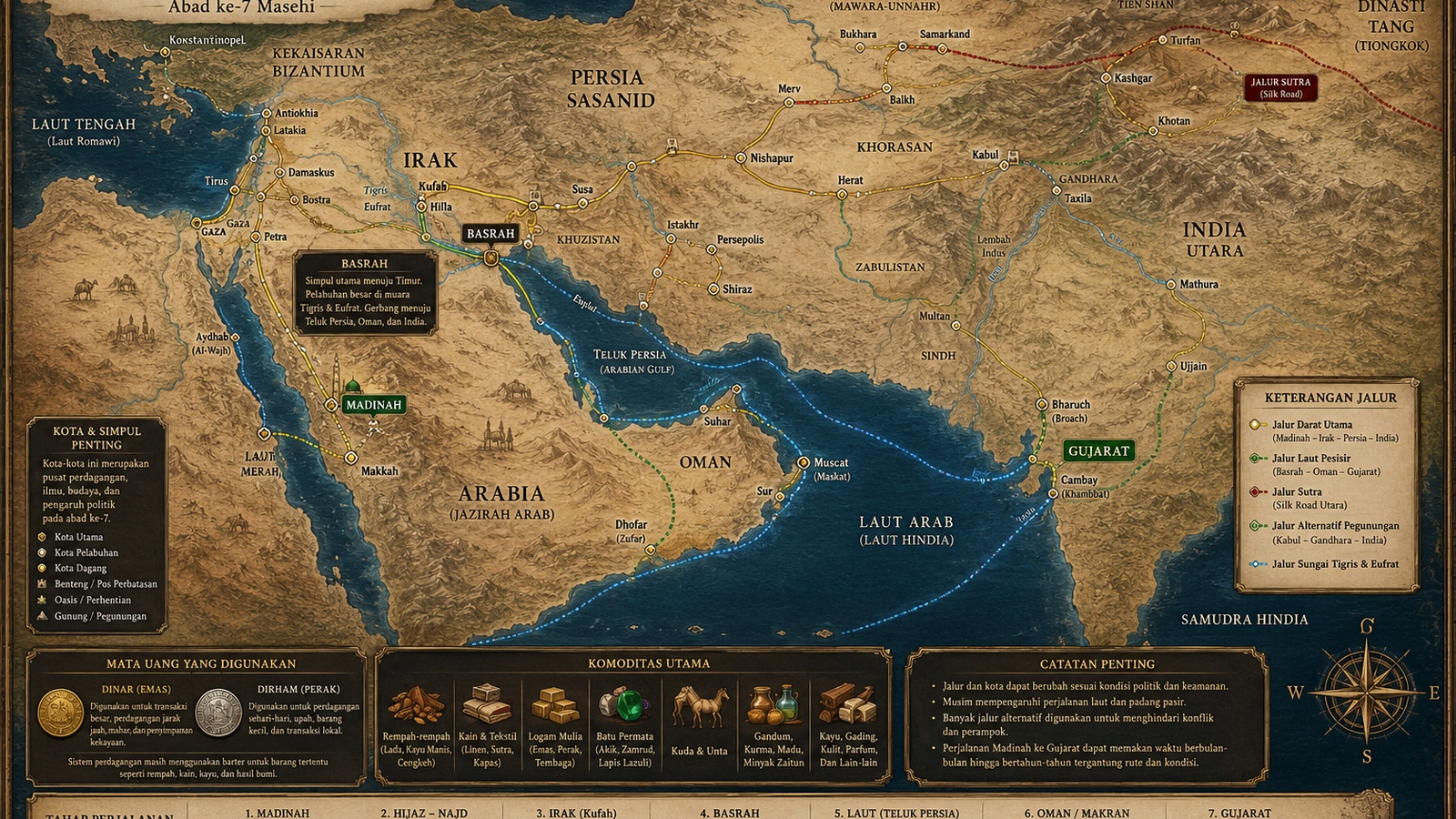
PART 3 — THE ARRIVAL OF THE WAYFARER : error and Hope, The Offspring That Must Be Preserved
From the deep recesses of the rear courtyard, the faint, hollow echo of water dripping into a massive limestone cistern resonated through the quiet. Hilal was a man universally recognized for his singular gift—he could read the secrets of the shifting sands and locate veins of living water far more intimately than any other soul in Medina. In one corner of the expansive chamber, coiled hempen ropes, wooden-bladed hooves, heavy leather buckets, and various specialized well-boring ironwork were stacked in meticulous order. The earthen walls of the dwelling bore the faded smudges of calloused hands and the persistent chalky dust of a lifetime spent digging into the earth. Yet on this particular morning, the compound utterly shed its identity as a mere tradesman's workshop. Instead, the structure had transformed into a sanctuary of shadows—a subterranean fortress where men gathered to shelter their lives from an unseen, encroaching malice.
Hafsah binti Malik emerged from the dimly lit inner quarters, hoisting a heavy terracotta jug of chilled water with practiced ease. She was a woman of sturdy build, though her features were shadowed by the unmistakable hollows of exhaustion—the toll of consecutive sleepless nights. Yet, her movements remained fluid and grounded, betraying the resilient, unshakeable composure of a matriarch long accustomed to anchoring a household through seasons of severe adversity. “Drink first,” she urged softly, her voice a low, steady current. Bilal accepted the jug, the corner of his mouth twitching into a thin, appreciative smile. “May the Almighty preserve the sanctuary of this roof, keeping it cool while the fires of Medina rage outside.” Hafsah did not return the gesture with a smile of her own. She merely offered a tight nod of acknowledgement, her eyes shifting instinctively toward the heavy curtain of the inner chamber. Through the partition, a glimpse of the interior revealed a gathering of women and young children, huddled together in a silence far more profound, far more fragile, than the house had ever known.
Lubna was kneeling beside Salma binti Nafi’, her small hands assisting in the repetitive task of folding travel linens and packing small leather pouches with desiccated dates. The young girl was naturally of a quiet disposition, but throughout the course of this morning, her silence had deepened into something heavy and absolute. At irregular intervals, her gaze would snap instinctively toward the front threshold, tracking every rogue footstep that vibrated through the outer lane. Near the central pillar of the dwelling, little Zaynab had succumbed to exhaustion, curled in sleep while her small fingers remained fiercely locked around the hem of her mother’s robes. Meanwhile, young Amr sat perched on a low stool by the narrow lattice window, his eyes scanning the parched thoroughfare with a severe, calculating gravity that was entirely too ancient for a lad of his winters. “Our youth are beginning to harvest entirely too much knowledge,” Malik murmured under his breath as his eyes swept over the children. “They have no need for ears to know,” Hafsah countered in a fragile whisper, her back turned to the sunlight. “The air itself betrays the danger; they breathe it in before we can even speak it.”
Abdullah stood frozen, his eyes drinking in the stark landscape of the home for a long, unblinking interval. And for the very first time since the shadows fell yesterday evening, the veil was stripped from his eyes; he truly witnessed how the tendrils of paranoia were breaching the thresholds of Medina's households: Not through the iron of a unsheathed sword, Not through the flow of sacrificial blood, But through the haunted countenances of mothers who had converted their tenderness into a sleepless watch, And through the uncharacteristic stillness of children whose laughter had been choked into absolute silence. From the central atrium, the subdued, gravelly resonance of Sheikh Umar’s voice drifted outward, locked in a low consultation with an unseen companion. As Abdullah and his brethren ventured deeper into the belly of the estate, they came upon two unfamiliar figures seated low against the earthen wall, flanked by Hilal bin Rasyid and Samir bin Wahhab. The two strangers bore the unmistakable, rugged hallmarks of men who had bartered with vast, merciless horizons. Their traveling cloaks were heavily caked in layers of gray silt, and their skin had burned to a deep, obsidian hue under the unforgiving crucible of the Iraqi sun. One of the wayfarers carried a jagged, silver scar tracking down his left temple, while his companion continuously kneeled and massaged his joint, his grimace betraying the agony of a man who had ridden hard from distant borders without a single hour of respite.
Samir bin Wahhab himself appeared utterly estranged from his usual jovial self. The merchant was widely celebrated for his keen wit, an expert at reading the shifting temperaments of the marketplace who regularly injected a lighthearted thread of laughter into any counsel. Yet on this morning, his countenance was cast in heavy shadow, and the light within his eyes was obscured by a profound, restless anxiety. The moment his gaze anchored upon Abdullah’s arrival, he delivered a low, gravelly greeting: “At long last, you have crossed the threshold.” Hilal bin Rasyid rose from his seat to receive them. The master of water veins possessed a massive, towering frame, as broad and unyielding as the trunk of an ancient date palm. His palms were heavily calloused, hardened by a lifetime of wrestling with flint and stone, yet his movements remained fluid, slow, and anchored. “Be seated,” he commanded briefly. Abdullah lowered his frame onto a woven mat adjacent to Sheikh Umar. The air within the chamber had turned thick and warm, crowded by the press of anxious bodies and the relentless climb of the midday sun outside. From beyond the heavy walls, the occasional bray of a passing beast of burden drifted into the room, accompanied by the faint, ghostly echoes of children playing in some distant, unbothered lane.
Yet within the fortifying walls of Hilal’s estate, not a single soul could claim even the semblance of peace. Sheikh Umar swept his heavy, discerning gaze across Abdullah and Bilal, offering a slow nod before extending a hand toward the two wayfarers stationed against the clay wall. “They have broken their fast on the hard road out of Iraq, charting the desolate tracks toward Basra,” the elder murmured, his voice laced with grim finality. The ambient noise within the room collapsed into an immediate, profound vacuum. Then, the traveler bearing the silver scar across his temple slowly hoisted his chin, his eyes locking onto the gathering as he spoke in a voice thoroughly ravaged and scraped raw by the desert grit: “Kufa has ceased to offer sanctuary for our kind.” The moment the weight of that verdict left his lips, the central chamber of Hilal bin Rasyid’s home plummeted into a suffocating, leaden silence. Even the domestic murmurs of the children huddled in the rear quarters seemed to recede into a distant, untouchable realm. The harsh mid-morning sun forced its way through the narrow fissures of the thatched roof, casting long, geometric spears of light across the earthen floor—illuminating a slow, ghostly ballet of dust motes suspended in the stagnant, warming air.
Abdullah fixed a more discerning gaze upon the two wayfarers now, mapping the heavy toll of their flight. The exhaustion radiating from their bodies was total, absolute. Their bare feet were thickly encrusted with the gray loam of the desert tracks, and the hems of their traveling cloaks were badly frayed and torn in several places—vicious scars left by the thorny brambles of a long, desperate migration. The companion seated beside the scarred man maintained a fierce, white-knuckled grip upon his wooden staff; it was as though his physical body refused to believe the message of his eyes—that their relentless flight had finally suffered a temporary arrest. Before the silence could ossify, Hafsah binti Malik stepped into the gathering, bearing a wide earthenware bowl filled with chilled well-water and a basket of warm, freshly baked wheat flatbread. The rich, yeasty aroma of the baked grain briefly saturated the humid air of the room, conjuring a fragile ghost of domestic comfort in the midst of a counsel that was rapidly turning toward the dark. “Partake of this nourishment first,” she urged the wayfarers softly, her voice a low, steady anchor.
The scarred wayfarer received the vessel of water with both hands, treating it with the reverence one might show a sacred relic. His knuckles were severely chapped, raw, and stained a deep crimson—the cruel signature of the blistering desert wind. “May the Almighty return a bountiful recompense upon the souls of this dwelling,” he murmured devoutly, his voice cracking slightly before he brought the rim to his lips and drank with deep, desperate gulps. The frantic rhythm of his throat betrayed the agonizing duration of his deprivation. From the shadows of the rear quarters, Lubna watched the stranger in absolute stillness, her small fingers fiercely anchoring the folded travel linens across her lap. Meanwhile, young Amr remained perched near the narrow lattice window, his body coiled tight as he absorbed every syllable with a severe, calculating intensity. “By what names may we know you?” Bilal inquired at last, breaking the heavy stillness. The scarred traveler lowered the earthen vessel with deliberate slowness, wiping his mouth with the back of his hand. “I am Khalid bin Mazin.” He inclined his head slightly toward the silent figure stationed at his flank. “And this is my kinsman, Farhan.” Farhan offered only a sharp, economical nod of assent, maintaining his silence. His eyes were deeply hollowed, sunken into dark sockets from a devastating lack of sleep.
“Did your boots strike the trail directly out of Kufa?” Malik bin Atiyah demanded, leaning forward to bridge the distance between them. Khalid shook his head with a slow, leaden weariness. “We did not.” He dragged his calloused palm roughly across his features, a gesture to banish the ghosts of the road. “We fled the gates of Kufa several weeks past, just as the air grew too thick with poison to breathe.” His gaze descended, anchoring itself to the parched, unmoving soil of Hilal’s floor. “Yet we found no deliverance on the highway to Basra; that artery, too, has been stripped of its peace.” Samir bin Wahhab let his heavy frame sink back against the clay wall, a long, ragged exhalation fracturing his chest. The merchant had remained trapped within the labyrinth of his own calculations since the morning bells. “Lay the truth bare before them,” he commanded Khalid, his voice dropping into a fragile, exhausted murmur. And with that summons, the chamber surrendered once more to an unyielding silence. Beyond the reinforced timber of the walls, the rising midday wind began to lash at the date palm fronds, their dry, rattling scrape echoing through the lane. Outside, the oppressive heat of the Hijaz continued its ruthless ascent, pressing down upon the thatched roof like a physical weight.
Khalid finally broke the stillness, his words issuing forth with a deliberate, agonizing slowness. “Dozens of households have begun to hollow out Kufa under the cover of darkness,” he recounted, his voice heavy and scraped raw by the desert grit. “Some make their flight in the dead of night, slipping like ghosts through the shadows. Others adopt false names, embedding themselves within the mercantile caravans to mask their escape.” Bilal creased his brow, his eyes narrowing into sharp slits. “Are they driven solely by the fear of the garrison?” Khalid’s mouth twitched into a grim, fleeting specter of a smile. “They are driven because men have begun to barter their neighbors' lives to purchase their own security.” That terrible verdict forced several of the elders to drop their faces, unable to hold his gaze. Farhan, whose silence had hitherto remained unbroken, finally released a fragile, spectral whisper. “With my own eyes, I witnessed a man surrender the registry of his lifelong neighbor’s household—solely so the officers would pass over his own threshold without raising their blades.” No soul in the chamber ventured a reply. For every man gathered within those earthen walls understood the grim alchemy of the hour: When a collective terror grows too massive to contain, The sacred bonds of brotherhood begin to fracture, splintering away shard by single shard.
From the shadows of the rear quarters, little Zaynab stirred from her troubled slumber, her fragile voice fracturing into a soft, fitful weeping as the oppressive midday heat bore down upon her cushion. Salma binti Nafi’ swept the child into her arms without a moment's delay, drawing her close against her shoulder while murmuring a low, rhythmic lullaby of reassurance. That tender, maternal cadence drifted like a thin stream of cool water through the sweltering room, cutting directly across the grim discourse of cities drowning in paranoia. And precisely because of that small, domestic sound, the overarching terror crystallized into a blinding, inescapable reality. This had long ceased to be merely the strategic chess play of grand emirs and distant governors. The fitnah—the grand tribulation—had officially breached the thresholds of the common people, creeping like a venomous mist into the most sacred sanctuaries of daily life: Into the very linens where innocent children sought sleep, Into the hearths and smoke where mothers labored over the daily bread, Into the modest vessels where families hoarded their meager rations of barley and water. Sheikh Umar held his gaze upon Khalid for a long, unblinking interval, the gravity of his years weighing heavily upon his brow, before he delivered a question in a hushed, trembling reverence: “And what of Hasan? How fares the grandson of the Prophet?” The words left his lips, and the central chamber of Hilal's estate was instantly plunged into an absolute, suffocating vacuum.
Khalid drew a long, shuddering breath, his chest rising and falling like a battered sail before the storm. Then, with the profound, crushing weariness of a man who had watched an empire fracture, he offered his reply: “The multitudes still proffer their bay'ah—their oath of allegiance—unto his hand…” He paused, his tongue halting as if the next truth were a blade he dreaded to swallow. “…yet the hearts of men have begun to turn away, hollowed out by a creeping skepticism and the paralysis of fear.” Following the verdict of Khalid bin Mazin, an absolute, unyielding stillness seized the assembly. The midday air within Hilal’s sanctuary grew thick and leaden, pressing against the lungs. The merciless sun beat down upon the thatched roof until the dry, scorched aroma of baked palm fronds bled into the mineral scent of the earthen floor, staling the stagnant heat. Beyond the reinforced timbers of the gate, the low, raspy wheeze of a laboring camel drifted from the narrow track bordering the orchard—a solitary, indifferent sound in a world on the brink of ruin. Sheikh Umar slowly inclined his chin, allowing his gaze to fall to the earth. His withered, trembling fingers moved with a rhythmic, mechanical slowness over the smooth wooden beads of the tasbih in his lap. “The clay of mankind is a fickle thing,” the elder murmured, his voice a spectral whisper that barely stirred the dust. “It softens and warps the very moment terror breaches the citadel of the heart.”
Bilal locked his sharp, piercing gaze onto Khalid, his posture bristling with tactical intensity. “Have the partisans of Muawiyah penetrated deep within the gates of Kufa?” Khalid offered a small, grim nod of assent. “They do not all march with unsheathed steel,” he replied, his hand rising instinctively to brush against the jagged scar on his left temple. “Some venture inward bearing solemn covenants of safety and amnesty. Others arrive with chests heavy with Levant gold. And the remainder carry nothing but the invisible, suffocating weight of terror.” Samir bin Wahhab let a heavy, ragged exhalation fracture his chest, tilting his head back until it rested against the rough clay of the wall. “The marketplace is ever the first womb where the seeds of a revolution or a surrender quicken,” the merchant murmured, his voice laced with the bitterness of a broken ideal. “The very moment the high traders begin to weigh the fear of financial ruin against their principles, they will invariably steer their caravans toward the shifting winds of supreme power.” Malik bin Atiyah shifted his frame, his eyes narrowing as he confronted him. “And you have witnessed this rot taking root among our own merchants?” Samir did not proffer an immediate reply. Instead, his gaze wandered toward the dim recesses of the rear quarters, where Ruqayyah was quietly assisting Hafsah in distributing the broken pieces of warm wheat flatbread to the huddled children. Yahya remained anchored at his mother’s flank, his youthful countenance drawn tight and rigid as he absorbed the grim calculus of the elders. “I have witnessed a populace that has begun to bar its lips and choose a tactical silence,” Samir answered at long last, his voice dropping to a spectral whisper. “And when a city’s silence endures for overlong, it is rarely out of peace; it is the absolute stillness of men waiting to see which tyrant will claim the throne before they prostrate themselves.” And with that indictment, the central chamber surrendered once more to a suffocating, leaden hush.
Abdullah permitted his gaze to wander across the circle of anxious souls, tracing the heavy, silent anatomy of a fracturing community: Hilal bin Rasyid, whose imposing frame maintained a semblance of calm, yet the profound gravity within his eyes bore the crushing weight of an impending collapse, Bilal, whose features had deepened into a severe, darkening gloom, the fiery resolve of his spirit slowly turning inward, Malik bin Atiyah, sitting as motionless and inscrutable as a desert monolith, though the sharp, white tension in his locked jaw betrayed a silent fury, And Sheikh Umar, whose weathered countenance appeared to have aged a decade under the suffocating anxieties that had plagued the town since yesternight. In the shadows of the rear quarters, Lubna knelt in absolute silence, meticulously pouring water into the smaller clay vessels destined for the road-weary guests. Her hands moved with a fragile, practiced precision, producing nyaris no sound against the earthenware. At irregular intervals, her dark eyes would dart toward the assembly of elders in the front chamber, desperately attempting to decipher a grand geopolitical discourse that was entirely too massive for her young winters to hold. Meanwhile, young Amr had shifted his posture, creeping closer toward the heavy timber threshold of the central atrium. He maintained the charade of assisting the women with the travel linens, yet his entire frame was coiled tight, his ears straining to harvest every syllable left in the wake of the elders' words. “Does the highway charting the course toward Basra still offer safe passage?” Abdullah inquired at long last, directing his query directly to Khalid. The sudden, razor-sharp edge of that question caused several heads to snap upward in unison, their eyes locking onto the speaker.
Khalid went entirely still, the query hanging in the humid air like an unresolved riddle as he weighed his response. “Safe…” he echoed, his tongue rolling over the word with a grim, experimental slowness, as if testing whether the concept still possessed any substance in the modern world. “There is no highway beneath the heavens that can truly claim that title now.” He took a modest, lingering sip from the clay vessel to wet his parched throat before continuing. “Yet, if one charts the southern coordinates, the tracks remain vastly more tranquil than the great northern artery leading toward Damascus.” “Do bandits hold the ridges?” Malik demanded, his fingers tightening. Farhan, whose lips had remained sealed throughout the exchange, offered a low, brittle response. “In part.” He kept his eyes anchored to the unmoving clay floor. “But the greater plague belongs to the irregular militias—armed factions operating under the banner of the state, claiming the authority to hunt down anyone branded a rebel against the realm.” Bilal released a sharp, bitter click of his tongue, his chest heaving with indignation. “It appears that under this shifting sky, every coward with a blade now feels entitled to hunt his fellow man like a beast.” From beyond the reinforced timber of the door, the sudden, rhythmic patter of small feet erupted—a handful of children sprinting past the estate, their pure, unrestrained laughter bleeding through the cracks of the wall. Within a heartbeat, their cheerful chorus dissolved into the far horizons of the quarter. That small, innocent intrusion only served to sharpen the structural oddity of the chamber: The realm of youth continued its vibrant, unburdened orbit, While the world of the elders was being systematically hollowed out, drowning in the long, creeping shadows of absolute paranoia.
Hafsah slowly sank onto a low stool near the central support timber, using the corner of her linen sleeve to brush away the gathering beads of sweat from her temples. “The whispers at the common well do not lie,” she recounted in a fragile, exhausted murmur. “Several households within our own quarter have already begun to liquidate their inheritance, parting with heirloom brass and woven rugs under the cover of dusk.” “They gather the coin required for flight,” Samir interjected, his voice heavy with the grim calculus of a merchant. “Or they hoard the silver to grease the palms of the border sentries,” Khalid added, his words dripping with a profound, unadulterated bitterness. And with that final verdict, the assembly was plunged once more into an enduring, heavy silence. For the very first time since the desperate notion of a second hijrah had been breathed into the darkness yesternight, the weight of that sacred word underwent a terrifying transformation: It was no longer a remote, theoretical hazard to be debated by the elders, But an looming, physical necessity that was systematically closing its grip around their domestic lives, household by single household. The relentless midday heat of the Hijaz continued its crushing, slow descent upon the mud-brick grid of Medina. The vertical sun beat down with absolute malice upon the small courtyard of Hilal bin Rasyid’s estate, forcing the dark silhouettes of the wooden pillars to contract into stunted pools of shadow upon the baked earth. Through the structural fissures of the thatched ceiling, shafts of blinding light pierced the gloom of the central chamber like slender, golden blades—vividly illuminating the chaotic, drifting ballet of dust motes suspended in the stagnant air. No soul within the chamber possessed the resolve to break the stillness; the conversation had dried up, leaving only the sound of their own shallow breath.
The compound of Hilal bin Rasyid had surrendered to an entirely different breed of silence: Not the empty quiet born of having nothing left to utter, But the heavy, suffocating stillness that reigns when every mind is crowded to the brink with agonizing calculations. In the dim recesses of the rear quarters, Ruqayyah binti Harits labored over the wooden trenchers, slicing small rounds of wheat flatbread for the young ones. Her movements were slow, deliberate, and rhythmic—the quiet defiance of a matriarch desperately clinging to the sanctuary of domestic routine while the foundations of the world outside were systematically being dismantled. Little Mariam sat perched on the earth near her mother's feet, absentmindedly teasing apart the dry fibers of a palm frond strewn across the floor; at irregular intervals, she would hoist her small, bewildered face, her brow knitting in confusion whenever the harsh names of Kufa or Basra drifted from the front chamber through the heavy air. A few paces away, Salma binti Nafi’ dipped a scrap of thin linen into an earthenware bowl, squeezing out the moisture before gently bathed the flushed, slick brow of little Zaynab, who remained listless and drained by the oppressive mid-morning heat. Lubna moved quietly between them, exchanging the empty water vessels for fresh ones, her silhouette frozen behind the central timber support as her young ears continued to harvest the grim whispers of the elders.
The estate of Hilal bin Rasyid pulsed with a raw, vibrating energy on that sweltering afternoon. Yet it was not the vibrant life born of celebratory gatherings or communal joy; rather, the structure was animated by the collective, coiled tension of souls marooned together, each man and woman desperately straining to anchor their own mounting anxieties beneath a veneer of composure. Hilal himself remained seated against the rough clay wall, his massive, sun-baked forearms resting heavily upon his knees. The master of water veins had hoarded his words throughout the exchange, his silence as deep as an undug well, yet the rigid lines carved into his brow betrayed a mind locked in continuous, frantic calculation. “What was the span of your transit from the gates of Kufa unto the walls of Basra?” he demanded at long last, his voice cutting through the thick heat as he confronted Khalid. Khalid hoisted his chin with a slow, heavy drag. “If the highway is unburdened and the skies are kind, a caravan may complete the passage in a fortnight and a handful of suns.” “And your own flight?” Hilal pressed, his dark eyes narrowing. Khalid’s mouth twitched into a grim, fleeting specter of a smile, his hand rising instinctively toward the jagged scar near his temple. “We were hunted across the wastes for well nigh a month.” The weight of that stark admission struck the chamber like an iron blow, causing several of the elders to snap their heads upward, their eyes widening in unison.
Farhan continuously massaged his swollen joint, his hand trembling slightly before he offered his testimony. “We were compelled to fracture our route and alter our coordinates at least half a dozen times,” he recounted, his words scraped raw by an all-consuming exhaustion. “Armed factions have garrisoned the major crossroads, subjecting every wayfarer to ruthless interrogations.” “By whose authority, and for what quarry do they hunt?” Bilal demanded, his brow knitting into sharp, dangerous lines. Farhan released a dry, hollow laugh that possessed not a single drop of mirth. “In these dark intervals, every faction has conjured a phantom enemy according to their own desperate grievances.” The sheer weight of that verdict caused Malik bin Atiyah to exhale a long, ragged breath through his teeth. “Therein lies the very genesis of our ruin,” the elder murmured, his voice a spectral whisper that barely stirred the dust. Beyond the reinforced timber of the threshold, the sudden, metallic crash of an overturned bucket resonated violently from the outer lane. Within the blink of an eye, little Zaynab bolted upright in terror, her small arms locking fiercely around her mother’s neck like a drowning child. Salma instantly cradled her close, her fingers weaving through the girl's tangled hair as she breathed low, rhythmic reassurances into her ear. That fragile domestic movement struck Abdullah’s chest like a physical blow, dragging his mind across the miles to his own vulnerable hearth. Maryam, his steadfast companion, Fatimah, his innocent child, Iskandar, his young boy. The thoughts of his kin descended upon him in relentless succession since the first morning light—surging against the walls of his resolve like a persistent, rising tide that threatened to breach the citadel of his heart.
Samir bin Wahhab rose from his seat with a slow, deliberate gravity, his sandals scraping softly against the earthen floor as he navigated the crowded chamber toward the narrow lattice window. He pulled aside a small section of the heavy linen curtain, his sharp eyes scanning the sun-drenched thoroughfare outside. “The marketplace is beginning to swell with bodies,” he reported in a low, tense murmur. “And that bodes ill for us.” Bilal creased his brow, his dark eyes narrowing into sharp slits. “Why should a bustling market bode ill?” “Because the denser the congregation of the marketplace,” Samir countered without turning his head, his gaze still anchored to the street, “the more effortlessly an unfamiliar face can dissolve into the tides of ordinary men.” Young Yahya, who had remained anchored near his father’s flank, mirrored the merchant's movement, peering through the sliver of open window. “I witnessed two strangers early this morning, drifting past the stalls where the dyed linens of Yemen are displayed,” the boy recounted, his youthful voice tight with an unnatural seriousness. “They did not bargain for a single textile. Yet they watched the populace intently, as if they were performing a silent ledger.” “A ledger of alliances,” Bilal interjected, his chest heaving. “Counting who stands adjacent to whom, and who speaks in confidence.” Rafi’, who had maintained a vigilant watch near the outer threshold throughout the morning, ventured deeper into the belly of the atrium, bringing with him the heavy scent of dust and the urgent tidings of the rear courtyard. “A handful of unfamiliar men have brought their mounts to a halt near the eastern edge of the date groves,” he whispered, his eyes locked onto Hilal. Hilal hoisted his chin with a sudden, razor-sharp speed. “Do they bear the cloaks of traders?” Rafi’ shook his head, his jaw rigid. “They travel light. Not a single beast of burden or pack of merchandise is among them.” And with that final verdict, the central chamber was plunged once more into an absolute, suffocating vacuum.
The profound vacuum of the chamber expanded outward, until even the children huddled in the rear quarters ceased their restless stirrings, their young bodies freezing into absolute immobility as they tracked the sudden, petrifying alteration written upon the countenances of the elders. Sheikh Umar finally hoisted his heavy chin, his weathered face appearing stark and hollowed where the merciless midday sun struck his skin. “Behold,” the old sage murmured, his voice a brittle, spectral whisper, “how the dark currents of fitnah begin to twist the very soul of a city.” He allowed his dimming eyes to wander toward the recesses of the rear chambers, mapping the slow erosion of their world: To the mothers who had begun to hoard their meager rations with a desperate, defensive haste, To the innocent children whose laughter had been systematically choked into a fearful stillness, To the young men who stood stiff-backed, converting their youthful vigor into a sleepless, vigilant watch, And to the veteran elders who found themselves compelled to bar their lips, bartering their truths in half-whispers inside the borders of their own ancestral hearths. “The grand devastation,” the elder continued, his breath barely stirring the dust in his lap, “never strikes with the suddenness of a thunderbolt. It slips through the cracks of our thresholds grain by single grain, long before mankind awakens to realize how utterly estranged their world has become.” Following the verdict of Sheikh Umar, the estate of Hilal bin Rasyid plunged once more into an enduring, suffocating silence. Beyond the reinforced timbers of the gate, the burning heat of the Medina noon continued its ruthless ascent, baking the parched lanes below. The rogue gusts of wind that filtered through the narrow lattice window offered no deliverance; they arrived hot, dry, and heavy—laden with the mineral grit of a city whose foundations were slowly turning to ash.
Yet within the suffocating belly of that estate, not a single soul possessed the luxury to contemplate the malice of the sun. Their minds had been entirely hijacked, weighed down by a much more savage and unyielding burden. Lubna stepped out from the shadows, carefully hoisting a fresh earthenware jug toward the center of the atrium. The young girl calibrated her movements with immense precision, her ankles stiffening to ensure not a single drop of the precious well-water would breach the rim. As her silhouette glided past the gathering of elders, the heavy cadence of the word “Basra” was once more exhaled into the air in a hushed, secretive tone. Her dark eyes darted toward her father with the swiftness of a startled bird, scanning his locked features for a fraction of a heartbeat before she instinctively lowered her chin and vanished back into the sanctuary of the rear quarters. The children had begun to harvest the fragmented wreckage of the elders' world: Catching the rogue syllables of distant wars, Absorbing the terror of cities they had never seen, Though their small hearts could not yet fully decode the grim finality of the doom that was fast approaching.
Stationed near the heavy timber barrier, Rafi’ maintained his relentless vigil, his sharp eyes periodically cutting through the narrow fissures of the wood to scour the outer lane. The young man’s frame was broad, muscled, and unyielding—a physical monument forged by a lifetime of wrestling with the stubborn, hard soil of the Hijaz alongside his father—yet the contours of his visage had grown distinctly harder, stripped of the youthful warmth it had carried just a few seasons past. “I find no comfort in the rhythm of the city today,” he murmured under his breath, his voice flat. Hilal cast a fleeting, measuring glance toward his son. “A city does not fracture its foundations within a single sun.” “Yet the flesh and blood within its gates can turn inside out within a heartbeat,” Rafi’ countered without breaking his watch. Not a single soul in the assembly ventured to dismantle his words. For every occupant of that clay fortress had already begun to read the terrible omens blossoming across the territory. Khalid bin Mazin shifted his frame with a slow, deliberate rustle. His sun-blackened features appeared marginally revived by the virtue of the well-water and fresh wheat, yet the profound, existential exhaustion of his month-long migration remained stubbornly anchored within the deep sockets of his eyes. “My boots struck the dust of several peripheral hamlets before our path finally converged upon Medina,” he recounted in a low, gravelly cadence. “And in the heart of those settlements…” He paused, his tongue halting as if he were meticulously weighing the lethal gravity of his next syllables. “…men have begun to dread the mere mention of Ali’s name if spoken above a breathless whisper.” The revelation struck the domestic quarters like an unseen frost. Salma binti Nafi’, whose hands had been occupied with folding the travel linens, froze mid-movement. Beside her, Ruqayyah’s fingers stiffened against the wooden trencher. Even the boys, Amr and Yahya, hoisted their young faces in unison, their eyes widening with a sudden, severe intensity. “Has the rot truly reached such a devastating depth?” Samir bin Wahhab inquired, his voice dropping into a fragile, hollow note. Farhan released a dry, barking laugh that carried no semblance of joy. “When the populace begins to treat the name of the righteous as a treasonous curse…” He dragged his calloused palm through his dust-caked beard, his expression turning grim. “…it is the absolute signature of a world dying from its own sickness.” And with that indictment, the central chamber surrendered once more to a suffocating, leaden hush.
From beyond the clay-bound perimeter of the estate, the booming, melodic chant of a textile merchant pierced the stagnant air, crying out his wares to the blistering streets. A handful of young children scattered past the walls in a frantic, joyful chase after the vendor's cart, their chaotic laughter abruptly truncated by the sharp, echoing scold of a mother from the adjacent lane. The ancient pulse of Medina continued its indifferent orbit, side by side with the silent, malignant anxiety that was systematically taking root within its foundations. Sheikh Umar shifted his posture, locking his dimming, deep-set eyes onto Khalid with a more profound, searching intensity. “Did your eyes behold any of the fleeing households of Kufa charting their course toward the vastness of the East?” the elder inquired, his words heavy with implication. Khalid offered a slow, somber nod of assent. “A significant remnant,” he recounted, a long, labored exhalation fracturing his chest. “Some have cast their lots with the rugged wilderness of Persia. Others harbor the fragile hope of dissolving into the remote, forgotten settlements skirting the outer marshes of Basra.” His gaze drifted across the room, anchoring sequentially upon Abdullah and Bilal. “And there are those who have begun to speak, in hushed and desperate whispers, of the sea.” That final, heavy word caused the remaining voices in the chamber to collapse into a sudden, profound stillness.
The sea. To the generations born of the parched sands of the Hijaz, that vast expanse of water was a realm thoroughly distant and unfathomable—an ancient, shifting wilderness defined by: The thunderous fury of swells that could swallow entire armies, The merciless tempests that mocked the constellations, The chaotic, salt-crusted ports teeming with strange tongues, And the mysterious souls arriving from empires whose names had never been uttered under a desert sky. Malik bin Atiyah dragged his calloused palm slowly across his knee, his eyes fixed on the clay floor. “In all my winters upon this earth, my eyes have never gazed upon the open water.” “I have,” Samir murmured, his voice a fragile, nostalgic thread as he maintained his lonely vigil by the narrow lattice window. “Upon the rugged coastlines of Oman, whilst embedding myself within a mercantile caravan several seasons past.” A collective rustle rippled through the chamber as several heads turned toward the merchant in unison. Young Yahya took a tentative, reverent step closer to his father's flank, his youthful gravity fracturing into pure curiosity. “What is the true shape of it?” Amr demanded from the threshold, the question escaping his lips with the suddenness of a stray arrow before his mother could summon a hand to restrain him. And there, for the absolute first time since the morning light had pierced the compound of Hilal bin Rasyid, a faint, ghost of a smile flickered across Samir’s weathered features.
“Imagine the great desert wastes,” the merchant whispered, his voice soft yet resonant in the sweltering heat, “yet crafted entirely of water—ever shifting, ever breathing, and raw with life.” The young ones fell into an instant, spellbound silence, their minds racing to stitch the imagery together. Even Lubna, stationed near the threshold of the domestic quarters, slowly hoisted her chin, her dark eyes capturing the fragile enchantment of the moment. Samir permitted his gaze to wander far beyond the narrow framework of the lattice window, his expression growing distant, as though he were unrolling an ancient parchment of memories long since locked away in his chest. “The water stretches unto the very margins of the sky, possessing no end that the eye of man can discern,” he continued in a low, reverent cadence. “And the voice of its swells…” He paused, his breath hitching slightly as he searched the air for the proper weight of words. “…at times, it resonates like the great northern gales delivering a solemn decree unto the bare earth.” The chamber surrendered to a deeper, more profound stillness than before. For without their conscious consent, the vivid specter of a world far beyond the borders of the Hijaz had officially breached the mud-brick walls of that modest Medina estate, taking root in the fertile soil of their imaginations. The children remained anchored to Samir’s silhouette, their faces upturned long after the merchant’s testimony of the great deep had ceased. Even the hardened elders preserved the silence far longer than they had during the strategic calculations of the morning. For one fragile, suspended heartbeat, the compound of Hilal bin Rasyid felt utterly unmoored—liberated from the merciless bite of the Hijazi sun and the suffocating paranoia that had garrisoned the lanes of the city. Their spirits had been carried aloft, borne away toward a vast, untamed wilderness that the boots of nearly every man and woman in the room had never trodden.
Lubna remained rooted to her station, her fingers anchoring the earthen water vessel securely against her chest like a protective shield. “Is the great deep more expansive than the open sands of the desert?” she inquired, her voice a fragile, tentative whisper in the quiet room. Samir turned his head slowly toward her, a faint, paternal softness breaking through the rigid contours of his face. “The desert sand remains forever paralyzed in its silent majesty,” the merchant answered in a low, measured tone. “But the sea rolls and heaves with the breath of a leviathan—it is a living, breathing creature.” Young Amr instantly breached the boundary of the rear quarters, advancing several eager paces into the room. “Is the legend true? Do there exist wooden vessels upon the water that stand as massive as our stone estates?” Yahya released a soft, uncharacteristic chuckle—the absolute first note of mirth to escape his lips since their arrival at yesternight's first watch. “Father has recounted to me that some of the grand dhows harbor great stores of dried dates, precious rolls of dyed linen, construction timber, and even young camels within their holds.” “Yet the ocean tempests can fracture those very timber monoliths as effortlessly as a man snaps a withered twig,” Samir interjected, shifting his sharp gaze toward his son to ground the boy's dangerous wonder. And with that sobering verdict, the fragile smiles that had blossomed upon the faces of the youth systematically receded, dissolving once more into the gravity of the hour.
From the shadows of the rear quarters, Hafsah tracked the trajectory of the conversation with a deep, unblinking intensity. Her calloused hands continued to press the heavy stone pestle into the mortar, crushing the raw grain alongside Ruqayyah, yet her ears remained finely tuned to the low, masculine cadence echoing from the central atrium. “It is a strange and surreal shifting of the winds,” Hafsah murmured, her voice barely a breath above the rhythmic, scraping sound of the stone. “Only yesternight, our anxieties were bounded by the familiar lanes of Medina… yet today, the tongues of men have begun to summon the vastness of the sea.” Ruqayyah permitted her hands to arrest their steady labor, the pestle coming to a gentle, silent rest against the fractured grain. “At times, the currents of destiny carry a household far into the deep water long before they have even gathered the resolve to trim their sails.” The stark finality of those words left Hafsah entirely speechless, her thoughts pooling into a heavy, contemplative stillness.
In the center of the atrium, Khalid bin Mazin once more traced the contours of his wounded temple. Beneath the unyielding glare of the midday sun, the jagged laceration flared a deep, angry crimson against his weathered skin. Abdullah held his gaze upon the mark for a long, measuring interval before delivering his query in a hushed tone: “By what manner did you inherit that iron stroke, my brother?” Khalid released a dry, hollow chuckle that possessed not a single drop of mirth. “Near the southern veins out of Kufa,” he recounted, lowering his chin as if staring into a dark abyss of memory he desperately wished to seal away. “A detachment of horsemen cut off our advance, their mounts kicking up a wall of choking dust.” His calloused fingertips hovered over the raw scar. “They demanded that every soul in the caravan declare aloud precisely where their bay'ah was anchored—to which lord their ultimate allegiance was surrendered.” The central chamber was instantly plunged back into an absolute, suffocating vacuum. Even the rhythmic, scraping sound of the stone pestle crushing grain in the rear quarters ground to a sudden, petrifying halt. “And should a man refuse to proffer an answer?” Bilal demanded, his voice dropping into a dangerous, low rumble. Farhan, keeping his eyes anchored to the earthen floor, offered the fragile, devastating verdict: “They treat a man's silence as a confession of treason.”
The atmosphere within the mud-brick sanctuary grew increasingly leaden, the stagnant air pressing against their chests like a physical weight. Rafi’ snapped his visage toward the narrow timber fissures of the door, his jaw locking so fiercely that the muscles beneath his tanned skin bunched into hard ridges. “I harbor a deep, unyielding hatred for an age such as this,” he snarled under his breath. Hilal held his gaze upon his firstborn for a long, unblinking interval, his dark eyes heavy with ancestral wisdom. “A crucible of tribulation never creates the rot within, my son. It merely burns away the veneer to expose the raw anatomy of the human heart.” “And the hearts of the multitudes, it seems, are thoroughly diseased,” Rafi’ countered with a bitter, razor-sharp swiftness. Hilal offered no dismantling reply. For he, too, had begun to map the slow, agonizing erosion of their community grain by single grain: To the next-door neighbors who now barred their lips, paralyzing their tongues whenever a familiar greeting was exchanged across the walls, To the companions of youth who systematically engineered a cold distance, dreading that old alliances might cost them their lives, And to the cowards who willingly bartered the sacred names of their brethren to the state emissaries, offering another's blood as currency for their own survival. Beyond the threshold of the estate, the sudden, jagged bray of a laboring donkey tore through the midday heat, promptly silenced by the guttural roar of a caravan master. A rogue gust of the sirocco wind forced its way through the structural gaps of the timber, carrying the pungent aroma of tanned leather and the mineral grit of the marketplace into the heart of the atrium. Sheikh Umar slowly hoisted his silvered head, the lines of his forehead deepening. “There is a vital truth your spirits must decipher,” the elder declared, his voice a low, resonant bell that commanded the air. Every eye in the assembly snapped back toward the ancient sage, the tension in the room tightening into absolute focus. “A hijrah is never merely the physical migration of boots from one coordinates to another,” he murmured, his breath steady amidst the dust motes. “At times, a hijrah is a desperate, sacred custody—the act of carrying knowledge, divine adab, and the purity of our lineage out of harm's way, ensuring they survive intact when a sovereign realm surrenders its sanity to the dark.”
Abdullah felt the solemn weight of those syllables descend slowly into the hidden chambers of his chest, anchoring themselves like iron spikes within his soul. And he was not alone in that silent capitulation. One by single one, the occupants of the clay fortress began to decipher the shifting of the cosmic tides: The grand discourse concerning a desperate migration toward the vastness of the East was no longer a remote chronicle to be hollowed out by weary wayfarers, But had systematically transformed into a bleak, looming architecture of survival—a tangible destiny closing its grip around the domestic future of every single household sheltered beneath Hilal’s roof. The tyrannical noon sun began its agonizingly slow tilt toward the horizon, the fierce glare of the zenith gradually losing its razor-edge. The shafts of light piercing the structural fissures of the thatched ceiling softened into a muted, amber hue, though the air within the central atrium remained as dry as bone and suffocatingly stagnant. Beyond the reinforced timbers of the gate, the unbothered pulse of the Medina marketplace continued its vibrant, chaotic symphony: The booming, melodic chants of merchants bartering with the populace, The heavy, rhythmic clatter of camel hooves striking the sun-baked, cobblestone tracks, The metallic, sharp ring of brass water vessels colliding at the common well, And the occasional, unrestrained laughter of little children, whose pure spirits remained thoroughly unburdened by the crippling anxieties of the elders. Yet within the mud-brick borders of Hilal’s sanctuary, the dimension of time itself appeared to warp, dragging its feet with a heavy, leaden slowness. The mortal souls assembled in that quiet gloom were no longer living in the narrow confines of that sweltering afternoon; their minds had been carried aloft, locked in a fierce, desperate wrestling match with a destiny far grander and more terrifying than the day itself.
Samir bin Wahhab finally abandoned his solitary post by the lattice window, his sandals dragging softly across the dust as he returned to the circle. The weight of the hours had visibly withered his posture, yet the fire within his eyes remained unquenched—the predatory, calculating sharpness of a master merchant long accustomed to deciphering the subtle tremors of a market before the common populace even sensed the shift. “The ancient arteries of commerce have begun to rupture and realign since the dark tidings of Ali’s martyrdom rippled across the lands,” he recounted in a fragile, sand-scraped murmur, offering a slight nod of gratitude as he accepted a fresh bowl of well-water from Ruqayyah’s hands. “The trade syndicates arriving from Damascus have grown distinctly bolder, their caravan masters marching with the arrogance of conquerors.” He took a modest, lingering sip to soothe his parched throat before continuing, “Meanwhile, the great merchants of Iraq have begun to clamp their own lips shut, burying their gold and their opinions beneath the floorboards.” Bilal slowly combed his calloused fingers through the coarse strands of his beard, his chest heaving with a cynical resonance. “The marketplace has ever been a sycophant, steering its beasts of burden whichever way the gale of supreme power blows.” “Because the marketplace harbors a mortal dread of insolvency,” Samir countered, his eyes narrowing. “And the common man harbors an even greater dread of a hollow belly,” Hafsah interjected from the dim recesses of the rear quarters, her voice cutting through the masculine gravity of the room like a cold blade. The sudden, stark pragmatism of the woman’s indictment caused several heads to snap toward the shadows, the elders shifting their frames to confront her.
Hafsah continued her quiet labor within the dim recesses of the chamber, systematically nesting small, woven linen sacks of ground wheat into the belly of a low cedar chest. Her posture remained remarkably serene, devoid of any visible panic, yet the deceptive simplicity of her actions was now thoroughly unmasked before the assembly. Every soul beneath Hilal’s roof finally deciphered the grim subtext of her routine: This was no longer the idle maintenance of a peaceful household, But the deliberate, frantic orchestration of a family preparing for exile. Salma anchored her gaze upon her companion for a long, heavy interval before offering her own hushed confession. “I, too, have begun to hoard the dried dates in quantities far exceeding our winter stores,” she whispered, her fingers trembling slightly against the travel linens. “A necessary insulation,” Hafsah replied, her response clipped and unadorned as she secured the clasp of the chest. The term insulation—to be prepared—was a modest, unassuming syllable. Yet its weight resonated through the mud-brick structure like a structural crack, for every adult in the room understood that it was merely a polite euphemism for surviving an impending apocalypse. Lubna then glided from the shadows, her small hands cradling a neatly pressed stack of children's tunics as she approached her mother's flank. “Mother…” she murmured, her youthful voice fracturing the heavy atmosphere with the fragile innocence of a bird, “does the rumor hold truth? Are we truly to abandon the gates of Medina forever?” The entire estate was instantly thrown into an absolute, petrifying vacuum. The fatal query had finally breached the threshold—uttered aloud, without guile, from the lips of a child who had merely gathered the scattered crumbs of the elders' terror.
Hafsah’s hands froze amidst the linen sacks of ground wheat, the rhythmic rustle of the grain dying instantly in the quiet air. She held her daughter’s gaze for a long, aching interval, her maternal mask straining to conceal the tremor beneath her features before she reached out, gently smoothing down the stray locks of the young girl's hair. “No decree has been sealed beneath this roof, my flower,” she answered, her voice a soft, protective embrace. “Yet the tongues of the elders do not rest from charting the horizon,” Lubna countered in a fragile murmur, her eyes searching the mother’s face for a truth she could not find. Hilal slowly lowered his heavy chin, his eyes anchoring onto the unmoving earth as the weight of the girl's words settled onto his broad shoulders. Abdullah maintained his silent vigil from the corner of the atrium, meticulously charting the shifting currents of the chamber. A profound sorrow pricked his chest as he realized that the absolute sanctity of youth had been irrevocably breached; the children were now actively gathering the stray, jagged vocabulary of a world in collapse: The sacred, heavy mandate of hijrah, The distant, blood-slicked battlegrounds of Basra, The volatile, alien wilderness of the open sea, And the eternal, punishing trials of exile. The borders of their innocent realm were being systematically dismantled and redrawn by the winds of fitnah—forced to bear the crushing weight of a fractured empire long before their minds were mature enough to decode the tragedy of man's ambitions.
Young Amr, who had preserved a stubborn stillness until this moment, abruptly cut through the heavy air with a rapid, eager query directed at Khalid: “Is the traveler’s myth true? Do there exist sovereign realms where the earth is draped in vibrant green for as far as the eye can journey?” Khalid permitted a faint, fleeting ghost of a smile to break through the rugged grimness of his features. “My own boots have trodden the lush, emerald valleys skirting the highlands of Persia,” he answered in a low, reverent cadence. “Great, ancient rivers course through the veins of that land, their waters surging freely across the surface without the grueling labor of fracturing the earth as we are forced to do here in the Hijaz.” Rafi’ hoisted his broad chin with a sudden, razor-sharp speed, his professional instinct ignited. “A land sustained without a single well?” Khalid offered a slow, deliberate nod of confirmation. Hilal released a low, rumbling chuckle—the absolute first note of genuine mirth to escape the water master’s chest since the morning light had breached his compound. “If such a paradise exists, my brothers, I fear my hands would find themselves thoroughly estranged and useless upon that soil.” A ripple of faint, spectral smiles bloomed across the faces of the assembly. And for one fragile heartbeat, those modest, stolen smiles felt more precious than hoarded silver amidst the crushing anxieties of that sweltering afternoon. Yet like the morning dew upon the desert scrub, the warmth of that collective smile possessed no endurance; it withered almost before it could be savored.
For the illusion shattered instantly as the frantic, overlapping thud of approaching boots vibrated from the outer lane, tearing through the quiet thoroughfare. Rafi’ bolted upright in a single, kinetic movement, his massive frame shielding the path to the inner quarters. Yahya’s head snapped toward the threshold with the speed of an uncoiling viper, his gaze locking onto the timber barrier. The cadence of the footfalls grew relentlessly louder, swifter, and heavier—the unmistakable, jagged rhythm of a messenger running with a chest hollowed out by sheer panic. Then, a violent volley of strikes rattled the reinforced wood of Hilal’s gate. The first blow cracked through the chamber like a sudden lightning strike, The second shattered whatever remained of their fragile oase, And the third plunged the entire household into absolute, petrifying silence. Within the blink of an eye, the young ones fell utterly mute, their breath hitching in their throats. Hafsah reacted on pure, maternal instinct, her calloused arm shooting outward to yank Lubna fiercely against her flank. Across the central floor, Malik bin Atiyah shifted his weight with a slow, predatory calculation, his knees bending slightly as he prepared to spring to his boots at a moment's notice. The frantic battery resonated once more. Harder this time, threatening to splinter the central bolt. And for a succession of agonizing seconds that stretched out into an eternity, not a single mortal soul within the borders of Hilal’s estate dared to draw breath or make a movement. They remained frozen—a collection of statues carved from clay and terror. Then, for the third time, the desperate assault violently convulsed the timber frames, the echoes reverberating through the parched foundations of the house.
The low, groaning vibration of the strained timber resonated through the belly of the atrium, settling into the bones of everyone present. Within the blink of an eye, little Zaynab buried her face fiercely into her mother’s robes, her small fingers bunching the linen cloth in a desperate, white-knuckled grip. Young Mariam, who had been quietly unraveling the dried fibers of a date palm shred upon the earthen floor, froze mid-gesture; the coarse threads slipped from her palm as her eyes widened into vast pools of silent interrogation, tracking the sudden shifts of the elders. Even Amr, who had spent the better part of the afternoon engineering an armor of youthful composure, surrendered his facade; he rose to his feet in a slow, calculated retreat, anchoring his frame adjacent to Salma's protective flank. The very oxygen within the mud-brick sanctuary seemed to solidify into jagged glass. Not a single soul ventured a step toward the barred entrance. The universe had shrunken down to the raw, rhythmic wheeze of human lungs and the distant, indifferent hiss of the desert wind scouring the outer walls. Rafi’ shifted his weight, planting one heavy boot a stride forward into the open space. The youth’s jaw was a locked fortress of bone and muscle, his chest expanding with the terrifying readiness of a man who had already resolved to throw his flesh between his kin and whatever specter stood beyond the threshold. But before the young warrior could cross the floor, Hilal hoisted his massive, calloused palm into the air, the silent gesture cutting through his son's momentum like an iron wall. “Restrain your blood,” the master of water veins commanded, his voice a low, gravelly anchor in the storm. “Do not rush to meet the unknown before its face is revealed.”
The frantic battery shifted into a short, double stroke, the vibration vibrating through the core of the timber structure. Tok! Tok! Before the echoes could dissolve into the parched air, the choked, urgent voice of a man cut through the grain of the wood from the outer lane. “Hilal! In the name of the Merciful, unbar the threshold!” A volley of rapid, searching glances weaponized the chamber as every man and woman scanned the countenances of their brethren. Bilal narrowed his dark eyes into dangerous slits, his head tilting toward the doorframe. “That cadence… my ears have harvested that voice before.” Samir offered a slow, microscopic nod of confirmation, his posture softening by a mere fraction. “It is Abu Rashid.” Upon the utterance of the name, the severe lines carved into several countenances began to loosen, a collective exhalation rippling through the central floor, though the ghostly residue of their paranoia refused to fully abandon the air. Hilal finally hoisted his massive frame from the earth, rising with a slow, deliberate majesty that defied the chaos of the hour. His boots struck the floor with a heavy yet thoroughly anchored cadence as he advanced toward the barred perimeter. For a suspended heartbeat, his broad, calloused palm enveloped the central timber bolt, feeling the frantic pulse of the street through the wood, before he threw the latch and cracked the gate inward. The merciless, golden glare of the Medina noon instantly breached the sanctuary, cutting a bright, dusty path across the stagnant gloom of the estate.
Framed within the blinding threshold stood Abu Rashid, the grain merchant from the adjacent avenue. He was a man of brief stature and stout build, his thin, sparse beard now slicked and glistening with a heavy sheen of perspiration. His woolen turban sat precariously askew upon his brow, bearing the unmistakable signs of a frantic, disorganized donning, while his chest heaved violently beneath his tunics as he struggled to capture the burning air. “Alhamdulillah... praise be to the Lord of All Creation,” the merchant wheezed the moment his eyes locked onto Hilal’s towering silhouette. “A terrible dread possessed my spirit that your household had resolved to bar the gate to all living flesh.” Hilal maintained a sharp, unblinking focus upon his neighbor. “Wherefore do you strike my timbers with the thunderous fury of an invading vanguard?” Abu Rashid executed a rapid, paranoid jerk of his chin toward the empty lane behind him, checking the shadows before delivering his reply in a choked, heavily guarded whisper. “Because the state emissaries have mounted their steeds again... they are systematically purging the households.” The central chamber was instantly thrown back into a petrifying, glacial stillness. Within the shadows of the domestic quarters, Hafsah’s fingers instinctively clamped down upon Lubna’s shoulder with a desperate, white-knuckled rigidity, anchoring the girl to her side. Bilal abandoned his place upon the floor, rising to his full, imposing height with an ominous slowness. “Upon which avenue do they strike?” “Adjacent to the textile bazaar, where the weavers gather,” Abu Rashid recounted, dragging his calloused palm roughly across his sweat-stained features. “Three ancestral thresholds have already been violently breached since the noon sun began its descent toward the horizon.”
Khalid bin Mazin instantly locked eyes with Farhan, a swift, unspoken transmission of alarm passing between the two wayfarers. Their sun-hardened countenances betrayed a terrible, grim recognition—an intimate familiarity with the precise anatomy of a crisis: The unmistakable symptoms of a political storm breaking its shores, And the chilling acceleration of an order transitioning from silent paranoia into raw, unchecked violence. “Under what pretense do they execute these incursions?” Malik demanded, his fingers tightening against his knees. Abu Rashid released a brief, hollow chuckle that carried the bitter sting of gall. “In these dark hours, my brother, the men with the blades no longer harbor any necessity for a pretense.” The indictment descended upon the central chamber with the dead, crushing weight of a boulder thrown into a quiet pond. Abdullah calibrated his focus onto the shivering grain merchant. In the bustling arenas of the marketplace, Abu Rashid was a man defined by a booming voice and an easy, infectious mirth; yet this afternoon, his eyes darted with a frantic, unhinged instability—the precise demeanor of a beast that had caught the scent of blood upon the wind. “Which of our brethren have been taken into custody?” Sheikh Umar inquired, his gravelly tone anchoring the room’s rising panic. Abu Rashid lowered his chin, reducing his voice to a fragile, raspy thread that barely survived the distance across the floor. “An ancient scribe…” He swallowed hard, his throat clicking in the silence. “Two youths from the peripheral quarters… and a veteran merchant who was once spotted sharing salt with an emissary out of Kufa.” Upon hearing the catalog of the condemned, Salman al-Katib, who had remained buried in the shadows adjacent to the clay wall, slowly surrendered his eyelids to the dark. “The registry of death is being systematically unrolled,” the old scribe murmured, his breath hitching against the timber behind him. “They have begun to erase the names, one by single one.”
Beyond the reinforced threshold, the scorched breath of the sirocco wind swept through the narrow corridors of the city, swirling columned vortexes of midday dust against the baking earth. A solitary beast of burden trudged past, its neck bowed beneath the yoke of a modest grain cart, while two young boys pursued its heavy wheels with reckless, drifting laughter—until the frantic, screeching command of their mother fractured the air from a distant lane, dragging them back to safety. On the surface, Medina still paraded the illusion of a vibrant metropolis. Yet beneath that familiar skin, the rhythm of daily life had officially surrendered to a darker current, charting its course beneath the heavy, advancing shadow of an absolute terror. Abu Rashid slid his stout frame deeper into the atrium's gloom, advancing toward Hilal until their tunics brushed, before exhaling a raspy, heavily guarded confidence: “And there exists a final, more treacherous whisper…” The grain merchant cut a furtive, trembling glance toward the ancient form of Sheikh Umar and the gathering of elders. “Certain informants within the palace gates suggest that a fresh inventory of names is being systematically compiled before the first watch of the coming night.” The merchant’s revelation regarding the new ledger of the state acted like a chemical frost, instantly altering the molecular weight of the air within Hilal’s compound. If their anxieties had hitherto resembled a vague, shifting mist upon the desert breeze, they had now crystallized into an unmistakable, razor-sharp architecture of doom. A ledger of names. Two fragile, mundane syllables, yet thoroughly possessed of the dark alchemy required to strip the sleep from a man's eyelids for a thousand nights to come.
Hilal slowly guided the heavy timber gate back into its frame, the iron-like latch settling with a dull, final thud that caused the vibrant, chaotic symphony of the outer lane to wither into a distant murmur. The sweeping shaft of golden noon light systematically narrowed, collapsing into a thin, bleeding thread before dissolving entirely into the gloom. The mud-brick structure immediately reasserted itself as a fragile, claustrophobic sanctuary—a tiny island of familiar clay anchored in the heart of a metropolis that was systematically transforming into an alien wasteland. Abu Rashid dragged his calloused palm across the slick, salt-stained flesh of his throat as he collapsed onto the earthen floor adjacent to the wall, his lungs still staging a desperate, ragged battle for composure. “My ears harvested the tidings that the names of several prominent seekers of sacred knowledge (talibat al-ilm) have begun to pass through the lips of the guard,” he recounted in a dry, sand-scraped whisper. “And with them, the merchant lords who were once seen offering shelter or coin to the emissaries out of Kufa.” Samir bin Wahhab fixed his grim, penetrating gaze upon the unmoving dust of the floor, the lines of his face hardening into an expression of profound melancholy. “The grand bazaar has officially surrendered its ancient purpose,” the merchant murmured, his voice heavy with betrayal. “It is no longer a neutral sanctuary for the bartering of silks and wheat; it has mutated into a theater of panoptic terror, a place where every man’s eye is engineered to track the shadow of his brother.” “And a place where every man’s tongue is ready to trade his neighbor for profit,” Bilal interjected, the syllable escaping his lips with the searing bitterness of pure gall.
Within the dim sanctuary of the rear quarters, Hafsah allowed her hands to fall away from the woven sacks of grain, the heavy stillness of her posture signaling an unspoken surrender to the gathering storm. Ruqayyah and Salma exchanged a slow, fractured glance—a silent language born of shared maternal dread. None of the women ventured to disrupt the grim assembly of the men in the central atrium, yet the stark, unblinking gravity of their expressions betrayed a terrifying truth: every syllable uttered at the threshold had breached their defenses, embedding itself permanently into the deep chambers of their hearts. Lubna remained anchored to the clay floor beside her mother, her small arms wrapping fiercely around her knees as if to shrink away from the encroaching world. Meanwhile, little Zaynab, utterly spent by the tyrannical heat of the midday sun and the suffocating weight of an afternoon that had stretched beyond human endurance, had surrendered once more to a fragile, heavy slumber upon Salma’s lap. “Did the whispers within the palace gates dare to utter the name of Sheikh Umar?” Malik bin Atiyah demanded at last, his voice a low, raspy threat that finally broke the stalemate. Abu Rashid executed a rapid, guilt-ridden turn of his chin toward the ancient sage, navigating the fragile terrain of his answer with extreme, trembling caution. “Not with open defiance... not yet.” “Yet your tongue harbors a caveat,” Bilal pressed, his tone dropping into a dangerous, interrogative rumble that demanded the unvarnished truth. Abu Rashid swallowed hard, his throat clicking dryly against the stagnant air. “The informers… they have begun to audit the names of those who systematically seek his counsel and cross his threshold.” And with that final, devastating verdict, the chamber was instantly thrown back into an absolute, suffocating vacuum.
Rafi’ slowly coiled his fingers into a rigid knot adjacent to the timber frame, his knuckles bleaching under the skin as he fought to harness the explosive fury humming in his veins. Across the central floor, young Yahya executed a swift, paranoid turn of his visage toward the narrow framework of the window, his chest hitching as a sudden, visceral terror seized his mind—the petrifying conviction that the very dust motes of the outer lane had sprouted ears and were actively absorbing the secrets of their rebellion. Yet Sheikh Umar remained anchored in an oasis of absolute serenity. The ancient sage merely permitted his eyelids to surrender to the dark for a succession of brief heartbeats, his weathered fingertips continuing their rhythmic, silent migration across the coarse grain of his wooden prayer beads. “The shadow was destined to lengthen unto our threshold, my children,” the elder murmured, his breath a gentle cadence in the sweltering heat. “Whether it arrived with the speed of a stallion or the crawling slowness of the noon sun, it was ever bound to find us.” “O Sheikh…” Hafsah’s voice drifted from the dim recesses of the rear quarters, fracturing the masculine monopoly of the assembly like a fragile crystal rod. “If the earth continues to shrink beneath our feet in this manner…” She arrested her speech, the syllable caught in her throat for a long, aching interval before she delivered the remainder of her plea in a heavily subdued register, “…is it truly the decree of heaven that we must abandon the gates of Medina?” Every eye within the mud-brick sanctuary migrated in a slow, heavy trajectory toward the shadow of the domestic partition. It was an extraordinary breach of custom; Hafsah was a woman who routinely guarded her lips, rarely offering her voice within the strategic councils of the men. Yet on that suffocating afternoon, the timbre of her utterance resonated with a raw, piercingly human truth: It possessed not a single note of political calculation, It was entirely detached from the grand, abstract theorems of sacred knowledge, But stood as the desperate, primal testimony of a mother whose universe was bounded entirely by the safety of her roof and the fragile breath of the infants sleeping in her lap.
Hilal slowly dropped his massive gaze to the earth, the heavy lines of his forehead carving deeper into his skin like structural fractures. Within the dim perimeter of the domestic quarters, Ruqayyah froze mid-gesture, the raw flatbread slipping from her unmoving fingers back onto the woven straw tray. Salma reacted with a desperate, reflexive contraction of her arms, reeling little Zaynab so tightly into the hollow of her chest that the child's soft breathing became a faint pulse against her ribs. And for a succession of agonizing moments that felt as vast as the desert itself, not a single throat in that assembly could muster the strength to proffer an answer to the woman's indictment. For to tear oneself away from the ancient gates of Medina was no trivial migration of boots; it was the violent uprooting of a soul from its very soil. Within the sacred architecture of that city: Their first breaths had been drawn beneath the dry canopy of the Hijaz, Their young minds had harvested the pristine traditions and the living memories of the Revelation, Their sacred vows of marriage had been sealed across the thresholds of these very estates, Their ancestral dead—the fathers and mothers who had built their lineages—lay slumbering in the sacred dust of al-Baqi', And their entire youth had been coddled, sheltered, and systematically reared beneath the holy, looming shadow of the Prophet’s Mosque since they were small enough to crawl across its palm-frond mats. Abdullah cast his gaze upward, watching the thin, bleeding thread of golden daylight that forced its way through the structural gaps of the thatched roofing. The dust motes dancing in that light transformed into a cruel, unrolling parchment of his own home. He remembered the familiar, cool shadows of his private alleyway. He remembered Maryam’s quiet steadiness at the hearth. He remembered little Fatimah, whose tiny hands had fiercely clamped around his ankle only this morning, pleading with him not to step beyond the safety of their door. He remembered Iskandar, whose youthful eyes had begun to lose their light, replaced by the heavy, searching questions concerning the butcheries of men and the creeping paranoia of the state. Then, breaking his own silence, Abdullah permitted his voice to spill into the gloom—low, gravelly, and freighted with the sorrow of a man who had already looked into the eyes of exile: “At times, a man does not surrender the soil he worships out of a treacherous desire to wander…” He paused, his breath hitching as he anchored his eyes to Hilal's frame. “…but because he chooses to carry the remnants of his world into the wilderness, desperate to salvage whatever sacred thing can still be preserved from the flame.” And with that heavy, devastating verdict, the stillness descended once more—not as a simple silence, but as a suffocating shroud that settled over the living and the dead.
Beyond the clay fortification of Hilal’s compound, the scorched noon breath continued its steady trek, carrying columned vortexes of mineral dust and blistering heat across the narrow, labyrinthine veins of Medina. And within the suffocating gloom of that small sanctuary, for the absolute first time since the crisis broke, the terrifying mandate of abandoning the City of the Prophet ceased to be a remote, desperate theory—it crystallized into a stark, unyielding reality within the silent architecture of their respective souls. Not a single tongue ventured to claim the air following Abdullah’s devastating verdict. His syllables seemed to descend with the heavy, unhurried gravity of stone sinking into oil, settling into the bedrock of every heart assembled beneath that roof, where they merged with the primal dread that had been systematically harvesting their peace since the first watch of the morning. To sever oneself from Medina. Even to permit the imagination to court such an exile felt like a violent, physical flaying—the act of ripping a vital organ straight out of a living chest. Beyond the reinforced timbers of the gate, the tyrannical sun began its slow, deliberate tilt toward the western horizon. The merciless, razor-sharp glare of the zenith systematically softened, lengthening into long, bleeding shafts of amber light. Across the parched earth of the rear courtyard, the jagged shadows of the date palms began their slow, predatory crawl across the dirt, marking the steady, indifferent march of the hour.
Ruqayyah slowly permitted her hands to resume their heavy labor, yet the rhythmic strike of the stone pestle against the mortar now resonated with a distinct, dragging slowness compared to the steady cadence of the morning. Salma settled her weight against the central cedar pillar of the room, her fingertips executing a tender, hypnotic stroke through the fine strands of Zaynab’s hair, guarding the child’s fragile, heavy slumber upon her lap. Hafsah herself remained utterly static, her eyes anchoring onto the low wooden chests packed tight with the small linen sacks of wheat and dried dates she had so meticulously organized. Within the span of a single heartbeat, those domestic provisions underwent a terrifying transmutation before her eyes; they no longer resembled the comforting inventory of a peaceful household. Instead, they lay in the gloom like the grim, unadorned heralds of a long and perilous exile. “I possessed not the wildest imagination to believe that my own tongue would one day court the discourse of a hijrah away from Medina,” Hafsah murmured into the quiet air, her voice a fragile, disembodied breath that was not truly directed at any soul in the assembly. Hilal held his gaze upon his wife for a long, heavy interval, his broad shoulders shifting beneath his travel tunics. The massive water master seemed to wrestle with a mountain of unspoken words, his jaw tightening as if to forge a protective lie—yet in the end, he merely surrendered his chest to a long, agonizingly deep exhale that dissolved into the dry heat.
“In the days of old, the multitudes undertook the great hijrah toward the gates of Medina, pursuing a sanctuary where their faith could outlive the blades of the idolaters,” Sheikh Umar declared in a slow, measured cadence that carried the gravity of ancient prophecy. “And perhaps…” The sage arrested his words, allowing a heavy, agonizing interval to lapse before delivery, “…there loometh an hour wherein a remnant of the believers must cast themselves out from its borders, ensuring that the breath of their offspring might remain untainted by the madness of this land.” The devastating verdict of the master caused the countenances of several women to drop instantly toward the earthen floor, their spirits buckling under the theological weight of his words. Young Lubna cast a furtive, silent gaze across the gloom toward her father’s towering silhouette, her eyes searching for a reassurance he could not proffer. Meanwhile, Yahya shifted his frame, crawling with an unhurried calculation closer to the center of the atrium to flank Amr and Rafi’. The three youths no longer possessed the idle demeanor of children merely collecting the scattered crumbs of their elders' discourse. A grim, terrifying metamorphosis was visibly unfolding within the windows of their souls: A stark, unblinking realization that the architecture of their universe was fracturing at its foundations, And a cold certainty that their own flesh and blood would inevitably be dragged into the churning vortex of the empire's undoing. “If the decree is truly sealed and we are to abandon this soil…” Amr ventured in a hushed murmur, his trembling fingers nervously fraying the selvedge of the wool tunic in his lap, “…will not a migration across such vast, uncharted leagues be fraught with mortal peril?” Farhan released a dry, rasping chuckle that carried not a single drop of warmth. “The open road, my young brother, hath ever been a theater of violence.” “And its teeth grow exponentially sharper,” Khalid interjected, his voice dropping into a somber, gravelly register, “the moment a man burdens his caravan with the fragile weight of women and infants.”
Rafi’ snapped his visage upward, his gaze cutting toward the older merchants like a drawn blade. “Does the traveler’s report hold substance? Are the arteries leading toward the vastness of Basra truly infested with marauders?” Samir shifted his frame, aligning his dark eyes with the youth before sinking his back heavier against the unyielding clay wall. “They harbor absolute substance,” the trader recounted, his fingers embarking on a slow, deliberate migration through the coarse strands of his beard. “And do not deceive your spirit into believing the wolves only patrol the open waves of the sea. They stalk the deep desert with an equal, predatory hunger.” He paused, his tone dropping into a darker register. “There exist desperate splinter clans who specialize in dismantling small, isolated caravans the moment the central apparatus of state power begins to fracture and bleed.” “And the official legions of the garrison routinely manage to arrive only when the sand has already drunk the blood of the slain,” Khalid added, the syllables escaping his lips with the searing bitterness of pure gall. The central chamber was instantly thrown back into an absolute, suffocating vacuum. With every heavy breath, the young ones assembled in the gloom were forced to abandon their fairy tales; they were actively learning that the universe stretching beyond the familiar gates of Medina was not merely a grand tapestry of bustling bazaars and lush, emerald valleys, but a savage wilderness haunted by: The endless, waterless stretches of the punishing desert, The lawless, bloodthirsty bands of marauders lurking in the wadis, The hollow, agonizing specter of starvation along the barren tracks, And the unbridled cruelty of mercenary forces who answered only to the steel in their palms. Adjacent to the narrow framework of the lattice window, Bilal held his gaze upon the high canopy of the sky, watching the fierce glare of the zenith systematically soften into a deeper, amber hue. “The parchment of my memory still preserves the image of Medina when the Commander of the Faithful, Ali, first graced these avenues with his presence,” he murmured, his voice a low, reverent chime that seemed to echo from a vanished epoch. “In those golden seasons, the narrow lanes were choked with a vibrant multitude, their souls desperate to harvest sacred knowledge and noble tidings.” He permitted a faint, ghostly whisper of a smile to fracture the grimness of his features—a smile drenched in profound melancholy. “And look upon us now... the very same lanes are populated by ghosts, by broken men whose solitary prayer is that their names are never uttered aloud before the coming of the night watch.”
Abu Rashid dragged his calloused, trembling palm slowly down the contours of his face, exhaling a breath that smelled of parched grain and panic. “The marketplace has forgotten its own tongue,” he recounted, his gaze dropping to the hard-packed earth between his boots. “Men now bargain for their sustenance in hushed, half-whispers... as though even the purchase of a measure of wheat were a treasonous conspiracy against the state.” Hafsah rose from her station in the rear quarters with a slow, deliberate grace, her skirts sweeping the dust as she advanced into the central atrium. In her hands, she bore a modest earthenware bowl laden with dark, wrinkled dates. Without breaking the silence, she knelt to place the offering in the center of the gathering, but as her shadow crossed the seated form of Sheikh Umar, the woman arrested her movement. “O Sheikh…” she murmured, her voice a fragile, trembling thread, “if the decree of heaven is sealed, and this migration must truly unfold…” Her eyes drifted over her shoulder, casting a fleeting, agonizing glance toward the children huddled in the shadows behind the partition. “…how are we to preserve their fragile spirits along the hazardous tracks?” The timbre of Hafsah’s utterance had shifted; it was no longer the frantic, high-pitched register of sudden alarm. It had hardened into the grim, terrifying calculus of a mother whose imagination had already begun to traverse the brutal miles ahead, visualizing: The tyrannical, unblinking glare of the furnace-like desert noon, The endless, freezing night marches through canyons haunted by wolves, The hollow-eyed fever of infants falling sick far from the reach of healers, And the ghost of the ancestral home fading into a small speck of dust far behind them. Sheikh Umar fixed his ancient, sorrowful gaze upon the mother for a prolonged, heavy interval. Then, utilizing a register so soft it barely stirred the dust motes in the air, the sage proffered his answer: “By sustaining one another, my daughter.” The simplicity of the master’s verdict fell upon the chamber with the profound, echoing resonance of a temple bell, plunging the mud-brick sanctuary into an even deeper, more enduring stillness. By sustaining one another. Not by the raising of impenetrable stone ramparts, Not by the muster of an invincible, iron-clad vanguard, Not by the leverage of hoarded silver or merchant wealth, But by the fragile, sacred shield of human flesh keeping vigil over human flesh.
Hafsah slowly bowed her head, acknowledging the elder’s profound verdict with a fragile, reverent submission before retreating once more to her sanctuary adjacent to the rear partition. Her slender fingers embarked upon a gentle, repetitive stroke through Lubna’s dark hair, her touch deliberate and intense—as though the physical sensation of the strands beneath her palm were the solitary anchor proving her daughter had not yet been torn away by the shifting tides. Beyond the clay perimeter of the compound, the voice of the late afternoon gale began to shed the tyrannical, furnace-like edge of the midday heat, softening into a languid breeze. The high, parched fronds of the date palms in the rear courtyard swayed in a slow, rhythmic dance, generating a long, sweeping hiss that drifted like a ghostly sigh into the very heart of Hilal’s central atrium. Samir bin Wahhab anchored his calculating gaze upon the fading light of that courtyard, his eyes tracking the long shadows. “A grand, heavily provisioned caravan yields the shield of numbers,” the merchant murmured in a low, gravelly register, as if auditing the ledger of their survival entirely to himself. “Yet its heavy dust column can be read from leagues away, making it a conspicuous target for the state emissaries.” Bilal offered a slow, solemn nod of confirmation, his chest heaving. “While a modest splinter party remains cloaked from the eyes of the garrison, yet stands utterly naked before the blades of the desert marauders.” “Or risks being swallowed whole by the trackless wastes, its bones buried beneath the shifting dunes before the second watch,” Farhan interjected, his voice flat and unyielding. Young Yahya swallowed hard, his throat clicking dryly in the heavy silence as the terrifying arithmetic of their flight settled like lead within his chest.
Rafi’s expression hardened further, the youthful contours of his face sharpening with a grim, defensive focus. Within the theater of his mind, the abstract routes he had only ever gathered from the campfire lore of wayfarers began to unroll into an urgent, cartographic reality: The immense, waterless infinities of the unbroken desert wastes, The bitter, bone-chilling frost of the wilderness under a canopy of dark velvet, The solitary, heavily guarded oases hidden deep within hostile territories, And the ghost-like caravans crawling in absolute silence beneath the icy illumination of the winter stars. “How many leagues must a man traverse to reach the gates of Basra from this threshold?” Amr inquired, his voice dropping into a fragile, tentative register. Khalid permitted a microscopic, knowing smile to graze the edges of his weathered lips. “Far enough, my young brother, that your heart will learn to bleed with longing for every solitary, sun-bleached date palm of Medina.” A ripple of faint, melancholic smiles passed through the assembly at the traveler’s poetic indictment. Yet the warmth of that collective breath withered almost before it could settle. For with every passing watch, and with every heavy sentence exchanged beneath Hilal's roof, the phantom journey systematically shed its mythical skin—creeping closer until it felt like a cold blade already pressing against their throats.
Abdullah held his gaze upon the hard-packed clay of Hilal’s floor, his consciousness sinking into the dark, churning depths of his own anxieties. Within the theater of his mind, the phantom miles of their flight unrolled with agonizing clarity. He visualized Maryam tramping through the shifting mountain ridges of the desert, her fine linens choked with mineral dust, her fingers clamped fiercely around the tiny, trembling hand of little Fatimah. He saw young Iskandar, his slender shoulders straining beneath the leather yoke of a heavy water skin, his boyish stride broken by the unrelenting demands of the trek. He tasted the bitter, bone-chilling frost of the wilderness stations, where the caravans huddled like sheep against the blackness of the uncharted wastes. And for the absolute first time since the first watch of the morning, the sheer, crushing density of this exodus broke through his defenses; he realized that to sever his blood from the gates of Medina was to court a slow, living death. “My lineage boasts a maternal uncle anchored in the coastal ports of Gujarat,” he declared abruptly, the sentence fracturing the heavy stillness of the atrium like a sudden stone thrown into a deep well. A volley of heads snapped toward him in a single, synchronized movement, the eyes of the assembly locking onto his features in sharp, unblinking interrogation.
Samir hoisted a single brow, a flash of commercial recognition cutting through the grimness of his expression. “Your maternal uncle... the one who trades in the fine, dyed linens of the East?” Abdullah offered a firm nod of confirmation. “The very same. Harun bin Salman.” Bilal tilted his chin, his mind navigating the vast, unwritten registry of his trading days. “My ears have harvested that name before,” he murmured thoughtfully. “A few seafaring merchant lords along the coastal docks used to speak of his credit.” “Has his anchor been dropped in that soil for a considerable span?” Hilal inquired, his deep voice carrying the structural weight of an elder evaluating a potential sanctuary. “For several seasons now,” Abdullah recounted, pausing a heartbeat to collect the memories of old letters. “In the beginning, his boots merely followed the seasonal monsoon tracks for trade.” He arrested his speech, his eyes widening slightly as the scope of the geography settled over him. “But his latest missives suggest that the great harbor ports there have begun to swell heavily—teeming with a vibrant multitude drawn from every known quarter of the world.” Within the deep shadows of the domestic quarters, the young ones fell utterly still once more, their ears straining to capture the strange phonetics of the word. Gujarat. To their young minds, the syllable resonated with a terrifying, mythic distance—a realm far more remote and alien than the fortified walls of Basra. It sounded as though their elders were no longer discussing a simple migration across the sand, but a journey toward the absolute precipice of another world entirely.
“Does the truth live in the travelers' tales, Uncle? Is that distant soil truly washed in emerald green?” Lubna inquired, her voice a fragile, hushed melody that barely breached the partition. Abdullah permitted a soft, ephemeral smile to graze the tired contours of his mouth. “If the ink of my uncle’s missives speaks without falsehood…” He tracked the long, amber shafts of the late afternoon sun as they bled diagonally across the high mud-brick beams, “…the heavens above that realm weep with rain far more routinely than the parched skies of our Hijaz.” Rafi’ released a sudden, low chuckle that vibrated through his massive frame. “By the Lord of the Ka'bah, if that be true, my father shall find himself anchored in a paradise tailored to his soul.” For the absolute first time since the first watch of that terrifying morning, a faint, ghostly shadow of a smile finally fractured the stern, stone-like countenance of Hilal. “My boots have never trodden an earth where my arms were not forced to hollow out the stone to summon a well,” the massive water master murmured, his voice laced with a deep, rustic warmth. A fragile, quiet ripple of mirth surfaced across several faces, passing through the gloom like a brief breath of cool wind. And that collective, subdued laughter resonated with a raw, profoundly human defiance—a brief, desperate defense mounted against a day that had systematically sought to crush them under the weight of an absolute paranoia. Yet Sheikh Umar did not surrender his features to the mirth. Instead, the ancient sage anchored his dark, deep-set eyes upon Abdullah, his gaze heavily laden with the unblinking, analytical intensity of an old judge. “Did your maternal kinsman dispatch his final parchment before the closing of the current seafaring season?” Abdullah offered a slow, deliberate nod of confirmation. “And what testament did his pen commit to the scroll regarding the true nature of Gujarat?” Sheikh Umar demanded, his tone dropping into a quiet, ominous register. And with that question, the fragile fortress of their laughter instantly collapsed, throwing the central chamber back into an absolute, suffocating vacuum.
Abdullah drew a slow, deliberate breath into the hollow of his chest, allowing the parched air to settle his nerves before he delivered his response: “He committed to the parchment… that within the vast expanses of the eastern realms, the multitudes remain far more consumed by the honest industry of the markets than by the dark ambition of hunting their brethren over the fractured arguments of statecraft.” The moment the contents of the uncle’s scroll slipped from Abdullah’s lips, the atmosphere within Hilal’s mud-brick compound underwent a profound, systemic shift, plunging the assembly into an enduring, heavy silence. Yet the texture of this quietude was fundamentally altered from the suffocating vacuum that had preceded it. Before, their stillness had been forged entirely from the iron weights of terror. Now, threading through the fabric of that fear, an unfamiliar specter began to take shape within the shadows: The fragile, blinding architecture of a new beginning.
The late afternoon gale migrated with an increasingly tender touch through the structural fissures of the clay compound. The scent of the sun-baked earth and parched palm fronds now commingled with the rich, yeasty aroma of the barley flatbread that Ruqayyah had freshly hoisted from the small terracotta hearth in the domestic quarters. The descending sun had officially surrendered its tyrannical glare, shifting into a deep, heavy gold that bathed the countenances of the assembly in a hue that was profoundly tranquil yet systematically melancholic. “A realm wherein the multitudes remain far more consumed by the honest industry of the markets than by the dark ambition of hunting their brethren…” Samir bin Wahhab murmured into his chest, his voice a low, gravelly thread. “It harboreth the qualities of an ancient fable, told by campfires to soothe the hearts of children.” Bilal permitted a microscopic, bitter shadow of a smile to graze his features. “Or it harboreth the exact likeness of Medina, before the shadows lengthened.” Not a single tongue rose to offer a contradiction. For the parchment of every memory assembled within that small sanctuary still preserved the vibrant chronicle of how the City of the Prophet had once stood as a glorious emporium, a sanctuary that welcomed the children of Adam from every known horizon: The spice-laden caravans out of the fertile valleys of Yemen, The proud, cultured merchants from the urban expanses of Bilad al-Syam, The dark-eyed wayfarers from the Christian kingdoms of Abyssinia (Habashah), The refined, literate exiles out of the fallen empires of Persia, And the fiercely independent kabilahs emerging from the deep, waterless heart of the desert wastes. They had all systematically descended upon these avenues, packing the grand square to exchange sacred knowledge, honest commerce, and the shared breath of an unyielding hope. Yet today, that very same soil was being systematically choked by the weeds of an absolute, predatory suspicion.
Farhan slowly hoisted his chin, his dark, road-weary eyes shifting from the shadow of the partition to the center of the floor. “My own boots have crossed paths with a crew of those Gujarat mariners,” he recounted, his voice a low rumble. “It was along the crowded stone quays of Basra, during the spring trade.” A volley of heads snapped toward him in a single, synchronized movement, the ears of the assembly straining for any scrap of knowledge regarding the eastern realm. “What is the nature of their bearing, Uncle?” young Yahya demanded, his syllables escaping with a breathless, youthful velocity. Farhan permitted a microscopic, nostalgic smile to fracture the grim mask of his features. “Boisterous,” he muttered, releasing a genuine, throaty chuckle for the absolute first time since his boots had crossed Hilal’s threshold. “They possess a thundering mirth; they laugh with the ferocity of lions and bargain with their hands nearly as much as they do with their tongues.” Within the deep shadows of the domestic quarters, the young ones leaned forward with an intensified, rapt fascination, their imaginations fueled by the traveler's words. “They descend from their massive dhows burdened with the wealth of the Indies,” Farhan continued, his eyes widening slightly as the sensory memories unrolled. “Piles of pungent spices that sting the eyes... rare, fragrant timbers harvested from ancient forests... silks so fine they can pass through a signet ring. And they prepare dishes whose rich, oily aromas systematically colonize the air of the entire harbor district.” “Do they bow their heads before the One True Lord? Are they of the Muslim brotherhood?” Amr interjected, his tone sharp with a youth’s black-and-white calculus of the world. Farhan executed a slow, measured shake of his head. “The greater portion of them have yet to receive the light,” he recounted, casting a fleeting, respectful glance toward the ancient form of Sheikh Umar. “Yet they harbor an unyielding reverence for any merchant lord who maintains the sanctity of the scales and speaks without guile.” Sheikh Umar offered a slow, profound nod of confirmation, his weathered fingers coming to a temporary rest upon his wooden prayer beads. “A righteous, unblemished honesty,” the old sage murmured into the quiet air, his voice a gentle cadence that carried the weight of scripture, “routinely breaches the heaviest timber gates—thresholds that could never be shattered by the fury of a thousand drawn blades.”
Within the dim perimeter of the rear quarters, Salma permitted her gaze to rest upon Hafsah’s countenance, a slow, fractured movement of her eyes. A silent, terrifying comprehension passed between the two women without the necessity of a single spoken syllable: If the iron decree of heaven should truly force their feet onto that eastern track, The entire architecture of their existence would be dissolved, and their lives would never harbor the same likeness again. “My boots have never trodden an earth beyond the familiar clay of the Hijaz,” Salma murmured into the gloom, her fingertips continuing their tender, hypnotic rhythm through the fine strands of Zaynab’s hair. “Nor have mine,” Hafsah responded, her voice a fragile breath that barely survived the distance between them. Young Lubna, anchored to the floor beside their tunics, slowly hoisted her small face toward the light. “Does that distant soil of Gujarat harbor any date palms, Uncle?” The unblemished innocence of the child’s inquiry caused a ripple of faint, melancholic smiles to fracture the grim countenances of the assembly once more. Abdullah aligned his soft gaze with the little maid, his expression laced with a deep, paternal warmth. “In truth, my child, the ink of my uncle’s missives hath not revealed that secret.” He permitted a microscopic shadow of a smile to graze his lips. “Yet it may be that the heavens there nurture wild, wondrous trees whose likeness our eyes have never encountered in all our seasons.” Adjacent to the narrow framework of the threshold, Rafi’ held his gaze upon the high canopy of the afternoon sky, his eyes wide and drifting as if already charting the far horizons. “It is a strange infirmity of the mind…” the youth murmured into the quiet air. “Since the days I was small enough to crawl across the palm mats, my spirit was thoroughly convinced that the universe met its absolute edge just beyond the final ridge of our desert wastes.” “The greater portion of mankind is born into that very same blindness,” Samir bin Wahhab countered softly, his back remaining anchored to the clay wall. “Until the harsh necessity of the road forces them to unroll the parchment of the world.”
Beyond the timber fortification of Hilal’s compound, the rhythmic, soft thud of a modest caravan’s march began to reverberate through the late afternoon air, tracing its course toward the bustling avenues of the twilight market. The delicate, crystalline chime of brass camel bells commingled with the swelling, distant roar of human commerce—the desperate, shifting barters of a populace racing against the setting sun. The familiar rhythm of Medina refused to arrest its pace. Yet within the dim sanctuary of Hilal's mud-brick dwelling, the air had systematically shed its monopoly on sheer terror and the suffocating rumors of state arrests. Stitch by stitch, the darkness of that room began to weave an entirely different tapestry, populated by the vivid, expanding silhouettes of: The intricate, winding veins of international trade routes, The vast, teeming quays of distant maritime harbors, The alien, sun-drenched architectures of uncharted lands, And the fragile, breath-taking promise of a brand-new existence waiting in the East.
Yet precisely as the suffocating tension within the chamber began to slacken, Abu Rashid—who had remained anchored in a grim, brooding silence—abruptly fractured the gathering with a low, sand-scraped whisper: “Your tongues may court the grand fables of Gujarat and the bounty of the East as much as they please…” He systematically dragged his heavy gaze across the assembly, locking eyes with every soul beneath that roof. “But do not permit your spirits to indulge in a traitorous complacency…” His voice decayed into a chilling, barely audible rasp, “…for your boots may not even cross the outer threshold of Medina before they resume their cold, iron-fisted auditing of these households when the night watch descends.” The devastating verdict of Abu Rashid fell upon the room like a violent, physical blow, instantly dragging every soul out of their reverie and throwing them back into the iron cage that held Medina captive. The shimmering mirage of Gujarat, the vast, unchained freedom of the eastern seas, and the mythical architectures of those foreign lands, all systematically withered, dissolving into the gloom like smoke. In their stead, the raw, unvarnished geometry of their immediate peril reasserted itself: The suffocating claustrophobia of homesteads targeted by imperial eyes, The treacherous network of alleyways choked with paranoid whispers, And the freezing, visceral certainty that their own timber door might be shattered by the blunt fist of the garrison before the coming of the dawn.
The late afternoon gale swept across the open courtyard of Hilal’s compound, stirring thin ribbons of mineral dust that spun in low, tight vortexes near the threshold. The sun had officially abandoned its amber warmth, sharpening into a long, bleeding streak of deep crimson-orange that stretched across the earth. Within the central atrium, the shadows of the assembled men elongated across the hard-packed clay floor, resembling a row of grim, unmoving stone pillars. Not a single throat ventured to challenge Abu Rashid’s indictment. For the truth was an absolute, suffocating weight in the room; every soul knew the short, weathered elder was not indulging in a traveler's exaggeration. Rafi’ anchored his gaze onto the reinforced timber door for a long, agonizing interval before he finally allowed his syllables to cut through the gloom. “If their boots truly halt before our threshold tonight…” His jaw tightened until the bone threatened to breach the skin, “…are we to simply offer our wrists to the iron in absolute silence?” “And what grand defense would your youth mount against them?” Hilal inquired, his voice a calm, deep tide that harbored neither anger nor mockery. The youth did not proffer an immediate answer. His fingers coiled into a rigid, trembling knot against the coarse fabric over his knees. “I possess no blueprint,” he muttered at last, his gaze dropping to his knuckles. “Yet the spirit buckles under the torment of merely sitting in the dark, awaiting the executioner’s hand.” Bilal offered a slow, heavy nod of understanding. “The very same fever is currently consuming the blood of every young man tramping the lanes of Medina this day.” “And a staggering multitude of those very same youths,” Farhan interjected, his voice dropping into a rasping, hollow whisper that carried the chill of the grave, “have already discovered that such a fever concludes only in a violent, utterly forgotten death beneath the imperial sand.” And with that final, devastating verdict, the stillness descended once more—not as a simple quietude, but as an absolute, suffocating vacuum that locked them all within the cage of the coming night.
Rafi’ dropped his chin toward his chest, yet the frantic, erratic pulse in his throat made it abundantly clear that the volatile tempest raging behind his eyes had not been subdued. Beside him, young Yahya shifted his weight with an equal, infectious restlessness. The ordinarily agile youth had spent the last watch continuously knotting and unknotting a frayed piece of cord between his twitching fingers, his frantic movements betraying a mind that refused to harbor a single moment of peace. “The whispers among the younger factions in the lower market have begun to discard their subtlety,” Yahya muttered in a low, tentative breath. “They do not merely speak of flight anymore; they speak of mounting an active resistance against the governor's legions.” Samir instantly pivoted his visage toward his offspring, his gaze cutting through the twilight like a drawn brand. “And your own tongue, I trust, did not venture to join that treasonous choir?” “I merely lent my ears to the wind, Father.” “In this wretched season, my boy, to merely possess ears is an act of mortal peril,” Samir countered, his syllables laced with a cold, unyielding gravity. Yahya quickly dropped his eyes to his lap, the rebuke settling heavily upon his shoulders. Within the dim perimeter of the rear quarters, the women absorbed the tactical discourse with pale, drawn countenances, the fragile domestic peace systematically fracturing under the weight of the boys' words. Salma reacted with a desperate, reflexive contraction of her arms, reeling little Zaynab so deeply into the hollow of her chest that the child’s soft breathing felt like a fragile, stolen mercy against her ribs. Hafsah, however, maintained a long, searching vigil upon Rafi’s rigid profile, watching her son wrestle with his masculine fury before she finally permitted her voice to drift across the divide—a low, reverent chime that carried the timeless wisdom of ancient mothers: “The true metric of a man’s nobility, my son, hath never been measured solely by the length or the fury of his blade.” Rafi’ slowly hoisted his heavy visage, his burning eyes locking onto his mother’s face. “At times, the most harrowing manifestation of courage,” Hafsah continued, her register softening into an embrace that seemed to wrap around his bruised spirit, “is the quiet, grueling resolve to keep his lineage alive through the slaughter, steering them safely away from the fires of men.” And with that maternal benediction, the central chamber surrendered its air once more to a profound, echoing stillness.
The mother’s quiet indictment cut through the boys' defenses with a chilling precision, penetrating far deeper into the bedrock of their souls than the most thunderous roar of an angry master could ever hope to reach. Following a long, heavy interval, Sheikh Umar slowly hoisted his ancient head, his eyes catching the final, horizontal rays of the dying sun. “Our strategy must cease to be a hostage to the panic of this solitary day,” the sage declared, his register returning to that calm, unhurried cadence that had guided their clan through a generation of storms. “We are commanded now to forge our thoughts for the seasons that loom far beyond the horizon of this night.” His gaze embarked on a slow, deliberate migration across the gloom, lingering upon the young lineaments of the children huddled within the sanctuary of Hilal's walls: Amr, whose trembling fingers still held the frayed wool of his tunic, Lubna, whose pristine innocence had just courted the green fables of India, Yahya, whose restless hands had finally ceased their frantic knotting of the cord, Rafi’, whose chest still heaved with the receding tide of his masculine fury, Little Zaynab, sleeping a fragile, heavy sleep against her mother's ribs, And little Maryam, whose quiet breathing was a soft counterpoint to the impending storm. Yet as the old man’s eyes traversed the spaces of the atrium, it became agonizingly clear that his inner vision was looking far past the clay fortifications of this compound, systematically cataloging the names of those children who were not present to hear his benediction: Iskandar, who had begun to lose his youth to the heavy, paranoid riddles of the state, Fatimah, whose tiny, desperate hands had clamped around her father’s boots only this morning, Talhah, whose fragile laughter still echoed in the neighboring quarters, Sa’ad, whose young steps were yet to find their footing along these ancient alleys, And the countless unwritten lineages—the unborn generations whose very breath and survival depended entirely upon the cold, agonizing choices their elders would make before the coming of the night watch.