Panembahan Wonokromo
Chapter 001 — Roots from Hijaz
Safar, 40 AH / 661 CE — The Atmosphere of the First Fitnah
PART 1 — The Wind That Brought News
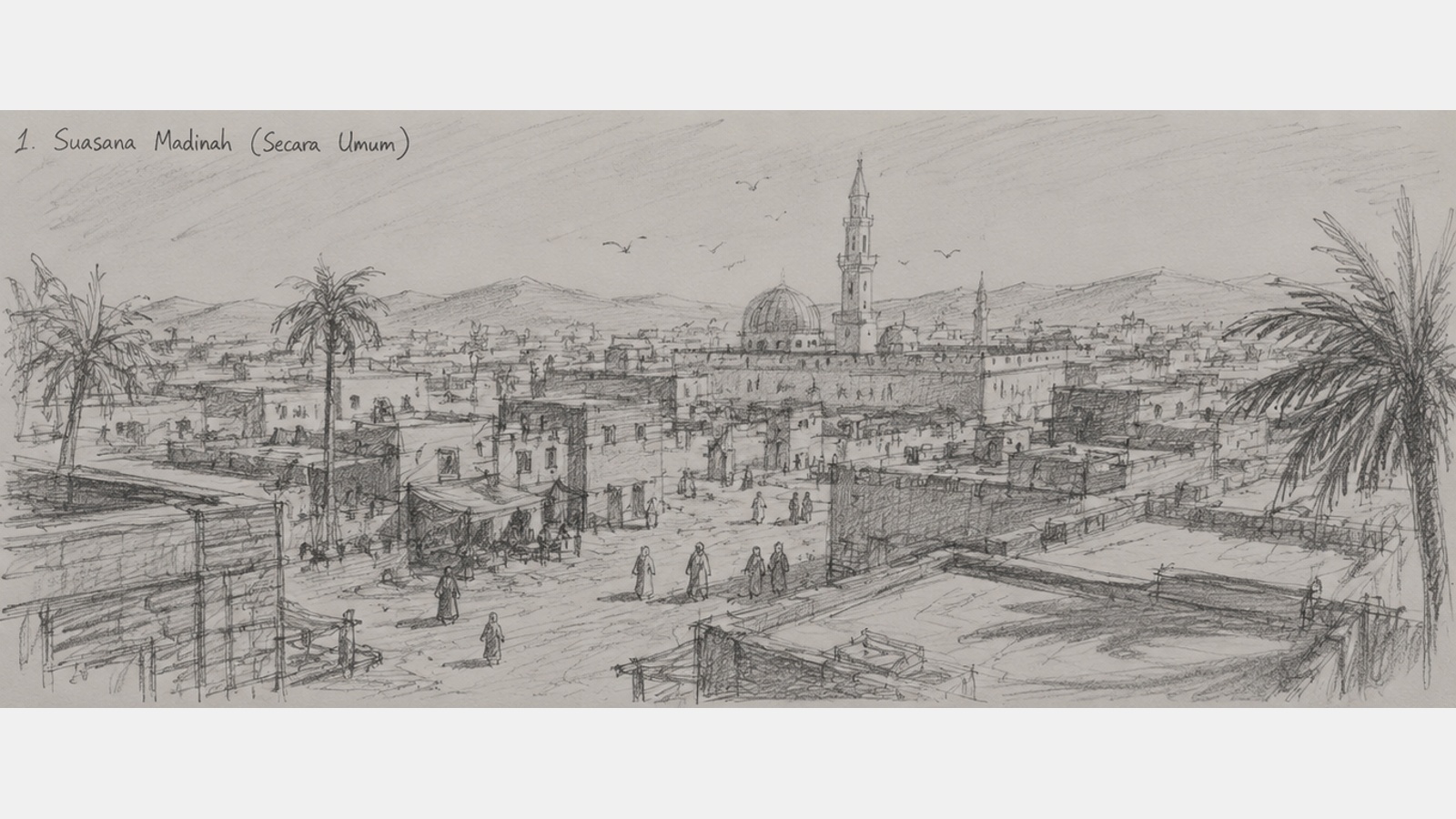
Evening descended slowly over Medina on the seventeenth day of Safar in the year 40 Hijri. The western horizon glowed with a dim crimson hue, like embers buried beneath desert dust. A hot wind drifted through the earthen alleyways, carrying with it the scent of sand, camel sweat, and dried dates from the market of Banu Qaynuqa Market. Along the narrow roads near Al-Masjid an-Nabawi, people still moved about before the coming of the Maghrib prayer. Merchants began lowering the cloth awnings of their stalls. The sound of wood striking wood echoed among the footsteps of passersby and the braying of donkeys laden with sacks of grain. From the distance came the laughter of children running near the public well, until a woman called them home in a loud voice. Yet that evening, something about the City of the Prophet felt different. People glanced over their shoulders more often while speaking. Some men even lowered their voices until only the movement of their lips could be seen. Near a row of water-jar vendors, Abdullah bin Yusuf stood holding the rope of a young pale-brown camel. His turban was wrapped neatly, though the end of its cloth had already gathered dust from the short journey from the date groves outside the city. Beside him, Bilal bin Harith inspected sacks of grain while occasionally wiping sweat from the back of his neck.
“Did you hear it?” Bilal asked quietly without lifting his head. His voice was swallowed by the noise of the marketplace, yet Abdullah could still sense the unease beneath its low tone. Abdullah did not answer immediately. Instead, his gaze fixed upon the northern gate of the market, where a group of travelers had just arrived. Dust swirled around the legs of their camels. Their clothes were torn and heavy with the sand of a long journey. One of the men dismounted unsteadily. His beard was coated with pale brown dust, while the cloth over his shoulder appeared ripped by something sharp. Near his arm were stains of dried blood. The man staggered forward a few steps before stopping beside a large water vessel. His hand trembled as he lifted a wooden dipper. People in the market began to watch. An old date merchant narrowed his eyes and stepped closer. “Where have you come from?” he asked cautiously. The traveler drank deeply before answering. His chest rose and fell heavily. Sweat ran along his temples, dampening the dust upon his face. When he finally lifted his head, his eyes were red like those of a man who had gone too long without sleep and lived too long with fear. “From Kufa...” he replied hoarsely. The marketplace, once loud with noise, slowly fell quiet. Even the bleating of goats tied near the bakery stall sounded clearer than the voices of men.
“What happened in Kufa?” the old man asked again, this time more softly. The traveler did not answer at once. He looked at the people around him one by one, as though afraid that every ear in the marketplace might carry danger. The desert wind blew gently, swaying the hanging cloth goods in front of the stalls. Near the stone path, a child stopped chewing his barley bread and stared in confusion toward the gathering crowd. At last, the traveler spoke in a low voice, yet clearly enough to make many hearts tighten. “Amir al-Mu’minin Ali ibn Abi Talib has fallen...” The words struck like a great stone cast into still water. A woman carrying a basket of dates instinctively covered her mouth. The old merchant stepped back, his face pale. “Inna lillahi wa inna ilaihi raji’un...” he whispered shakily. On the other side of the market, two men who had been speaking immediately cut off their conversation. One of them quickly glanced around before muttering under his breath, “Lower your voice...” Abdullah felt his throat turn dry. Bilal stared at him intently. For several moments, neither of them spoke. The only sounds were the whisper of wind carrying fine sand across the marketplace and the soft creaking of wooden cart wheels rubbing against their axles. Then a young man in a black turban hurried forward from behind the crowd. His face was covered in dust, and his eyes burned with anxiety. “And what of Hasan ibn Ali and Husayn ibn Ali?” he asked quickly. “Where are Ali’s sons?” The traveler lowered his head for a moment before replying quietly, “They are still in Kufa...” The words had barely settled when the Maghrib call to prayer began to echo from Al-Masjid an-Nabawi. The voice of the muezzin flowed through the evening air of Medina, yet that night its melody felt less like a summons to prayer and more like tidings of grief hanging above the City of the Prophet.
People did not immediately make their way to the mosque after the call to prayer echoed through the city. Some remained standing motionless around the traveler from Kufa, as though their legs had lost the strength to move. The sky above Medina slowly darkened. The crimson light on the western horizon began to sink behind the clay houses and the tall date palms that stood silently beneath the evening wind. Near an oil shop owned by an old man from Banu Aslam, small lamps were lit one by one. Their flames flickered gently in the desert breeze, casting a yellow glow across the somber faces of the people gathered there. Abdullah remained where he stood. His hand still gripped the camel’s rope, yet his thoughts felt far away. Around him, whispers began to spread like small flames creeping through dry grass
“Is it true that he fell by assassination?” asked a thin man with a sparse beard as he tightened his turban around his head. The traveler from Kufa slowly raised his face. “I saw people rushing toward the mosque in Kufa with my own eyes,” he said hoarsely. “People were weeping... some were striking their chests in grief. Blood was still visible on the floor when we arrived.” “And who was responsible?” another man asked quickly. The traveler swallowed hard. “People spoke of a Kharijites fighter... but after that, the city descended into chaos. Many forces have begun to move.” “Muawiyah ibn Abi Sufyan’s forces?” Bilal asked quietly.
The traveler did not answer immediately. Instead, he glanced around the marketplace first. Several unfamiliar faces stood in the distance near the grain sellers. One of them wore a dark gray turban and a long robe that remained strangely clean despite the dust-covered streets. The man appeared to be buying nothing. He merely stood there, watching the gathering crowd with narrowed eyes. The traveler from Kufa lowered his voice. “Many people have begun pledging allegiance to Muawiyah ibn Abi Sufyan...” he said slowly. “And the names of Ali’s supporters are beginning to be recorded.”
Those words caused several people to exchange uneasy glances at once. An elderly woman quickly pulled her grandchild away from the crowd. Two young men who had been standing near one of the market’s wooden pillars quietly left without saying a word. Even the desert wind seemed colder after the traveler’s warning. Abdullah studied the faces around him. He recognized most of them — the oil merchant, the cloth seller, the goat herders, the carpenters, and the students of knowledge who usually filled the porticoes of Al-Masjid an-Nabawi. But that night, the faces he had known all his life seemed different. A fear was slowly growing within their eyes.
“By Allah...” Bilal whispered softly. “The fitnah has finally reached Medina.” Abdullah finally spoke after remaining silent for so long. “The fitnah has been unfolding for a long time already,” he said quietly while gazing at the marketplace streets that were beginning to empty. “Only now has it begun knocking upon the doors of our homes.”
Near them, a small child suddenly burst into tears after stumbling while running. His mother quickly lifted him into her arms, all the while casting anxious glances toward the gathering crowd. From the main road leading to Al-Masjid an-Nabawi, several men could be seen walking with unusual haste. Their turbans fluttered lightly in the night wind. One of them whispered something to his companion while pointing toward the marketplace. Abdullah could see the unease written plainly across their faces.
The traveler from Kufa slowly lowered himself beside the large water vessel. His body looked utterly exhausted. “On the road to Medina...” he said quietly, “I saw several homes belonging to Ali’s supporters in the Hijaz beginning to be watched. Some people were seized shortly after nightfall. Others disappeared before dawn.” “And who is carrying out all of this?” the old date merchant asked. The traveler shook his head slowly. “Some claim to be soldiers. Others are merely armed men acting in the name of those in power.” Bilal clenched his fists tightly. His jaw stiffened. “They want to purge Medina of Ali ibn Abi Talib’s family.” “Lower your voice,” Abdullah warned sharply without turning his head.
Bilal drew a heavy breath and glanced around the marketplace. In the distance, the man in the gray turban still stood in the very same spot. His gaze remained cold and unmoving. Only his eyes shifted, studying people one by one like someone committing every face in the market to memory. The call to prayer gradually faded away. The sky was now completely dark. Oil lamps hanging before the shops swayed gently in the wind. A desert dog barked once from an eastern alley before silence settled again over the city. Abdullah looked toward Al-Masjid an-Nabawi standing at the heart of Medina. Its lamps glimmered faintly in the distance. His chest felt heavy with something he could not yet name. Yet deep within his heart, he was beginning to understand one thing: Medina was slowly becoming a foreign place to some of its own children.
“We will be late for the prayer,” Bilal said quietly as he lifted a sack of grain onto his shoulder. Yet his voice sounded hollow, as though his thoughts were no longer truly in that marketplace. Abdullah gave a slight nod. He handed the rope of his camel to a stable boy near the well before slowly making his way toward Al-Masjid an-Nabawi alongside Bilal. The others gradually began moving in the same direction. Their footsteps sounded heavy against the sand and scattered stones of Medina’s roads. Very little conversation could now be heard. And when voices did rise, they were only brief whispers that ended the moment another person approached. From several narrow alleyways, women stood behind the doors of their homes, watching the streets with anxious eyes. Some held their children tightly against their chests. The night wind descended with the coolness of the desert, slowly replacing the heat of the day. Thin dust drifted through the glow of oil lamps hanging before the clay houses.
As they passed through an alley near the homes of Banu Hashim, Abdullah noticed two unfamiliar men standing beneath an old date palm. One of them was tall, with a neatly trimmed short beard. The other was older, sharp-eyed, and dressed in a dark brown robe. They did not speak. Yet their eyes followed every person walking toward Al-Masjid an-Nabawi. Bilal slowed his pace slightly. “I have never seen them before,” he whispered without moving his lips much. “Do not stare for too long,” Abdullah replied calmly. Bilal clicked his tongue softly. “They are not men of the marketplace.” “I know.” “Soldiers?” Abdullah gave a faint shake of his head. “Not ordinary soldiers.” They continued walking. From the distance came the overlapping sounds of sandals striking the road as people made their way to the mosque. A donkey passed by pulling a small cart filled with water jars. Its wooden frame creaked softly whenever the wheels rolled across the uneven stones of the street. In front of a house near a narrow alley, an old man hurriedly extinguished the oil lamp outside his door the moment he saw the two strangers slowly moving in another direction. Abdullah watched everything in silence. A growing unease was beginning to fill his chest, one that was becoming harder and harder to conceal.
“Abdullah...” Bilal spoke again as they neared the courtyard of Al-Masjid an-Nabawi. “If they have begun recording the names of Ali’s supporters in Kufa, then it will not be long before Medina follows.” “Perhaps such a list existed long before this,” Abdullah replied quietly. Bilal turned toward him quickly. “You mean...” “Those who love the Prophet’s family have always been watched.” Abdullah gazed toward the courtyard of the mosque, now gradually filling with worshippers. “Only now, they no longer feel the need to hide it.” They passed several students of knowledge who usually sat in the study circle of Shaykh Umar. Yusuf ash-Shaghir stood near one of the mosque’s pillars, his face pale. The young man was normally talkative, yet tonight his lips remained tightly sealed. Nearby, Musa al-Yamani was calming an elderly man who kept clutching a wooden prayer bead strand while quietly seeking forgiveness from Allah under his breath.
“Is the news true?” Yusuf asked quickly the moment he saw Abdullah approach. Abdullah nodded slowly. Yusuf’s face immediately turned pale. “By Allah...” he whispered faintly. “I still remember the sermon of Amir al-Mu’minin Ali ibn Abi Talib when he once came to Medina.” “Lower your voice, young man,” Musa reminded him gently while placing a hand upon his shoulder. Yusuf quickly lowered his head. Around them, more worshippers continued arriving. Yet that night, the atmosphere inside Al-Masjid an-Nabawi felt unlike any other night. People still came for prayer, but their faces carried something heavier than the weariness of travel or the burdens of trade. Even the sound of footsteps crossing the mosque courtyard seemed strangely cautious.
As Abdullah was about to enter the main courtyard, his eyes once again caught sight of the man in the gray turban from the marketplace. Now the man stood near the ablution area, pretending to wash his hands. Yet his eyes continued moving, carefully observing the people arriving at Al-Masjid an-Nabawi. From time to time, he exchanged a few quiet words with another man standing beside one of the outer stone pillars of the mosque. Abdullah recognized that kind of gaze. It was the gaze of someone counting and memorizing faces. Bilal noticed him as well. “He has followed us since the market,” he muttered quietly. Abdullah drew a long breath. The night air of Medina felt colder than usual. “From tonight onward,” he said softly without looking at Bilal, “do not speak carelessly in the streets of this city anymore.” Bilal fell silent.
Then, from within Al-Masjid an-Nabawi, the iqamah began to echo through the night air. The worshippers quickly tightened their rows. Yet amid the sacred call to prayer, Abdullah felt something he had never before experienced in all his years living in Medina: a fear slowly entering the very heart of the City of the Prophet. The rows of worshippers drew close together across the cool floor of the mosque. The dim glow of oil lamps reflected softly against the wooden pillars supporting the roof. The scents of earth, travel dust, and olive oil mingled within the night air of Medina. Abdullah stood in the middle row beside Bilal, while to their right Yusuf ash-Shaghir kept his head lowered deeply. The young man’s breathing sounded uneven. Several times his hands tightened around the edge of his own garment, like someone struggling to calm the unrest within his chest. At the rear of the mosque, several travelers from Kufa sat leaning against the pillars, their bodies exhausted and their faces dulled by the sand of the journey. One of them still bore a long wound near his temple that had not yet fully dried.
The imam raised the opening takbir. His voice echoed gently throughout Al-Masjid an-Nabawi. The worshippers followed the movements of the prayer in orderly rows, yet that night their devotion seemed burdened by a heavy sorrow. As the verses of the Qur’an were recited, some people lowered their heads longer than usual. An elderly man in the front row could be heard quietly sobbing when the imam recited verses about patience and the trials placed upon mankind. Even the whispering wind that entered through the open sides of the mosque seemed to carry a sadness difficult to explain. Abdullah himself struggled to focus his heart upon the prayer, yet his thoughts continually returned to the faces he had seen in the marketplace earlier that evening: the dust-covered traveler from Kufa, the man in the gray turban, and the hushed whispers about names that were beginning to be recorded.
After the final salam, the mosque did not immediately return to its usual lively atmosphere. Few people spoke loudly. Instead, the worshippers gathered in small circles, their voices low and their expressions grim. Some chose to leave quickly before the night grew darker. From outside Al-Masjid an-Nabawi came the slow sound of camels passing along the city’s main road. Bilal wiped his face slowly before turning toward Abdullah. “I do not like this atmosphere,” he whispered. “No one does,” Abdullah replied quietly. Near one of the mosque’s pillars, several men had begun surrounding the traveler from Kufa who had brought the news. Their voices remained hushed, though fragments of their questions could still be heard. “Is it true that the homes of Ali’s family are being watched?” “Has Hasan ibn Ali already received the pledge of allegiance?” “How many have been killed?” The traveler shook his head weakly. “The city descended into chaos after the death of Amir al-Mu’minin Ali ibn Abi Talib,” he answered slowly. “Some people wept... while others immediately began searching for advantage.”
A young man in a dark robe suddenly spoke with restrained anger in his voice. “Muawiyah ibn Abi Sufyan will not stop until every supporter of Ali ibn Abi Talib is silenced.” “Quiet!” an older man hissed quickly as he pulled the young man by the arm. “Do you want the entire mosque to hear your words?” The young man clenched his jaw but finally lowered his head. Abdullah watched the exchange in silence. Fear now truly seemed alive among the people. Even the names that were once spoken openly and proudly had begun to be uttered like dangerous secrets.
Not far from them, Shaykh Umar al-Madani finally emerged from one of the porticoes of Al-Masjid an-Nabawi. The elderly scholar walked slowly yet upright. His white beard moved gently in the night wind. His face appeared weary, as though both age and the sorrow of that night had added equal weight upon his shoulders. People immediately stepped aside as he passed. Several students of knowledge approached him respectfully, among them Yusuf and Musa al-Yamani. “Shaykh...” Yusuf said softly, his eyes glistening with tears, “is it true that Amir al-Mu’minin has fallen?” Shaykh Umar looked at the young man for a few moments before slowly nodding. “May Allah have mercy upon Ali ibn Abi Talib,” he said calmly. “He has returned to his Lord.”
The atmosphere around them grew even quieter. Even those who had been whispering moments earlier now held their breath to listen to the words of the elderly scholar. “O people...” Shaykh Umar continued in a low yet steady voice, “do not allow grief to drag you into a blinding hatred. A great fitnah has now been opened. And when the hearts of men become filled with anger, blood is spilled more easily than water.” A man standing near the back asked anxiously, “Then what should we do, O Shaykh?” Shaykh Umar did not answer immediately. His gaze slowly moved across the faces surrounding him — faces worn by exhaustion, fear, and unrest. In the distance, near the outer gate of Al-Masjid an-Nabawi, Abdullah once again noticed the man in the gray turban standing silently while observing them all. “Hold your tongues,” Shaykh Umar finally replied softly. “And protect your families.”
Shaykh Umar’s words lingered in the night air of Al-Masjid an-Nabawi long after he had spoken. No one answered at once. The people merely exchanged glances, their faces growing ever more somber. In one corner of the mosque, a small oil lamp flickered gently beneath the wind drifting through the open walls. Shadows moved faintly across the sandy stone floor. Abdullah studied Shaykh Umar’s face, which seemed older that night than ever before. The fine lines around the scholar’s eyes appeared deeper beneath the yellow glow of the mosque lamps. Near the outer gate, several worshippers began departing in haste while tightening their turbans around themselves. The sound of sandals echoed one after another into the darkening alleys of Medina.
Shaykh Umar’s words lingered in the night air of Al-Masjid an-Nabawi long after he had spoken. No one answered at once. The people merely exchanged glances, their faces growing ever more somber. In one corner of the mosque, a small oil lamp flickered softly beneath the wind drifting through the open walls. Shadows moved faintly across the floor of sand and stone. Abdullah studied Shaykh Umar’s face, which seemed older that night than ever before. The fine lines around the scholar’s eyes appeared deeper beneath the yellow glow of the mosque lamps. Near the outer gate, several worshippers hurried away while drawing their turbans tighter around themselves. The sound of sandals faded one after another into the darkening alleys of Medina. “Shaykh...” another voice rose from behind the gathering. A thin man with an unkempt beard stepped forward slowly. “Is it true that they have begun arresting those who remain loyal to Ali’s family?” Several heads turned sharply toward him at once. Even Bilal drew a short breath, as though afraid the question might reach the wrong ears. Shaykh Umar regarded the man calmly. “News that travels across distant roads is often mixed with both truth and falsehood,” he replied with care. “Yet men who hunger for power seldom allow fear to sleep long among the people.” The thin man bit his lip. “My brother in Yanbu sent word...” he said quietly. “Homes are being searched after nightfall.” “And in Mecca,” another man added quickly, “I heard that some people are already being forced to declare their allegiance openly.” “Enough...” Musa al-Yamani said gently, raising a hand to calm them. “This mosque is not a place for voices of fear to be raised.”
Yet fear had already taken root upon the faces of the people. Abdullah could see it plainly. One young man kept glancing toward the mosque gate every few moments. Two elderly men spoke in hushed tones while covering their mouths with the edges of their turbans. Even the children who had been playing in the courtyard earlier now sat quietly beside their mothers, as though they too could sense the change that had settled into the night air.
PART 2 — A Fear That Gripped Medina
Outside Al-Masjid an-Nabawi, the sudden thunder of horses’ hooves broke across the city’s main road. Several worshippers instinctively turned toward the sound. Iron shoes struck against stone in sharp echoes before fading westward into the night of Medina. Bilal narrowed his eyes. “They have begun moving even at night now,” he murmured. “Who?” Yusuf ash-Shaghir asked quickly. Bilal had not yet answered when Abdullah spoke first in a quiet voice. “Those who wish to ensure this city remains obedient.” Yusuf swallowed hard. His youthful face looked pale beneath the glow of the oil lamps. “Will Medina become like Kufa?” The question cast the gathering back into silence. No one answered at once. Even Shaykh Umar lowered his head for a few moments while slowly stroking his white beard. “This is the city of the Messenger of Allah,” he finally said softly. “But men remain men. And when hearts become consumed by worldly desire and the hunger for power, not all will continue to honor what is sacred as they once did.”
The night wind drifted once more through Al-Masjid an-Nabawi. Fine dust stirred softly across the floor near the entrance. Abdullah felt the chill creep along the back of his neck. For the first time in all his life, he no longer saw the Prophet’s Mosque merely as a place of worship and learning, but also as a refuge where people concealed their fears lest they spill out into the streets. Suddenly, a small boy came running in from the outer courtyard, breathing hard. He could not have seen more than ten summers. His clothes were wrinkled and covered in dust, and one of his sandals was nearly torn through. He stopped beside an elderly man and gasped between breaths, “Father... father... there are soldiers near the homes of Bani Harith!” The gathering stirred at once with unease. “Whose soldiers?” someone demanded quickly. The boy shook his head nervously. “I do not know... they are carrying spears...” Bilal looked toward Abdullah. Their eyes met for a brief moment without words. Yet both men understood the same truth: from this night onward, Medina was beginning to become a city under watch.
Near the gate of Al-Masjid an-Nabawi, the man in the gray turban finally turned to leave. His steps were calm, yet before disappearing into the dark alleys of the city, he cast one final glance toward the gathering of worshippers. It was a long, cold look — like that of a man silently choosing which names to remember. The congregation slowly began to disperse after word spread through the mosque courtyard about soldiers near the homes of Bani Harith. There was no open panic, yet unease could plainly be seen in the movements of the people. Some men chose to return home quickly with their families. Others gathered briefly in small circles before parting in hushed voices and strained expressions. More oil lamps were being lit now along the streets of Medina. Their dim glow shimmered against clay walls crowded with the shadows of people hurrying home before the night deepened. Abdullah left the mosque beside Bilal without speaking much. Behind them, Yusuf ash-Shaghir followed with hurried steps, while Musa al-Yamani remained behind to help an elderly man who struggled to walk.
The night air grew colder still. Desert winds carried fine dust that occasionally swirled through the narrow lanes between the houses. From afar came the sound of wooden doors being shut with more force than usual. A dog barked once again before falling suddenly silent. Medina was not truly quiet that night, yet its small sounds only made the unease feel more alive. “I did not like the way that man in the gray turban looked at people,” Bilal muttered, glancing briefly over his shoulder. “Because he did not come there to worship,” Abdullah replied softly. Yusuf, walking beside them, immediately lifted his head. “Do you think he is a spy?” Bilal clicked his tongue quietly. “In times such as these, a man may become a spy for nothing more than a pouch of dinars.” “Or for the safety of his own neck,” Abdullah added calmly.
They passed through a narrow alley near the home of Umar bin Jundab. The scent of freshly cut wood still lingered faintly in the night air. From inside the house came the soft sound of hammering — perhaps Umar was finishing the frame of a chest or the wheel of a cart before retiring for the night. Not far from there, lamplight spilled from the home of Qasim bin Thauban. The shadow of someone moved behind the cloth covering a small window. The city was still awake, yet its nights were now filled with caution. “Abdullah...” Yusuf spoke again, his voice uncertain. “Is it true that they will begin arresting the families who remain loyal to Ali ibn Abi Talib?” Abdullah did not answer at once. His pace slowed briefly as they passed an abandoned house belonging to an elderly man who had died several months earlier. Its door remained tightly shut, and dust had begun gathering along the lower threshold.
“I do not know how far they intend to go,” Abdullah finally replied. “But men who pursue power are seldom satisfied with a single victory.” Bilal let out a long, weary breath. “What I fear most is not their swords.” “Then what?” “The fear they plant within the hearts of men.” Bilal fixed his gaze upon the dark road stretching before them. “Once people become afraid to speak, this city will begin to change.” Yusuf fell silent. The young man seemed to swallow down his own unease. Several times his hands tightened around the edge of his thin robe as the night wind brushed against it.
As they drew near Abdullah’s home, the gentle recitation of the Qur’an drifted from one of the neighboring houses. The voice was soft and trembling, as though the one reciting sought to calm his own heart through the verses. Near the small well at the end of the alley, a woman drew water while casting anxious glances toward the road from time to time. The wooden bucket knocked softly against the stone rim each time the rope was pulled upward.
Abdullah’s house stood not far from the family’s small date grove. Its walls were modest, built from earth and stone, yet clean and well kept. The glow of an oil lamp shone warmly from within. The moment Abdullah pushed open the wooden door, the scent of fresh bread and barley soup greeted them from the main room. Yet the warmth of the house was quickly overshadowed by the anxious face of Maryam bint Salman, who had clearly been troubled since the instant she saw them enter. “You are late,” Maryam said quickly as she rose from beside the small hearth. Her head covering was not properly arranged, as though she had been hurrying in and out of the house since Maghrib. “What has happened in the city?” Abdullah did not answer at once. He slowly removed his turban and hung it near the door. A thin layer of dust fell onto the earthen floor. Maryam stepped closer. “Abdullah?” Bilal looked at her for a moment before speaking softly. “News has come from Kufa.” Maryam’s face immediately lost its color. “Ali ibn Abi Talib has fallen,” Bilal continued quietly.
The small room fell abruptly silent. Even the crackling of firewood in the hearth could be heard clearly between their breaths. In one corner of the room, little Fatimah, who had been sitting beside a woven basket of dates, slowly lifted her face in confusion. From behind the curtain leading to the inner room, Iskandar appeared with hurried steps after overhearing their conversation. “What do you mean by fallen?” Iskandar asked innocently, though his eyes had already begun to catch the unease upon the faces of the adults around him. No one answered immediately. Only the night wind slipping through the cracks in the walls carried the chill of the desert into their silence. Iskandar remained standing near the curtain of the inner room, his expression uncertain. The glow of the oil lamp reflected dimly in his youthful eyes. The boy had scarcely lived through thirteen summers, yet that night he began to witness something he had previously known only from the guarded conversations of grown men: fear. Little Fatimah slowly moved closer to her mother’s side, clutching the edge of Maryam’s garment tightly in her small hands. Outside the house, the night wind swept through the date palms, their fronds brushing together in a soft rustling sound like distant whispers.
Abdullah walked slowly toward the small hearth in the center of the room and lowered himself onto a rough woven mat. His face looked weary. Dust from the road still clung to the edge of his beard and the folds of his clothing. For several moments he merely stared at the small flames dancing beneath the pot of barley soup. “Father...” Iskandar asked softly once more. “What did Uncle Bilal mean when he said Amir al-Mu’minin has fallen?” Abdullah slowly lifted his gaze toward his son. There was weight in his eyes, as though he were carefully choosing words that would not wound the boy’s heart too deeply, too soon. “Ali ibn Abi Talib has passed away,” he finally replied in a quiet voice. Iskandar fell silent. “Was he killed?” Bilal lowered his head, rubbing his face roughly with his hand. Maryam closed her eyes briefly before sitting down beside Fatimah. “Men can become terribly hungry for this world,” Abdullah said softly. “And when that happens, blood is often spilled among fellow Muslims.” The room sank into silence once again. Only the sound of the small fire and the occasional wind pressing against the walls of the house could be heard. Iskandar stepped a little closer, his youthful face tense with unease. “Are Hasan ibn Ali and Husayn ibn Ali in danger as well?” he asked. The question caused Maryam to turn quickly toward Abdullah. Even Bilal slowly raised his head. The boy, it seemed, had heard far more than they had realized over the years. “They are still in Kufa,” Abdullah answered carefully. “But people will protect the grandsons of the Messenger of Allah... will they not?” Iskandar asked again, his voice still carrying the innocent hope of a boy his age. Bilal let out a long breath. “My son...” he said quietly, “in times of fitnah such as these, men sometimes become too afraid to protect even their own families.”
Iskandar seemed about to speak again when the sharp sound of knocking suddenly cut through their conversation. Tok. Tok. Tok. At once, everyone fell silent. Fatimah instinctively clung tightly to her mother’s arm. Maryam held her breath. Bilal quickly raised his head and looked toward the wooden door, which trembled faintly beneath the night wind. The knocking came again — softer this time, yet hurried. Abdullah rose slowly to his feet. His face remained calm, though his eyes had grown alert. Bilal stood as well, glancing toward the corner of the room where a long wooden staff rested beside a water jar. “Who is it?” Abdullah called from inside the house. The voice outside answered quickly, restrained and breathless. “It is I... Hadi bin Malik.” Bilal exhaled roughly. “That boy nearly stopped my heart.”
Abdullah opened the door slowly. Hadi bin Malik hurried inside, breathing heavily. The young man looked as though he had come straight from the streets in great haste. His dark hair was disheveled by the night wind. Dust clung to his face and clothing, and a thin scrape marked the edge of his left jaw as though something sharp had grazed him. Even his turban was nearly coming loose from his head. “What has happened?” Abdullah asked quickly. Hadi glanced briefly toward the street outside before Abdullah shut the door firmly behind him. “They have begun moving,” he said, still struggling to steady his breath. “Who?” “Muawiyah ibn Abi Sufyan’s men.” Hadi’s eyes burned with both anger and unease. “I came from near the homes of Bani Harith. Several armed men arrived there shortly before the ‘Isha prayer.” Maryam quietly covered her mouth. “Did they arrest anyone?” Bilal asked. Hadi gave a firm nod. “Two men were taken away.” His jaw tightened. “They were accused of hiding letters from Kufa.” The room once again fell beneath a heavy silence. Outside the house, the desert wind continued moving through the alleys of Medina as the city sank deeper into the night. Yet the night no longer felt peaceful. It felt like something waiting in the shadows beyond the doors of the Prophet’s city.
Hadi remained standing near the door, his chest rising and falling heavily. Sweat ran from his temples down to the collar of his robe, dulled by the dust of the road. His breath carried the scent of sand and the weariness of a long night’s journey. Abdullah studied the young man in silence for several moments. Beneath the glow of the oil lamp, the shadows upon Hadi’s face made him appear harsher than usual. There was anger in his eyes that had not yet cooled. “Sit down first,” Abdullah finally said quietly. Hadi shook his head at once. “I did not come here to eat or rest.” “And yet you breathe like a man pursued by desert spirits,” Bilal replied as he poured water into a clay cup. Hadi accepted the cup and drank deeply. Water dripped down his dust-covered beard before he wiped his face roughly with one hand. Then he spoke again. “They have begun going from house to house.” “How many?” Abdullah asked. “I do not know yet.” Hadi stared at the small fire burning beneath the hearth. “But people are growing frightened. In the alley near the homes of Bani Harith, some women were weeping when the armed men entered.” Fatimah moved even closer to her mother. Maryam gently wrapped an arm around her daughter while continuing to listen. “Are they official soldiers?” Bilal asked. Hadi clicked his tongue softly. “Some carry spears and swords like soldiers. But others are merely rough men hiding behind the name of those in power.” Iskandar, who had remained silent until then, finally stepped closer. “Why are they arresting those people?” he asked. Hadi looked at the boy for a moment, and his expression softened slightly. “Because they are afraid,” he answered shortly. “Afraid of whom?” “Of those who still love the family of Ali ibn Abi Talib.” The room fell silent once more. The fire crackled softly as dry wood beneath the pot broke apart in the embers. Outside the house, the sound of hurried footsteps passed through the alley before slowly fading toward the southern quarter of Medina.
Bilal slowly lowered himself beside the wall, rubbing the stiffness from the back of his neck. “I have seen Medina gripped by fear before,” he said quietly. “When the Messenger of Allah passed away... people wept openly in the streets. But tonight is different.” He looked toward the oil lamp swaying gently in the draft slipping through the cracks of the door. “Tonight, men are afraid of fellow Muslims.” Maryam lowered her gaze. “I do not like any of this,” she whispered. Abdullah looked at his wife for a long moment. Her face appeared pale beneath the lamplight. Maryam was usually calm, yet tonight her fingers continually tightened around the fabric of her own garment. “Will matters grow worse?” she asked softly. No one answered immediately. Instead, Hadi walked toward the small door of the house and opened it slightly. The night air swept in at once, carrying with it the scent of cold sand and desert earth. The alley outside appeared deserted. Only the faint glow of lamps from a few neighboring homes showed that others were still awake.
“I met Umar bin Jundab on the road earlier,” Hadi said without turning around. “He told me that several strangers have been seen moving around the homes of Banu Hashim since the afternoon.” Bilal quickly raised his head. “The same men from the market?” “Perhaps.” Abdullah drew a long breath. He was beginning to understand that the fear spreading through the night was no longer merely a rumor carried by travelers from Kufa. It had already arrived in Medina together with spies, hushed whispers, and the footsteps of armed men. “Shaykh Umar must hear of all this,” Abdullah finally said. “He already has.” Hadi slowly shut the door again. “Several of his students gathered at Musa’s house before I came here.” “And what did they decide?” Hadi fell silent for a moment before answering softly, “No decision has been made yet.” “None?” Bilal frowned. “Some wish to remain silent and stay in Medina. Others have begun speaking of leaving.” Hadi fixed his gaze upon Abdullah. “Some mention Yemen. Others speak of going to Kufa.” “Kufa now is like embers drenched in oil,” Bilal muttered. “And Medina is slowly drying like desert grass,” Hadi replied quietly. Those words cast the room into silence once more.
Outside the house, the night deepened. The sky above Medina was strewn with pale stars that seemed distant and cold. The wind continued wandering through the city’s alleys, brushing against doors that had been bolted shut far earlier than usual. And within the house of Abdullah bin Yusuf, for the first time, the word leave no longer felt like a distant possibility, but like a shadow slowly drawing nearer to their lives. The night wore on, yet no one in Abdullah’s home truly felt the pull of sleep. The barley soup resting above the hearth had begun to cool untouched. The scent of boiled grain and warm bread still lingered throughout the small room, mingling with the dust of the road clinging to the garments of Hadi and Bilal. The oil lamp beside the wall trembled faintly whenever the night wind slipped through the cracks in the roof. The shadows within the house stretched long across the earthen walls, swaying gently in the dim light.
Fatimah eventually fell asleep in Maryam’s lap after struggling too long against fear and drowsiness. The little girl’s breathing became soft and steady. Maryam gently stroked her daughter’s hair without once closing her own eyes. Her gaze continued moving between Abdullah, Bilal, and Hadi. Iskandar still sat near the hearth with his knees drawn close to his chest. His face remained solemn as he listened to the conversation of the adults, though at times his eyes seemed distant, as though he were trying to understand a world that had suddenly changed before him. “I saw Harith al-Qurashi tonight.” Hadi’s words caused Bilal to lift his head at once. “Harith?” Bilal repeated quietly. “The same man who once served as one of Muawiyah ibn Abi Sufyan’s intermediaries in Greater Syria?” Hadi nodded. “I saw him near the homes of Bani Harith before the armed men arrived.” Abdullah narrowed his eyes. “Are you certain it was him?” “I saw him two years ago when he came with a trading caravan from Syria.” Hadi slowly clenched his jaw. “I could not mistake his face.”
The room sank once more into a heavy silence. Even the cracking of burning wood could be heard clearly between their breaths. “If Harith is already in Medina...” Bilal said quietly while staring at the floor, “then this is no longer ordinary surveillance.” Maryam looked quickly toward Abdullah. “Who is this man?” “A man skilled at turning people against one another,” Abdullah replied softly. “And men like him are often more dangerous than those who carry swords.” Iskandar frowned slightly. “Is he a soldier?” “Not always,” Bilal answered. “Sometimes he arrives bearing smiles and pleasant news. And afterward, homes begin burning with fitnah.”
The night wind stirred the door of the house once more. In the distance, a donkey let out a long, mournful cry before silence settled again. Medina appeared asleep, yet behind its tightly shuttered doors many eyes still remained awake. “Shaykh Umar once said,” Abdullah murmured slowly, “when fitnah begins to walk among men, people are no longer slain by the sword alone.” He lifted his gaze toward the wavering flame of the oil lamp. “Sometimes a man’s name is killed first.” Hadi lowered his head and rubbed the scrape along his jaw. “I nearly came to blows earlier tonight.” Maryam immediately turned toward him. “A fight?” Bilal let out a rough breath, as though the news did not surprise him in the least. “I suspected as much.” Hadi seemed faintly ashamed, though the anger still burned plainly across his face. “One of their men spoke of Ali ibn Abi Talib with contempt.” His fingers curled tightly against his knee. “I could not hold myself back.” “And then?” Abdullah asked calmly. “I shoved him.” Hadi stared into the fire beneath the hearth. “He drew a dagger. We would have stabbed one another had the men in the market not pulled us apart.” Maryam quietly covered her mouth. Iskandar stared at Hadi wide-eyed. “You must learn to master your anger,” Abdullah said in a low but firm voice. “How can I remain silent while they insult the family of the Messenger of Allah?” Hadi shot back. His voice rose for the first time that night. “They walk into Medina as though this city belongs to them!” “Lower your voice,” Bilal warned, casting a glance toward the door. Hadi drew a long breath before lowering his head once more. The muscles along his jaw still tightened visibly as he struggled to contain the turmoil within him.
Abdullah studied the young man for several moments. He understood Hadi’s anger. Many of the youth of Medina had been raised with deep love for Ali ibn Abi Talib and his family. Yet Abdullah also understood something far more dangerous: young men like Hadi were the easiest targets for those who wished to provoke unrest. “Listen to me carefully,” Abdullah finally said, his voice quiet yet weighted with gravity. “From this night onward, none of you is to walk the streets alone after the ‘Isha prayer.” Bilal gave a faint nod. “And do not answer their provocations,” Abdullah continued. “That is precisely what they desire.” Hadi slowly raised his head. “So we are simply to remain silent?” Abdullah did not answer immediately. His gaze moved toward his children, then to Maryam, who still held little Fatimah silently in her arms. “Sometimes,” he said softly, “keeping one’s family alive is the hardest form of courage.” Abdullah’s words drew the room once more into a long and heavy silence. Hadi lowered his head again and let out a weary breath. His hands still gripped his knees so tightly that the veins along the backs of them stood out beneath the glow of the oil lamp. The fire in the hearth was beginning to die down. Red embers beneath the wood flickered now and then before fading again into darkness. Outside the house came the whisper of wind passing through the date palms, along with the faint sound of someone hurrying through the alley deep in the night.
Bilal finally broke the silence, slowly stroking his beard as he spoke. “I never imagined I would live to see Medina like this.” He looked toward the walls of the house, which trembled faintly beneath the night wind. “Once, people came to this city seeking peace for their hearts. Now men have begun watching one another.” “Fitnah always begins with fear,” Abdullah murmured. “And with greed,” Hadi added quietly. Maryam rose slowly and lifted the small cooking pot from beside the hearth. With calm, careful movements, she poured the barley soup into several clay bowls, though anxiety still lingered plainly upon her face. The warm scent of grain and thinly sliced goat meat once again filled the room. “Eat first,” she said softly. “You have spoken of fear all night while your stomachs remain empty.”
Bilal gave a faint smile for the first time that evening. “By Allah, Maryam...” he said as he took the bowl. “Sometimes you’re wiser than all the men in Medina put together.” Maryam didn’t respond to the jest. “Men all too often forget that a hungry body makes the heart more prone to anger.” Hadi bowed his head respectfully as he accepted the bowl from Maryam. His rough hands still seemed to tremble slightly, his emotions not yet fully subsided. Iskandar, for his part, immediately sat closer to the hearth, but his eyes remained fixed on the adults’ conversation. “Father...” he said softly, holding the warm bowl in both hands. “Will they be looking for us too?” Bilal immediately turned his head sharply towards Abdullah. Maryam, too, paused in her movements for a moment. Abdullah looked at his son for a long time before finally replying cautiously, “I don’t know.” “But we love the family of Ali,” Iskandar continued innocently. “Isn’t that what they’re looking for?” Hadi looked at the boy with a gaze that was a mixture of admiration and sadness. “Son,” Abdullah said slowly, “loving the family of the Prophet is not a mistake.” “Then why are people being hunted down for that?” No one answered straight away. The child’s question felt too honest for an adult world filled with self-interest and fear. Bilal finally let out a long sigh. “Because people often place power above their own hearts.”
Iskandar didn’t seem to have fully understood, but he didn’t ask any more questions. The boy simply looked down at the surface of the soup in his bowl, from which a thin wisp of steam was still rising. Outside the house, the sound of footsteps could be heard passing by once more. This time there was more than one person. Everyone’s heads snapped up. Hadi slowly set down his bowl and moved silently towards the door. His hand shot out—”Hadi stopped dead in his tracks, then took a short breath whilst roughly rubbing his face. His hand slowly reached for the wooden stick leaning against the water jug.
Abdullah watched the narrow passageway beneath the front door. The shadows of several people could be seen moving past the dim light of the outside lamp. Their footsteps were heavy, like those of armed men. Knock... knock... The sound of knocking came from the house next door. Maryam immediately hugged Fatimah tighter. The little girl woke up slowly, her eyes half-frightened and half-confused. “Don’t open the door!” came a woman’s voice from the neighbouring house, her tone panicked yet restrained. Then a gruff male voice called out from outside, “We just want to ask a few questions!” Bilal clenched his jaw. Hadi glared at Abdullah. “They’re starting to make their way into the house’s corridors,” Hadi whispered softly. Abdullah remained seated in silence, but his gaze grew sharp. For the first time that night, he truly sensed that the Madinah he had always known was slowly being gripped by a very real fear.
Sounds from the house next door continued to drift faintly through the earthen walls. He couldn’t make out the whole conversation, but the tense atmosphere between them was enough to make the small corridor feel even more cramped and stifling. Hadi stood near the door, clutching his wooden staff tightly. His breathing sounded laboured. Bilal himself slowly rose from his seat and moved closer to Abdullah. “I recognise that voice,” Bilal whispered very softly. “One of them is the man who was near the market earlier.” Abdullah did not reply. His gaze remained fixed on the front door. The oil lamp on the wall swayed gently in the breeze, casting shifting, restless shadows across the small room. From outside came the sound of wood being struck once more. Knock! Knock! “Open the door!” barked a harsh voice.
Fatimah immediately hugged Maryam tighter, until her little face was hidden against her mother’s chest. Iskandar swallowed hard as he stared at the door without blinking. The child tried to look calm, but her fingers gripped the clay bowl so tightly that her knuckles turned white. “Will they go into other houses too?” Maryam asked softly. “If they dare to knock on one house tonight,” Bilal replied quietly, “then tomorrow they will knock on another.”
Suddenly, the sound of a woman’s stifled sobs could be heard from the house next door. This was followed by the sound of something falling and hurried footsteps inside the house. Iskandar jumped to his feet. “They’re hurting someone...” he said quickly. Abdullah raised his hand to signal him to stay quiet. Yet even Abdullah’s own face was beginning to tense now. The lines around his eyes looked sharper in the lamplight. Then another man’s voice was heard from outside the corridor. “That’s enough!” he snapped. “Don’t wake the whole corridor!” The atmosphere suddenly fell silent for a few moments. After that, a brief, low-voiced conversation could be heard, though the words were indistinct. Then footsteps began to recede slowly from the neighbouring house. The faint clang of a sword against a leather buckle could be heard amidst the rustling of the night wind. Everyone in Abdullah’s house remained silent until the sound of the footsteps had completely faded away.
Hadi finally opened the door a crack and peered out. The alley was dimly lit by a small oil lamp in front of Umar bin Jundab’s house. A thin layer of night-time dust settled on the ground. There was no one else there except a skinny cat darting across the narrow street. “They’ve gone,” muttered Hadi. But shortly afterwards, the door of the neighbouring house opened slowly. An old man emerged, walking unsteadily whilst holding onto the wall. His turban was askew, almost falling off. Under the lamplight, a small bloodstain could be seen near his temple. “That’s Abu Faris...” Bilal whispered quickly.
Abdullah quickly got to his feet and walked out of the house without saying much. Hadi immediately followed behind him. The night air felt cold, piercing the skin. The narrow alley was now filled with the smell of dust, lamp oil, and the lingering fear of the people. “Abu Faris!” Abdullah called softly, catching the old man before he fell. “They say I’ve been keeping news from Kufa a secret...” “Did they hurt you?” asked Hadi, his eyes blazing. Abu Faris smiled bitterly. “I’m old...” he said weakly. “It didn’t take much to bring me down.” Abu Faris raised his face slowly. His breath was trembling. “They’re looking for the letter...” he said softly, his words faltering.
From inside Abu Faris’s house came the sound of his wife weeping softly, whilst a small child called out to his father in fear. Abdullah helped the old man sit down near the wall of the corridor. The light from the oil lamp clearly revealed Abu Faris’s face, covered in dust and sweat. The mark of a slap was beginning to turn blue on his cheek. Bilal came out carrying a jug of water. “Drink slowly.” Abu Faris took the jug with trembling hands. After taking a small sip, he looked at Abdullah with eyes heavy with exhaustion. “This is only the beginning,” he whispered softly.
The night wind blew once more through the alleys of Medina. High above them, the sky over the Prophet’s city lay dark and vast, filled with cold stars. And in that narrow alley, amongst the mud-brick houses beginning to be filled with fear, Abdullah slowly realised that this night was not merely a night of mourning for the passing of Ali ibn Abu Talib. This was the night when the gates of sedition began to truly open in Madinah. The narrow alley remained silent for a few moments after Abu Faris’s words had been swallowed up by the night breeze. No one spoke immediately. From inside the surrounding houses, a few faces could be seen peering out faintly from behind curtains and doorways. People did not yet dare to come out fully, yet curiosity and fear kept them watching the alley. In the distance, the sound of a desert dog barked long and loud, then stopped abruptly. The night air in Medina feels increasingly cold, piercing the skin.
Hadi stood there, his jaw clenched. His eyes followed the direction in which the armed men had gone. He gripped the wooden staff so tightly that the knuckles on his fingers turned white. “I swear...” he muttered softly but fiercely, “one day they will feel the same fear.” “Don’t let your anger speak before your reason,” said Abdullah calmly, without turning his head. Hadi exhaled roughly. “How can I stay silent after seeing this?” Hadi let out a heavy sigh. “How can I stay silent after seeing this?” He pointed to Abu Faris’s bruised face. “He’s an old man. Even walking a short distance is difficult for him.” Abu Faris smiled weakly as he wiped away a thin trickle of blood near his temple. “A young man’s anger is always hotter than the fire in a furnace,” he said softly. “And the world often uses it to burn down more houses,” Bilal added quietly.
A few moments later, the door to Abu Faris’s house swung wider. Hafsah bint Malik emerged, her face pale, carrying a damp cloth. Her headscarf was slightly askew, as if she’d put it on in a hurry. Behind her, Lubna could be seen clutching her mother’s arm, her eyes wide with fear. The little girl looked at her father’s bruised face, then quickly looked down, holding back her tears. “Come inside,” Hafsah said softly to her husband. Abu Faris shook his head slightly. “Let me get some fresh air first.” “The air tonight is thick with fear,” Bilal murmured softly. Hafsah began to clean the small wound on her husband’s face with trembling hands. Every now and then she glanced towards the end of the corridor, as if afraid the armed men might return. Rafi’, Abu Faris’s eldest son, finally emerged carrying an extra oil lamp. The young man was tall and strong, yet his face was etched with a youthful, raw anger. “Father shouldn’t have let them in,” he said, his voice strained. “And then what?” Abu Faris looked at his son wearily. “Do you want them to drag our whole family off tonight?” Rafi’ lowered his head, but his chest was still heaving heavily.
Abdullah watched the young man for a moment. He recognised that look. The look of a young person who was beginning to see the injustice of the world but had not yet realised that anger alone was not enough to save humanity. “What are they looking for?” Abdullah asked slowly. Abu Faris swallowed before answering. “They asked if I’d received a letter from Kufa.” He looked down at the corridor floor, covered in a thin layer of dust. “They want to know who in Medina is still connected to Ali’s family.” Bilal narrowed his eyes. “So they really are compiling a list.” Hadi tapped the earthen wall of the passageway gently with his staff. Dust crumbled away from the surface. “A list...” he repeated bitterly. “As if people could be counted like sheep at the market.” “For rulers who fear losing their power,” said Abdullah softly, “a person’s name is indeed more dangerous than a sword.”
Umar bin Jundab suddenly emerged from the adjacent alleyway, carrying a small lantern. The carpenter’s figure loomed large in the moonlight. His beard was still dusted with fine sawdust, as though he had left his work the moment he heard the commotion. “I heard them go into Abu Faris’s house,” he said briefly, looking at the old man’s bruised face. “And they’ll go into another house after this,” replied Bilal. Umar nodded slowly. “A few strangers were also seen near Malik bin Atiyah’s house before Isha.” He lowered his voice. “People are starting to hide their letters and notes.” Hearing this, Abdullah immediately thought of Qasim bin Thauban and Salman al-Katib, who kept many writings and travel notes in their homes. “Qasim must be told tonight,” said Abdullah quickly. “I have already sent Sa’ad to warn him,” replied Umar.
PART 3 — Encounters of Companions and Kin
A breath of wind stirred once more through the corridor, coaxing the lantern’s flame into a fragile dance. Along the dull, earthen walls of the houses, their shadows stretched long and gaunt. Far in the distance, the heavy thud of doors being barred shut echoed one by one. Medina did not sleep that night. The City of the Prophet was holding its own breath.
Before long, Sa’ad bin Umar emerged from the deep shadows of the corridor, his strides swift and purposeful. The young man’s breath came in ragged, shallow gasps; a sheen of sweat still glistened upon his brow, defying the creeping chill of the desert night. Clutched in his hand was a small lantern, its fragile light swaying violently, casting frantic arcs with every hurried step. He bore the tall, towering frame of his father, Umar bin Jundab, yet his face still betrayed the restless anxiety of a youth witnessing the only world he had ever known unravel and transform too quickly before his eyes. “Qasim has shuttered his home,” he reported, halting beside his father. “He extinguished the front lamps, leaving the facade in darkness so as not to draw unwanted eyes.”
“Did you see any strangers loitering near his house?” Abdullah questioned. Sa’ad gave a slow, solemn nod. “Two men, lingering by the small well at the street’s end.” He cast a fleeting glance back toward the shrouded corridor behind him. “They feigned small talk about camels, yet their eyes never ceased to prowl the surrounding homes.” Bilal let out a sharp, quiet click of his tongue. “They no longer even bother to cloak their surveillance.” “Because they want men to know they are being watched,” Abdullah answered, his voice a low, grim undertone. Hadi averted his gaze, rubbing the back of his neck with a rough, agitated hand. “If this persists, Medina will be choked with fear long before the next moon arrives.” “Fear has already breached the gates tonight,” Umar bin Jundab murmured, his eyes sweeping across the tightly barred doors that lined the length of the corridor.
Within the walls of Abdullah’s home, Maryam remained standing by the door, cradling Fatimah, who had not yet surrendered fully to sleep. The child’s eyes were half-open, peering at the adults outside with a heavy, bewildered dread. Near the threshold stood Iskandar, flanked by Lubna and Rafi’, who had just emerged from the house of Abu Faris. The three youths stood in collective silence, yet their faces bore the heavy weight of the exact same question: was their world beginning to unravel tonight? From the distance, the thunder of horse hooves once again drifted from the city’s main thoroughfare. This time, they were far greater in number. Iron horseshoes struck the cobblestones with a heavy, frantic cadence. Every head turned instinctively toward the sound. “They are patrolling again,” Sa’ad whispered.
Hadi narrowed his eyes, peering toward the grand avenue at the end of the alley. The faint, flickering glow of torches shifted in the distance, cutting through the dense maze of Medina’s dwellings. “I recognize the way they move,” he said softly. “They are not hunting for thieves or bandits.” “They are parading their power,” Bilal uttered. The night wind carried the faint, distorted murmurs of the riders’ conversation, yet the words remained elusive, just out of reach. Only their harsh tones and occasional, brief laughter broke the silence before drowning once more into the abyss of the night. Abdullah looked up at the Madinian sky, dark and heavily blanketed by pale, fading stars. Once, in the days of his youth, he would wander through this city at night without a shred of fear. The narrow alleys of Medina had felt as intimate and welcoming as his own courtyard. Men knew one another, exchanged blessings, and fiercely guarded each other’s honor. But now, a shift had begun. Fear had crept through the cracks of their doors and bled into the very whispers of men.
“We cannot remain standing outside like this,” Maryam urged from the threshold. “The children are growing frightened.” Abu Faris gave a weary nod. “Go inside, all of you. This night has been long enough.” Yet, before they could truly disperse, a sudden voice shattered the quiet from the far end of the alley. “Abdullah!” Every head snapped around. An elder gentleman clad in a flowing brown robe was advancing toward them in frantic haste, clutching a small lantern. His breath came in ragged gasps, and a sheen of sweat drenched his long, silver beard. Abdullah recognized him instantly. “Salman al-Katib?” The old manuscript copyist rushed closer, his hands visibly trembling as they gripped the lantern. “Sheikh Umar requests your presence this very night,” he uttered urgently, his voice strained and hushed. Bilal’s countenance hardened instantly. “Now?” Salman nodded. “A secret council has been convened at the house of Musa al-Yamani.” He dropped his voice to a bare whisper. “Word has just arrived from Iraq... and Sheikh Umar says we are running out of time.” The narrow corridor plunged once more into a profound silence. Only the desert wind continued its restless sweep past the dwellings of Medina, like a harbinger carrying whispers of something far greater, looming over the City of the Prophet.
Not a single soul spoke in the immediate wake of Salman al-Katib’s words. The fragile light of the small lantern in his hand danced to the whim of the night wind, casting long, shifting shadows across their strained faces. From the distance, the faint, sporadic echo of the patrolling hooves still drifted from Medina’s grand avenue. Yet within this narrow corridor, the silence hung far heavier than any sound could ever bear. “What news?” Abdullah finally asked, his voice barely a murmur. Salman cast a swift, cautious glance down both ends of the alley before replying. “This is no place for open air,” he whispered, his voice so low it seemed to merge with the passing breeze. “Sheikh Umar requested only a chosen few to attend.” Hadi took half a step forward, closing the distance. “Is it about Hasan and Husain?” “In part.” Salman drew a sharp, shallow breath. “And in part, it is about Medina herself.”
Bilal gently rubbed his face. “By Allah... this night just keeps getting worse.” Umar bin Jundab looked at Abdullah with a grave expression. “If Sheikh Umar is calling at a time like this, it means the situation can no longer be taken lightly.” Abdullah gave a slight nod. He then looked at Maryam, who was still standing in the doorway, holding little Fatimah. His wife’s eyes were filled with anxiety that she could no longer hide. “I have to go,” Abdullah said quietly. Maryam stared at him for a moment without speaking. The night breeze ruffled the few strands of black hair peeking out from beneath her headscarf. Her face looked pale in the light of the house lamp.
“Have things truly grown so dire?” she asked in a fragile, hushed tone. Abdullah did not offer an immediate reply. His gaze drifted toward Iskandar and Fatimah, before finally returning to rest upon Maryam. “I do not yet know,” he said at last. “But I feel tonight is no small beginning.” Iskandar took a definitive step forward. “I am coming with you.” “No,” Abdullah interjected, swift yet entirely composed. “But I—” “You remain at home to guard your mother.” The tone of Abdullah’s voice was not harsh, yet it possessed a weight that instantly silenced Iskandar. The youth lowered his head slowly, though it was plain to see he deeply resented the decree.
Hadi clapped Iskandar lightly on the shoulder. “First, learn to distinguish a night that must be met with a sword from a night that must be faced with patience.” “I am not afraid,” Iskandar shot back swiftly. Hadi offered a faint, fleeting smile. “That is precisely why you are not yet permitted to come.” Bilal let out a short chuckle, the first to break his silence that night, though the sound was swiftly swallowed by the lingering anxiety in the air. With Rafi’s assistance, Abu Faris slowly rose to his feet. The old man’s face still bore the marks of deep exhaustion, yet his gaze had grown steadier now that the men were gathered in the corridor. “Go,” he said, looking at Abdullah. “Sheikh Umar is not a man easily swayed by fear. If he calls for you tonight, then you must listen.” Abdullah bowed his head in respectful assent.
Maryam stepped inside the house for a fleeting moment before returning with an extra turban cloth and a thin travel blanket. Her movements were composed, yet her fingers trembled slightly as she handed the garments to Abdullah. “The night grows ever colder,” she murmured softly. Abdullah accepted the cloth, his gaze lingering upon his wife for a long, silent moment. In that brief exchange of looks lay something left unspoken: a creeping dread that the nights to follow might alter the course of their lives forever. At the far end of the corridor, Salman al-Katib kept a restless vigil over the city’s main thoroughfare. Now and then, he would raise his small lantern a fraction higher whenever the distant echo of footsteps or the thud of horse hooves drifted through the dark.
“We must move now,” he urged in a breathless whisper. “Sheikh Umar requested that everyone arrive by way of the back roads, near the date orchards.” “Does he fear we are being watched?” Bilal asked. Salman offered a bitter smile. “These days, even a bird perching upon a rooftop feels like a prowling eye.” The wind swept once more through the narrow alleys of Medina, spinning fine dust low across the earth. One by one, the lights of the houses were extinguished, while the night sky grew darker, swallowing the world whole. Abdullah finally stepped away from his home, flanked by Bilal, Hadi, and Salman al-Katib. Their strides were quiet yet swift, tracing the narrow passageways illuminated only by the fragile glow of the small lantern and the pale moon hanging high above the City of the Prophet. Behind them, Maryam remained frozen at the threshold, cradling Fatimah close, with Iskandar by her side—his eyes locked onto his father’s retreating figure as it vanished into the abyss of the night. And for the very first time since making Medina her home, Maryam felt a sensation she had never truly known before: a cold, gripping dread that the City of the Prophet might no longer be able to shield her family.
The alleys of Medina bore a hauntingly different face in the dead of night. By day, these narrow paths bustled with the lively chorus of merchants, laughing children, and laden camels arriving from the marketplace. But now, only the pale moonlight and a few flickering oil lamps kept the travelers company. The shadows of the clay-walled houses stretched into long, dark silhouettes flanking the street. Now and then, the desert wind would gust, stirring fine dust that swept low across the ground like phantom smoke. Abdullah took the lead alongside Salman al-Katib. Bilal followed a step behind, casting occasional glances back at the corridor they had just traversed, while Hadi monitored every crossroads with sharp, vigilant eyes. The young man had clearly not relinquished the simmering fury that had consumed him since witnessing the brutal treatment of Abu Faris. “This way,” Salman whispered, gesturing toward a narrow passageway squeezed between two ancient dwellings.
They turned the corner with measured grace. The soles of their sandals made scarce a sound upon the cold, loose sand of the path. From within one of the dwellings, the long, labored cough of an old man broke the quiet. From another, a infant’s brief, muffled cry arose before being swiftly hushed by its mother. The city wore the illusion of sleep, yet beneath its heavy shroud, countless souls remained awake, held captive by a restless anxiety. “I have no fondness for these winding detours,” Bilal muttered. “Nor have I,” Salman replied in a hushed tone. “But Musa said several unfamiliar faces were spotted near the main avenue leading to his home.” Hadi let out a quiet, sharp click of his tongue. “They are truly beginning to scatter across the city.” Abdullah maintained his silence, his gaze sweeping over the surroundings without pause. More than once, he caught the faint silhouettes of men standing rigid behind the small windows of the homes they passed. The people, it seemed, had begun to watch one another, scrutinizing anyone who dared to tread the night in times such as these.
As they skirted a small date orchard near the ancient well, the rustle of palm fronds hissed long and low, whipped by the night wind. A pale crescent moon hung suspended in the Madinian sky, casting its faint, silvery light across the rough tree trunks and the jagged piles of stones marking the well’s edge. Suddenly, Hadi raised his hand, signaling a halt. Instantly, every man froze. From the path ahead, the approaching footsteps of several men echoed through the dark. Bilal instinctively lowered his posture, crouching into the shadows, while Salman snuffed out his small lantern in frantic haste, plunging the alley into nothing but the pale, ghostly glow of the moon. The footsteps drew closer. The faint clinking of iron or steel rang out, accompanied by low, murmured conversations drifting upon the night breeze. “…has the house near the eastern date orchard been searched yet?” “Not yet. Harith said a few more names must be verified first.” Abdullah narrowed his eyes, a sudden chill running through him. He recognized that name instantly. Harith al-Qurashi.
They all held their breath in collective, suffocating silence as three armed men crossed the path ahead. The flickering glow of the small torch they carried cast shifting, elusive beams between the rugged trunks of the date palms. One of them was draped in a long black cloak, a heavy sword dangling from his hip. Another was a man of massive stature with a thick, unruly beard, while the third appeared younger, yet his head turned incessantly, scanning the darkness like a hound tracking a fresh scent. “This city is too vast to be scoured entirely in a single night,” the thick-bearded man grumbled, his voice a low rumble. “But we are only hunting for specific prey,” the other shot back. They pressed onward, until the heavy thud of their footsteps and the dim glow of their torch gradually dissolved into the distance toward the main avenue.
For a long, agonizing moment, not a soul stirred. Only the sigh of the wind and the rhythmic beat of their own frantic breaths could be heard in the depths of the darkened orchard. “They are truly hunting for names,” Bilal whispered at last. “And they are not yet satisfied with the ruins of Abu Faris’s home,” Hadi chimed in, his eyes burning with a fierce, subterranean fire. Salman reignited his small lantern, his fingers trembling ever so slightly against the flint. “We must hasten,” he urged, his voice dropping into a tight, strained murmur. “I am beginning to feel as though the very walls of Medina are listening to the confessions of men.” They resumed their trek, slipping through the narrow trail that skirted the back of the orchard. The earth beneath them grew damp, fed by an ancient, forgotten aqueduct. The rich scent of moist soil mingled with the heavy, sweet aroma of overripe dates, filling the heavy night air.
Before long, the dwelling of Musa al-Yamani materialized at the dead end of the narrow path. It was a modest structure of dark, weathered earth, fronted by a low wooden door. No lantern hung outside to offer its customary welcome; only a sliver of faint, bleeding light escaped from the crack beneath the threshold. Salman rapped softly against the wood three times. Thud… thud… thud. For a breathless moment, a heavy silence hung in the air. Then, a cautious voice drifted from within. “Who goes there?” “Salman al-Katib, with Abdullah bin Yusuf.” The low, scraping groan of a wooden bar being slid back echoed from the other side. The door creaked open a fraction, revealing the countenance of Musa al-Yamani, bathed in the dim, amber glow of an oil lamp within. The man’s gaze was far heavier than they had ever seen it. “Enter, quickly,” he urged in a strained whisper. “Sheikh Umar is already waiting.”
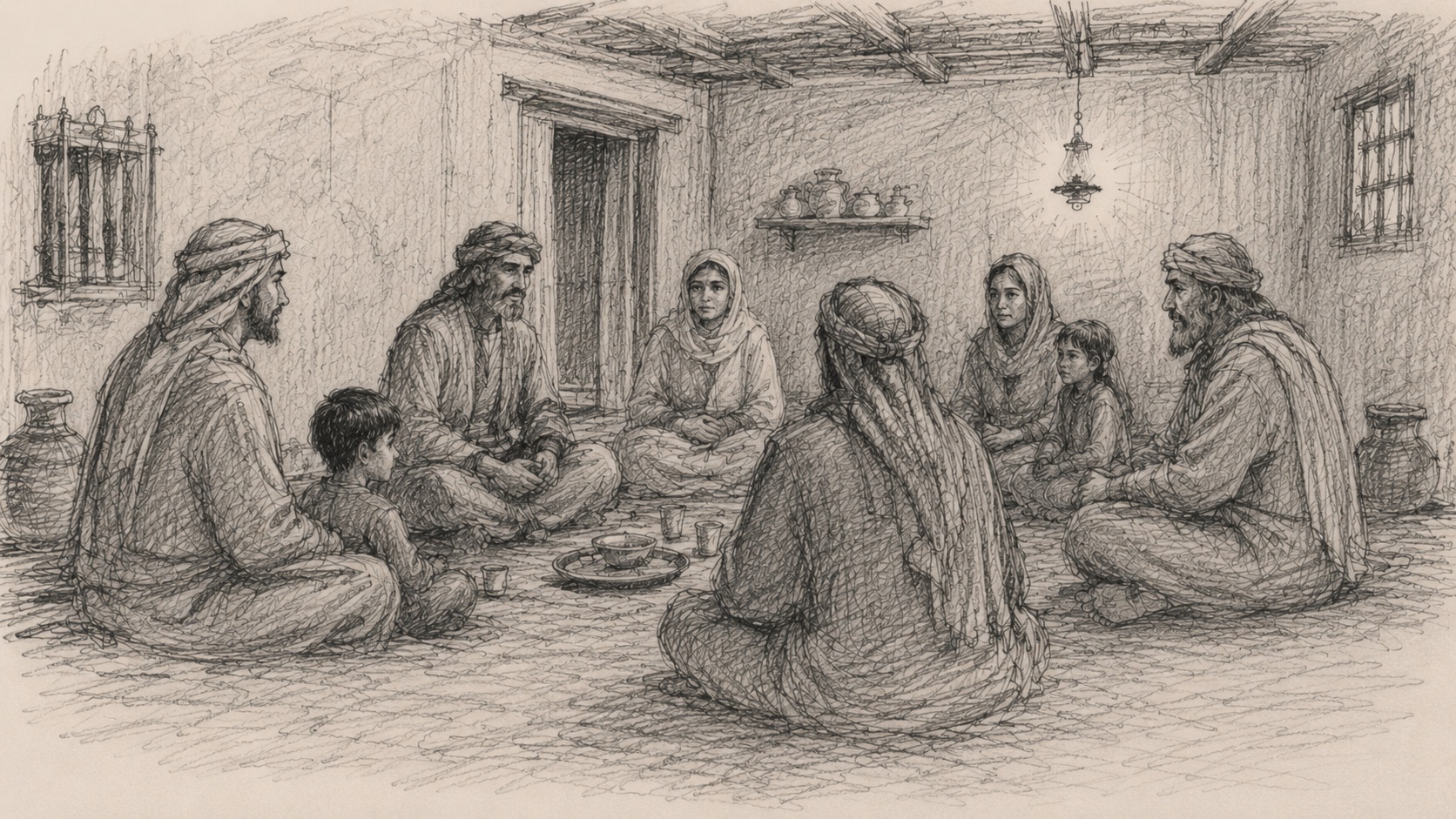
Musa al-Yamani swiftly barred the door the moment they crossed the threshold. The heavy thud of the wooden beam sliding into place offered a dull, ominous echo against the backdrop of the silent night. Inside, the chamber was a sanctuary of shadows, dimly lit by three small oil lamps perched in separate corners. The air was thick with the scent of olive oil, the dust of ancient manuscripts, and woven palm fronds. Though modest in size, the dwelling possessed a cloistered warmth, its earthen walls lined with crude wooden shelves where parchment scrolls and loose codices were meticulously preserved. In a far corner sat a large clay amphora and several untouched earthenware bowls. A few men were already seated in a tight circle upon a coarse woven mat. Qasim bin Thauban sat nearest to the oil lamp, his fingers clutching a small scroll. The scribe’s countenance appeared uncharacteristically pale. Beside him sat Umar bin Jundab, his massive frame hunched slightly forward, while Yusuf ash-Shaghir sat restlessly against the wall, his fingers nervously working the frayed edge of his turban.
And at the furthest edge of the chamber, Sheikh Umar al-Madani sat reclined against a thin cushion, his somber face a picture of absolute stillness. The dim light caught his white beard, turning it to the color of tarnished silver in the deep of night. The old scholar’s eyes bore the heavy weight of exhaustion, yet they remained fiercely sharp, measuring each soul as they entered. “Be seated,” he uttered softly. Abdullah and Bilal immediately took their places within the circle. Hadi chose to sit slightly apart, near the threshold, as though poised to spring to his feet at a moment’s notice should anything stir beyond the walls.
For a long moment, a tense silence held the room captive. Only the soft, rhythmic crackle of the oil lamp’s fragile flame and the distant, sweeping sigh of the wind outside broke the quiet. Sheikh Umar finally raised his head with deliberate slowness. “How many corridors have been scoured tonight?” he inquired. “Three, to my knowledge,” Umar bin Jundab answered curtly. “And every single one belongs to those known to hold ties with the family of Ali.” Qasim added in a hushed tone, “Several scribes and couriers are being hunted as well.” “Because the written word outlives the man,” Salman al-Katib murmured under his breath. Sheikh Umar gave a tight, knowing nod. “Those who yearn to shackle history are always plagued by a profound fear of the record.” Yusuf ash-Shaghir swallowed hard, finally summoning the courage to break his silence. “O Sheikh… is the tide truly turning for the worse?” Slowly, every eye in the room converged upon the old scholar, waiting for his reply.
Sheikh Umar did not offer an immediate response. Instead, he fixed his gaze upon the oil lamp by the wall for a long moment, as though gathering the fragmented remnants of his own spirit. “When the Messenger of Allah passed away,” he finally uttered, his voice low, “this Ummah was tested with loss.” His tone was serene, yet each word carried a monumental weight that filled every corner of the small chamber. “When Uthman was martyred, this Ummah was tested with wrath.” He drew a slow, deliberate breath. “And now, after Ali has fallen…” his eyes swept across them, looking at each soul one by one, “this Ummah shall be tested with fear.” Once more, the chamber plunged into a profound, breathless silence.
Outside the walls, the wind howled, shaking the palm fronds with a lingering groan. The shadows cast by the lamps danced in a slow, eerie cadence across the earthen walls. Bilal rubbed his face with a rough, weary hand. “I fear the cowardice of men far more than I fear the edge of their steel.” “Because a man consumed by fear is easily turned into a weapon,” Abdullah murmured in a strained voice. Hadi, who had remained frozen in silence, finally spoke, his voice tightly reined. “Then what are we to do? Wait for them to arrive, one by one, at our doorsteps?” Sheikh Umar shifted his heavy gaze toward the young man. “What is it you wish to do, Hadi?” Hadi slowly clenched his fist. “Fight back.” “Against whom?” “Against any soul who dares bring dishonor upon the lineage of the Messenger of Allah.” The atmosphere grew suffocatingly heavy. Musa al-Yamani lowered his head in silence, and even Bilal closed his eyes for a fleeting moment, as if weathering a blow.
Sheikh Umar regarded Hadi for a long, unbreaking moment before finally speaking in a hushed tone. “Young man… a sword is easiest to lift when the heart is consumed by wrath.” Hadi offered no reply. “But to build a sanctuary for human life,” Sheikh Umar continued, his voice dropping to a bare whisper, “is far more difficult than to spill blood.” Abdullah gazed at the old scholar, his eyes harboring a profound realization. He began to understand that this council tonight was not merely gathered to speak of Medina’s growing fears. Something far greater was beginning to be weighed upon the scales of fate. And that premonition hardened into certainty as Sheikh Umar slowly uttered: “Perhaps… some of us will not be able to remain in this city for much longer.”
Sheikh Umar’s words seemed to instantly steal the very air from the small chamber. For a breathless moment, not a single soul stirred. The fragile light of the oil lamps flickered, casting elongated shadows across faces now gripped by a new, creeping dread. Outside Musa al-Yamani’s dwelling, the night wind continued its restless sweep through the palm fronds, its low sigh sounding like an endless, haunting whisper. Yusuf ash-Shaghir was the first to let his composure fracture. The youth snapped his head up, his features written with shock. “Leave Medina?” he asked in a fragile, hushed tone, as if unable to grasp the weight of his own words. Sheikh Umar regarded him with absolute serenity. “I did not say all must go.” “But you are weighing the choice,” Bilal interjected softly. The old scholar did not offer an immediate reply. Instead, his fingers moved with deliberate slowness, tracing the smooth wooden beads of the prayer chain in his hand. Beneath the dim glow of the lamp, his countenance appeared more exhausted than ever before.
“I am weighing the preservation of human life,” he finally answered in a strained, fragile whisper. “And I am weighing what will become of us if Medina alters into a sanctuary that no longer grants safety to a portion of the Muslims.” Hadi snapped his head up instantly. “We must not abandon the City of the Messenger of Allah merely because of avaricious men!” His tone rang out louder than before. Musa al-Yamani cast a swift, anxious glance toward the wooden door. “Lower your voice,” Salman al-Katib hissed. Yet Hadi seemed entirely heedless. His chest heaved with violent breaths. “Shall we flee from them?” he pressed, his voice tightly reined. “Is that the legacy we are to leave to our children?” “And what legacy will you leave if you die a senseless death in the narrow alleys of Medina?” Abdullah countered, entirely composed. Hadi turned his gaze upon him fiercely. The young man’s eyes burned with a tempestuous fury that had yet to find its anchor. “Better to taste death than to live a life choked by fear,” he shot back swiftly. “Such words are easily spoken by a youth,” Umar bin Jundab uttered, his voice a low, heavy rumble. “But a father must look beyond the horizon of his own courage.” Once more, the chamber plunged into a profound silence.
Abdullah searched the faces around him, studying them one by one. Qasim remained anxious, his hands tightly clasping the parchment scroll resting upon his lap. Salman al-Katib kept his eyes locked on the oil lamp, as though mentally calculating a complex thread of thoughts. Yusuf ash-Shaghir looked uncharacteristically pale, lost in a daze of confusion, while Hadi still resembled a glowing ember that refused to be extinguished. Sheikh Umar finally broke the silence once more. “Listen to me with all your heart,” he uttered, his voice dropping low, yet every syllable rang out with crystal clarity in the small chamber. “Hijrah is not always a testament of weakness.” He held Hadi’s gaze for a lingering moment. “Sometimes, Hijrah is the only way to preserve sacred knowledge, to protect your lineage, and to shield your faith so that it does not meet an untimely death.” Hadi finally lowered his head, though his heavy, labored breaths still echoed through the quiet room. Bilal let out a long, weary sigh and spoke in a hushed tone, “I never envisioned a day where the word Hijrah would ever be spoken again within the walls of Medina.” “Nor did I,” Sheikh Umar replied, his voice barely a fragile whisper.
The night wind seeped once more through the fissures in the roof, causing the fragile flames of the oil lamps to dance. From the far distance, the long, hollow baying of a hound echoed through the dark, before being swiftly swallowed by the abyss of the night. “Is the world beyond Medina truly any safer?” Musa al-Yamani inquired, breaking the silence. “No place remains truly safe when men begin to clash for absolute power,” Sheikh Umar replied. “Yet, there are still corners of the earth that afford a man the simple grace to breathe.” Qasim bin Thauban finally spoke, breaking his lengthy silence. “I have received word that a portion of the Bani Hashim family has begun moving toward Egypt.” “And some toward Yemen,” Salman al-Katib added in a hushed tone. “While others have departed for Kufa to align themselves with Hasan,” Umar bin Jundab remarked. Abdullah kept his eyes anchored to the earthen floor before him. “Kufa, at this very hour, is a city built upon glowing embers.” “True,” Sheikh Umar conceded. “And Sham is no sanctuary for those suspected of harboring love for Ali.” Once more, a heavy, suffocating silence descended upon them.
Then, Salman al-Katib slowly raised his head. “There is one more destination that the merchants have begun to whisper of late,” he uttered in a low, hushed tone. Several heads snapped toward him. “Where?” Bilal demanded. Salman swallowed hard, a brief hesitation in his throat, before he answered. “The lands across the eastern sea.” The small oil lamp flickered softly in the heavy stillness that followed. And on that fateful night, for the very first time, the path of a long odyssey toward the far east was truly spoken aloud within the walls of a modest dwelling in Medina.
Salman al-Katib’s words caused several men to look at one another in stunned silence. The word “East” sounded impossibly distant from Medina, as though it lay entirely beyond the fringes of the world they had always known. Even Hadi, whose veins had been pulsing with fiery wrath, furrowed his brow in sheer disbelief. “Across the sea?” Yusuf ash-Shaghir repeated slowly, testing the weight of the syllables. “Those lands of India?” Salman gave a tight nod. “The sea-merchants of Basra and Oman speak of them often.” He slowly stroked his silver-streaked beard. “Bustling ports. Earthen soil that is damp and remarkably fertile. A vast network of trade routes stretching onward to kingdoms our eyes have never beheld.”
Bilal exhaled a short, sharp breath as he leaned his back against the earthen wall. “I always assumed those tales were merely the wild imaginings of sailors who had spent too long battered by the ocean waves.” “They are not,” Umar bin Jundab countered. “I encountered a merchant from Gujarat some three years ago.” The massive man fixed his gaze on the oil lamp before him, his mind drifting back to a distant memory. “His skin was darker than that of the men of the Hijaz. He brought with him fine textiles and spices whose aromas completely consumed the marketplace.” “And you truly believe we are to venture that far?” Hadi asked, his voice still rigid with disbelief. “No decision has been made,” Sheikh Umar replied with absolute composure. Yet Abdullah caught a faint glint in the old scholar’s eyes. He had made no final choice, but his mind had already begun to gaze far, far beyond the horizons of Medina.
Outside Musa al-Yamani’s dwelling, the night wind grew sharper, biting with a new cold. Now and then, the faint, muffled thud of passing footsteps echoed from the narrow path behind the date orchard. Every minor sound forced brief, guarded glances toward the wooden door, as though the night itself had morphed into a living, breathing threat. “Why the East?” Qasim bin Thauban asked softly. “Why not remain within the Hijaz, or journey toward Egypt like the other clans?” Salman replied with measured deliberation, “Because the further a man ventures from the epicenter of power struggles, the greater his chances of nurturing a peaceful life.” “Or of being entirely forgotten,” Bilal murmured. Hadi shook his head defiantly. “I have no desire to be forgotten.” “Sometimes,” Sheikh Umar uttered gently, locking his eyes onto the youth, “a man must choose between being remembered by tyrants, or staying alive to shield those he loves.” Hadi fell back into a sullen silence.
Musa al-Yamani rose slowly, making his way toward the wooden shelves tucked into the corner of the room. He retrieved an ancient parchment scroll, its edges frayed and yellowed by the relentless march of time. The document was bound tightly by a slender cord made of dried palm fiber. “This was brought to me by a merchant from Basra some months ago,” he said, extending his hand to pass it to Abdullah. Abdullah unfurled the scroll with deliberate care. Within, drawn in a faded black ink, lay a crude map of trade networks. It bore the names of Basra, Oman, and several foreign ports whose characters had never before been beheld by most of the men in that room. “What is this?” Bilal inquired, drawing closer to catch a glimpse. “The maritime path to the East,” Musa replied.
Yusuf leaned in closer, his eyes wide with a desperate, child-like curiosity. “By Allah…” he murmured under his breath, tracing the sweeping, continuous lines of the ocean inked onto the ancient parchment. “Is the world truly so vast?” “The world is always infinitely grander than the imaginations of men who spend their lives within the confines of a single city,” Salman al-Katib replied in a quiet, solemn tone. Abdullah studied the scroll for a long, unblinking moment. His fingertips brushed against the foreign names of distant ports, names that felt entirely detached from his current existence. Basra. Oman. Gujarat. The words felt alien on his tongue, yet they echoed like a faint, spectral summons from a horizon he had never beheld. “I have heard tales of those shores before,” Bilal said softly. “The sea-merchants claim that rains fall with a merciful frequency there. The rivers run wide and deep. And the earth is draped in endless green.” Hadi let out a short, humorless chuckle. “Green or not, an alien land remains an alien land.” “And yet, Medina is already beginning to feel alien to some of her own children,” Abdullah murmured, his gaze remaining anchored to the parchment in his hands. Once more, a heavy, suffocating silence descended upon the chamber. His words had fallen like a leaden weight into the very heart of the room.
Outside the walls, the night pressed onward, trailing its dark shroud over the City of the Prophet. The desert wind still carried the sharp scent of sand and dust into the winding alleys of Medina. Yet inside the modest dwelling of Musa al-Yamani, a monumental truth began to take root that fateful evening: The harrowing realization that some among them would one day abandon the soil of their birth, embarking on a vast odyssey toward a world entirely unknown to their ancestors. A heavy stillness held the chamber captive following Abdullah’s words. The ancient scroll remained unfurled in his hands, its crudely drawn maritime routes stretching across the aged parchment like long, branching veins reaching into the deep abyss of the foreign world. The dim glow of the oil lamp reflected softly off the fading ink, a fragile testament to a map weathered by time. Beyond the low wooden door, the night wind swept gracefully through the orchard, carrying the lingering rustle of palm fronds and the rich, moist scent of the earth from the aqueduct near the ancient well.
Yusuf ash-Shaghir stared at the scroll, his gaze trapped in a delicate balance between sheer bewilderment and burning curiosity. “I have never once envisioned abandoning the Hijaz,” he admitted in a fragile voice. “Even Mecca felt impossibly distant the very first time I journeyed beyond the borders of Medina.” Bilal offered a faint, fleeting smile. “I still remember you vomiting along the entire trail, unable to endure the blistering heat of the desert.” A few of the men let out soft, suppressed smiles at the memory, and for a fleeting second, the suffocating tension in the room seemed to loosen its grip. Yusuf, flushing with embarrassment, quickly cast his eyes downward. “And now, you speak of vast oceans,” the youth murmured under his breath. “The sea is a terrifying entity,” Umar bin Jundab remarked curtly. “I place my trust in the shifting sands far more than I ever would in the treacherous waves.” “The sand has never swallowed a grand merchant vessel,” Salman al-Katib countered softly. “But neither does the sand devour a man alive the way the ocean does,” Umar shot back. Hadi clicked his tongue in sharp frustration. “You all speak as though our departure is already a certainty.” “Because tonight, we have come to realize that the path does, in fact, exist,” Abdullah replied, his voice entirely steady. Hadi locked his eyes onto the earthen floor, slipping into a heavy silence. The fiery wrath that had been burning within his gaze was far from extinguished, but it was now swirling with a bitter new element: an undeniable restlessness.
Sheikh Umar slowly raised his hand, a gentle gesture that brought the drifting chatter to a sudden halt. Once more, every eye in the room gravitated toward him. “Listen to me with all your heart,” the old scholar uttered in a low, yet piercingly clear voice. “I did not summon you here tonight to sow the seeds of fear.” He held each of their gazes one by one. “But a man who willfully blinds himself to an approaching storm will only drag his family down into the depths to drown with him.” The chamber plunged right back into a heavy silence. Musa al-Yamani broke the quiet, adding in a hushed tone, “The dispatches from Iraq bring no comfort. Several tribes have already begun to shift their allegiances following the martyrdom of Ali.” “And in Sham,” Salman interjected softly, “Muawiyah’s grip grows tighter by the day.” Bilal rubbed his face with a slow, weary hand. “While Medina itself begins to crawl with spies.” “Medina will not unravel entirely in a single night,” Sheikh Umar observed, his voice steady. “But avaricious men, once they taste victory, are seldom known to halt their march.”
Abdullah slowly rolled the parchment scroll shut, placing it gently beside the flickering oil lamp. “What is the true nature of your fear, O Sheikh?” Sheikh Umar did not offer an immediate response. He seemed to weigh his next words upon the finest of scales, tracking the gravity of his thoughts. “I fear,” the old scholar finally whispered, his voice trembling with a quiet intensity, “that a time will dawn when your children will grow up in such terror that they dare not even utter the names of the righteous.” The revelation struck the chamber like a heavy blow, leaving chests tightening with a sudden, suffocating ache. Hadi closed his eyes for a lingering moment, drawing a sharp, ragged breath to anchor himself. Beside him, Yusuf clenched the hem of his tunic so tightly his knuckles turned white. “And I fear something greater still,” Sheikh Umar continued, his gaze drifting as if looking through the very walls of the house. “That the sacred knowledge and noble character taught by the Messenger of Allah will slowly bleed out of existence, lost to a world where men care for nothing but the violent pursuit of crowns.”
The night wind filtered once more through the fissures in the ceiling, causing the fragile flames to tremble. Then, drifting from a distant corner of the city, the call to prayer echoed through the dark. It was not the call for a mandatory prayer, but the solemn invitation to Tahajjud, cried out by an old man whose lifelong habit was to rouse souls before the final watch of the night. The voice was faint and heavy with sorrow, cutting through the shadows of Medina. Bilal slowly lowered his head. “There was a time when a voice like that would cradle the heart in absolute peace.” “And now?” Musa inquired softly. Bilal kept his eyes locked on the oil lamp before him. “Now, I fear that one day, such a voice will vanish entirely from this city.” The heavy silence descended upon them once more. Then, without warning, a sharp, incredibly soft rap echoed from Musa’s wooden door. Knock... knock... Every head snapped up instantly. Hadi surged to his feet by instinct, his body coiled tight. Musa shot a swift, panicked glance at Sheikh Umar. For several agonizing seconds, time itself seemed to freeze, and no one dared to breathe.
The knocking came again. Knock... knock... This time, a breathless, hushed voice bled through the wood from the outside. “Open... it is I, Zubair bin Rahman...” Hadi remained frozen near the entrance, his entire frame rigid as the name was uttered. By sheer reflex, his fingers wrapped tightly around the heavy wooden staff leaning against the earthen wall. A flurry of tense glances swept across the room before Musa al-Yamani finally took slow, guarded steps toward the threshold. “Are you alone?” Musa questioned in a low, tight whisper from behind the safety of the timber. “Alone,” the voice outside assured him quickly. The man’s breaths rushed out in heavy, labored gasps, sounding like someone who had just broken into a desperate, unending run through the dark. Musa glanced back at Sheikh Umar. The old scholar gave a subtle, tight nod. Slowly, the wooden door began to creak open.
Zubair bin Rahman slipped inside and instantly threw his weight against the door, shutting it firmly behind him. The sea-merchant looked uncharacteristically unraveled, his usual composure entirely shattered. His light brown tunic was caked in a thick layer of road dust, dried mud clung heavy to his hemline, and his turban had loosened, slipping precariously from his brow. Despite the biting chill of the night, beads of sweat rolled down his pale face. His chest heaved with violent, ragged breaths as he stood stranded in the center of the room. “By Allah…” Bilal murmured under his breath. “You look as though you have just fled the vanguard of an invading army.” Zubair offered no response to the remark. His panicked eyes swept the room, locking instantly onto Sheikh Umar. “They have begun interrogating anyone moving in or out of Medina,” he choked out. The chamber instantly plunged into a dead, suffocating silence.
“Who?” Abdullah demanded. “Muawiyah’s men,” Zubair answered, wiping the slick sheen of sweat from his face. “At the northern gate of the city. They intercepted several travelers just this night.” “What are they searching for?” Musa pressed. “Names.” Zubair’s response was curt, yet it carried a devastating weight. “And correspondence.” Salman al-Katib slowly lowered his head, while Qasim’s fingers instantly tightened in a death grip around the parchment scroll resting beside him. “I witnessed it with my own eyes—a merchant from Yanbu was struck down across his face simply for carrying a letter from Iraq,” Zubair continued, his voice tight. “They are going as far as tearing open the merchant sacks.” Hadi clenched his jaw so hard the muscle coiled. “Those hounds are beginning to rule the city.” “Lower your voice!” Umar bin Jundab hissed sharply. But Hadi’s fury was contagious, spilling across the room and settling over the faces of the others. Even Yusuf ash-Shaghir seemed to hold his breath, frozen in a state of mounting dread.
Zubair finally collapsed into a seat as Musa handed him a clay water vessel. He took a long, desperate swig, his throat working heavily, before finding his voice once more. “And that is not the worst of it.” Every eye in the room locked onto him with renewed intensity. “I encountered a shipmaster from Basra just outside the city borders late this afternoon.” Zubair dropped his voice to a conspiratorial whisper. “He brought word that several families from Kufa have begun moving southward in absolute secrecy.” “Toward Basra?” Abdullah pressed. Zubair nodded grimly. “Some are hoping to secure passage on a ship and set sail before their names ever reach the hands of the governors.” Bilal slowly turned his gaze toward Sheikh Umar. “Then this is not merely a localized dread confined within our walls in Medina.” “No,” the old scholar replied, his voice a frail, haunting echo. “The fitnah has broken its banks, and its poison is beginning to seep into many cities.”
The oil lamp flickered once more as a draft swept through the room, causing their shadows to sway violently against Musa’s earthen walls—like silhouettes of desperate men being forced to choose the path of their own survival. “I know Basra well,” Zubair muttered, rubbing the tense muscles at the nape of his neck. “Its ports are vast. Men from every corner of the earth converge there. If a soul wishes to vanish entirely from the watchful eyes of the Hijaz...” He shifted his gaze between Abdullah and Bilal. “Basra is perhaps the most viable crucible.” “And after Basra?” Yusuf asked, his voice barely a breath. Zubair raised his head, his eyes weathered with exhaustion yet mirroring the vastness of a distant horizon. “The open sea.” Once again, a heavy, unyielding silence flooded the chamber.
Even Hadi, who was usually swift to argue, remained utterly silent, his eyes locked onto the earthen floor. “I have sailed as far as the coasts of Oman,” Zubair continued in a hushed tone. “And I have heard countless tales of the eastern lands from the sailors there.” He drew in a slow, measured breath. “Distant realms where men care little for the bloody feuds of Sham and Kufa.” “Or perhaps, where they care not yet,” Bilal murmured under his breath. Sheikh Umar gave a tight, solemn nod. “The world changes with a frightening speed.” Zubair stared deeply at the old scholar. “That is precisely why I came tonight.” He swallowed hard, a brief hesitation in his throat, before speaking his next words. “If you are truly contemplating abandoning Medina… then you must begin mapping out your path this very hour.” Outside the walls, the desert wind continued its relentless march beneath the cold, black canopy of the Medina sky. And inside that modest dwelling, the word Hijrah no longer felt like a distant ghost. It was beginning to morph into a stark, undeniable reality.
The oil lamp in the center of the room let out a faint sputter as its wick began to drown within the warm, pooling oil. Musa al-Yamani quickly adjusted the fiber with the tip of a slender wooden splinter, and the amber flame swelled once more. Its warm, golden glow swept across their faces—faces no longer gripped by mere terror, but shadowed by the heavy, exhausting calculations of a destiny they had never before imagined. Hijrah. The word hung suspended in the air of Musa’s dwelling like a living, breathing entity. It was no longer just the sacred history of the early Companions, a tale they had revered since childhood. It was a threshold knocking at the door of their own lives. “I still find it so difficult to grasp…” Yusuf ash-Shaghir murmured, his eyes anchored to the earthen floor. “We are speaking of abandoning Medina… the very City of the Messenger of Allah…” “Not a single soul in this room desires it,” Sheikh Umar replied with a quiet, grounding composure. The old scholar slowly raised his face, his eyes heavy with a profound melancholy under the flickering light of the night.
“I was born within the embrace of this city,” the old man continued, his voice a frail whisper. “I learned the recitation of the Qur'an within the sacred walls of its mosque. I watched the Tabi'un walk through its winding alleys when I was nothing but a boy.” His weathered fingers moved with a rhythmic, measured cadence over his wooden prayer beads. “And it was my deepest prayer that my bones would one day be laid to rest in the soil of Medina.” The chamber plunged into an absolute, unyielding stillness. Even Hadi remained silent, his sharp defiance swallowed by the gravity of the scholar's words. “But,” Sheikh Umar resumed softly, “a man must never allow his love for a city to blind his eyes to the creeping shadow of an approaching storm.” Abdullah bowed his head slightly. He absorbed the weight of those words far deeper than the rest. For during his tense walk to Musa’s dwelling tonight, he had witnessed the shifting, fractured countenance of Medina with his own eyes: • Alleys and thoroughfares that had begun to choke under heavy, watchful surveillance, • Modest dwellings that barred their wooden doors much earlier than the sun could set, • Grown men who reduced their conversations to paranoid, hushed whispers, • And a subtle, chilling dread that had begun to take root in the innocent eyes of the children.
“Do you truly, in your heart, believe they would go so far as to hunt ordinary families like ours?” Qasim bin Thauban asked, his voice trembling with a fragile hope. “Today? Perhaps not,” Zubair bin Rahman replied, letting his exhausted frame sink heavily against the earthen wall. “But if the tide continues to turn against us, even a man who does nothing more than put ink to parchment will be branded a threat to the state.” Qasim looked down at the bundle of scrolls resting near his lap, his expression clouded with a sudden, suffocating weight. Salman al-Katib then spoke, his voice a low, gravelly whisper. “I have already lived through an era when men began burning their own manuscripts, driven by the sheer terror of their own written words.” “And I have witnessed men slaughter one another,” Bilal added solemnly, “driven by nothing more than the terror of a name.”
The night wind sneaked once more through the narrow fissures in the wall, causing the fragile flame of the oil lamp to dance. From the dark distance, the rhythmic thud of several footsteps echoed from the path behind the date orchard, lingering for a brief moment before slowly dissolving back into the silence. Hadi’s head snapped toward the threshold, his body instantly on edge. “Peace, my brother,” Musa uttered in a low, grounding voice. “Those are not the boots of soldiers.” “How can you be so certain?” Hadi demanded, his posture remaining unyielding. Musa offered a faint, knowing smile. “A soldier marches like a man who demands to be feared. A traveler walks like a man who simply longs to reach his home.”
A few faint, weary smiles broke across the room at his words, allowing the suffocating tension in the chamber to fray, if only for a fleeting heartbeat. Yet, Sheikh Umar raised his voice once more, fracturing the brief relief. “Listen to me with all your heart.” His ancient gaze swept through every corner of the room, gathering their focus. “I am not asking a single soul to abandon Medina this night.” The assembly fell back into a disciplined stillness. “But from tomorrow onward…” the old scholar continued, “every head of a household must begin to carefully weigh the survival of his own blood.” Abdullah felt his chest tighten, his breath hardening into a cold, heavy knot. “Store what food and water you can spare,” Sheikh Umar commanded quietly. “Hold your tongues in the marketplace. And no longer keep letters or critical records in places where careless eyes might easily uncover them.” Qasim’s head snapped up, a flicker of panic in his eyes. “Even the manuscripts of knowledge?” he asked, his voice barely a whisper. Sheikh Umar fixed a long, unblinking gaze upon the young scribe before offering his answer. “Especially the manuscripts of knowledge.” And once more, the room was dragged down into the depths of a crushing, leaden silence.
The night had now bled past its zenith, and the air of Medina grew sharper, biting with a deepened chill. In the distance, the faint lights of scattered dwellings had begun to die out one by one, yet the City of the Prophet remained poised, refusing to fall into a true, restful slumber. And within the cramped walls of Musa al-Yamani’s home that fateful night, each man, in his own solitary silence, began to accept a terrifying truth: their lives were fracturing, shifting toward a transformation from which they could never return. For a long, agonizing stretch of time, all grand discussions ceased within Musa's dwelling. The men drowned quietly in the depths of their own thoughts. The oil lamp in the corner maintained its low, fragile burn, casting long, spectral shadows that danced faintly against the coarse earthen walls. Outside, the ambient murmurs of Medina retreated into a cold, distant hum. Occasionally, a sudden gust of wind would rake through the date orchard behind the house, forcing the heavy palm fronds to scrape against one another with the dry, rustling hiss of a barren rain.
Abdullah sat in a heavy, motionless silence, staring down at his own upturned palms. They were the hands of a working man: skin calloused and hardened by the coarse friction of camel reins, rough-hewn timber, and endless, grueling treks beneath the unforgiving Hijazi sun. Yet tonight, for the very first time in his life, a chilling certainty gripped him—that these hands might no longer be strong enough to shield everything he loved within the fracturing peace of Medina. Maryam. Iskandar. Fatimah. The names drifted through the corridors of his mind like a rhythmic, haunting refrain. He could still vividly picture the sudden, paralyzing terror that had washed over Fatimah’s face when the abrupt knocking echoed at their door the previous night. He remembered, too, how Iskandar’s gaze had begun to alter. The boy was losing his innocence, forced to bear witness to an adult world increasingly consumed by the violent pursuit of power, blood, and paranoia. And Abdullah despised that reality with every fiber of his being. “You have not uttered a single word for some time,” Bilal noted softly from his side, breaking into his thoughts. Abdullah slowly lifted his heavy gaze. “I am thinking of my home.” Bilal offered a small, weary smile that didn’t quite reach his eyes. “Tonight, my brother, every man in this room is thinking of his home.”
Near the wall, Qasim bin Thauban carefully unfurled his leather scroll. His fingertips moved with deliberate reverence, brushing across the black ink characters that tightly crowded the weathered parchment. Under the dim, shifting light of the oil lamp, the shadows of the script seemed to dance, as if the letters themselves had found a pulse. “I have kept the early sermons… the records of sacred knowledge… and the testimonies of the Tabi'un within my home,” he whispered, his eyes remaining tethered to the scroll. “If the hour comes, I do not even know which of them I should save first.” “Your family,” Umar bin Jundab cut in, his answer brief and unyielding. Qasim offered a bitter, hollow smile. “I know that.” He drew a long, heavy breath into his chest. “And yet, these writings… they are the very fiber of my existence.” Salman al-Katib gazed at the young scribe, his weathered eyes brimming with a profound, timeless understanding. “Sacred knowledge,” the old man murmured, “has always walked hand in hand with sacrifice.”
Hadi, who had remained stationed near the threshold all this time, finally let his heavy frame sink back against the earthen wall. The fierce embers of wrath that had defined his features all evening began to cool, replaced by a deep, hollow exhaustion that had slowly crept upon him as the long night wore on. “I still despise all of this,” he muttered, his voice dropping to a low rumble. “None of us find any joy in it,” Musa replied gently. “If I am forced to run… I feel like a coward.” Sheikh Umar fixed a long, unyielding gaze upon the proud young man. “Do you truly believe that the Messenger of Allah and his noble Companions undertook the Hijrah because they were cowards?” the old scholar questioned, his voice a calm, piercing tide. The words struck home, and Hadi fell instantly silent. “Sometimes,” Sheikh Umar continued, his voice dropping to a fragile whisper, “Allah opens a vast, untrodden path before His servants simply because a land has ceased to yield any soil where goodness can take root and grow.” Once more, the fragile flame of the oil lamp danced as the night wind swept through the room.
Zubair bin Rahman slowly lifted his head, breaking the heavy stillness. “If the worst should come to pass…” he offered, choosing his words with measured caution, “I can help pave the way toward Basra.” Once more, every eye in the room gravitated toward him. “I know a few of the shipmasters stationed there,” he continued, a quiet confidence returning to his voice. “And I still maintain trade alliances with several prominent merchant houses of the sea.” “The overland journey to Basra is a punishing ordeal in itself,” Bilal murmured, staring into the shadows. “And it will be doubly brutal if we are to shepherd women and small children across those wastes,” Umar bin Jundab added, his realism cutting through the room. Abdullah’s gaze drifted back to the leather nautical chart resting beside the flickering oil lamp. Basra felt impossibly distant from the sacred earth of Medina. And the vast, uncharted ocean that lay beyond the gates of Basra felt like an entirely different realm—a world completely untouched by any life he had ever known.
“I have never even laid eyes upon the ocean,” Yusuf ash-Shaghir confessed suddenly, breaking his own silence. Bilal let out a low, gravelly chuckle. “You will lose your stomach far worse than you did on the road to Mecca.” A few faint, fragile smiles rippled across the room once more. Even Hadi exhaled a sharp breath, a shadow of an amused laugh almost escaping his lips. But those brief smiles withered instantly as a distant, chaotic uproar suddenly fractured the quiet from the northern sector of the city. Every head snapped up in unison, bodies coiling tight. The noise was still muffled by the distance, yet it was distinct enough to strike their chests with a sudden, suffocating dread: • Distorted shouts of men echoing through the dark, • The rapid, heavy thud of panicked footsteps marching in unison, • And the violent splintering crack of wood being struck with immense force. Hadi surged to his feet, his hand locking onto his wooden staff. “What is that?” he hissed sharply. Musa moved swiftly toward a narrow fissure in the window shutter, pressing his eye against the gap to peer into the pitch-black alleyway outside. A few grueling seconds stretched out like an eternity. When Musa finally turned back to face the room, his countenance was completely drained of color. “They have broken into the northern alley.” A suffocating, leaden silence flooded the modest dwelling once more. And outside, the night of Medina continued its relentless march, drifting steadily into a looming, inescapable darkness.
The fragile atmosphere within Musa al-Yamani’s home shattered instantly, replaced by a suffocating, razor-sharp tension. Not a single trace of the brief smiles remained. Every man in the room sat frozen, tracking the distant, chaotic uproar from the northern sector with grim, unblinking focus. The shouts were not continuous; instead, they erupted in erratic, violent bursts—like a rolling thunderstorm of confrontation tearing its way from one household to the next. Hadi lunged toward the threshold. “I am going out to see.” “Sit,” Sheikh Umar commanded, his tone low, quiet, and completely unyielding. The proud young man halted in his tracks, though his chest continued to heave with a violent, repressed fury. “We do not yet know the shape of what unfolds in the dark,” the old scholar continued with a grounding composure. “And a night such as this births far more snares than it does true acts of valor.” Hadi snapped his head away, dragging his fingers roughly through his hair. Defiance burned in his eyes, but the weight of the old man's wisdom ultimately broke his stride. He sank back down near the door, his movements heavy and heavy-hearted.
Bilal fixed his eyes on the narrow slit of the window shutter. “The northern alley… whose homes are situated there?” “It belongs to the clan of Bani Khalid,” Musa answered in a hushed, strained voice. “And several dwellings of the students of knowledge.” Qasim’s head snapped up, a flash of recognition in his eyes. “Abdullah bin Harun resides in that quarter as well.” “The one who frequently receives correspondence from Kufa?” Salman pressed. Qasim nodded slowly. There was no need for further explanation; the truth hung heavily over them. Once more, the chamber drowned in a long, suffocating silence. Abdullah studied the faces around him, one by one. The grim reality had finally set in for everyone: the threat they so deeply feared was no longer creeping toward them from a distance. It had already arrived, knocking violently at the doors of Medina this very night.
Outside Musa’s dwelling, the wind gathered a violent momentum. A fine spray of desert dust could be heard scraping ruthlessly against the exterior walls. Faint strands of silver moonlight bled through the fissures in the thatched roof, mingling with the warm, amber glow of the dying oil lamp. Zubair bin Rahman sank deeper against the earthen wall, pressing his eyelids shut for a fleeting moment to steady his nerves. “I passed through the marketplace before navigating my way here,” he murmured, his voice laced with exhaustion. “Several stalls had already barred their shutters long before the Isha prayer.” “Men are afraid to gather,” Bilal reasoned softly. “It is far worse than mere fear.” Zubair opened his eyes, their dark depths flashing with a grim urgency. “I witnessed unfamiliar men—strangers to our streets—loitering in the shadows, asking pointed questions about specific households.” “Whose households?” Abdullah demanded, his jaw tightening. “The families known to be close to Sheikh Umar…” Zubair whispered, letting the words fall like heavy stones. “…the scribes, and several dwellings belonging to the lineage of Bani Hashim.”
Musa slowly lowered his head, the weight of the revelation pressing down on his shoulders. Beside him, Hadi clenched his jaw once more, the muscle coiling like a sprung trap. “So now they begin counting human souls as if they were nothing but ledger entries in a slave market.” “A frightened ruler will always demand to know a man's name long before he ever looks upon his face,” Salman al-Katib murmured, his voice heavy with ancient cynicism. Yusuf ash-Shaghir’s countenance grew visibly paler, the blood draining from his lips. “Do you think… do you think our names are already on their lists?” No one answered. And it was that very silence—dense, unyielding, and pregnant with implication—that made the question feel infinitely more terrifying. Sheikh Umar finally drew a long, deliberate breath, his chest rising beneath his robes. “Perhaps some already are.” Yusuf cast his gaze downward instantly, unable to hold the old man's eyes. “But listen to me, and heed my words well,” Sheikh Umar continued, his voice reclaiming the center of the room. “Never allow terror to rob you of your adab or your intellect.” His ancient, weathered eyes traveled slowly from face to face, anchoring every man there. “The most destructive fitnah is not when men are hunted down like prey.” His voice dropped to a low, resonant whisper. “It is when men allow fear to morph them into tyrants themselves, committing injustices in the name of their own survival.” Abdullah gave a tight, solemn nod. The old scholar’s words struck a deep chord within him. He had already witnessed too many good, pious men turn cruel and volatile once their lives became saturated with paranoia. “Then what is our decree once the sun rises?” Umar bin Jundab asked, his pragmatism breaking the spell. Sheikh Umar stared into the dancing core of the oil lamp for a few agonizing heartbeats before offering his answer. “We begin to prepare.”
Hadi’s head snapped up, his sharp eyes locking onto the scholar. “Prepare to flee?” “Prepare for every conceivable destiny.” Once more, the nocturnal gale raked across the exterior walls of the dwelling, its chill seeping through the clay. Then, from the darkness outside, another muffled cry erupted in the distance. This time it was brief, severed sharply by the heavy, dull thud of something substantial crashing onto the hard earth. Bilal closed his eyes slowly, letting out a long, heavy breath that seemed to carry the weight of the entire room. “Medina…” he murmured, his voice cracking with a quiet, devastating sorrow. “I can scarcely recognize you tonight.”
The chaotic uproar from the northern alley gradually began to ebb, yet the razor-thin tension remained heavily suspended within the walls of Musa al-Yamani’s home. True peace had abandoned them entirely. Even after the distant, stomping footsteps and hostile barks dissolved into the void, the chamber was left suffocating under a weight of hyper-vigilance. The oil lamp flickered lower now, its fuel dwindling. The shadows of their faces wavered weakly against the coarse earthen walls, looking less like men and more like spectral shapes perched precariously on the precipice of an unknown fate. Musa finally broke the stillness, pouring water into a few small, clay bowls and distributing them one by one. Few actually drank. Most merely held the vessels in their palms, letting their hands absorb the cool moisture without ever bringing the water to their lips.
“The night is drawing near its end,” Salman al-Katib murmured, his eyes tracking a narrow gap in the thatched roof where the obsidian sky bled faintly into view. “And we are left with no answers,” Hadi countered, his voice flat. “Not all answers descend upon a man in a single night,” Sheikh Umar replied with a quiet, unshakeable poise. Hadi lowered his head once more, his fading fury finally giving way to raw, undeniable exhaustion. His eyes were shot with red, strained from holding back the violent storm of emotions that had battered his chest since dusk. Abdullah watched the young man for a silent moment before speaking softly. “You are still young, Hadi.” “I know.” “And because you are young, your blood marches far swifter than your thoughts.” From his corner, Bilal offered a faint, knowing smile. “I was no different once.” “And now?” Yusuf asked under his breath. Bilal drew in a long, deliberate breath and let it fall. “Now I know that the fabric of the world does not shift simply because a single man is angry.” And the chamber plunged once more into silence.
Supported Reading Space
Support This Epic Publication
This reserved space is prepared for cultural, educational, or publishing partners supporting long-form historical storytelling.